Free Tool
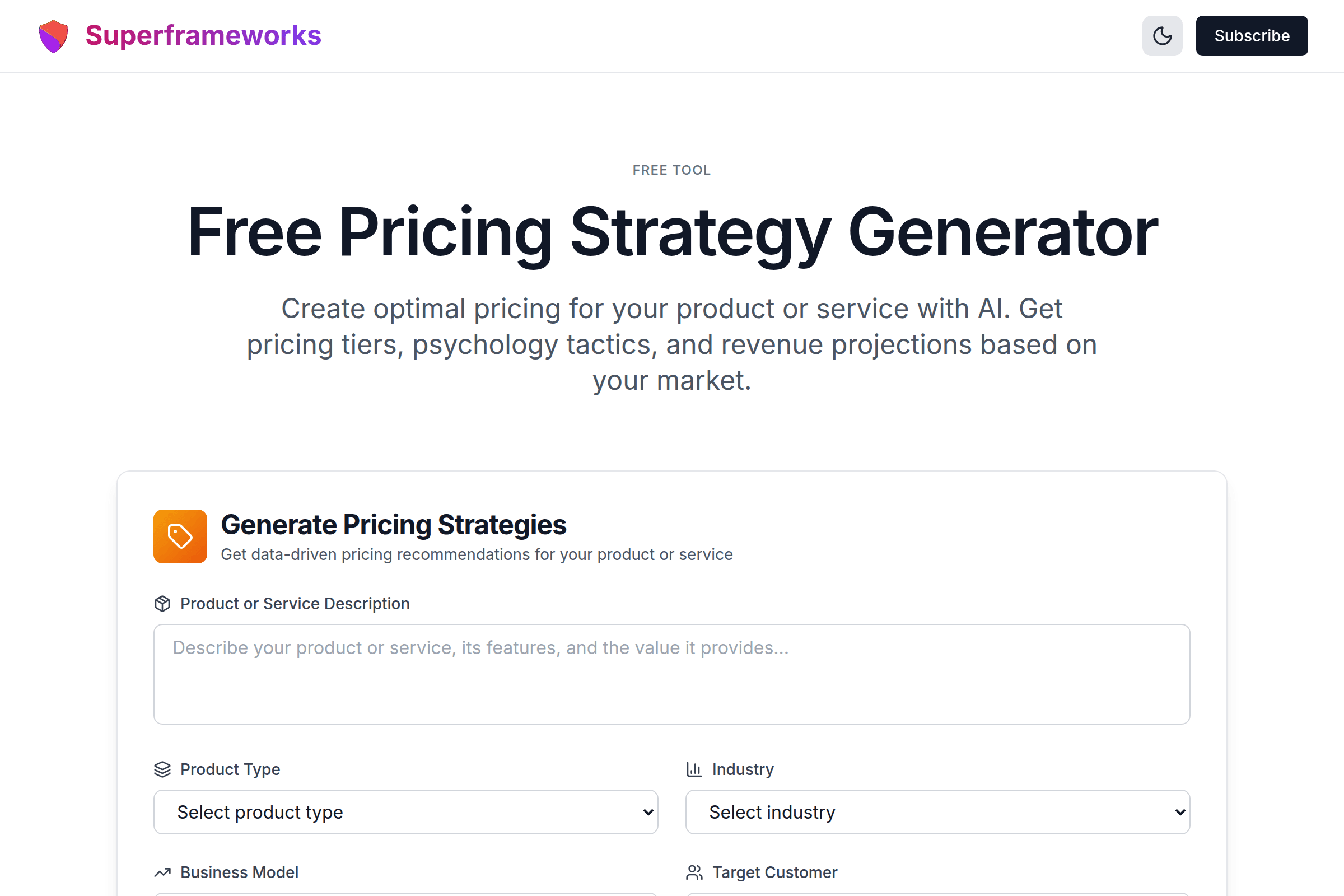
Free Pricing Strategy Generator
Create optimal pricing for your product or service with AI. Get pricing tiers, psychology tactics, and revenue projections based on your market.
Generate Pricing Strategies
Get data-driven pricing recommendations for your product or service
Optimal Pricing
Get specific price points based on your value proposition and market.
Tier Structures
Recommended pricing tiers with features for each level.
Revenue Impact
Projected revenue and conversion impact of each strategy.
What Your Pricing Strategy Includes
Comprehensive pricing recommendations backed by psychology and market data.
Optimal Price Points
Specific price recommendations based on value, competition, and market willingness.
Tier Structure
Recommended pricing tiers with feature allocation and target customer for each.
Psychology Tactics
Anchoring, charm pricing, decoys, and other tactics to optimize conversions.
Revenue Projections
Expected revenue impact and conversion rates for different pricing approaches.
Competitive Positioning
How to position your pricing against competitors for maximum advantage.
Free/Trial Strategy
Whether to offer free tier or trial, and how to optimize for conversion.
Example Pricing Strategy Output
Here is a sample pricing tier structure our generator creates for a project management SaaS.
Starter
For individuals and small teams
- Up to 5 users
- 10 projects
- Basic integrations
- Email support
Professional
For growing teams
- Up to 25 users
- Unlimited projects
- Advanced integrations
- Priority support
Enterprise
For large organizations
- Unlimited users
- Custom integrations
- SSO & advanced security
- Dedicated account manager
This sample uses psychological pricing ($19 vs $20), anchoring (Enterprise makes Professional look affordable), and a "most popular" badge to guide user choice. Our generator explains these tactics for your specific product.
Common Pricing Models
Our generator recommends the best model for your product type and market.
Subscription
Monthly or annual recurring revenue model
Usage-Based
Pay for what you use, scales with value
Freemium
Free tier with paid upgrades
Tiered
Multiple packages at different prices
How It Works
Describe Your Product
Tell us about your product, value proposition, and target customers.
Set Your Goals
Share your pricing goals, constraints, and competitive context.
AI Analysis
Our AI analyzes market data and generates optimal pricing.
Get Your Strategy
Receive detailed pricing with tiers, psychology, and implementation.
Get Weekly Pricing Insights
Join entrepreneurs getting actionable tips on pricing, monetization, and revenue growth.
Why Use Our Pricing Strategy Generator?
Pricing is the Fastest Lever for Growth
A 1% improvement in pricing has more impact on profit than 1% more customers or 1% lower costs. Yet most businesses guess their pricing or copy competitors. Our generator helps you find the optimal price point based on value and market data.
Stop Leaving Money on the Table
Many businesses price too low, afraid to charge what their product is worth. Our generator uses value-based analysis to show you what customers are actually willing to pay based on the value you deliver.
Psychology-Based Recommendations
Pricing is as much about psychology as economics. Our generator incorporates proven psychological principles like anchoring, decoy pricing, and charm pricing to maximize conversions and revenue.
Implementation-Ready Strategies
The recommendations are not just theoretical - you get specific price points, tier structures, and a roadmap for implementing and communicating your pricing strategy.
Structure Ascending Offers with a Value Ladder
Tiers work best when each step naturally leads to the next. If you sell multiple offers at different price points, pair this generator with our free value ladder template to map how customers ascend from your entry offer to your premium products.
See the Pricing Strategies Generator in action
Explore Related Tools
Discover more tools to help you build and grow your business
Marketing Strategy Generator
Create data-driven marketing strategies tailored to your business goals and target audience.
Marketing Ideas Generator
Generate creative marketing campaign ideas to grow your business and engage your audience.
Marketing Budget Calculator
Calculate optimal marketing budgets based on your revenue goals and business stage.
Marketing Email Generator
Generate high-converting marketing emails for promotions, product launches, newsletters, and re-engagement campaigns.
Frequently Asked Questions
How do I know if my pricing is right?
Right pricing balances customer willingness to pay with your revenue goals. Signs of good pricing: healthy conversion rates (typically 2-5% for B2B SaaS), low price objections in sales, customers who stay long-term, and healthy margins. Our generator helps you find this balance using value-based and competitive analysis.
How does the pricing strategy generator work?
Our AI analyzes your product, target customers, value proposition, and competitive landscape to generate pricing recommendations. It considers pricing psychology, industry benchmarks, and your specific goals to create optimal pricing tiers with specific price points and feature allocations.
Is this pricing strategy generator really free?
Yes, this tool is completely free with no hidden costs, no credit card required, and no usage limits. Generate as many pricing strategies as you need to find the optimal approach for your product or service.
What is included in the pricing recommendation?
The recommendation includes: specific price points, pricing tier structure with features, pricing psychology tactics, free/trial strategy, discounting guidance, revenue projections, implementation roadmap, and competitive positioning advice.
Should I use value-based or competitive pricing?
Value-based pricing is generally better if your product delivers measurable value (like saving time or increasing revenue). Competitive pricing works when products are similar and customers shop by price. Most businesses should use a hybrid approach - price based on value but sanity-check against competitors.
How many pricing tiers should I have?
Most products do well with 3-4 tiers. This provides enough choice without overwhelming customers. The classic structure is: a starter tier for price-sensitive customers, a popular middle tier that most choose, and a premium tier for power users. Our generator recommends the optimal tier structure for your situation.
Should I offer a free tier or free trial?
Free trials work best for products where value is clear once experienced. Free tiers (freemium) work for products with viral potential or when building a large user base matters. The generator recommends the right approach based on your product type and goals.
How often should I change my pricing?
Review pricing annually at minimum, and whenever you add significant value. For early-stage products, iterate quickly based on customer feedback. Once established, changes should be less frequent but can include regular small increases as value grows.
What is psychological pricing and should I use it?
Psychological pricing uses tactics like charm pricing ($99 vs $100), anchoring (showing a higher price first), and decoy pricing (a tier that makes another look better). Most businesses should use these tactics thoughtfully - our generator shows you how.
How do I communicate pricing changes to existing customers?
Be transparent about the change and the value you have added. Give advance notice (30-90 days), consider grandfathering existing customers at their current rate temporarily, and emphasize what they get for the new price. The generator includes implementation guidance for pricing changes.