Free Tool
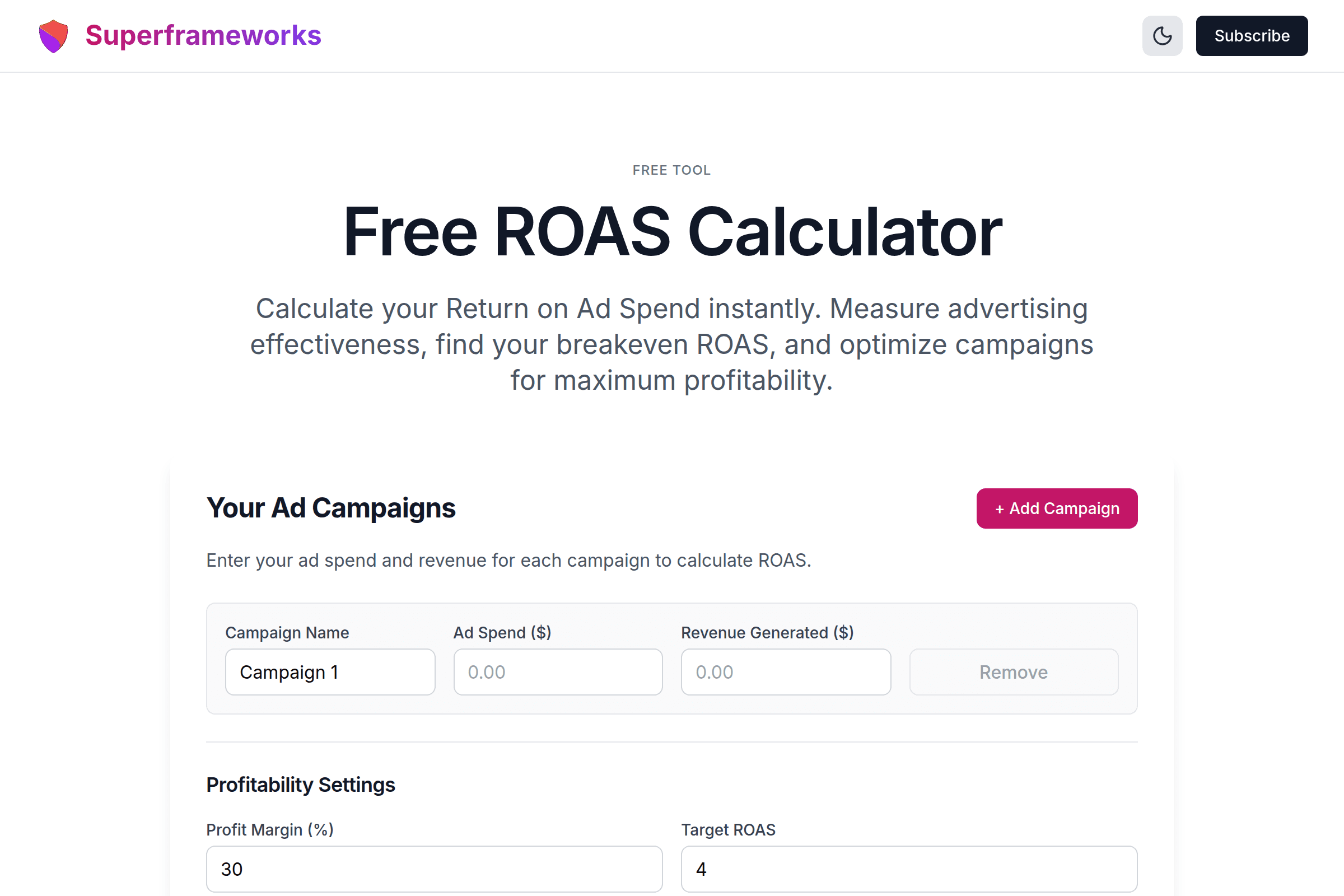
Free ROAS Calculator
Calculate your Return on Ad Spend instantly. Measure advertising effectiveness, find your breakeven ROAS, and optimize campaigns for maximum profitability.
Your Ad Campaigns
Enter your ad spend and revenue for each campaign to calculate ROAS.
Profitability Settings
Your gross profit margin on products/services
Your desired ROAS goal for campaigns
Understanding ROAS Metrics
What is ROAS (Return on Ad Spend)?
ROAS measures the revenue generated for every dollar spent on advertising. It's calculated by dividing total revenue by total ad spend. A ROAS of 4x means you earn $4 for every $1 spent on ads.
ROAS vs ROI
ROAS measures revenue return, while ROI (Return on Investment) measures profit return. ROAS doesn't account for product costs, fulfillment, or other expenses. Use breakeven ROAS to factor in your profit margin.
What is a Good ROAS?
A good ROAS depends on your profit margins. Generally:
- E-commerce with 30% margins: 3-4x ROAS to break even
- SaaS with high LTV: 1-2x ROAS can be profitable
- High-margin products (50%+): 2x ROAS can be profitable
- Low-margin products: May need 5x+ ROAS
Tips for Improving ROAS
- Optimize targeting to reach high-intent audiences
- Improve landing page conversion rates
- Test different ad creatives and copy
- Focus budget on best-performing campaigns
- Increase average order value with upsells
What You'll Get From Our ROAS Calculator
More than just a calculator - get actionable insights to optimize your advertising spend and maximize profitability.
ROAS Calculation
Calculate your Return on Ad Spend across all campaigns to measure advertising effectiveness.
Breakeven ROAS
Find the minimum ROAS needed to break even based on your profit margins.
Multi-Campaign Support
Track ROAS across multiple campaigns to identify your best and worst performers.
Profit Analysis
See actual profit after accounting for your costs and ad spend.
Margin-Adjusted Results
Factor in your profit margin to get accurate profitability insights.
Target Revenue Goals
See exactly how much revenue you need to hit your target ROAS.
Example ROAS Calculations
See how ROAS works for different business types and advertising strategies.
E-commerce Store
Ad Spend: $5,000
Revenue: $20,000
Profit Margin: 30%
ROAS: 4.0x
Breakeven: 3.33x - Profitable!
SaaS Business
Ad Spend: $10,000
First Month Revenue: $15,000
Profit Margin: 80%
ROAS: 1.5x
Breakeven: 1.25x - Profitable with LTV!
Agency Client
Ad Spend: $25,000
Revenue: $150,000
Profit Margin: 25%
ROAS: 6.0x
Breakeven: 4.0x - Highly Profitable!
ROAS Benchmarks by Platform & Industry
Compare your ROAS to industry standards and understand what to expect from different channels.
Google Search Ads
High-intent traffic from search keywords
Facebook/Meta Ads
Social advertising for e-commerce
Google Shopping
Product-focused search ads
Retargeting
Warm audiences who visited before
ROAS Formula
ROAS = Revenue from Ads / Cost of Ads
Breakeven ROAS = 1 / Profit Margin (e.g., 1 / 0.25 = 4x for 25% margin)
How to Calculate ROAS
Add Your Campaigns
Enter each advertising campaign with its total ad spend.
Enter Revenue
Add the revenue generated from each campaign.
Set Profit Margin
Enter your profit margin to calculate breakeven ROAS.
Analyze Results
See ROAS, profitability status, and optimization opportunities.
Perfect for Every Advertiser
Whether you're running your first ad or managing millions in spend, this calculator helps you make data-driven decisions.
E-commerce
Track ROAS across Facebook, Google, and TikTok ads to optimize your marketing budget.
- Multi-campaign tracking
- Breakeven analysis
- Profit margin calculations
Marketing Agencies
Report clear ROAS metrics to clients and demonstrate campaign performance.
- Client-ready calculations
- Compare campaign performance
- Profitability analysis
Startups & DTC
Understand unit economics and ensure sustainable growth with profitable ads.
- Unit economics insights
- Target ROAS planning
- Scale with confidence
Why ROAS is the Most Important Advertising Metric
ROAS Tells You If Ads Are Working
Unlike vanity metrics like impressions or clicks, ROAS directly measures whether your advertising is generating profitable returns. A campaign with millions of impressions is worthless if it doesn't generate revenue. ROAS cuts through the noise and shows you exactly how much revenue each ad dollar produces.
Make Confident Budget Decisions
When you know your ROAS, scaling becomes simple math. If a campaign generates 5x ROAS, you can confidently increase budget knowing you'll likely maintain similar returns. Conversely, campaigns below breakeven ROAS should be paused or optimized before spending more.
Compare Channels Effectively
ROAS allows you to compare the effectiveness of different advertising channels on equal footing. Whether you're running Google Ads, Facebook Ads, TikTok, or influencer campaigns, ROAS tells you which channels deliver the best returns so you can allocate budget accordingly.
The Foundation of Profitable Growth
Sustainable business growth requires profitable customer acquisition. By tracking ROAS alongside your profit margins, you ensure every advertising dollar contributes to bottom-line growth. Companies that master ROAS optimization can scale aggressively while maintaining profitability, a rare combination that leads to long-term success.
Want More Marketing Optimization Tips?
Join thousands of marketers getting actionable strategies to improve ROAS and grow profitably.
See the ROAS Calculator in action
Explore Related Tools
Discover more tools to help you build and grow your business
MRR Calculator
Calculate and forecast your Monthly Recurring Revenue with detailed metrics and growth projections.
MRR Screenshot Generator
Generate beautiful MRR dashboard screenshots with customizable themes and charts for sharing on Twitter/X and LinkedIn.
Business Ideas Generator
Generate profitable business ideas tailored to your interests, skills, and market trends.
Business Plan Generator
Create comprehensive business plans with market analysis, financial projections, and growth strategies.
Frequently Asked Questions
What is ROAS (Return on Ad Spend)?
ROAS (Return on Ad Spend) measures the revenue generated for every dollar spent on advertising. It is calculated by dividing the total revenue attributed to ads by the total ad spend. For example, a ROAS of 4x means you earn $4 in revenue for every $1 spent on advertising. ROAS is the most important metric for evaluating advertising campaign effectiveness.
What is a good ROAS?
A good ROAS depends on your profit margins and business model. Generally, 4:1 (or 4x) is considered a good benchmark for e-commerce. However, businesses with higher profit margins can be profitable at lower ROAS (2-3x), while low-margin businesses may need 5x+ ROAS. SaaS companies with high customer lifetime value can often profit at 1-2x ROAS.
How do I calculate ROAS?
ROAS is calculated using this formula: ROAS = Revenue from Ads / Cost of Ads. For example, if you spent $1,000 on ads and generated $4,000 in revenue, your ROAS is 4,000 / 1,000 = 4x (or 400%). This means you earned $4 for every $1 spent on advertising.
What is the difference between ROAS and ROI?
ROAS (Return on Ad Spend) measures revenue relative to ad spend, while ROI (Return on Investment) measures profit relative to total investment. ROAS = Revenue / Ad Spend, while ROI = (Profit - Investment) / Investment. ROAS does not account for product costs, fulfillment, or overhead, making ROI a more complete profitability measure.
What is breakeven ROAS?
Breakeven ROAS is the minimum ROAS needed to cover your costs and break even on ad spend. It is calculated as 1 / Profit Margin. For example, with a 25% profit margin, your breakeven ROAS is 1 / 0.25 = 4x. Any ROAS above this threshold generates profit, while below means you are losing money on ads.
How do I improve my ROAS?
To improve ROAS: 1) Optimize targeting to reach high-intent audiences, 2) Improve landing page conversion rates, 3) Test different ad creatives and copy, 4) Focus budget on best-performing campaigns and channels, 5) Increase average order value through upsells and bundles, 6) Reduce cost per click through better quality scores, 7) Implement retargeting for warm audiences.
What is Target ROAS bidding?
Target ROAS is an automated bidding strategy in Google Ads and Facebook Ads that automatically sets bids to maximize conversion value while achieving your target ROAS. If you set a target ROAS of 400%, the algorithm will optimize bids to generate $4 in revenue for every $1 spent. This requires conversion tracking and sufficient historical data.
Why is my ROAS low?
Common reasons for low ROAS include: poor audience targeting, weak ad creative, low landing page conversion rate, product-market mismatch, high competition driving up ad costs, insufficient budget for optimization, lack of retargeting, and tracking issues. Analyze each step of your funnel to identify bottlenecks.
How does ROAS differ by platform?
ROAS benchmarks vary by platform: Google Search Ads typically see 2-4x ROAS due to high intent, Facebook/Instagram Ads average 2-3x for e-commerce, Google Shopping sees 4-8x for product searches, and retargeting campaigns can achieve 10x+ ROAS. Each platform requires different strategies and expectations.
Should I use ROAS or CPA as my primary metric?
Use ROAS when products have varying prices or when optimizing for revenue/profit. Use CPA (Cost Per Acquisition) when products have similar prices or for lead generation. ROAS is better for e-commerce with diverse product catalogs, while CPA works well for subscription businesses or when all conversions have equal value.