
We Tested 5 AI Models on Real Founder Work. GLM 5.2 Beat GPT-5.5.
We ran GPT-5.5, Grok 4.20, DeepSeek V4 Flash, GLM 5.2, and Claude Code through three messy founder tasks. The winner was not the model most people would guess.
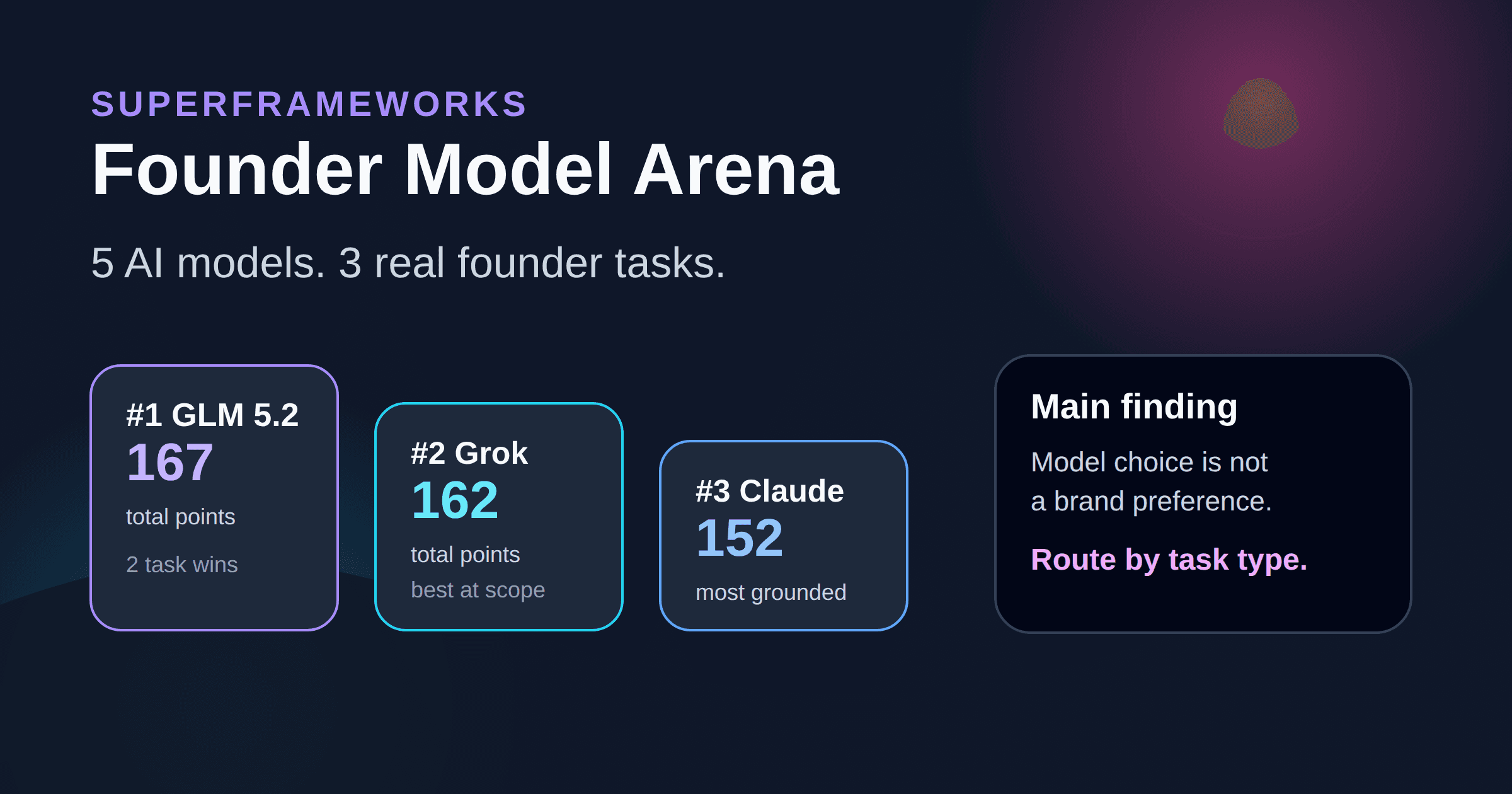
Key takeaways
- GLM 5.2 won two of the three founder tasks and finished first overall with 167 total points.
- Grok 4.20 Reasoning finished close behind with 162 points and won the MVP scoping task.
- Claude Code was the most grounded and technically realistic, but less distinctive for strategy and marketing tasks.
- GPT-5.5 was solid but underperformed on ruthless prioritization and complete founder-ready output.
- The bigger lesson: founders should route work by task type, not model reputation.
Most AI model benchmarks answer a question founders do not actually ask: which model is best at exams, puzzles, or synthetic coding tasks?
Useful, but incomplete. A founder does not wake up thinking, "I need 2% more MMLU." A founder wakes up thinking: should this feature ship? How do I respond to this sales objection? What should we publish first if we need customers this month?
So we ran a small, practical arena: five models, three messy founder tasks, scored on strategic clarity, specificity, editorial quality, founder usefulness, groundedness, and publishability. The result was uncomfortable in the useful way. The famous model did not win.
The setup: five models, three founder jobs
We tested GPT-5.5, Grok 4.20 Reasoning, DeepSeek V4 Flash, GLM 5.2, and Claude Code. The tasks were deliberately ordinary:
Product scope and MVP sequencing
Winning score: 56
Grok was the most ruthless about what belonged in the first version. It kept the product focused on trust, Gmail-only scope, reminders, and paid beta sequencing instead of trying to build the whole company in three weeks.
Sales objection handling
Winning score: 55
GLM produced the most usable positioning and follow-up sequence. It sounded like a founder writing to a skeptical prospect, not sales automation wearing a human mask.
SEO content strategy
Winning score: 58
GLM gave the most complete month-one strategy: clear page sequencing, strong intent judgment, credible comparison-page guidance, and fewer risky claims than the cheaper models.
One caveat: this was a practical founder benchmark, not a statistically massive lab study. Treat it as a buying signal and workflow signal, not eternal truth about every future model release.
How the test was run
This batch was not run by hand in five browser tabs. A Hermes agent orchestrated the benchmark: it loaded each task prompt, called each model through the configured provider, saved raw outputs, generated scorecards, and then produced the judge packet for comparison.
The full Hermes benchmarking session took roughly 123 minutes wall-clock because it included setup, harness fixes, intermediate reruns, judging, and final artifact generation. The final clean scored batch itself took roughly 22 minutes, with 19 minutes and 41 seconds of measured model-generation time across the 15 final candidate runs.
GPT-5.5, Grok 4.20, DeepSeek V4 Flash, GLM 5.2, Claude Code
MVP scoping, sales objections, SEO strategy
Wall-clock time across setup, harness fixes, reruns, judging, and final artifacts
The three final scored runs from first artifact to last artifact
Sum of candidate generation latency across the 15 final model calls
The final scoreboard

GLM 5.2 won the aggregate with 167 points and two task wins. Grok was close enough that the right answer is not "use GLM for everything." The right answer is to stop treating model choice as a brand preference.
The useful question is: what kind of work is this? Strategy, voice, scope, code, research, or cheap first-pass ideation all reward different strengths.
What each result tells founders
GLM 5.2 is better than its brand awareness
GLM did not win by being flashy. It won because it gave complete, practical answers that a founder could use with light editing. In the sales task, it avoided the weird polished-but-dead tone that makes AI-written outreach feel radioactive. In the SEO task, it understood intent and sequencing instead of dumping a keyword calendar.
Grok is the sharper product partner
Grok won the MVP scoping task because it was willing to cut. That is more valuable than it sounds. Early products usually die from scope obesity: too many features, too many edge cases, too much fake completeness. Grok pushed toward a smaller product with a clearer trust path.
Claude Code is the safe pair programmer, not always the best strategist
Claude Code finished third on all three tasks, which looks boring until you look at the notes: grounded, disciplined, technically realistic. That is exactly what you want near implementation work. The trade-off is that its outputs were less distinctive for strategy and marketing.
GPT-5.5 was competent, but not decisive
GPT-5.5 gave useful answers, but it often tried to keep too much in play. For founder work, that is a real weakness. The best advice is usually not the most comprehensive answer; it is the answer that helps you make the next high-leverage move.
DeepSeek V4 Flash needs a leash
DeepSeek had good instincts in places, especially for fast draft exploration. But across the tasks it invented too many specifics and drifted toward generic SaaS copy. If you use it, use it upstream: ideas, outlines, alternatives. Do not let it be the last mile before publishing or sending.
The founder routing playbook
Use GLM 5.2 for founder strategy and marketing drafts
If the task needs positioning, objection handling, SEO sequencing, or a founder-readable plan, GLM 5.2 deserves a serious slot in your workflow.
Use Grok when the task needs taste and sharp cuts
Grok was strongest when the job was deciding what not to build. That matters because most founder failures are scope failures wearing product-manager clothes.
Use Claude Code when correctness beats voice
Claude Code was consistently safe, grounded, and implementation-aware. It may not write the spiciest strategy memo, but it is the model you want near code, specs, and technical trade-offs.
Do not let a cheap model invent your facts
DeepSeek V4 Flash had useful instincts, but the hallucination pattern was obvious. Cheap is great for drafts and brainstorming; it is dangerous as an unsupervised source of truth.
Sample inputs and outputs
Input: MVP scoping from messy feature requests
A solo consultant inbox tool has Gmail OAuth, manual label sync, a dashboard, and one-click draft generation. Users ask for Slack notifications, Outlook, team inboxes, custom rules, invoice reminders, CRM sync, mobile app, voice dictation, weekly health summaries, and automatic send. The founder has three weeks and one part-time developer.
Grok cut the scope back to Gmail-only urgency labeling, one-click drafts, and follow-up reminders delivered outside the dashboard. It explicitly rejected Outlook, team inboxes, CRM sync, mobile app, and auto-send until trust and repeat usage were proven.
Input: sales objection sequence
Write founder-led responses to skeptical prospects who think the product is too early, too risky, or too expensive, without sounding like generic sales automation.
GLM produced the most human sequence: acknowledge the concern, narrow the promise, offer a low-risk next step, and avoid pretending the product is more mature than it is. The judge called it “sharp positioning” that sounded like a founder, not a drip campaign.
Input: month-one SEO strategy
Create a first-month content strategy for a founder who needs customer-intent traffic, not a vanity blog calendar. Include what to publish, what not to publish, and how to sequence pages.
GLM prioritized comparison and competitor-intent pages first, then supporting educational content. It gave clearer sequencing than the others and avoided the common trap of starting with broad top-of-funnel topics that do not convert soon enough.
The hidden lesson: your model stack is now an operating system
Founders used to ask, "Which model should I use?" That question is starting to feel like asking which employee should do every job in the company. The answer depends on the work.
A serious founder workflow will look more like routing than loyalty: one model for scope, another for copy, another for code, another for cheap exploration, and an eval harness that tells you when the leaderboard changed. The winning edge is not access to a single frontier model. Everyone will have that. The edge is knowing which model to trust for which decision.
That is the practical reason to run your own small benchmarks. You do not need a research lab. You need three to five tasks that look like your real work, a simple scoring rubric, and enough discipline to judge outputs by usefulness instead of vibes.
How to run this for your own company
- Pick three real tasks you already do every month: sales, content, product, support, hiring, or code review.
- Write a rubric before you run the models. Include usefulness, specificity, correctness, and how much editing you needed.
- Blind yourself where possible. Model logos are expensive placebo.
- Save the best outputs and the worst mistakes. Mistake patterns matter more than one-off wins.
- Turn the result into routing rules. The benchmark only matters if it changes your workflow.
Want the raw artifacts?
We are not publishing the full artifact folder publicly because it contains complete prompts, raw model outputs, and harness details that are easy to misread without context. If you want to inspect the scorecards or sample outputs, reach out and I will share the relevant subset.
Want more founder-grade AI experiments?
I send practical frameworks, model tests, and operator playbooks for indie founders building with AI. No hype. No generic prompt packs.
Keep Reading
We Tested Claude Fable 5 vs GPT-5.6 Sol on Founder Work. Fable Won 4/4.
We ran Claude Fable 5 and GPT-5.6 Sol through four non-marketing founder tasks: product scope, customer synthesis, churn diagnosis, and pricing strategy. Fable swept the benchmark, but Sol still belongs in the workflow.
We Tested 5 Non-Frontier AI Models on Founder Work. Qwen Won Everything.
We ran Qwen3.7 Plus, GLM 5.2, DeepSeek V4 Flash, Kimi K2.6, and Mimo V2.5 Pro through three real founder tasks: positioning, pricing, and customer research synthesis.
Claude Opus 5 vs GPT-5.6 Terra: Blind Judging Picked Opus 13–3 on Founder Work
We tested Claude Opus 5 and GPT-5.6 Terra across 16 real founder jobs. Self-judging produced opposite conclusions. A blinded third judge gave Opus a 13–3 win.