
10 Best AI Customer Support Tools for 2026 (Real Resolution Rates, Real Per-Ticket Costs)
The 10 best AI customer support tools for 2026 — Intercom Fin, eesel AI, Chatbase, Tidio Lyro, Pylon, Lorikeet, Parahelp, Gradient Labs, Decagon, and Sierra. Ranked by founders-first criteria: what AI agents actually resolve in production (not marketing benchmarks), per-resolution cost math at startup volumes, and whether you can deploy without replacing your helpdesk.
Marketing resolution rates and production resolution rates are different numbers.
Vendors advertise 67-86% resolution. Production tells another story: Intercom's own Fin case studies cluster at 42-50%, an independent 500-ticket small-business test landed at 38%, and B2B deployments run 17-25 points below vendor benchmarks because B2B tickets are harder. The honest planning range is 40-70%, driven mostly by your ticket mix and knowledge-base quality — not the vendor's model. Every entry below quotes both the claim and the production evidence, and two tools (eesel, Pylon) will simulate against your own historical tickets before you pay.
Key Takeaways
- Vendor resolution claims and production reality are different numbers. Intercom reports a 67% average resolution rate for Fin; independent tests and Intercom's own case studies cluster at 38-53%. Plan your math around 40-50% resolution in year one — anything above that is upside, not baseline.
- Intercom Fin is the proven default: transparent 99¢-per-resolution pricing, a 14-day unlimited trial, 2,900+ G2 reviews (#1 AI Agent), and — the underrated part — it now runs standalone on 8+ other helpdesks. You do not need to migrate to Intercom to use Fin.
- At founder volumes the AI bill is small: 300 tickets/mo with 50% AI resolution costs roughly $32/mo flat on Chatbase, ~$120 on eesel AI (40¢ per ticket touched), or ~$149 on Fin (99¢ × 150 resolutions). The expensive part is not the AI — it is choosing a platform with a $50K platform fee you cannot consume.
- Decagon ($4.5B valuation) and Sierra ($15.8B, $100M+ ARR in under two years) are real — and unbuyable below roughly $95K-$150K/yr. The founder-priced equivalents exist: Lorikeet for regulated scale-ups, Parahelp for technical SaaS, Gradient Labs for fintech.
- The Klarna lesson is the one every vendor leaves out: after claiming its AI did the work of 700 agents, Klarna rehired humans in 2025 because AI-only support produced lower quality and brand damage. Hybrid wins. Never ship an AI agent without a clean human handoff path.
- Read the billing mechanics before the feature list. Fin bills "assumed resolutions" (customer silence for 24 hours counts as success). Decagon reportedly bills ~$1 per conversation including the ones the AI fails. eesel bills 40¢ per ticket touched regardless of answer quality. The resolution definition is where the money moves.
The best AI customer support tools list you find on page one of Google is almost always written by one of the vendors — ranked, naturally, with themselves first. This one is independent: we don't sell support AI, no tool paid for placement, and every resolution-rate claim below is paired with what the production evidence actually shows.
2026 is the year the category split into tiers. At the top, Sierra ($15.8B valuation, $100M+ ARR in under two years) and Decagon ($4.5B) sell six-figure enterprise contracts to the Fortune 500. In the middle, procedure-following specialists — Lorikeet for regulated industries, Parahelp for technical SaaS, Gradient Labs for fintech — brought that architecture down to five-figure contracts. And at the founder tier, Fin, eesel, Chatbase, and Lyro made real AI support a $30-$150/month line item. Meanwhile per-resolution pricing won the business-model war: you now mostly pay for outcomes, not seats — which makes the fine print of what counts as "resolved" the most important paragraph in any contract.
We ranked for founders: what can you deploy this week, on the helpdesk you already run, at a cost you can model — and what should you merely understand because TechCrunch keeps writing about it. Each entry covers verified pricing, the claim-vs-production gap, billing gotchas, and whether the tool requires replacing your stack.
Quick Comparison
| # | Tool | Best For | Starting Price | Rating |
|---|---|---|---|---|
| 1 | Intercom Fin | Best Overall | 99¢ per resolution, one charge max per conversation | 4.5 |
| 2 | eesel AI | Best Budget Overlay | Pay-per-task: 40¢ per ticket or chat session, light lookups free | 4.7 |
| 3 | Chatbase | Best for Indie Hackers | Free (50 message credits/mo, 1 agent) | 4.3 |
| 4 | Tidio Lyro | Best Free Entry | Free (50 lifetime Lyro conversations) | 4.7 |
| 5 | Pylon AI | Best for B2B SaaS | AI Agents add-on from $100/mo, scaling with issue volume (~50¢/ticket reported at volume) | 4.7 |
| 6 | Lorikeet | Best for Regulated Scale-Ups | Start $1,500/mo billed annually (under 5,000 tickets/mo) | n/a |
| 7 | Parahelp | Best for Technical Tickets | Custom, per-resolution (reported 50¢-$1 per resolved ticket — third-party estimates; pricing is sales-gated) | n/a |
| 8 | Gradient Labs | Best for Fintech | Custom outcome-based — pay only per successful resolution, no platform fees | n/a |
| 9 | Decagon | Enterprise Co-Leader | Custom, sales-only | 4.9 |
| 10 | Sierra | The Fortune-50 Tier | Custom outcome-based (contracts reportedly from ~$150K/yr) | n/a |
"n/a" = no statistically meaningful review base; these vendors' proof is named production customers, noted per entry.
Intercom Fin
Best Overall — The Proven Default at 99¢ per Resolution
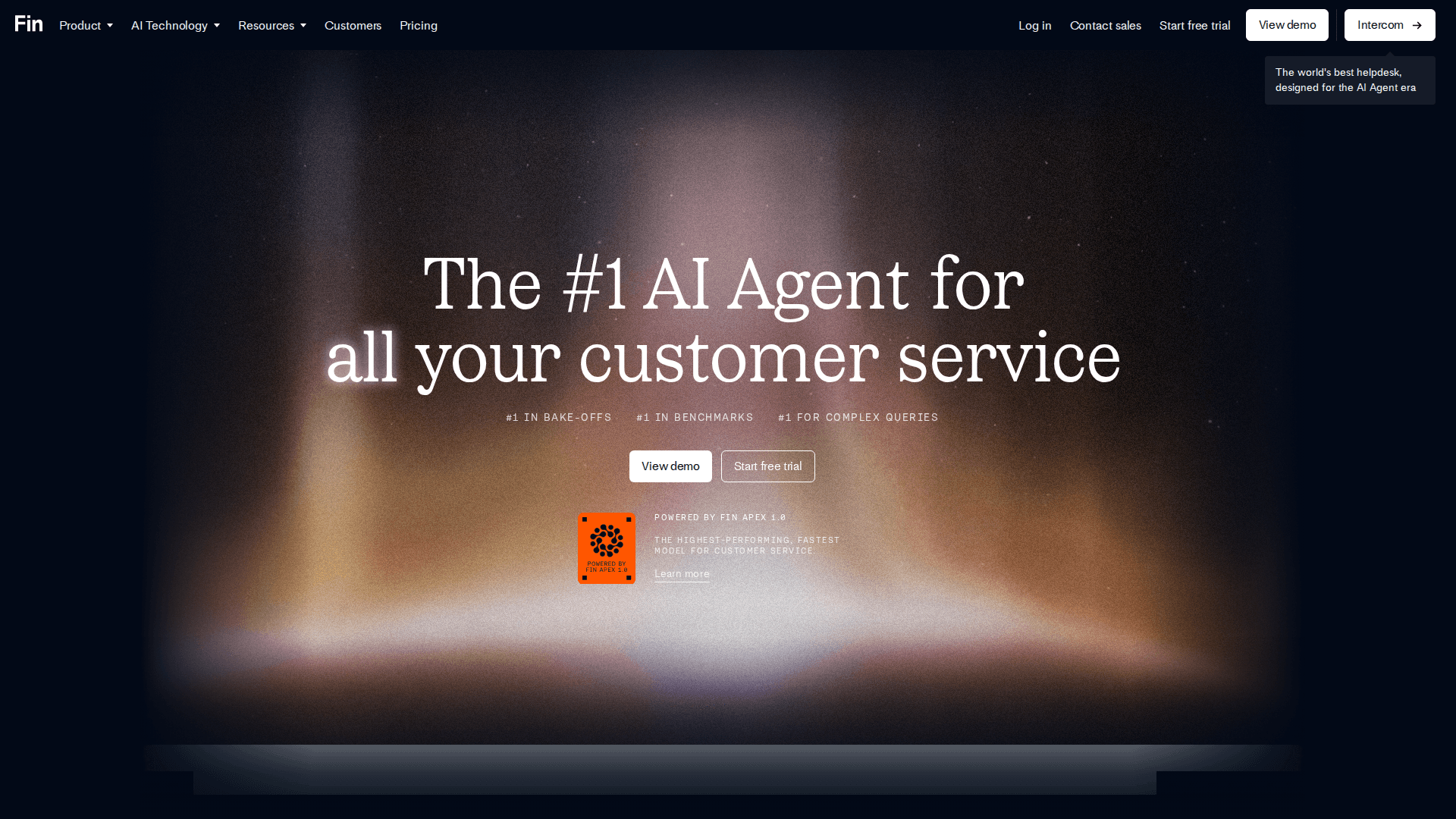
Fin is Intercom's AI agent and the volume leader of the category — 2M+ conversations resolved weekly, 2,900+ G2 reviews, ranked #1 AI Agent. It combines RAG over your help center with Procedures: agentic workflows that execute refunds, account lookups, and API calls, then hand off cleanly. The strategic shift that matters for 2026: Fin is no longer Intercom-only. It deploys standalone on Salesforce, HubSpot, Freshdesk, Zoho Desk, Front, Gorgias, Dixa, and Sprinklr at 99¢ per resolution with a 50-resolution monthly minimum — no seats, no migration.
Fin is the benchmark every other tool here is priced against, and it earns the slot: the largest verified review base in the category, self-serve setup, a 14-day unlimited free trial, and pay-for-performance pricing with no charge when the customer asks for a human. The honest numbers: Intercom reports 67% average resolution, but its own case studies cluster at 42-50% and an independent 500-ticket small-business test landed at 38% — plan around 40-50%. The gotcha to watch is "assumed resolution" billing: if the customer simply stops replying for 24 hours after Fin answers, that counts as a billable outcome. Reddit documents bills jumping from $4K to $9K/month as resolutions, seats, and add-ons stack on Intercom's own helpdesk. Start on the trial, measure your real resolution rate, and set a usage budget before going live.
Key Features
- Procedures: no-code agentic workflows that take real actions (refunds, lookups, API calls)
- Runs standalone on 8+ helpdesks — Salesforce, HubSpot, Freshdesk, Zoho, Front, Gorgias — no migration
- Omnichannel: chat, email, SMS, WhatsApp, and Fin Voice for phone
- 14-day unlimited free trial, no credit card; Intercom startup program includes 1 year of Fin free
- Fin Copilot for human agents ($29-$35/agent/mo) + Pro analytics add-on
Pricing
99¢ per resolution, one charge max per conversation. Standalone on other helpdesks: 50-resolution/mo minimum (~$50/mo floor), no seat fees. On Intercom's helpdesk, seats ($29-$132) stack on top. 14-day unlimited trial.
Rating
4.5/5 — G2 (2,900+ reviews, #1 AI Agent)
Best For
SMB and mid-market SaaS that want the proven category leader — and Zendesk/Sales...
Pros
- Most-validated AI agent in the category — 2,900+ reviews, #1 on G2
- Pay-for-performance: no charge when the customer explicitly asks for a human
- Helpdesk-agnostic since 2025 — deploy on what you already run
Cons
- "Assumed resolution" billing (24 hours of customer silence = billed success) inflates the count
- Costs scale brutally with volume and success — documented $4K to $9K/mo bill jumps on the full Intercom stack
eesel AI
Best Budget Overlay — 40¢ per Ticket on the Helpdesk You Already Use
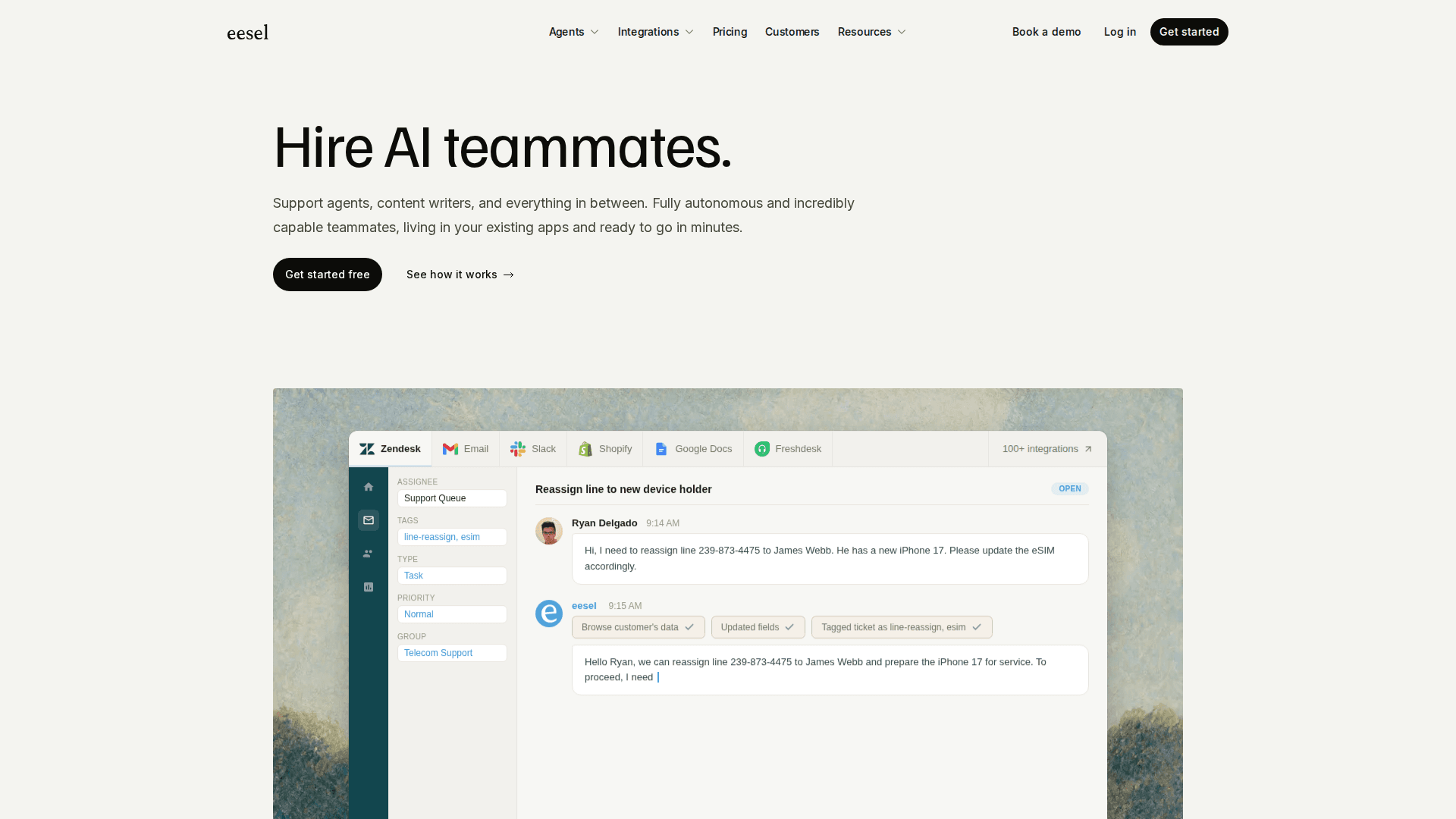
eesel AI is a helpdesk-agnostic AI layer that plugs into Zendesk, Freshdesk, Intercom, Gorgias, Help Scout, and a dozen others, training on your past tickets, macros, and docs — not just the help center. In Q1 2026 it dropped flat plans for the cleanest pricing in the category: 40¢ per ticket or chat session handled, light lookups free, no platform fee, no seats, no minimums, with a default $250/mo spend cap and a $50 free trial credit. Its standout feature is simulation mode: run the AI over thousands of historical tickets and see the forecast deflection rate before a single customer talks to it.
For a small team already on a helpdesk, eesel answers the two questions that matter before buying AI: "what will it actually resolve?" (simulation mode tells you, on your own tickets, before you pay) and "what will it cost?" (40¢ × tickets touched, capped at whatever you set). That combination — predictable usage pricing plus a pre-launch forecast — does not exist anywhere else at this price. The honest caveats: the G2 base is thin (4.7 from ~16 reviews) for the 1,000+ customer claim, its 81% resolution marketing number is unverified, and you pay 40¢ per ticket touched whether or not the answer was good. Note also that many "competitor pricing" articles ranking high in Google are eesel's own blog — their tool is genuinely good, but read their competitive claims with that in mind.
Key Features
- Simulation mode: forecast resolution rate on thousands of your historical tickets before launch
- Trains on past tickets + macros + docs (Confluence, Notion, Google Docs), not just the help center
- Works inside 14+ helpdesks: Zendesk, Freshdesk, Intercom, Gorgias, Help Scout, and more
- Four products in one: AI Agent, Copilot, Triage, and internal Slack/Teams Q&A
- Hard spend caps (default $250/mo) — agents pause when the cap hits, no surprise bills
Pricing
Pay-per-task: 40¢ per ticket or chat session, light lookups free. No platform fee, seats, or minimums; $50 trial credit, no card; default $250/mo spend cap. Annual: commit $300+/mo for 25% off. Enterprise $1,000/mo flat + usage.
Rating
4.7/5 — G2 (16 reviews — small base)
Best For
SMB SaaS and ecommerce teams already on Zendesk/Freshdesk/Intercom/Gorgias who w...
Pros
- Simulation mode is the only pre-purchase resolution forecast in the category
- Cleanest billing mechanics on this list: per-task, capped, no resolution-definition games
- Self-serve with a real free trial — live in 15 minutes per G2 reviewers
Cons
- Thin review base (~16 G2 reviews) relative to the 1,000+ customer claim
- Bills 40¢ per ticket touched regardless of answer quality — a bad answer still costs
Chatbase
Best for Indie Hackers — $32/mo, Bootstrapped to $10M ARR
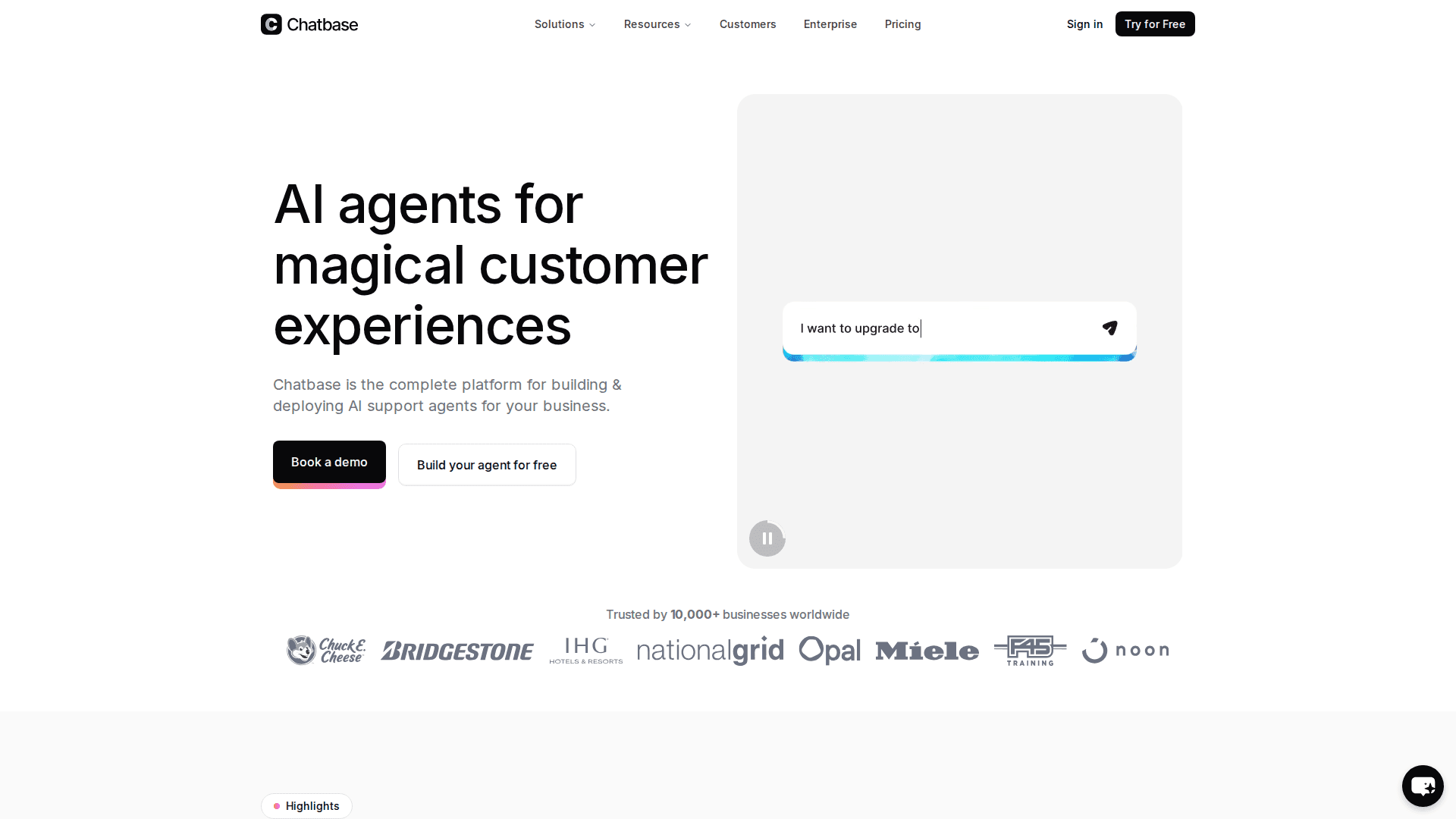
Chatbase is the indie-hacker success story of the category: a solo-founder, zero-VC company that crossed $10M ARR with ~18 people and 8,000+ paying customers by making AI support agents radically self-serve. Point it at your docs site, get an embeddable RAG agent in minutes, pick your model (GPT, Claude, Gemini), and wire AI Actions for API calls. It is not a support platform — there is no inbox or ticketing — it is the answer layer you put in front of one. Free tier included; Hobby is $32/mo for 500 message credits.
If you are a solo founder with a docs site and 50 support emails a week, Chatbase is the rational first move: $0-$32/mo, an afternoon of setup, and a working agent that deflects the repetitive half of your queue. The trade-offs are exactly what you would expect at this price. Hallucination complaints are the persistent negative theme — confident wrong answers and invented URLs when training data is thin — so curate what it learns from and watch the conversation logs weekly. Credits are not messages (premium models burn 2-5 credits per reply), the bot goes silent mid-month if credits run out without auto-recharge, and human handoff is your problem to wire up. Use it as the deflection layer in front of Help Scout or a shared inbox, not as the whole support system.
Key Features
- 5-minute setup: scrape your site/docs, embed the widget, done
- Multi-LLM choice (GPT, Claude, Gemini) with per-model credit costs
- AI Actions: call external APIs mid-conversation (order lookups, bookings, lead capture)
- Channels: web widget, Slack, WhatsApp, Messenger + API
- Built-in analytics to spot failing answers and knowledge gaps
Pricing
Free (50 message credits/mo, 1 agent). Hobby $32/mo (500 credits). Standard $120/mo (4,000). Pro $400/mo (15,000). Extra credits $40/1,000; branding removal $1,188/yr. Premium models burn 2-5 credits per reply.
Rating
4.3/5 — Capterra (73 reviews)
Best For
Indie hackers and solo founders with a docs site who want a working support bot ...
Pros
- Cheapest credible entry into AI support — and the vendor is profitable, not burning VC
- Genuinely self-serve: no sales call anywhere in the funnel
- Model flexibility lets you trade answer quality against credit burn
Cons
- Persistent hallucination complaints — confident wrong answers need weekly log review
- No inbox, ticketing, or native human handoff — it is a bot, not a support system
Tidio Lyro
Best Free Entry — Ecommerce AI With a Contractual 50% Guarantee
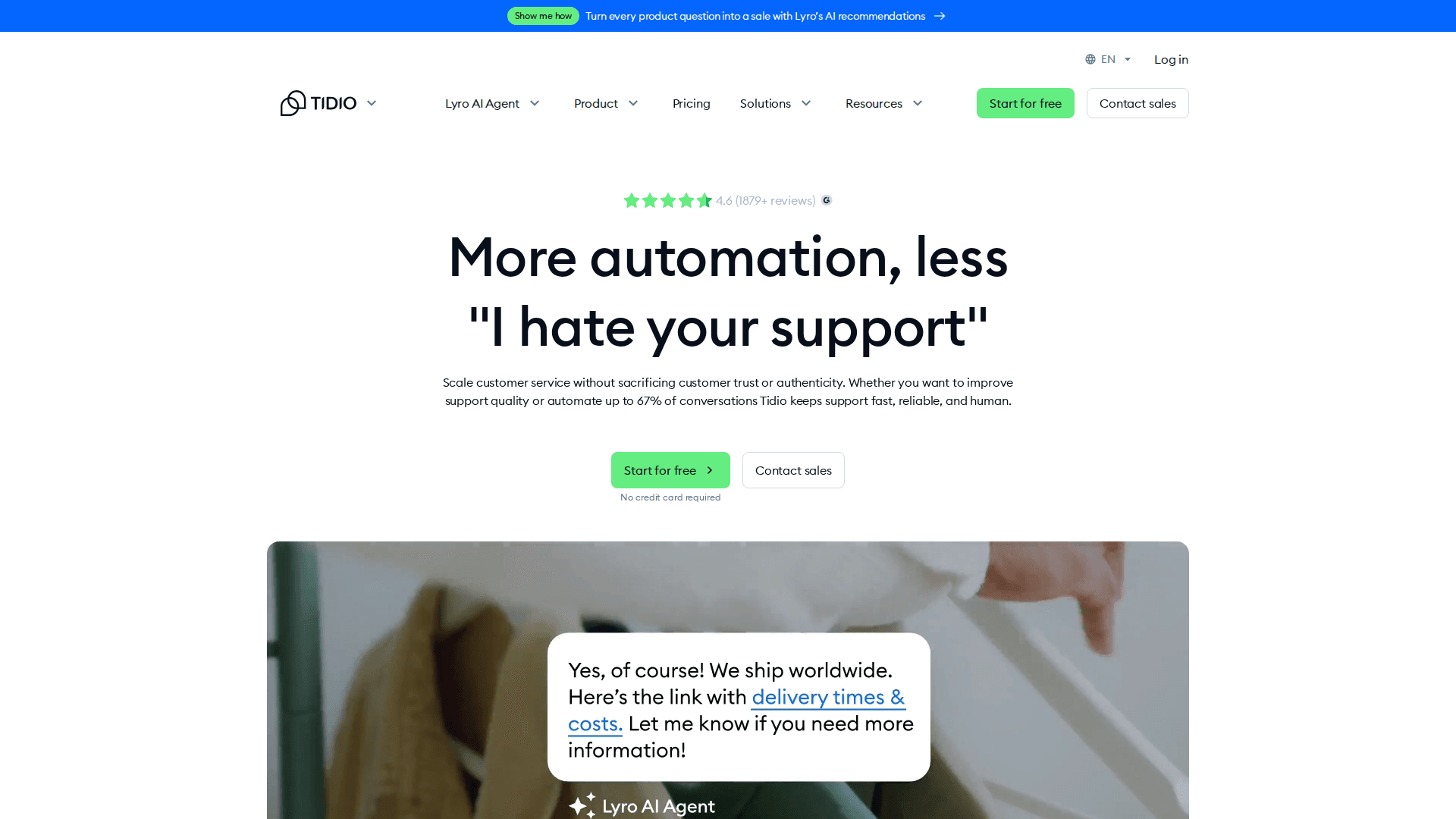
Lyro is the AI agent inside Tidio, the live-chat platform used by 300,000+ businesses. It auto-scrapes your site and help docs, runs on Claude plus in-house models, and handles chat, email, WhatsApp, Instagram, and Messenger from one inbox, with Smart Actions for order status and product recommendations — its sweet spot is Shopify. Tidio claims a 67% average resolution rate, and the Premium tier puts money behind it: a contractual 50% resolution guarantee. The free plan includes 50 lifetime Lyro conversations to test with.
For a small ecommerce store, Lyro is the fastest path from zero to working AI support: live in an afternoon, free to test, and effective on the order-status and shipping questions that dominate retail queues. The contractual 50% guarantee on Premium is unique — no other vendor on this list contractually backs its resolution number. The billing mechanics are where you need to pay attention: Lyro is metered separately from Tidio's plans (from ~$33/mo for 50 AI conversations), a "conversation" is anything with at least one AI reply — billed whether or not it resolved — and conversations reset after ~15 minutes of customer silence, so one returning customer can burn multiple billed conversations. Real-world cost runs 2-3x the advertised plan price. When the quota runs out, Lyro silently stops answering — set alerts.
Key Features
- One-click setup: auto-scrapes your website and help center, no training required
- Omnichannel: chat, email, WhatsApp, Instagram, Messenger from one inbox
- Smart Actions: order status, lead qualification, product recommendations (Shopify-native)
- Contractual 50% resolution-rate guarantee on the Premium tier
- Built-in live-chat inbox — no separate helpdesk needed at small scale
Pricing
Free (50 lifetime Lyro conversations). Lyro packs from ~$33/mo for 50 AI conversations, scaling in blocks. Tidio platform plans separate (Free to $749/mo). Premium: custom, 3,000+ conversations, 50% resolution guarantee with pay-per-resolution billing.
Rating
4.7/5 — G2 (1,800+ reviews, Tidio platform)
Best For
Small ecommerce and Shopify stores that want cheap, fast FAQ + order-status auto...
Pros
- Only vendor on this list with a contractual, refund-backed resolution guarantee
- Free tier + afternoon setup is the lowest-friction test in ecommerce AI
- Large validated review base (1,800+ on G2) for the underlying platform
Cons
- Double metering (platform conversations + Lyro conversations) lands real cost at 2-3x sticker
- The ~15-minute conversation reset inflates billing, and Lyro goes silent when the quota runs out
Want More Tool Recommendations?
Subscribe for curated indie hacker tool picks every week. No sponsored content, no fluff.
Pylon AI
Best for B2B SaaS — AI Built Into Slack-Native Support
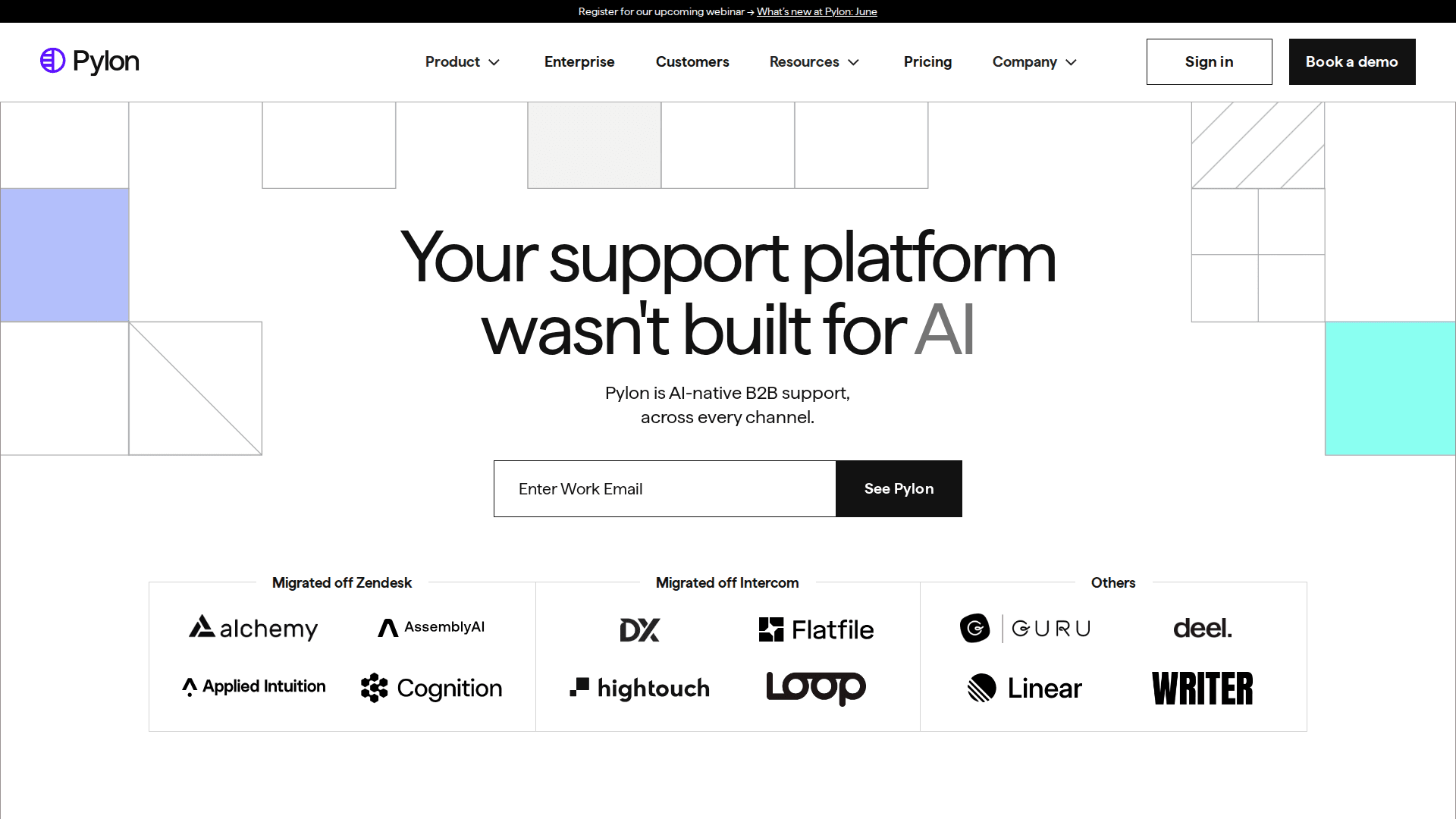
Pylon is the AI-native B2B support platform (YC W23, $31M Series B from a16z and Bain Capital Ventures), and its AI agent is the only one on this list that answers customers inside shared Slack Connect threads as a first-class channel — plus chat, email, and portal. The agent combines RAG over your knowledge base and past tickets with Runbooks: structured, testable action sequences you can simulate against historical tickets before launch. AI Agents are an add-on from $100/mo scaling with issue volume, on top of Pylon seats ($59-$139/seat/mo).
B2B support has a structural problem no B2C-shaped AI agent solves: your highest-value customers ask questions in shared Slack channels, not a chat widget. Pylon's agent lives there natively, which is why 780+ B2B SaaS companies (Deel, Hightouch, AssemblyAI) run on it — AssemblyAI reports 50% of eligible inquiries resolved without human touch. The honest framing: "eligible" is doing work in that sentence (that is resolution of AI-routed tickets, not all tickets), the AI agent is younger and less proven than Fin for pure deflection, and the all-in cost stacks — 3-seat minimum plus $100+/mo AI plus $50/seat copilot lands realistic deployments near $800/mo. If you are B2B-in-Slack, nothing else fits this well; if you are not, a cheaper overlay wins.
Key Features
- AI agent answers natively in shared Slack Connect / Teams threads — unique in this list
- Runbooks: structured agentic workflows, simulated against historical tickets before launch
- Full B2B platform underneath: ticketing, KB, CSAT, account views, Linear/Jira sync
- AI Assistants copilot ($50/seat/mo) for human agents
- Knowledge-gap detection + AI article drafting from resolved tickets
Pricing
AI Agents add-on from $100/mo, scaling with issue volume (~50¢/ticket reported at volume). Requires Pylon seats: Starter $59/seat/mo (3-seat min), Professional $89/seat/mo. AI Assistants $50/seat/mo.
Rating
4.7/5 — G2 (108+ reviews)
Best For
Post-seed B2B SaaS doing support in shared Slack/Teams channels that wants helpd...
Pros
- The only credible AI agent for shared-Slack-channel B2B support
- Runbook simulation against past tickets de-risks launch the same way eesel's simulation does
- Highest-rated B2B support platform on G2 (4.7, growing fast)
Cons
- AI is an add-on on top of seat minimums — realistic all-in lands near $800/mo
- Locked to Pylon's platform: the AI agent cannot run on your existing helpdesk
Lorikeet
Best for Regulated Scale-Ups — Transparent Outcome Pricing
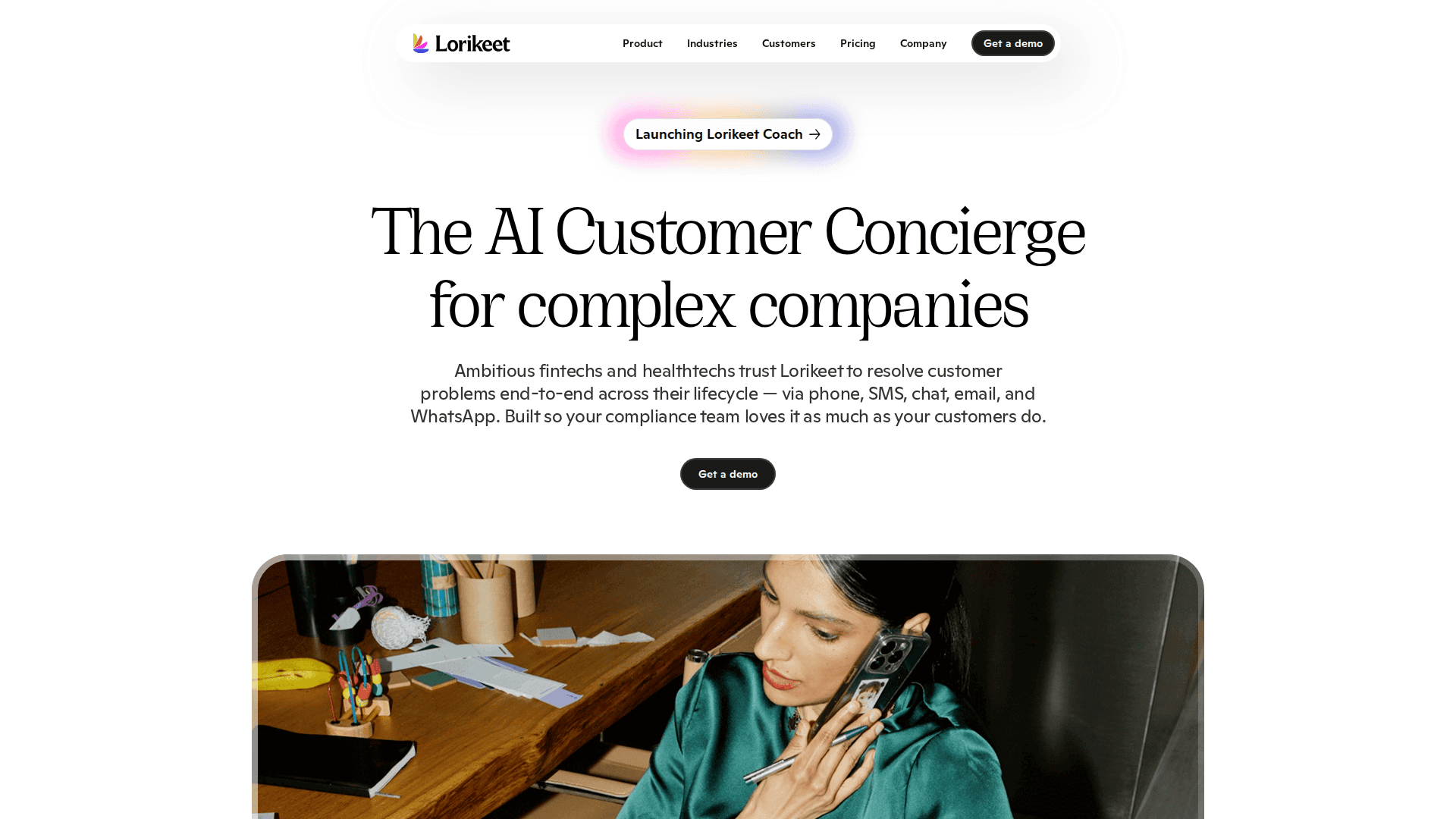
Lorikeet is the procedure-following AI agent for companies where a hallucinated answer is a compliance incident: fintech, healthtech, crypto. Instead of RAG-and-hope, it executes the same multi-step SOPs human agents follow (3-40 steps), takes real actions through Zendesk, Stripe, and internal APIs, and escalates with full context when a case falls outside its playbook — it would rather hand off than guess. Founded by ex-Stripe and ex-Google AI leads, $75M raised in ~10 months, with Airwallex, Linktree, and Magic Eden in production. Uniquely for this tier, pricing is published: $1,500/mo (annual) plus 95¢ per resolved chat/email/SMS ticket.
Lorikeet is what Decagon/Sierra-grade procedure-following looks like at a price a Series A company can actually buy, with the rarest trust signal in the enterprise tier: a public pricing page and a "you don't pay for tickets we failed on" policy. It also refuses to play the resolution-rate marketing game — Lorikeet publicly argues that vendors claiming 70-90% achieve it by attempting everything and quietly failing on the hard 30%. The fit test is volume and complexity: the $18K/yr floor only makes sense past roughly 1,000 tickets/mo with action-heavy workflows (refunds, account changes, verification). Below that, use Fin or eesel; above it, in a regulated vertical, Lorikeet is the most founder-accessible serious option. Note the metering details: voice resolutions cost ~50% more, and routing/QA each consume credits on top of resolutions.
Key Features
- Executes multi-step SOPs (3-40 steps) with real actions — card freezes, refunds, verification
- Pay-per-resolution: unhappy with how a ticket was handled? You don't pay for it
- Omnichannel: chat, email, voice, SMS, WhatsApp from one agent
- Compliance-oriented escalation design (e.g., urgent medical questions route to clinicians)
- Published pricing — unique among procedure-following enterprise agents
Pricing
Start $1,500/mo billed annually (under 5,000 tickets/mo). Per resolution: 95¢ chat/email/SMS, $1.50 voice; routing/tagging and auto-QA ~30¢ each on top. Scale $4,000/mo with lower rates. No per-seat or implementation fees.
Rating
No meaningful G2 base yet — proof is Airwallex, Linktree, Magic Eden in production
Best For
Fintech, healthtech, and regulated scale-ups past ~1,000 tickets/mo with action-...
Pros
- Transparent published pricing and failure-tickets-free billing — rare honesty at this tier
- Genuinely agentic: resolves cases that require account actions, not just answers
- Strong regulated-vertical references (Airwallex, Eucalyptus) and +30pt CSAT case studies
Cons
- $18K/yr annual-commit floor with no self-serve trial — high evaluation friction
- Almost no independent review footprint — claims rest on vendor case studies
Parahelp
Best for Technical Tickets — What Perplexity, Cursor, and Replit Use
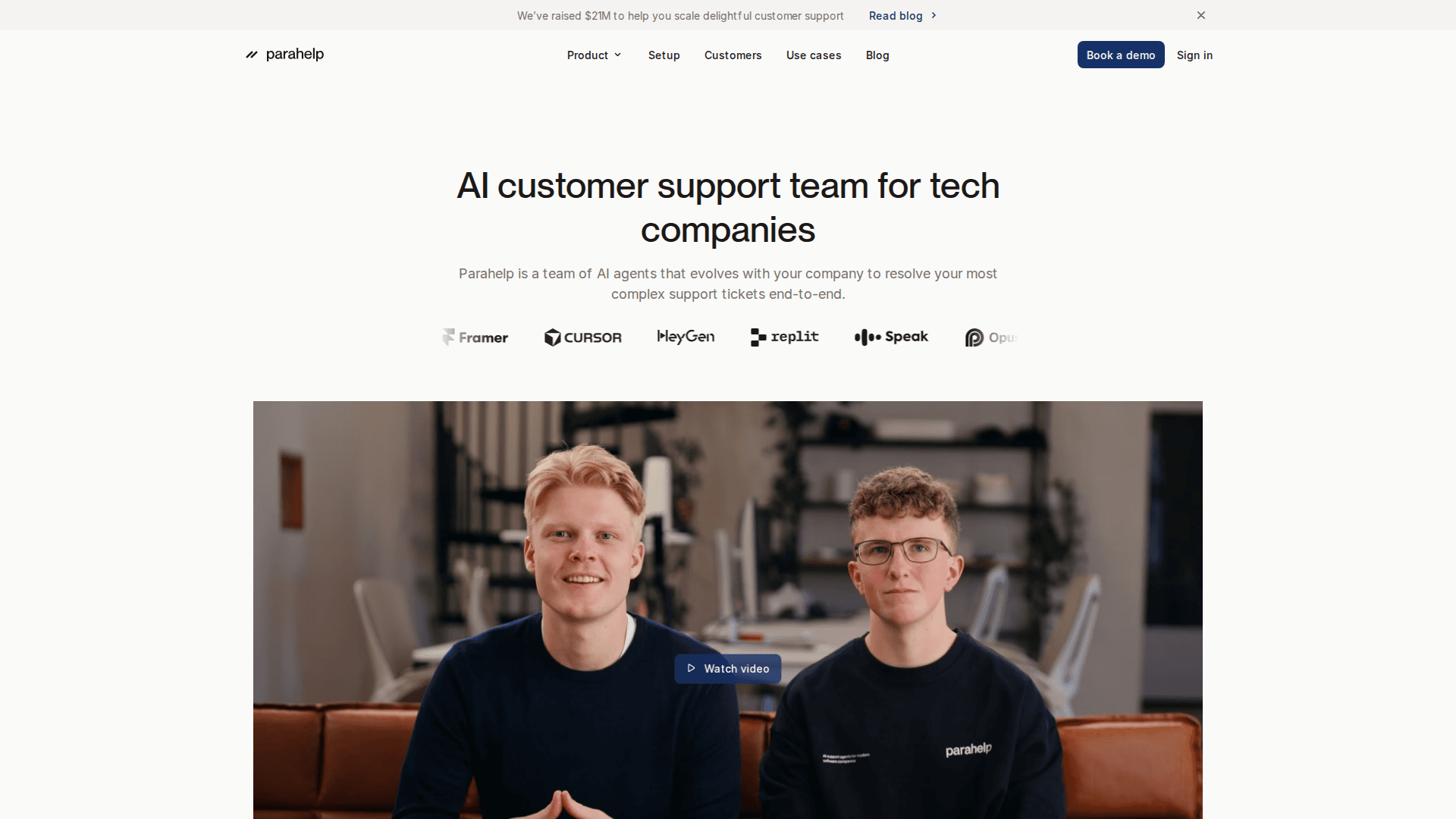
Parahelp (YC 2024) is the AI support agent behind the most demanding AI-native companies: Perplexity, Cursor, Replit, Bolt, Framer, HeyGen. Its Customer Agent resolves technical tickets end-to-end — building explicit resolution plans and executing tool calls against Stripe, Slack, Linear, and internal APIs — while an AI Manager agent continuously configures, tests, and optimizes the support agent itself. It raised $21.2M within 13 months ($18M Series A led by Jack Altman, with Perplexity investing as both customer and backer) and claims 0% customer churn. Pricing is per-resolution, sales-gated.
Technical support tickets — "my deploy fails with this stack trace," "the API returns 429s" — are exactly where docs-RAG agents like Chatbase and Lyro fall over. Parahelp is built for that tier: it digs through context, takes actions, and files bugs in Linear, which is why the best-known AI startups route over half their support through it. The credibility comes from the logo wall and an unusually transparent engineering culture (its prompt-design writeups circulated widely among practitioners) rather than review sites — there is essentially no G2 footprint, no public pricing, no trial, and reported contracts start low-five-figures per year. For a funded dev-tool company doing hundreds of technical tickets a month, it is the strongest fit on this list. For everyone else, it is sales-gated and unproven outside its niche.
Key Features
- End-to-end resolution of technical tickets with explicit plans + tool execution
- Actions across Stripe (refunds), Linear (bug filing), Slack, Notion, and internal APIs
- AI Manager agent that self-tunes the support agent — no manual prompt engineering
- Runs inside your existing helpdesk: Zendesk, Intercom, Front
- SOC 2 Type II, GDPR, no training on customer data
Pricing
Custom, per-resolution (reported 50¢-$1 per resolved ticket — third-party estimates; pricing is sales-gated). Annual contracts reportedly start low-five-figures (~$10K-$20K/yr). No self-serve or free trial.
Rating
No G2 base — proof is Perplexity, Cursor, Replit, Framer in production
Best For
Funded dev-tool and AI-native SaaS companies with real technical ticket volume —...
Pros
- The strongest customer logo wall in the startup cohort, with claimed 0% churn
- Handles genuinely technical tickets that docs-RAG agents cannot touch
- Pay-only-for-resolution model aligns incentives
Cons
- Total pricing opacity: no published numbers, no sandbox, no trial
- Virtually zero independent reviews — social proof is curated testimonials
Gradient Labs
Best for Fintech — Ex-Monzo, Compliance-Grade Agents
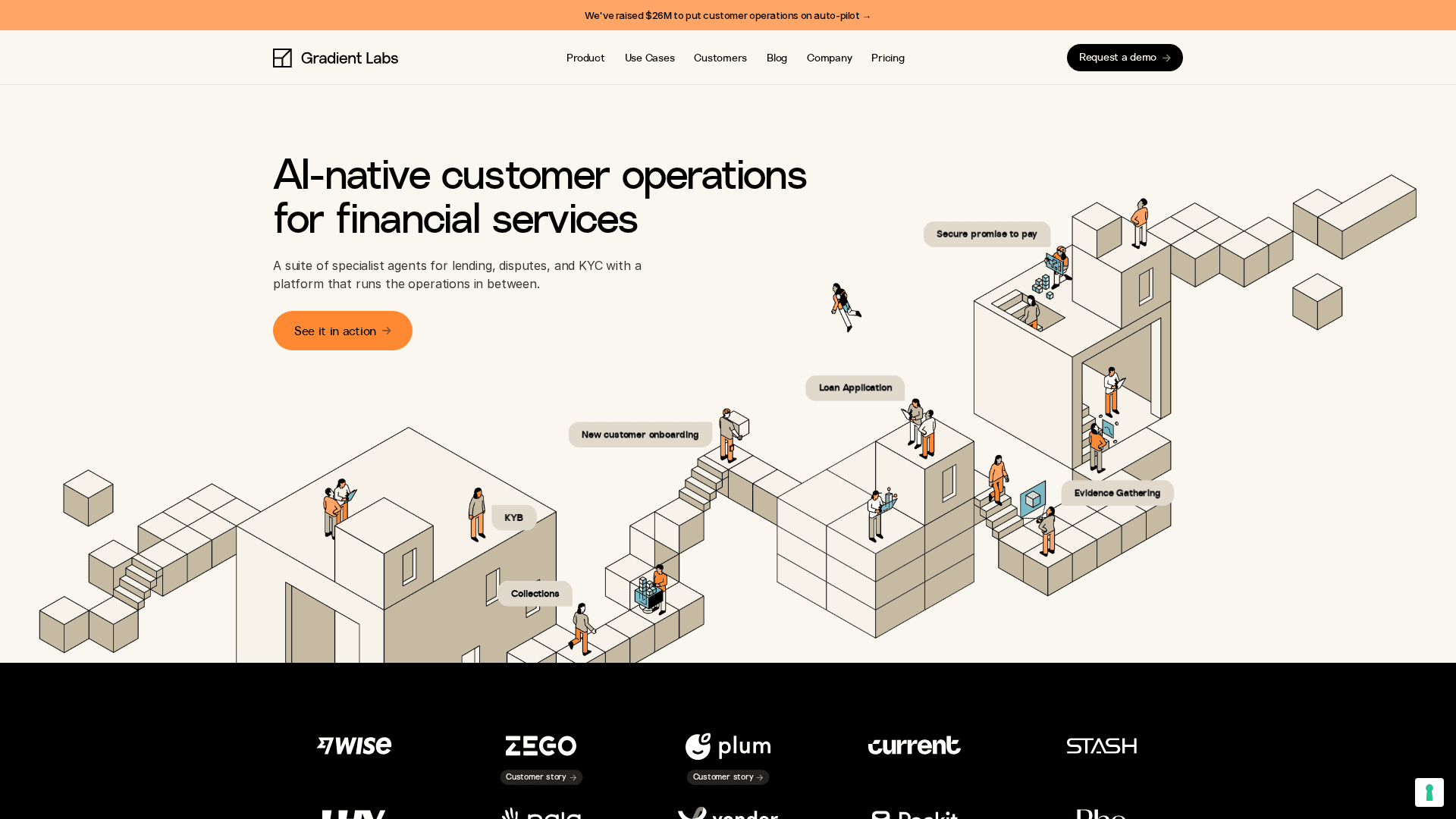
Gradient Labs was founded by the ex-Monzo leaders who ran ML and customer operations at the UK neobank, and its agent Otto is built for one buyer: regulated financial services. Otto follows natural-language procedures that mirror your SOPs, takes account actions, and has expanded into a multi-agent platform covering KYC/KYB, disputes, lending, collections, and onboarding across email, chat, and voice. After 900% revenue growth, 32M+ end users reached, and a doubled $26M Series A (June 2026), it entered the US market with Pockit reporting 70%+ end-to-end resolution. Pricing is outcome-based with no platform fee — pay only for successful resolutions.
If you are a fintech, the generic AI-agent question ("can it answer from our docs?") is the wrong one — the right ones are "can it pass an FCA audit?" and "will it freeze the right card?" Gradient Labs is the only vendor on this list built entirely around those questions, with SOC 2, audit logs, RBAC, and procedure-level compliance guardrails, deployable day-one on Intercom, Zendesk, or Freshdesk without engineering. Its pricing page is also unusually candid: basic helpdesk integration gets you 20-50% of the easy queries; the 80%+ numbers come after optimization. The constraints are the mirror image: no public rates, no free trial, no self-serve, near-zero review footprint, and if you are not in financial services you are not the target customer.
Key Features
- Procedure-following agents trained on your SOPs — they take account actions, not just answer
- Specialist agents for KYC/KYB, disputes, lending, collections, complaints
- Compliance posture: SOC 2, SSO, audit logs, RBAC — built for FCA-style scrutiny
- Outcome-based pricing with no platform fee — pay only for successful resolutions
- Day-1 deployment on Intercom, Zendesk, Freshdesk without engineering work
Pricing
Custom outcome-based — pay only per successful resolution, no platform fees. No public rates; sales-led annual contracts. No free trial. Vendor guidance: 40-60% of cases solved out of the box, ~80% after optimization.
Rating
No review-site base — proof is Pockit (70%+ resolution), Plum, Zego in production
Best For
Fintech, banking, and insurance companies (mid-market up) that need an AI agent ...
Pros
- Built by people who ran support ML at a regulated bank — the compliance depth is real
- Zero platform fee + pay-per-resolution = low downside risk for the buyer
- Candid about ramp expectations (20-50% out of the box) — rare anti-overpromise posture
Cons
- No public pricing, no trial, essentially no independent reviews
- Narrow vertical: wrong tool outside financial services
Decagon
Enterprise Co-Leader — When You Have $95K+/yr and the Volume
Decagon is one of the two enterprise leaders in AI support agents, built around Agent Operating Procedures — deterministic, auditable workflow logic layered on LLMs — with deep backend integrations so agents execute refunds, order changes, and account actions across chat, email, and voice. The customer list reads like a who's-who: Notion, Chime, Duolingo, Rippling, ClassPass, Substack, plus 2026 wins like Mercado Libre and Deutsche Telekom. It raised a $250M Series D at a $4.5B valuation (January 2026), tripling its valuation in seven months. Pricing is sales-only: reported ~$1 per conversation plus a ~$50K/yr platform fee, with Vendr data putting the median contract near $386K/yr.
Decagon is on this list as the honest enterprise reference point, not a recommendation for founders — the entry math (reported $95K+/yr realistic floor) disqualifies anyone below serious scale. What makes it worth understanding: the customer-reported numbers are the strongest in the category (Chime 70% chat/voice resolution, Duolingo 80% deflection, Bilt $1.75M cost reduction), and its per-conversation pricing model is the inverse of Fin's — you are not penalized rate-wise for AI success, but you reportedly pay ~$1 even for conversations that escalate to humans unresolved. If you are at tens of thousands of tickets a month with engineering resources, shortlist it against Sierra. If you are not, the founder-priced equivalents above (Lorikeet, Parahelp, Gradient Labs) borrow most of its architecture at a tenth the commitment.
Key Features
- Agent Operating Procedures: deterministic, testable, auditable agent workflows
- Deep backend integrations for true action-taking (refunds, order changes, account updates)
- Production voice agents alongside chat and email
- White-box visibility into prompts and decision logic for admins
- Built-in QA, analytics, and agent-assist copilot
Pricing
Custom, sales-only. Reported ~$1 per conversation (including unresolved/escalated ones) + ~$50K/yr platform fee; Vendr median contract ~$386K/yr, range $95K-$590K+. No free tier or self-serve trial.
Rating
4.9/5 — G2 (18 reviews — too few to weight)
Best For
Enterprises and late-stage scale-ups (consumer fintech, marketplaces, subscripti...
Pros
- Strongest customer-reported resolution numbers in the category (Chime 70%, Duolingo 80%)
- Per-conversation pricing is predictable — no resolution-definition games
- White-glove implementation consistently praised in the (small) review base
Cons
- Reported ~$1 billed even for conversations the AI fails to resolve — the inverse gotcha of Fin
- Six-figure realistic entry locks out everyone below late-stage scale
Sierra
The Fortune-50 Tier — Outcome Pricing at $15.8B Scale
Sierra — founded by Bret Taylor (OpenAI chairman, ex-Salesforce co-CEO) and Clay Bavor — is the highest-valued pure-play in AI customer support: a $950M Series E at a $15.8B valuation in May 2026, roughly $200M ARR, and 40%+ of the Fortune 50 as customers (ADT, SiriusXM, Sonos, WeightWatchers, Chime, Rocket Mortgage). Its Agent OS builds supervised, branded agents with guardrails that execute real business processes — returns, claims, cancellations — with voice as a first-class channel. It pioneered the outcome-based pricing model the whole category now imitates: pay per resolved conversation, with escalations typically uncharged.
Sierra is here for the same reason Decagon is: founders keep reading about it and need the honest framing. The product is real — case studies cluster around 70-77% resolution, the voice agents are the most mature in the industry, and outcome-based pricing genuinely aligns incentives. It is also genuinely unbuyable below enterprise scale: no public pricing, reported contracts from ~$150K/yr plus $50K-$200K implementations, and every "outcome" definition is negotiated per contract — whether a no-reply counts, whether a saved cancellation bills — which is exactly where the money moves in outcome pricing. The takeaway for a founder is the model, not the vendor: per-outcome pricing won the category argument, and the tools at the top of this list let you buy that model at two, not six, figures a month.
Key Features
- Agent OS + SDK: supervised agents with guardrails that execute real business processes
- The most mature voice AI deployments in the category (millions of calls/month)
- Outcome-based pricing — escalated/unresolved conversations typically uncharged
- Multi-model architecture with supervisor models for safety and brand control
- Enterprise trust layer: auditing, supervision, compliance for regulated industries
Pricing
Custom outcome-based (contracts reportedly from ~$150K/yr). Reported $1-$2.50 per resolution by complexity, implementation fees $50K-$200K, realistic year-1 $180K-$350K. No public pricing, trial, or self-serve.
Rating
Too few G2 reviews to weight — proof is 40%+ of the Fortune 50 in production
Best For
Large enterprises and regulated consumer brands with millions of customer contac...
Pros
- The most credible enterprise deployments in the category, especially on voice
- Outcome-based pricing with escalations typically free — the incentive-aligned model
- Founder pedigree and capital ($15.8B valuation) make vendor durability a non-issue
Cons
- Unbuyable below ~$150K/yr — wrong tier for almost everyone reading this list
- "Outcome" definitions are negotiated per contract — the fine print determines the economics
What AI-First Support Looks Like When It Fails
Every list like this one should include the Klarna story, and none of the vendor-written ones do. In 2024 Klarna announced its AI assistant was doing the work of 700 human agents. Through 2025, CEO Sebastian Siemiatkowski publicly walked it back: AI-only support had produced "lower quality," rising complaints, and brand damage, and Klarna began rehiring humans into a hybrid model — AI for volume, a human pool for everything that matters.
The lesson is not "AI support doesn't work." It demonstrably does, at 40-70% of volume. The lesson is architectural: resolution rate is not the metric — resolution quality is. A tool tuned to maximize its billable resolution count (remember: customer silence can bill as success) optimizes against you. Favor tools that escalate rather than guess, keep a clean human handoff path on every conversation, audit a sample of "resolved" tickets monthly, and treat CSAT on AI-handled conversations — not deflection percentage — as the number you manage to.
How We Chose These Tools
We evaluated 14 AI support tools in June 2026. Four did not make the ten: Ada (mature and capable, but quote-only pricing with a reported ~$70K median contract and a self-stated fit threshold of 300,000+ annual conversations), Crescendo (compelling AI + managed-human hybrid at $2.99/resolution, but it is outsourcing your support operation, not software — a different decision), Duckie (promising for Slack/Discord technical support, but a 4-person team with sub-$500K revenue is vendor risk we won't put in a top 10), and Forethought (acquired by Zendesk in March 2026 — this list excludes Zendesk, and its roadmap now points there; if you were evaluating Forethought as a way off Zendesk, see our Zendesk alternatives ranking instead). The criteria for the ten that remain:
- Production evidence over marketing benchmarks — claimed resolution rates cross-checked against case studies and independent tests
- Cost modeled at founder volumes — 100-1,000 tickets/mo, not the 50-agent scenarios enterprise lists model
- Billing mechanics scrutiny — what counts as a billable resolution, minimums, platform fees, and silence-equals-success clauses
- Helpdesk-agnostic preferred — tools you can overlay on your existing stack ranked above tools that force a migration
- Vendor durability — funding, revenue, and review-base reality checks, with honest flags where proof is thin
The Per-Resolution Math at Founder Volumes
Worked example: 300 tickets/month, AI resolving 50% (150 resolutions) — a realistic year-one scenario for a small SaaS:
Chatbase Hobby — ~$32/mo
Flat plan covers it if credit burn stays in budget. Cheapest — but no ticketing, and you wire up the handoff.
eesel AI — ~$120/mo
40¢ × 300 tickets touched. Note it bills per ticket handled, not per resolution — cheaper than Fin when your resolution rate is high.
Intercom Fin — ~$149/mo
99¢ × 150 resolutions, standalone on your existing helpdesk. Audit the "assumed resolutions" in that count monthly.
The enterprise tier — $95K-$350K/yr
Decagon and Sierra platform fees buy implementation depth and voice scale — not better answers at 300 tickets/mo. Wrong tier until volume forces it.
Versus the human baseline of $15-$35 per handled ticket, every founder-tier option above pays for itself in week one. The trap in this category is not per-resolution rates — it is platform fees and minimums you cannot consume.
Stay Ahead of the Tool Curve
We research dozens of tools so you don't have to. Get our top picks and insider insights delivered weekly.
Frequently Asked Questions
What is the best AI customer support tool in 2026?
Intercom Fin for most teams: transparent 99¢-per-resolution pricing, a 14-day unlimited trial, the largest verified review base in the category (2,900+ on G2), and it deploys standalone on 8+ helpdesks so you don't need to migrate. The right answer changes with your shape: eesel AI if you want capped, predictable per-ticket costs on your existing helpdesk; Chatbase if you are a solo founder with a docs site and a $32/mo budget; Tidio Lyro for small ecommerce; Lorikeet or Gradient Labs if you are in a regulated vertical; Parahelp if your tickets are technical and your customers are developers.
What percentage of tickets can AI actually resolve?
Less than the marketing says, more than skeptics think. Vendor benchmarks run 67-86% (Intercom's official Fin average is 67%), but production numbers cluster lower: Intercom's own case studies show 42-50%, an independent 500-ticket small-business test landed at 38%, and B2B SaaS deployments typically run 17-25 points below vendor benchmarks because B2B tickets are harder. The honest planning range is 40-70% depending on ticket mix and knowledge-base quality — order-status-heavy ecommerce sits at the top, technical B2B at the bottom. Two tools let you find your number before paying: eesel's simulation mode and Pylon's Runbook testing both run the AI against your historical tickets.
How much does AI customer support cost at startup volumes?
Far less than the enterprise headlines suggest. At 300 tickets/mo with AI resolving half: Chatbase is $32/mo flat (Hobby), eesel AI is ~$120 (40¢ × 300 tickets touched), Fin is ~$149 (99¢ × 150 resolutions), and Lyro lands around $100-$150 in conversation packs. Per-resolution rates across the category run $0.50-$2.99. The six-figure numbers you read about — Decagon's reported ~$386K median contract, Sierra's ~$150K+ entry — buy enterprise platform fees and implementation, not better answers at your volume. Budget rule: AI resolutions cost $0.40-$1 each at founder scale, versus $15-$35 per human-handled ticket, so the ROI math works early — the trap is platform fees you cannot consume.
Can AI fully replace human support agents?
No — and the most famous attempt is the cautionary tale. Klarna claimed its AI assistant did the work of 700 agents, then spent 2025 rehiring humans after its CEO publicly admitted AI-only support produced "lower quality," rising complaints, and brand damage; it now runs a hybrid model. The pattern repeats at the category level: Gartner predicts agentic AI will autonomously resolve 80% of common issues by 2029 — common is the load-bearing word. The working architecture in 2026 is hybrid: AI resolves the repetitive 40-70%, humans own escalations, edge cases, and angry customers, and every AI conversation has a clean handoff path. Tools that would rather escalate than guess (Lorikeet's explicit design stance) age better than tools tuned to maximize their resolution count.
Do I need to switch helpdesks to use an AI support agent?
Usually not anymore — and you should be suspicious of any pitch that requires it. Fin runs standalone on Salesforce, HubSpot, Freshdesk, Zoho, Front, Gorgias, and others at 99¢/resolution with no Intercom seats. eesel AI plugs into 14+ helpdesks. Parahelp works inside Zendesk, Intercom, and Front; Gradient Labs deploys day-one on Intercom, Zendesk, or Freshdesk; Decagon and Sierra sit on top of whatever you run. The exceptions are platform-bound agents: Pylon's AI only works inside Pylon, and Tidio's Lyro is effectively Tidio-only below the Premium tier. The overlay strategy is the right default — test AI on your existing stack first, and only consider a platform migration if the AI results justify it.
What is the difference between a chatbot and an AI agent?
A chatbot follows scripted decision trees — "press 1 for billing" with buttons — and answers only what it was explicitly programmed for. An AI agent understands free-form questions, retrieves answers from your knowledge (RAG), and — the part that actually matters in 2026 — takes actions: issuing refunds through Stripe, checking order status, freezing cards, filing bugs in Linear. The litmus test when evaluating vendors: ask whether the tool can execute a multi-step procedure end-to-end (Fin's Procedures, Lorikeet's SOPs, Decagon's AOPs) or only answer questions from docs (most budget tools). Action-taking is what moves resolution rates from ~30% (FAQ deflection) to 60%+, because most real tickets require doing something, not just knowing something.
Is Intercom Fin worth 99¢ per resolution?
For most teams, yes — with two disciplines. The math: a resolved ticket costs your team $15-$35 in human time, so 99¢ per genuine resolution is a 90%+ cost reduction on the tickets Fin handles. The disciplines: first, understand "assumed resolutions" — if a customer goes silent for 24 hours after Fin answers, that bills as a resolution even if the customer left unsatisfied, so audit a sample of assumed resolutions monthly. Second, measure during the 14-day unlimited trial: if your real resolution rate lands at 40-50% (typical) rather than the 67% benchmark, make sure the economics still work at your volume. Cheaper per-resolution alternatives exist (Helply at $0.50, Help Scout AI at $0.75) with smaller AI capability; eesel's 40¢-per-ticket flat model wins when your resolution rate is high.
The Bottom Line
AI customer support in 2026 works — at 40-70% of ticket volume, for $30-$150 a month at founder scale, deployed on the helpdesk you already run. The gap between that sentence and the marketing is where buying decisions go wrong: vendor benchmarks describe their best high-volume B2C cohorts, not your queue.
The playbook: start with Fin's 14-day unlimited trial or eesel's simulation mode to measure your real resolution rate before spending anything. Solo founders with a docs site start at Chatbase; small ecommerce starts at Lyro; B2B-in-Slack teams go to Pylon. If you are in fintech or another regulated vertical, skip the generic tier and talk to Lorikeet or Gradient Labs; if your tickets are stack traces, talk to Parahelp. Admire Decagon and Sierra from a distance until your volume earns their platform fees.
And whatever you deploy: keep the human handoff clean, audit what the AI marks "resolved," and manage to CSAT on AI conversations — not the deflection number on the vendor dashboard. Klarna already ran that experiment so you don't have to.
Related Reading
- 10 Best Zendesk Alternatives — Including why Zendesk's 72-hour automated-resolution rule bills customer silence as success, and how to cut the AI bill without migrating
- Case Study: How Chatbase Bootstrapped to $10M ARR — The AI support chatbot from this list that did $1M in 117 days, starting from a tweet to 16 followers
- 10 Best Customer Service Software for 2026 — The helpdesk layer these AI agents sit on top of
- The Founder's Guide to Agent Loops — How agentic AI systems actually work under the hood
- Best AI Tools for Internal Workflow Management — Apply the same agent patterns inside your company
- 10 Best AI Search Visibility Tools (AEO/GEO) for 2026 — Track how AI engines talk about your brand to prospects
Sources
- Intercom Fin — Official Pricing
- eesel AI — Official Pricing
- Chatbase — Official Pricing
- Tidio — Official Pricing (Lyro AI)
- Pylon — Official Pricing
- Lorikeet — Official Pricing
- Gradient Labs — Official Pricing
- Sierra — Outcome-Based Pricing for AI Agents (official)
- Intercom — Fin AI Agent Outcomes (billing rules)
- TechCrunch — Sierra Raises $950M at $15.8B (May 2026)
- Decagon — $250M Series D at $4.5B Valuation (Jan 2026)
- Parahelp — Series A + Seed Announcement ($21.2M)
- Gradient Labs — $26M Series A for Autonomous Customer Operations
- Klarna Reinvests in Human Talent After AI-Only Support (Customer Experience Dive)
- Gartner — Agentic AI Will Autonomously Resolve 80% of Common Issues by 2029
- Independent Fin Production-Rate Analysis (Clonedesk)
Stay Ahead of the Tool Curve
We research dozens of tools so you don't have to. Get our top picks and insider insights delivered weekly.
Trusted by indie hackers and startup founders
Keep Reading
7 Best AI Search Visibility Tools for Agencies in 2026
Seven AI search visibility tools ranked for agencies by client workspaces, reporting, prompt economics, and the real cost of managing multiple brands.
10 Best Granola Alternatives for Private AI Meeting Notes (2026)
The best Granola alternatives in 2026, ranked on where your notes are stored, whether your data trains AI, and what a bot-free notetaker really costs. Verified pricing.
10 Best Bot-Free AI Note Takers in 2026 (No Bot Joins Your Call)
The best bot-free AI note takers of 2026, ranked by what happens after the call: where notes are stored, whether audio is kept, and whether your meetings train AI.