
10 Best ZoomInfo Alternatives in 2026 (Ranked by How You Buy, Not Just What You Get)
The 10 best ZoomInfo alternatives in 2026 — Apollo.io, Clay, Lusha, Lead411, RocketReach, Cognism, Amplemarket, Instantly, Saleshandy, and 6sense. Ranked by buying friction rather than database size, with ZoomInfo's real contract math: quote-only pricing, ~$33,500 median contract, and the 60-90 day auto-renewal window that catches people.
The top result for “ZoomInfo alternatives” is published by ZoomInfo.
That is not a joke — the highest-ranking page for this query sits on ZoomInfo's own domain, and most of the rest come from SalesIntel, Demandbase, Salesforce, Saleshandy and Salesgenie, each with its own product in the ranking. We sell no sales data and took no placement fees. So this list ranks on the dimension those pages have no reason to raise: how you buy it — self-serve or quote-gated, monthly or annual, and whether there is a notice window you have to remember three months in advance.
Key Takeaways
- The top result for "ZoomInfo alternatives" is published by ZoomInfo, and most of the rest come from SalesIntel, Demandbase, Salesforce, Saleshandy and Salesgenie — each ranking its own product. We sell no sales data and took no placement fees, which is why this list ranks on how you buy rather than on whose database is biggest.
- ZoomInfo's contract is the thing people actually get trapped by, not its data. Contracts are annual and quote-only, and auto-renewal is the single most common complaint across G2, Capterra and Trustpilot: cancellation requires 60 to 90 days' notice before the renewal date, and missing that window locks you in for another full year, typically at a 10-20% increase.
- The real number is much higher than the entry number. Published estimates put SalesOS Professional near $14,995/yr, Advanced near $24,995 and Elite at $39,995+, but Vendr's tracking of more than 1,500 purchases in 2026 puts the median contract value around $33,500/year, with all-in costs commonly landing between $30,000 and $60,000 once add-ons and implementation land.
- Apollo.io is the clearest escape for most teams: a genuine free plan, self-serve checkout, and $49-$59/user/mo — meaning no quote call, no annual commitment and no notice window to diarise. It holds 4.7/5 on G2 across 9,000+ reviews, the same review depth as ZoomInfo itself.
- Clay is the structural answer rather than the cheaper one. Instead of replacing one database with another, it waterfalls enrichment across 150+ providers, so no single vendor's coverage gap or renewal terms can hold your pipeline hostage. From $185/mo with a free tier for testing.
- Two entries here reproduce ZoomInfo's buying model and we say so in their entries: Cognism carries a platform fee around $15,000/yr plus roughly $1,500/user/yr, and 6sense runs $55,000-$130,000+/yr with no self-serve or free trial. They are on the list because they are genuinely better at specific jobs, not because they are easier to buy.
Most ZoomInfo alternatives lists compare databases — contact counts, coverage percentages, refresh rates. That comparison is mostly a wash, and it is not why people are searching. ZoomInfo holds roughly 4.5/5 on G2 across 9,000+ reviews and rates highly on data quality specifically. The data is not the problem. The contract is.
ZoomInfo sells annual, quote-only contracts, and auto-renewal is the single most frequently raised complaint across G2, Capterra and Trustpilot. Cancellation requires 60 to 90 days' notice before the renewal date; miss it and you are committed to another full year, typically at a 10-20% increase. In practice that means the decision to leave has to be made about three months before you feel the pain of staying — which is exactly why so many teams describe serving a second year they never wanted.
The money is not small either. Published estimates put SalesOS Professional near $14,995/yr, Advanced near $24,995 and Elite at $39,995+, but the figure worth anchoring on comes from Vendr, which tracked over 1,500 purchases in 2026 and puts the median contract value around $33,500/year. All-in totals commonly land between $30,000 and $60,000 once per-seat fees, add-on modules such as Intent Data, Engage, Global Data Passport and Chorus, and implementation land on top.
So this list is ordered by buying friction as much as by capability. Every entry is labelled with how you actually purchase it, and two entries — Cognism and 6sense — are flagged plainly as reproducing ZoomInfo's model rather than escaping it. They are here because they are better at particular jobs, not because they are easier to buy.
ZoomInfo Alternatives Compared by How You Buy
| # | Tool | Entry price | How you buy it | G2 |
|---|---|---|---|---|
| 1 | Apollo.io | Free (50 mobile credits + unlimited email credits/mo) | Self-serve — free plan, monthly billing | 4.7/5 |
| 2 | Clay | Launch $185/mo (2,500 Data Credits + 15,000 Actions) | Self-serve — free tier, monthly billing | 4.7/5 |
| 3 | Lusha | Free (70 credits/mo) | Self-serve — free plan, published per-seat pricing | 4.3/5 |
| 4 | Lead411 | Spark $75/user/mo annual ($99 month-to-month) | Published per-seat pricing, month-to-month available | 4.5/5 |
| 5 | RocketReach | Essentials $33/user/mo annual (1,200 lookups/yr, email only) | Self-serve — published per-seat tiers | 4.5/5 |
| 6 | Cognism | Grow around $15,000/yr platform fee plus roughly $1,500/user/yr | Quote-only — annual platform fee plus per-user | 4.6/5 |
| 7 | Amplemarket | Starter $600/mo billed annually | Annual only — published $600/mo entry | 4.6/5 |
| 8 | Instantly | Outreach Growth $37 | Self-serve — published monthly tiers | 4.8/5 |
| 9 | Saleshandy | Outreach Starter $25/mo annual | Self-serve — published monthly tiers from $25 | 4.6/5 |
| 10 | 6sense | Custom enterprise pricing, roughly $55,000-$130,000+/yr depending on features and account volume | Quote-only — enterprise contracts, no free trial | 4.4/5 |
For comparison, ZoomInfo is quote-only and annual with a 60-90 day cancellation notice window, at a median contract value around $33,500/year.
The ZoomInfo Contract, Reconstructed
The notice window
Contracts auto-renew unless you give 60 to 90 days' notice. Miss it and you owe another full year, typically at a 10-20% increase. The most common complaint across G2, Capterra and Trustpilot.
The real number
Vendr tracked 1,500+ purchases in 2026 and puts the median contract at ~$33,500/yr. All-in totals commonly land $30,000-$60,000 with add-ons and implementation.
The published estimates
SalesOS Professional near $14,995/yr, Advanced near $24,995, Elite $39,995+. Copilot Advanced runs roughly $22,000-$30,000/yr and Copilot Enterprise $35,000-$45,000+.
What stacks on top
Per-seat fees estimated at $2,000-$5,000/user/yr. Add-on modules (Intent Data, Engage, Global Data Passport, Chorus) estimated at $15,000-$40,000/yr. Implementation $1,000-$8,000.
To be fair to the incumbent: ZoomInfo rates roughly 4.5/5 across 9,000+ G2 reviews and scores well specifically on data quality and feature depth. Its international coverage still beats most of this list. The case for leaving is about how it is sold, not whether it works — which is why the entries below are labelled by buying model.
Apollo.io
Best Overall — The One You Can Buy Without Talking to Anyone
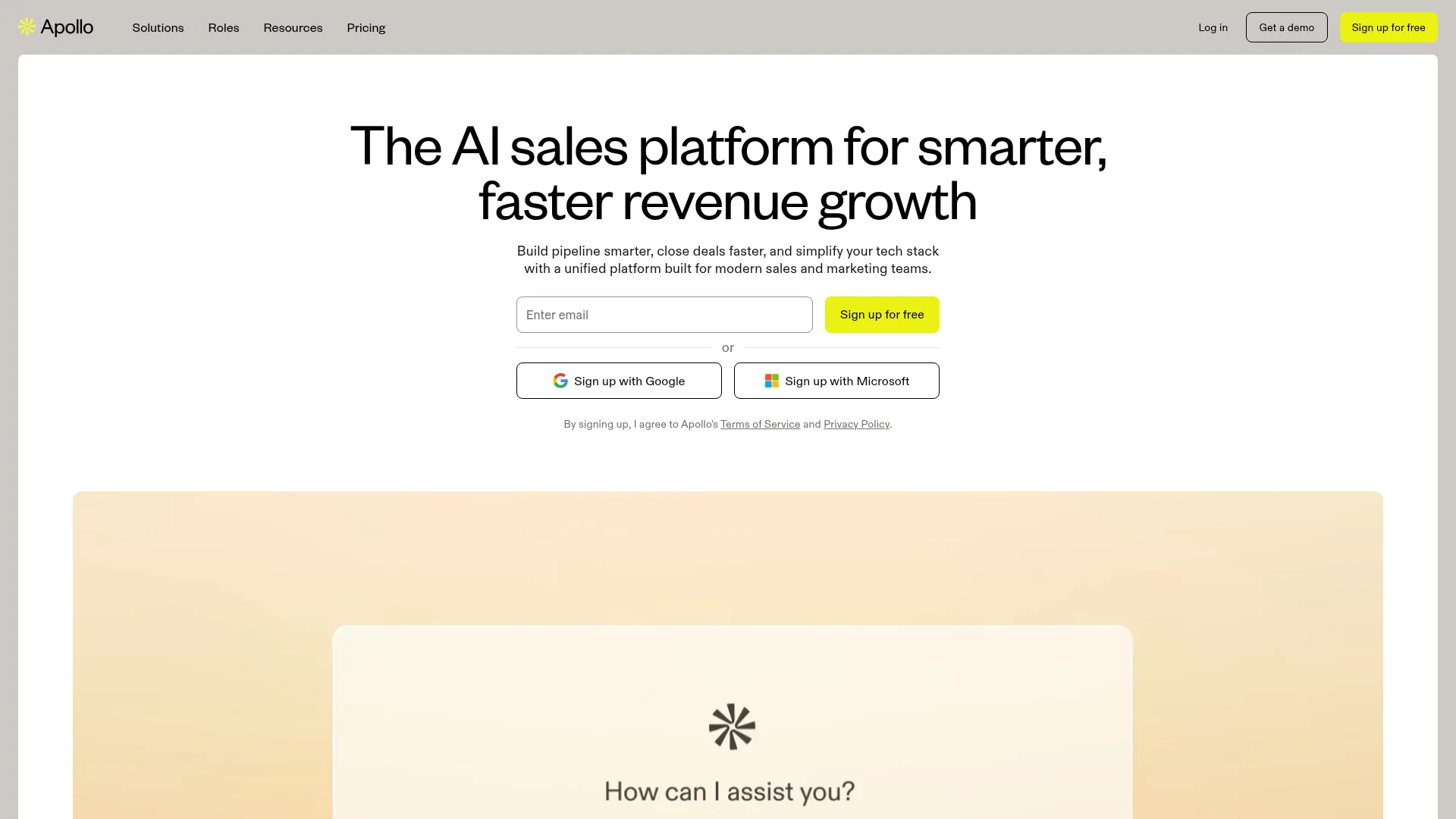
Apollo.io is the default ZoomInfo alternative for a reason that has nothing to do with database size: you can sign up, evaluate it and pay for it without a sales call, a quote, or a twelve-month commitment. It carries roughly 275M contacts, bundles a sequencer so you are not buying outreach separately, and prices at Basic $59/user/mo monthly ($49 annual), Professional $79-$99 and Organization $119-$149 — with a free plan that includes 50 mobile credits and unlimited email credits per month.
Apollo.io holds 4.7/5 on G2 across 9,000+ reviews, which is the same order of review depth as ZoomInfo itself — this is not a scrappy downgrade, it is a peer product with a different go-to-market. For the overwhelming majority of teams leaving ZoomInfo, the win is not that Apollo's data is better (in US-heavy prospecting it is comparable; internationally ZoomInfo often still wins) but that a bad month costs you one month. You can test it against your own ICP before spending anything, which is precisely what a quote-gated annual contract prevents. The honest limits: data quality is inconsistent outside core US coverage, mobile credits on lower tiers run out faster than teams expect, and heavy users report needing the Organization tier sooner than the pricing page implies.
What Apollo.io does well
- Free plan with 50 mobile credits and unlimited email credits per month
- Self-serve checkout and monthly billing — no quote call, no notice window
- Roughly 275M contacts with a sequencer bundled rather than sold separately
- 4.7/5 across 9,000+ G2 reviews — comparable review depth to ZoomInfo
- Buying intent signals included on paid tiers
Pricing
Free (50 mobile credits + unlimited email credits/mo). Basic $59/user/mo monthly ($49 annual). Professional $79-$99/user/mo. Organization $119-$149/user/mo.
Best for
Founders, SMBs and mid-market sales teams who want to stop signing annual data contracts and start testing data against their own ICP before paying.
Pros
- The only top-tier option you can fully evaluate for free before paying
- Monthly billing means no auto-renewal window to miss
- Sequencer included — replaces a second line item for most teams
- Enormous verified review base at a high rating
Cons
- Data quality is inconsistent outside core US coverage — ZoomInfo often still wins internationally
- Mobile credits deplete faster than expected; heavy users reach Organization sooner than planned
Clay
Best Structural Fix — Stop Buying a Database, Buy the Router
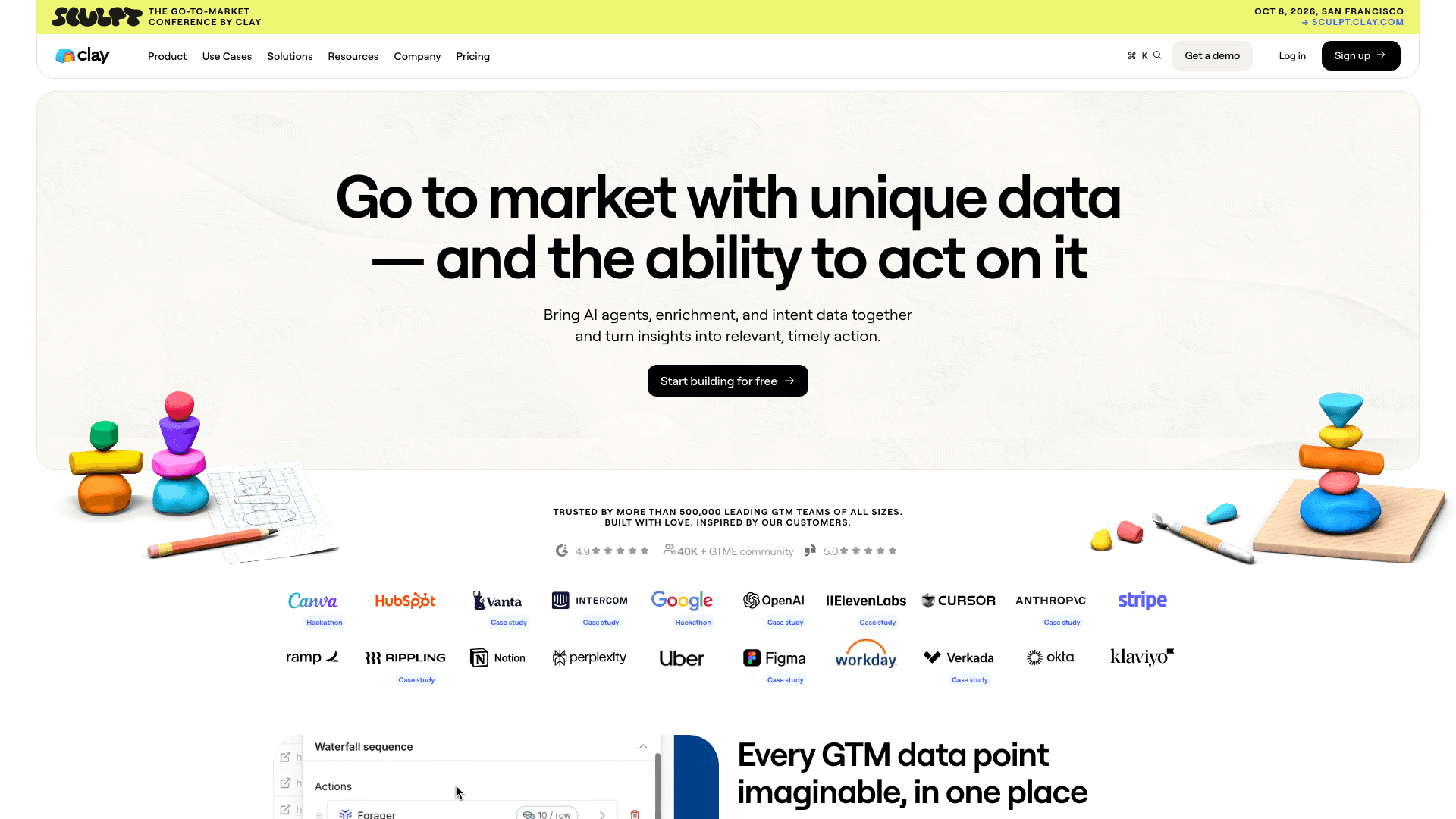
Clay is the answer for teams who realised the problem was not which vendor they picked but that they picked one at all. It waterfalls enrichment across 150+ data providers: a record is tried against the first source, and if that comes back empty it falls through to the next, so coverage is the union of many databases rather than the ceiling of one. Pricing is Launch $185/mo (2,500 Data Credits, 15,000 Actions), Growth $495/mo (6,000 Credits, 40,000 Actions) and Enterprise custom, with a free tier for testing.
Clay changes the negotiating position rather than the line item, which is why it ranks second. When enrichment routes across many providers, no single vendor's renewal terms or coverage gap can hold your pipeline hostage — the exact leverage problem a ZoomInfo auto-renewal creates. It holds 4.7/5 on G2 across 189+ reviews. Two honest caveats: Clay is a builder's tool, and a team without someone who enjoys constructing workflows will underuse it badly; and the credit model means costs scale with how much you enrich rather than how many seats you have, which is better for small teams running targeted lists and worse for undisciplined bulk exports.
What Clay does well
- Waterfall enrichment across 150+ providers — coverage is the union, not one vendor's ceiling
- Free tier for testing before any commitment
- Credit-based pricing that scales with usage rather than headcount
- Removes single-vendor dependency, which is the underlying leverage problem
Pricing
Launch $185/mo (2,500 Data Credits + 15,000 Actions). Growth $495/mo (6,000 Credits + 40,000 Actions). Enterprise custom. Free tier for testing.
Best for
RevOps-minded teams and technical founders who would rather own an enrichment pipeline than rent one vendor's database.
Pros
- The only entry that removes single-vendor dependency rather than swapping vendors
- Free tier plus monthly billing — evaluate without commitment
- Usage-based costs suit small teams running precise lists
- High rating (4.7) and rapid ecosystem growth
Cons
- A builder's tool — teams without a workflow-minded owner underuse it badly
- Credit costs scale with enrichment volume; undisciplined bulk exports get expensive
Lusha
Best for Solo Founders and Small Teams — $22.45/User With a Free Tier
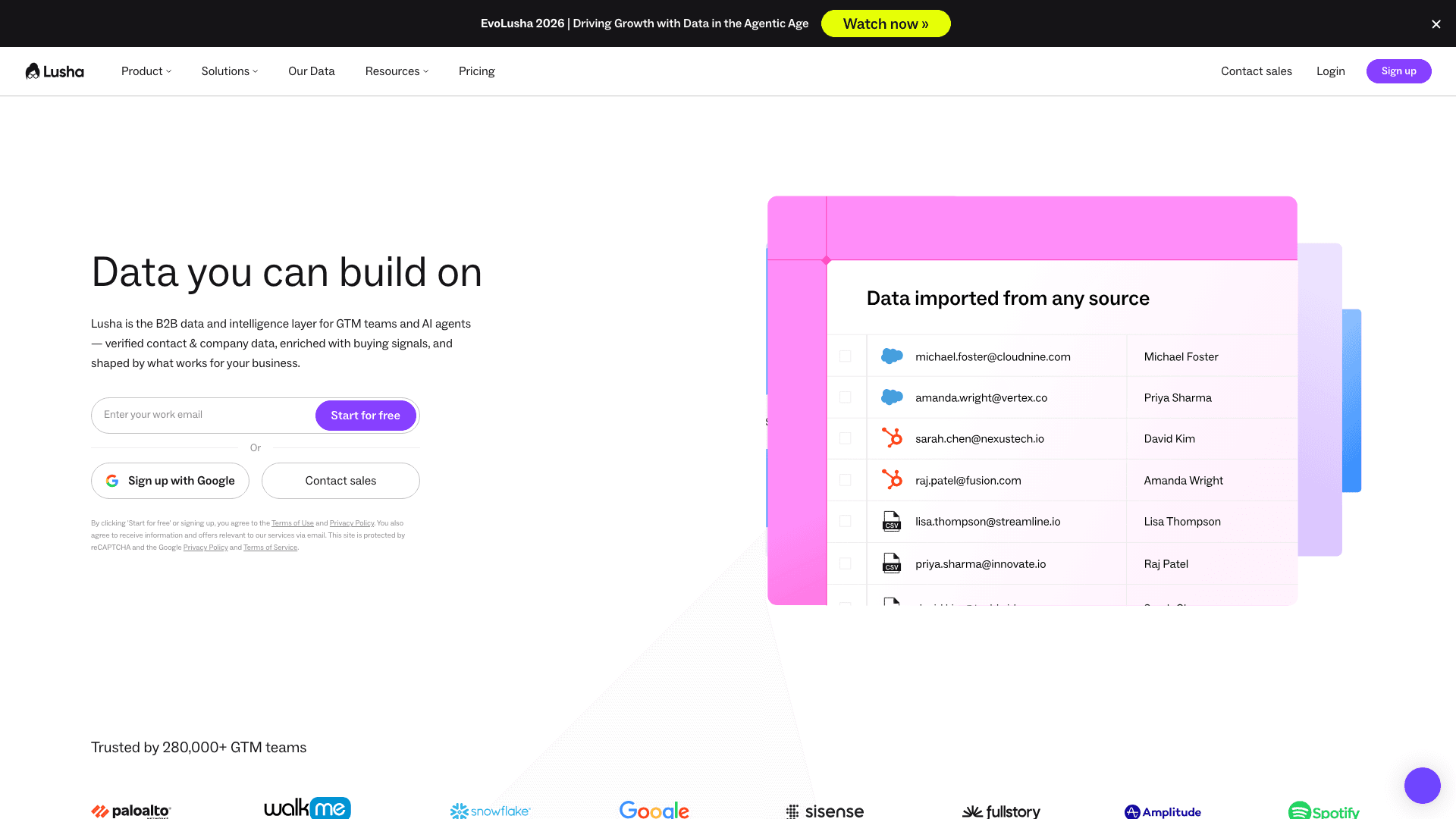
Lusha is the lightweight contact-finding layer for people who never needed a platform in the first place. A free tier gives 70 credits a month, Pro is $22.45/user/mo annual (3,000 credits a year) and Premium is $52.45/user/mo annual (7,200 credits a year), with a custom Scale plan above that.
Lusha is the honest answer for the founder or two-person sales team who was quoted $15,000 for ZoomInfo and knew it was absurd but did not know what else to do. At $22.45/user/mo it is roughly one-fiftieth of ZoomInfo's median contract, and the free tier means you can validate whether the contacts you need are even in the database before paying. It holds 4.3/5 across 1,500+ G2 reviews — the lowest rating in this list's top half, which is the honest trade-off: coverage is thinner than Apollo's and users consistently report phone-number accuracy as the weak spot. Buy it as a contact finder, not as a sales platform.
What Lusha does well
- Free tier with 70 credits per month for genuine evaluation
- Pro at $22.45/user/mo annual with 3,000 credits per year
- Browser extension workflow that suits ad-hoc prospecting
- Published per-seat pricing with no quote call
Pricing
Free (70 credits/mo). Pro $22.45/user/mo annual (3,000 credits/yr). Premium $52.45/user/mo annual (7,200 credits/yr). Scale plan custom.
Best for
Solo founders and two-to-three-person sales teams who need contact lookup, not a go-to-market platform.
Pros
- Roughly one-fiftieth of ZoomInfo's median contract value
- Free tier lets you check coverage of your ICP before paying
- Simple, published pricing with no negotiation
Cons
- Lowest rating in the top half (4.3) — phone accuracy is the consistent complaint
- Thinner coverage than Apollo; it is a contact finder, not a platform
Lead411
Best Mid-Market Pick — Published Pricing and an Unlimited Tier
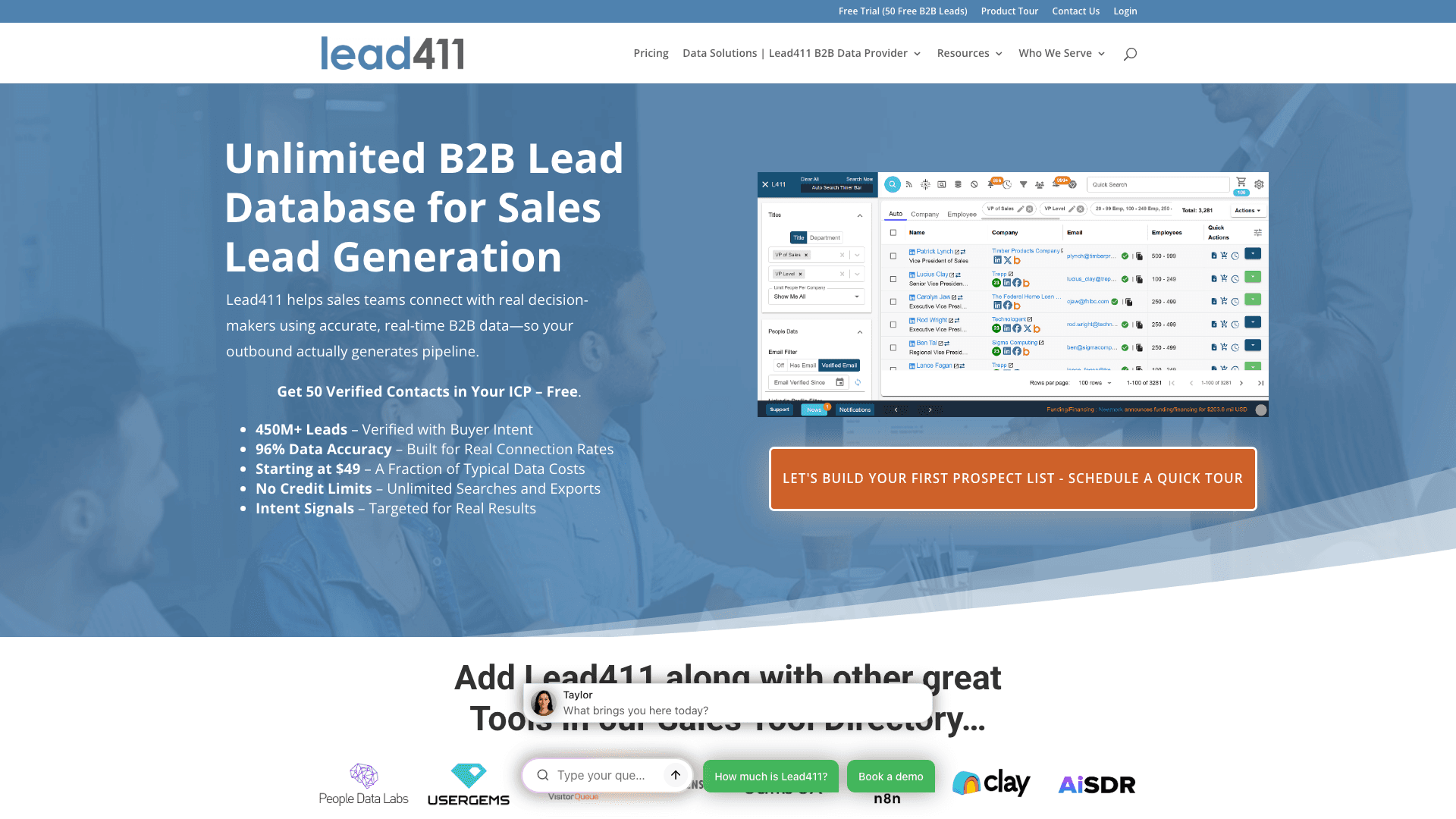
Lead411 occupies the space ZoomInfo abandoned: mid-market data with a price on the website. Spark is $75/user/mo annual ($99 month-to-month), Ignite is custom, and Blaze runs about $6,000/yr for unlimited usage, with a buyer-intent add-on at $750-$1,000/user/yr. It combines AI matching with human verification rather than relying purely on automated collection.
Lead411 matters because the month-to-month option at $99/user is a direct structural answer to the auto-renewal problem — you can leave in thirty days rather than diarising a notice window ninety days out. The Blaze tier at roughly $6,000/yr for unlimited usage is the single most interesting number here for a team whose ZoomInfo quote came in at $33,500: same unlimited-feeling workflow, an order of magnitude less money. It holds 4.5/5 across 450+ G2 reviews. The trade-offs are that the interface is dated next to Apollo or Clay, international coverage is weaker than Cognism's, and the intent add-on pricing pushes the total back up if you need it.
What Lead411 does well
- Published pricing including a month-to-month option at $99/user
- Blaze tier around $6,000/yr for unlimited usage
- Hybrid AI plus human verification rather than purely automated collection
- 4.5/5 across 450+ G2 reviews
Pricing
Spark $75/user/mo annual ($99 month-to-month). Ignite custom. Blaze around $6,000/yr unlimited. Buyer intent add-on $750-$1,000/user/yr.
Best for
Mid-market sales teams who want ZoomInfo-shaped coverage with a price they can read and a contract they can exit in thirty days.
Pros
- Month-to-month billing directly solves the auto-renewal trap
- Blaze unlimited at roughly $6,000/yr against a $33,500 median ZoomInfo contract
- Human verification in the loop, not just automated scraping
Cons
- Interface feels dated next to Apollo and Clay
- International coverage trails Cognism; intent add-on pushes total cost back up
We Read the Contracts So You Do Not Have To
Renewal terms, notice windows and metering rules are where software money actually moves. One honest email a week on the tools founders buy — no sponsored placements.
RocketReach
Best Pure Contact Finder — 700M+ Profiles With Org Charts on Top
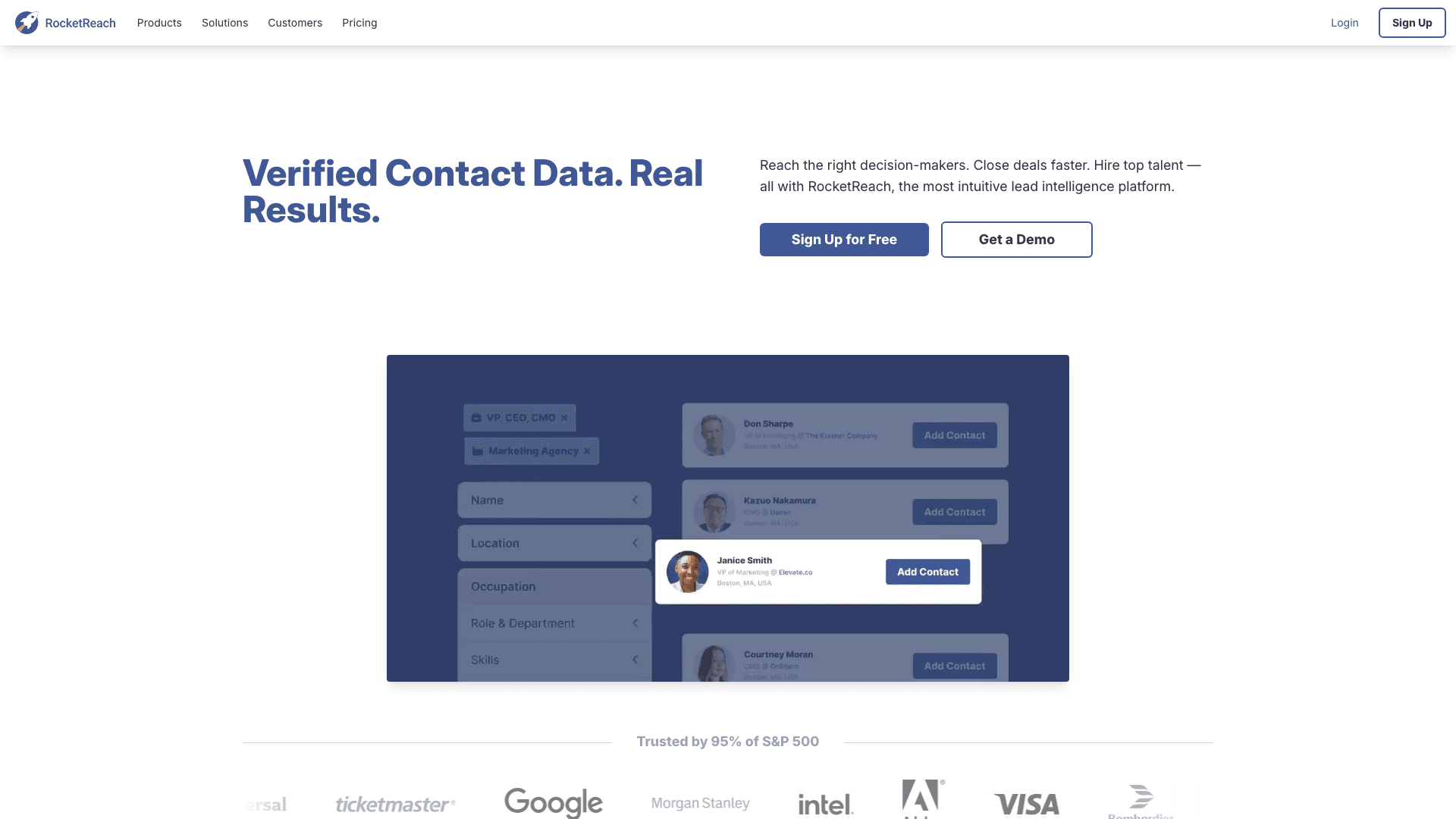
RocketReach is a lookup engine rather than a platform: 700M+ professional profiles with org-chart data on the upper tier. Essentials is $33/user/mo annual (1,200 lookups a year, email only), Pro is $83/user/mo adding phone numbers, and Ultimate is $207/user/mo adding API access, Salesforce integration and org charts, with enterprise above that.
RocketReach earns a place for teams whose ZoomInfo usage was, honestly, lookups — find the person, get the email, move on. Buying that as a $33/user/mo subscription instead of inside a five-figure platform contract is the entire value proposition, and the tier ladder is unusually honest about what you are paying for: email only at the bottom, phones in the middle, API and org charts at the top. It holds 4.5/5 across 700+ G2 reviews. Be clear that lookup allowances are annual rather than monthly, which catches people who front-load a campaign, and that there is no sequencing or intent layer here at all.
What RocketReach does well
- 700M+ professional profiles with org charts on the Ultimate tier
- Transparent ladder: email only ($33), phones ($83), API and Salesforce ($207)
- API access for teams building their own enrichment
- 4.5/5 across 700+ G2 reviews
Pricing
Essentials $33/user/mo annual (1,200 lookups/yr, email only). Pro $83/user/mo (adds phone numbers). Ultimate $207/user/mo (API, Salesforce, org charts). Enterprise above.
Best for
Teams whose actual ZoomInfo usage was contact lookups, who want to buy exactly that and nothing else.
Pros
- Buys the lookup capability alone, without the platform contract around it
- Very clear tier ladder — you can see what each step is actually for
- Org-chart data is genuinely useful for multi-threading
Cons
- Lookup allowances are annual, not monthly — front-loaded campaigns exhaust them early
- No sequencing and no intent layer; this is a finder, not a platform
Cognism
Best for EMEA and GDPR — But It Buys Like ZoomInfo
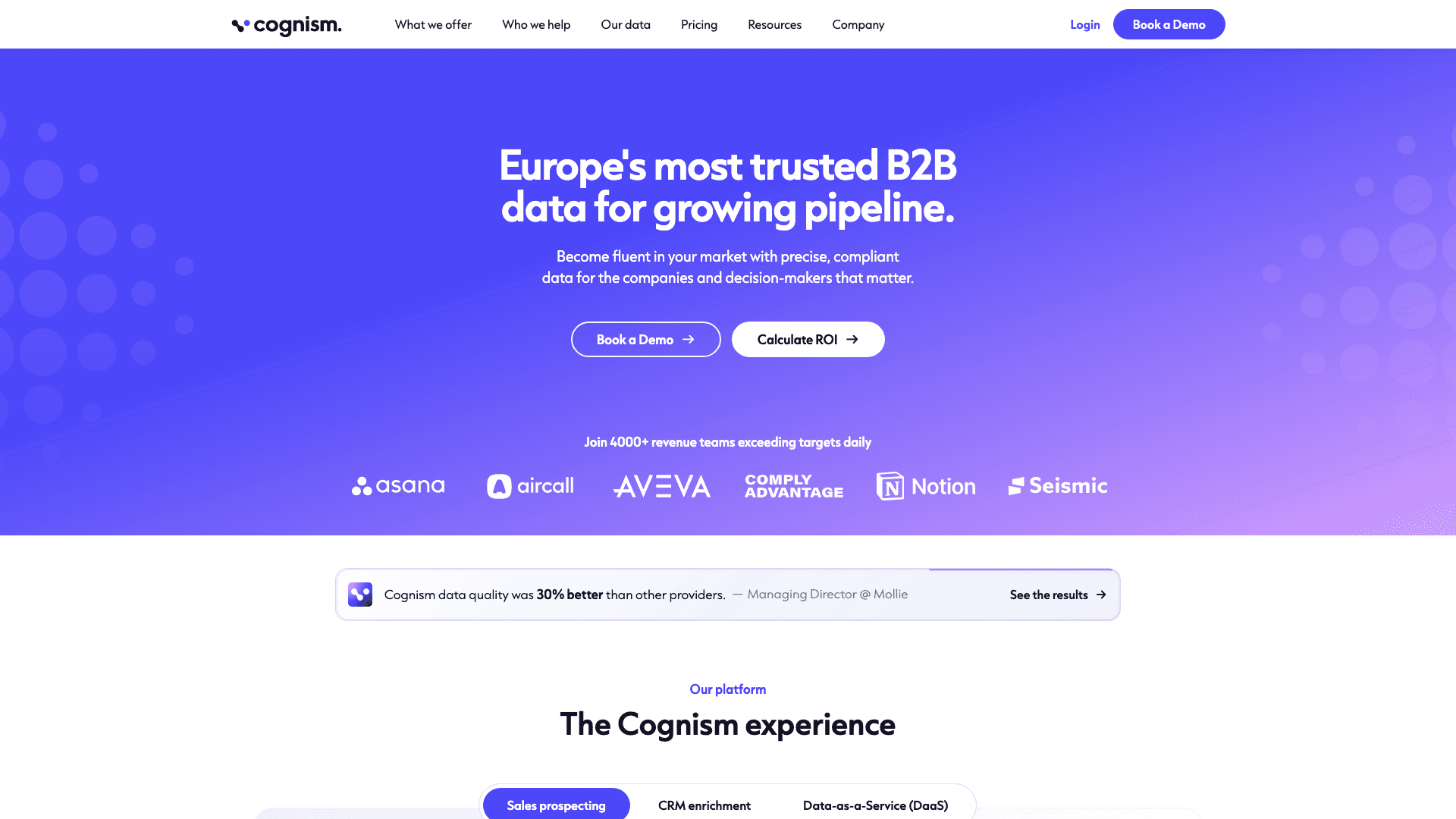
Cognism is the strongest alternative on European coverage and compliance, and its Diamond Data phone verification — numbers checked by humans rather than inferred — is the capability ZoomInfo users most often say they miss when they downgrade. Pricing is a Grow plan around $15,000/yr platform fee plus roughly $1,500/user/yr, Elevate around $25,000/yr plus roughly $2,500/user/yr, with a solo user landing near $16,500/yr and a five-user team near $22,500/yr.
Cognism ranks sixth rather than higher for a reason this list is obliged to state plainly: it reproduces the exact buying model people are trying to escape. A platform fee plus per-seat pricing, quote-gated and annual, is structurally the same trap as ZoomInfo — you just get better EMEA data and GDPR posture inside it. If your reason for leaving was European coverage or compliance, Cognism is the right answer and the price is defensible at 4.6/5 across 700+ G2 reviews. If your reason for leaving was the contract, this is not an escape, and no amount of data quality changes that.
What Cognism does well
- Best-in-class EMEA coverage and GDPR-compliant sourcing
- Diamond Data phone verification — human-checked numbers, not inferred
- Notify and intent layers available on the higher tier
- 4.6/5 across 700+ G2 reviews
Pricing
Grow around $15,000/yr platform fee plus roughly $1,500/user/yr. Elevate around $25,000/yr plus roughly $2,500/user/yr. Solo user around $16,500/yr; five-user team around $22,500/yr. Intent available as an add-on.
Best for
Teams selling into Europe where GDPR posture and verified mobile numbers matter more than how the contract is structured.
Pros
- Clearly the best European coverage and compliance story here
- Human-verified mobile numbers are a real, checkable differentiator
- Strong rating (4.6) on a solid 700+ review base
Cons
- Quote-only annual contracts with a platform fee — the same buying model as ZoomInfo
- A solo user near $16,500/yr prices out exactly the buyers most desperate to leave
Amplemarket
Best AI-Native End-to-End Outbound — Data and Execution in One
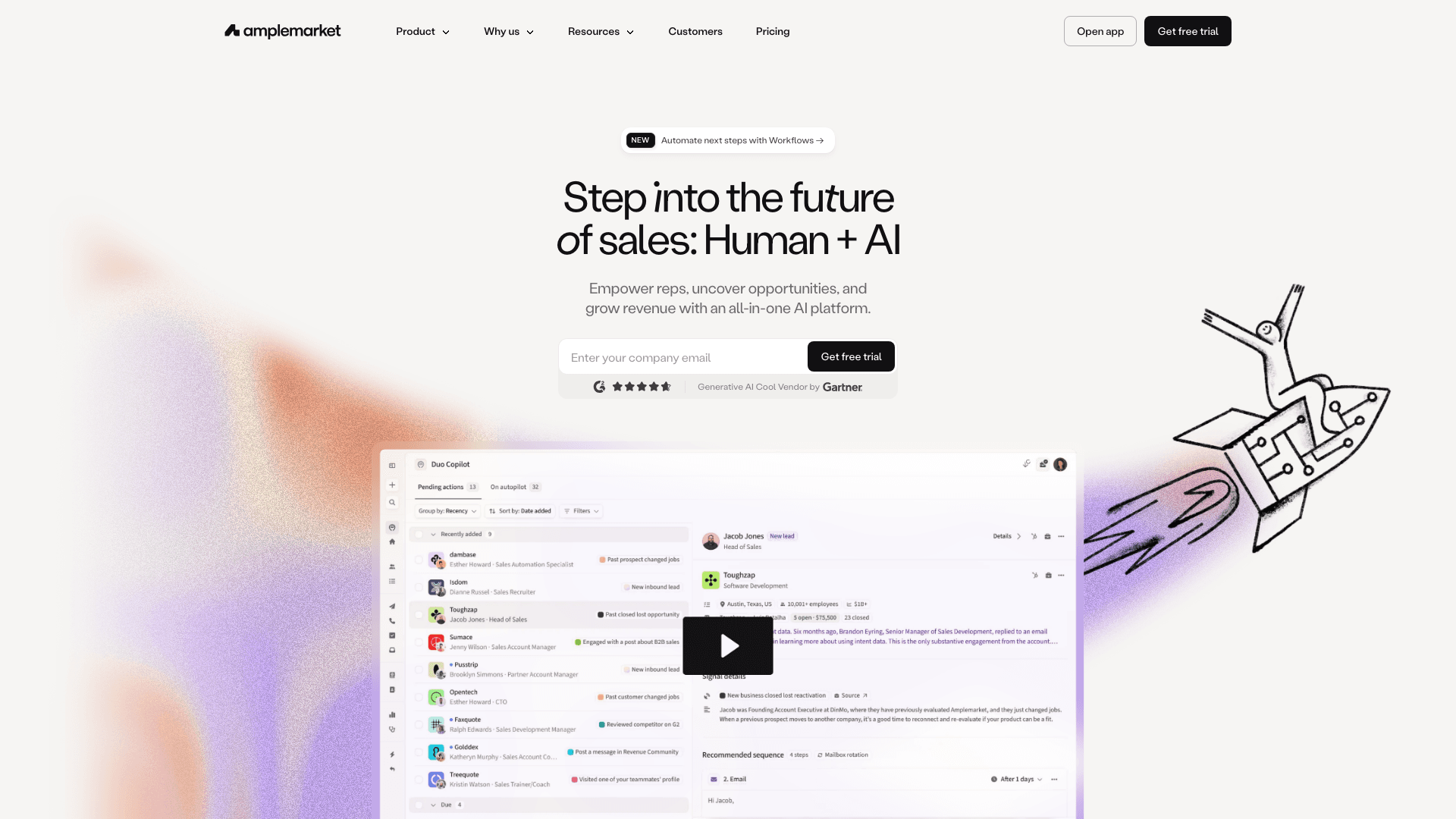
Amplemarket collapses the data-plus-sequencer-plus-signals stack into a single AI-native platform, which is what ZoomInfo customers are usually approximating by bolting Engage onto SalesOS. Starter is $600/mo billed annually, with Growth and Enterprise custom-quoted and additional users typically $300-$400/mo each.
Amplemarket is the right migration for a funded team whose ZoomInfo bill was really a bundle — data, plus outreach, plus intent — where consolidating into one AI-native product removes both the integration tax and a line item or two. Its 4.6/5 across 598+ G2 reviews is strong for a product at this scale. The caution is that at $600/mo annual-only, it is not an escape from commitment, just a smaller one, and the per-user add-on cost climbs quickly for larger teams; price a three-year total, not a monthly, before deciding it is cheaper than what you have.
What Amplemarket does well
- Data, sequencing and buying signals in one AI-native platform
- Published $600/mo entry rather than a quote call
- Replaces the SalesOS-plus-Engage bundle pattern with one product
- 4.6/5 across 598+ G2 reviews
Pricing
Starter $600/mo billed annually. Growth and Enterprise custom-quoted. Additional users typically $300-$400/mo each.
Best for
Funded startups running real outbound who want data and execution in one product instead of an integration project.
Pros
- Genuine consolidation — removes the data-plus-outreach integration tax
- Entry price published rather than quote-gated
- Strong verified rating on a substantial review base
Cons
- Annual-only billing — a smaller commitment, but still a commitment
- Per-user add-ons at $300-$400/mo make larger teams expensive fast
Instantly
Best Deliverability Play — B2B Database Bundled With the Sending Layer
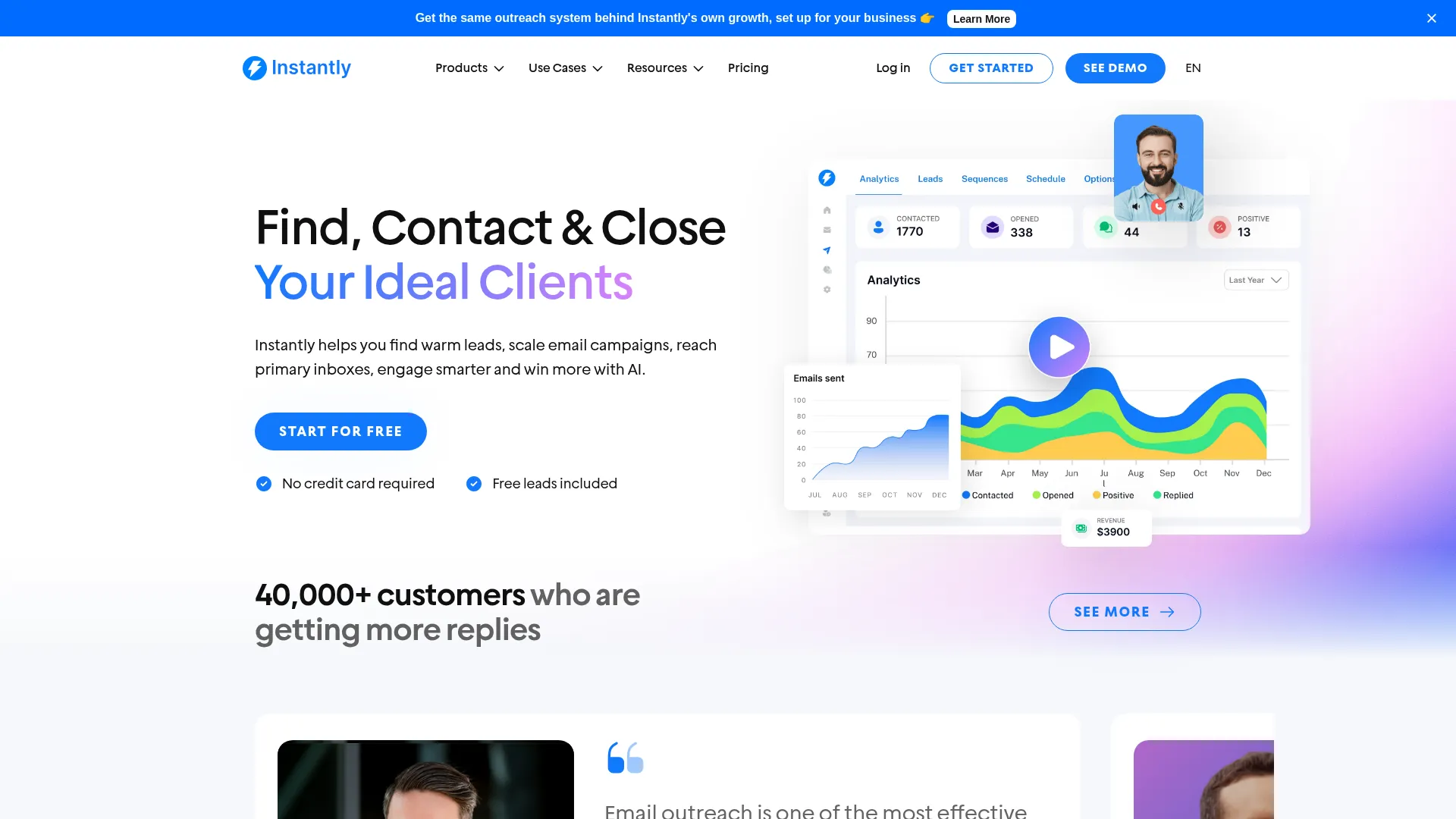
Instantly approaches the problem from the other end: it is a cold-email platform with deliverability tooling that happens to include a built-in B2B lead database, so for high-volume outbound teams it replaces both the data vendor and the sending stack. Outreach Growth is $37.60/mo annual, Hyper Growth $97/mo and Light Speed $358/mo, with credit add-ons from $47/mo and a realistic full setup landing near $144/mo.
Instantly holds 4.8/5 across 3,400+ G2 reviews, the highest rating on this list on a genuinely large base. For a team whose ZoomInfo contract existed to feed cold email campaigns, buying the sending infrastructure and the data together at roughly $144/mo all-in is a different order of spend entirely — two orders of magnitude below a $33,500 median contract. Be honest about the fit: the database is narrower and shallower than Apollo's or ZoomInfo's, this is built for volume rather than precision account research, and if your motion is enterprise multi-threading rather than cold outbound at scale, it is the wrong tool regardless of the rating.
What Instantly does well
- Deliverability tooling and a built-in B2B database in one purchase
- Realistic full setup around $144/mo — orders of magnitude below a ZoomInfo contract
- Highest rating here: 4.8/5 across 3,400+ G2 reviews
- Self-serve with published monthly pricing
Pricing
Outreach Growth $37.60/mo annual. Hyper Growth $97/mo. Light Speed $358/mo. Credit add-ons from $47/mo. Realistic full setup around $144/mo.
Best for
High-volume cold outbound teams whose ZoomInfo contract existed mainly to fill email campaigns.
Pros
- Highest verified rating on this list, on a 3,400+ review base
- Replaces the data vendor and the sending stack in one purchase
- Self-serve monthly pricing with no commitment
Cons
- Database is narrower and shallower than Apollo or ZoomInfo
- Built for volume, not precision account research or enterprise multi-threading
Saleshandy
Cheapest Real Replacement — AI Lead Finder Plus Multichannel From $25/mo
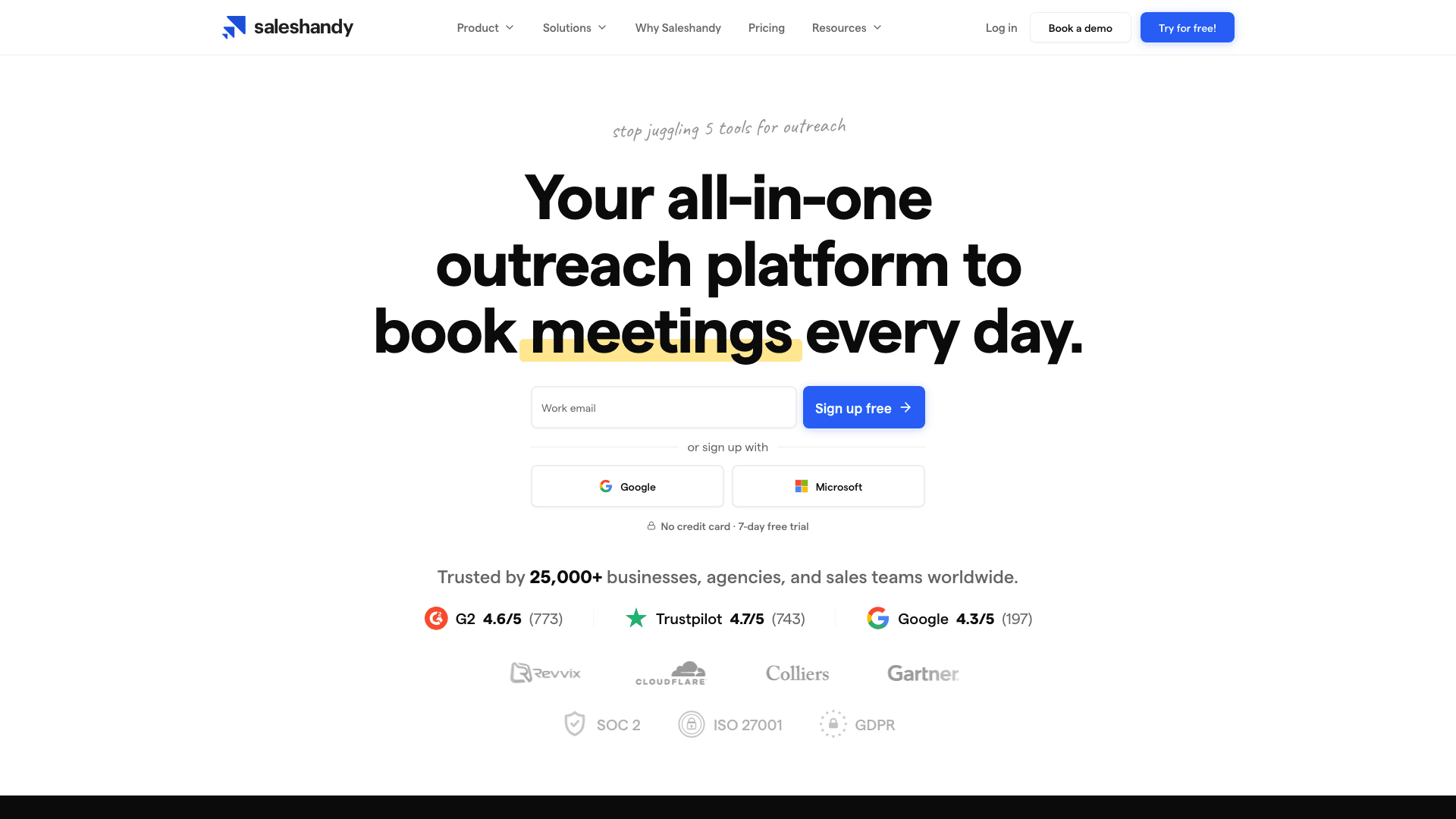
Saleshandy is the budget floor for a genuine data-plus-outreach combination: Outreach Starter at $25/mo annual, Pro $69/mo, Scale $139/mo and Scale Plus $169/mo, with lead-finder credits bundled into each plan rather than metered separately.
Saleshandy is the answer for a bootstrapped team that needs the ZoomInfo job done at a bootstrapped price, and bundled lead-finder credits mean the bill is predictable in a way credit-metered products are not. It holds 4.6/5 across 770+ G2 reviews, which is a serious base at this price point. The honest framing is scope: the database is materially smaller than Apollo's, the enrichment depth will not support account research, and the bundled credits are a welcome allowance rather than an unlimited supply. This is the right pick when the budget is the binding constraint and you know it.
What Saleshandy does well
- Data and multichannel outreach from $25/mo annual
- Lead-finder credits bundled into plans rather than metered separately
- Predictable bill — no separate credit meter to watch
- 4.6/5 across 770+ G2 reviews
Pricing
Outreach Starter $25/mo annual. Pro $69/mo. Scale $139/mo. Scale Plus $169/mo. Lead Finder credits bundled per plan.
Best for
Bootstrapped teams where budget is the binding constraint and the job is outbound rather than account research.
Pros
- Cheapest genuine data-plus-outreach combination here
- Bundled credits make the monthly bill predictable
- Strong rating on a 770+ review base at a very low price
Cons
- Materially smaller database than Apollo — not for account research
- Bundled credits are an allowance, not an unlimited supply
6sense
The Upward Exit — If You Are Leaving for Intent, Know What You Are Signing
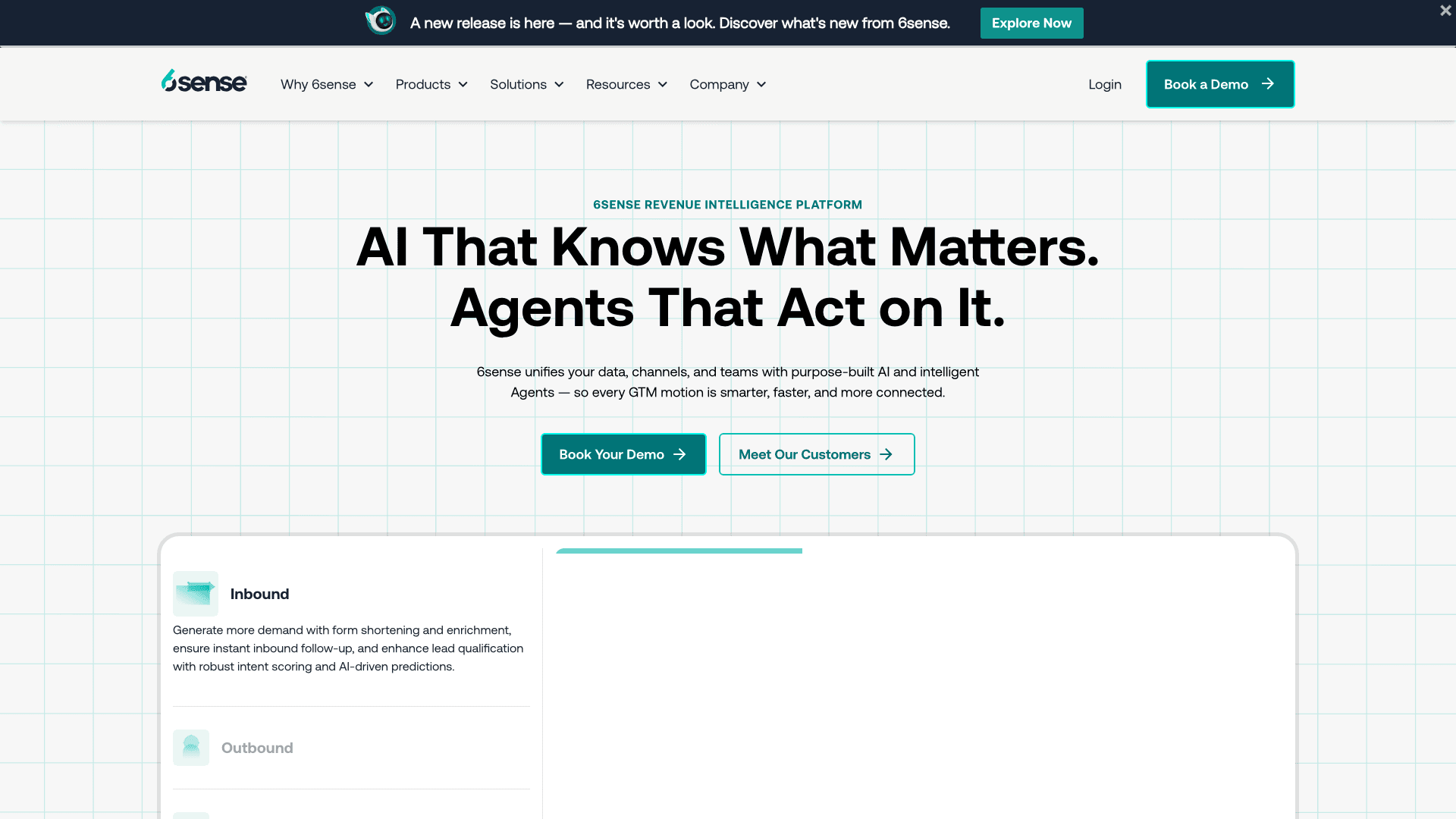
6sense is here for the minority who are leaving ZoomInfo not because it costs too much but because it does not do enough: predictive analytics, account identification and intent-driven ABM at a depth ZoomInfo's intent add-on does not reach. Pricing is custom enterprise, running roughly $55,000-$130,000+/yr depending on features and account volume, with no self-serve option and no free trial.
6sense is the honest tenth entry rather than a recommendation for most readers, and it belongs on the list because "leave ZoomInfo" sometimes means "go bigger", not "go cheaper". It holds 4.4/5 across 1,100+ G2 reviews and is genuinely strong at predictive account intelligence. But every structural complaint this page makes about ZoomInfo applies here with more force: quote-only, annual, no trial, and at $55,000-$130,000+/yr the commitment is larger, so the notice window matters more. If you sign this, negotiate the cancellation terms at the same time as the price, not at renewal.
What 6sense does well
- Predictive account identification and intent at a depth ZoomInfo's add-on does not reach
- Full ABM orchestration rather than a contact database
- 4.4/5 across 1,100+ G2 reviews
Pricing
Custom enterprise pricing, roughly $55,000-$130,000+/yr depending on features and account volume. No self-serve, no free trial.
Best for
Enterprise revenue teams leaving ZoomInfo upward for predictive intent and ABM, with the budget and procurement capacity to match.
Pros
- Genuinely deeper predictive intent and ABM than ZoomInfo offers
- Strong review base (1,100+) for an enterprise platform
Cons
- Reproduces every structural problem with ZoomInfo's contract, at a larger number
- No trial and no self-serve — you cannot validate fit before committing
Four Things to Do Before You Switch
1. Diarise the notice deadline today
Whatever you decide, put the date 90 days before your renewal in a calendar now. The most expensive outcome on this page is discovering the window closed last week.
2. Test coverage of your actual ICP
Pull 50 real target accounts and check them in Apollo's free plan, Lusha's free tier and Clay's free tier. Total database size is irrelevant; coverage of your list is the only number that matters.
3. Separate the bundle
Work out what you actually use: contact data, sending, intent. Priced separately these are three cheap markets; bundled into one contract they command a five-figure premium.
4. Use the quotes as leverage
A credible alternative priced in writing is the only thing that moves a renewal negotiation. Even if you intend to stay, getting the quotes costs you nothing and changes the conversation.
Who We Left Off, and Why
Bombora and G2 Buyer Intent are pure intent-data products rather than ZoomInfo replacements — Bombora runs roughly $12,000-$25,000/yr standalone and is often bundled into 6sense or Demandbase subscriptions anyway, and G2 Buyer Intent starts around a $15,000/yr core subscription before signal add-ons. Both are covered in our sales intelligence tools guide, where intent is the subject rather than a footnote.
UserGems does one thing extremely well — alerting you when champions change jobs — but at $2,750/mo ($33,000/yr) for the Core plan it costs roughly a full ZoomInfo contract to solve a much narrower problem. It is a complement to a data provider, not a replacement for one.
LinkedIn Sales Navigator gets recommended constantly here and should not be treated as a replacement: it is excellent for social selling and relationship-led deals, but it does not export contact data the way a database does, so most teams end up running it alongside one of the picks above rather than instead of one.
How to Choose Your ZoomInfo Alternative
Never signing an annual contract again…
Apollo.io (free plan, monthly billing) or Lead411 ($99/user month-to-month). Both let you leave in thirty days.
Never depending on one vendor again…
Clay — waterfall enrichment across 150+ providers from $185/mo, so no single database's renewal terms are your problem.
Solo or a two-person team…
Lusha at $22.45/user/mo, or RocketReach at $33/user/mo if you only need email lookups.
Selling into Europe…
Cognism — the right data and compliance answer, but go in knowing it buys exactly like ZoomInfo: platform fee, per-seat, quote-gated, annual.
It was really feeding cold email…
Instantly (~$144/mo realistic full setup) or Saleshandy (from $25/mo) — data and sending in one purchase.
Leaving upward, not downward…
6sense for predictive intent and ABM at $55,000-$130,000+/yr — and negotiate the cancellation terms at signing, not at renewal.
How We Chose These Alternatives
- Independence — we sell no sales data and took no placement fees, unlike the incumbent and the competitors who dominate this query
- Buying model named — every entry is labelled self-serve, annual, or quote-only, including the two that reproduce the problem
- Fair to the incumbent — ZoomInfo's data genuinely beats most of this list internationally, and the page says so rather than pretending the product is bad
- Verified ratings only — G2 scores with review counts attached, and estimated figures labelled as estimates rather than presented as published pricing
The Renewal Clause Is Where the Money Is
We research the tools founders buy and the terms they sign — one honest email a week, no sponsored placements, no pay-to-play.
Frequently Asked Questions
What is the best ZoomInfo alternative in 2026?
Apollo.io is the best ZoomInfo alternative for most teams in 2026, because it removes the part that actually traps people: it has a free plan, self-serve checkout and monthly billing at $49-$59/user/mo, so there is no quote call, no annual commitment and no cancellation window to diarise. It holds 4.7/5 on G2 across 9,000+ reviews. The right answer changes with your reason for leaving — Clay if you want to stop depending on any single database, Lead411 if you want ZoomInfo-shaped mid-market coverage with month-to-month billing, Cognism if you sell into Europe and need GDPR-compliant verified mobiles, Instantly or Saleshandy if the contract existed to feed cold email, and 6sense if you are leaving upward for predictive intent.
How much does ZoomInfo actually cost in 2026?
ZoomInfo does not publish pricing, but published estimates put SalesOS Professional near $14,995/yr, Advanced near $24,995 and Elite at $39,995+, all as annual contracts. The more useful figure comes from Vendr, which tracked more than 1,500 purchases in 2026 and puts the median contract value around $33,500/year. All-in costs commonly land between $30,000 and $60,000 once you add per-seat fees (estimated $2,000-$5,000 per user per year), add-on modules such as Intent Data, Engage, Global Data Passport and Chorus (estimated $15,000-$40,000 annually), and implementation fees (estimated $1,000-$8,000).
Why is ZoomInfo's auto-renewal such a common complaint?
ZoomInfo contracts auto-renew unless you give notice, and the notice window is 60 to 90 days before the renewal date — which is the single most frequently raised complaint across G2, Capterra and Trustpilot reviews. Miss that window and you are committed to another full year, typically at a 10-20% increase. The practical consequence is that the decision to leave ZoomInfo has to be made roughly three months before you feel the pain of staying, which is why so many teams describe being locked into a second year they did not want. If you are on ZoomInfo now, put the notice deadline in a calendar today regardless of whether you plan to leave.
How do small sales teams rate Apollo.io's data accuracy when replacing ZoomInfo for US-based outbound prospecting?
Apollo.io is the alternative small teams most often replace ZoomInfo with for US outbound, and it holds 4.7/5 on G2 across 9,000+ reviews — comparable review depth to ZoomInfo itself. For US-heavy prospecting, teams generally rate its roughly 275M-contact database as comparable rather than inferior, and the free plan (50 mobile credits plus unlimited email credits monthly) lets a team validate accuracy against its own ICP before paying anything, which a quote-gated annual contract prevents. The two consistent criticisms are that data quality drops noticeably outside core US coverage, where ZoomInfo often still wins, and that mobile credits on lower tiers deplete faster than teams expect, pushing heavy users to the Organization tier sooner than the pricing page suggests.
Is there a free ZoomInfo alternative?
Apollo.io has the most useful free plan of any ZoomInfo alternative, including 50 mobile credits and unlimited email credits per month — enough to genuinely test coverage of your target accounts. Lusha's free tier gives 70 credits a month and suits ad-hoc lookups, and Clay offers a free tier for testing its enrichment workflows before committing. None of these free tiers will sustain a full outbound motion, but all three let you validate whether a vendor actually has your ICP before spending money, which is the specific thing ZoomInfo's quote-gated sales process makes impossible.
Should I replace ZoomInfo with one tool or several?
Several is often cheaper and more resilient, and this is the structural insight most alternatives pages skip. ZoomInfo bundles contact data, intent signals and outreach into one contract, but those are three markets with very different prices — Apollo.io or Lead411 for contact data at $49-$99/user/mo, Instantly or Saleshandy for sending at $25-$144/mo, and intent bought separately only if you can prove you act on it. Clay goes further by routing enrichment across 150+ providers so no single vendor holds your pipeline. The trade-off is integration work and more vendors to manage, which is real but usually smaller than the five-figure premium a bundle commands.
Is ZoomInfo's data actually better than the alternatives?
Often yes, and a fair comparison has to say so. ZoomInfo holds roughly 4.5/5 on G2 across 9,000+ reviews and rates highly specifically on data quality and feature depth — its international coverage and enrichment depth still beat most of this list, and Apollo users report exactly that gap outside core US coverage. The case for leaving is rarely that the data is bad; it is that quote-only annual contracts with a 60-90 day notice window and $30,000-$60,000 all-in costs are a poor fit for teams whose prospecting does not depend on that marginal coverage. Decide by testing whether your ICP is adequately covered by a cheaper source, not by assuming the incumbent is overrated.
The Bottom Line
Apollo.io is the right first move for most teams leaving ZoomInfo, not because its database wins on paper but because you can test it against your own accounts for nothing and leave after any month. Clay is the better answer if you have the appetite to build, because routing enrichment across many providers means no vendor ever holds that leverage over you again. And Lead411's month-to-month tier at $99/user is the most underrated line on this page for a mid-market team that wants ZoomInfo-shaped coverage without ZoomInfo-shaped terms.
Whatever you choose, do the boring thing first: find your renewal date, count back ninety days, and put it in a calendar. ZoomInfo's data is good and its product is well-rated — the reason people end up trapped is almost never that they misjudged the database. It is that they missed a date.
Related Reading
- Best Sales Intelligence Tools
The full category including the pure intent-data products cut from this list.
- Best AI Sales Tools
The execution layer that sits on top of whichever database you land on.
- Best ABM Platforms
If you are leaving ZoomInfo upward for account-based orchestration.
Sources
One Honest Email a Week
Independent tool research for founders — no sponsored placements, no pay-to-play, and we tell you when the incumbent is actually fine.
Keep Reading
10 Best Sales Intelligence Tools for 2026 (Ranked for Founders, Not Enterprise Procurement)
The 10 best sales intelligence tools for 2026 — Apollo, Cognism, Clay, Lusha, Lead411, RocketReach, 6sense, Bombora, UserGems, and G2 Buyer Intent. Ranked by founders-first criteria: real pricing, data verification depth, and the path to coverage that does not start at $25K/yr.
10 Best AI Sales Tools for 2026 (Ranked for Founders, Not Enterprise Buyers)
The 10 best AI sales tools for 2026 — Apollo, Clay, Amplemarket, Saleshandy, Smartlead, Instantly, Lemlist, HeyReach, 11x.ai, and Gong. Ranked by founders-first criteria: pricing transparency, time-to-first-meeting, and what works for teams under 20 reps.
10 Best AI GTM Tools for 2026 (Ranked for Founders Building the Revenue Engine)
The 10 best AI go-to-market tools for 2026 — Clay, Apollo, Attio, Unify, Common Room, HubSpot Breeze, Amplemarket, 11x, Gong, and Warmly. Ranked by founders-first criteria: how fast you can turn a signal into a booked meeting, real pricing, and which tools survive the GTM consolidation wave now that HubSpot bought Warmly and Zoom bought Common Room.