
10 Best Customer Service Software for 2026 (Ranked by Real Cost, Not Sticker Price)
The 10 best customer service software picks for 2026 — Help Scout, Crisp, Pylon, Freshdesk, Zoho Desk, Gorgias, Intercom, Helply, HubSpot Service Hub, and Tidio. Ranked by founders-first criteria: real all-in pricing including AI fees, per-seat vs. per-resolution economics, and how fast you will outgrow each one.
In 2026, you are choosing a pricing model before you are choosing a product.
Four models compete: per-seat (Help Scout, Freshdesk, Zoho Desk, Pylon, HubSpot — pay per agent), flat workspace (Crisp — one price for the whole team), per-ticket (Gorgias — unlimited agents, pay per conversation), and per-AI-resolution add-ons layered on all of them ($0.50-$0.99 per resolved conversation). The cautionary anchor: Zendesk's $115/agent Professional plan becomes $165/agent with the $50 Copilot add-on, $215 with the $50 Workforce Engagement bundle and $298 with the $83 Contact Center add-on (Zendesk official pricing, checked 2026-08-10), before $1.50-$2.00 per automated resolution. Match the model to your ticket volume and hiring plans first — then compare features.
Key Takeaways
- In 2026 the buying decision is pricing model first, product second. Customer service software now splits into four models: per-seat (Help Scout, Freshdesk, Zoho Desk, Pylon, HubSpot), flat workspace pricing (Crisp), per-ticket (Gorgias), and per-AI-resolution add-ons layered on all of them ($0.50-$0.99 each). Match the model to your ticket volume before comparing features.
- Help Scout is the best overall pick for bootstrapped SaaS: a real free plan (5 users), $25/user entry, near-zero learning curve, and AI Answers at $0.75/resolution. Crisp wins when you want a bill that does not grow with headcount — $45-$95/mo flat for the whole workspace.
- Every vendor "best of" list ranks itself #1 — Help Scout's list puts Help Scout first, Zendesk's puts Zendesk first, Tidio's puts Tidio first. We do not sell support software, and no tool on this list paid to be here.
- Real cost runs 1.5-3x sticker price once AI lands. Tidio's advertised plans exclude Lyro AI (real cost 2-3x). Gorgias bills the ticket AND the AI resolution. The excluded incumbent anchor: Zendesk's $115/agent Professional becomes $165/agent with the $50 Copilot add-on and $298 once Workforce Engagement and Contact Center stack (Zendesk official pricing, checked 2026-08-10), before $1.50-$2.00 per automated resolution.
- Per-AI-resolution pricing arrived across the board: Helply $0.50, Help Scout $0.75, Gorgias $0.90-$1.00, Intercom Fin $0.99. At founder volumes (100-500 tickets/mo) this beats per-seat AI add-ons by a wide margin — you pay for outcomes, not capacity.
- Skip the enterprise platforms until you have 20+ agents: Kustomer (8-seat minimum, ~$8,500/yr floor), Gladly (10-seat minimum, ~$21,600/yr floor), and HappyFox (pricing behind a sales form) are built for procurement teams, not founders.
Search for the best customer service software and every top result is a vendor ranking itself #1 — Help Scout's list puts Help Scout first, Zendesk's puts Zendesk first, Tidio's puts Tidio first. This list is different: we don't sell support software, no tool paid to be here, and every pick is ranked by what it actually costs a founder-led team once AI fees and overage mechanics land — not the sticker price on the pricing page.
The 2026 market splits cleanly. Email-first help desks (Help Scout) and flat-priced all-in-ones (Crisp) own the bootstrapped tier. Ticketing platforms (Freshdesk, Zoho Desk) deliver SLAs and routing at $7-$19/agent. Vertical specialists won their niches: Gorgias for Shopify, Pylon for B2B-SaaS-in-Slack. Intercom turned itself into an AI company around Fin. And a genuine pricing experiment arrived: Helply (the Groove rebrand) ships a free unlimited-seat help desk and charges $0.50 per AI outcome — nothing else like it exists.
Every entry below covers verified pricing (including the AI fees vendors keep off the comparison pages), G2 sentiment, who the tool is actually for, and — because no one else publishes this — the billing gotchas users report after six months. Zendesk is deliberately absent: it is the incumbent every tool here gets compared against, and its add-on economics are the cautionary tale in the callout above.
Quick Comparison
| # | Tool | Best For | Starting Price | Rating |
|---|---|---|---|---|
| 1 | Help Scout | Best Overall for Bootstrapped SaaS | Free plan (5 users, 1 inbox) | 4.4 |
| 2 | Crisp | Best Flat Pricing | Free (2 seats, chat + inbox) | 4.5 |
| 3 | Pylon | Best for B2B SaaS | Starter $59/seat/mo annual ($70 monthly, 3-seat min) | 4.7 |
| 4 | Freshdesk | Most Features per Dollar | Free for 2 agents (currently listed as 6 months — verify) | 4.4 |
| 5 | Zoho Desk | Best Budget Pick | Free (3 agents) | 4.4 |
| 6 | Gorgias | Best for Ecommerce | Starter $10/mo (50 tickets, then $0 | 4.6 |
| 7 | Intercom | Best AI Agent | Essential $29/seat/mo | 4.5 |
| 8 | Helply | The Wildcard | Free forever platform (unlimited seats: inbox, ticketing, chat, KB) | 4.6 |
| 9 | HubSpot Service Hub | Best if You Are Already on HubSpot | Free tools (ticketing, chat, shared inbox) | 4.4 |
| 10 | Tidio | Best Free Starting Point | Free (50 conversations/mo, 10 seats) | 4.7 |
Help Scout
Best Overall for Bootstrapped SaaS — Free Plan + $0.75/Resolution AI
Help Scout is the email-first help desk that most bootstrapped SaaS teams should start with. The shared inbox works like Gmail with superpowers — collision detection, saved replies, workflows — plus a Docs knowledge base and the Beacon chat widget. After a turbulent 2025 (a contact-based pricing change, real customer backlash, then a partial walk-back), new signups now get classic per-user pricing with unlimited contacts, a genuinely free plan for up to 5 users, and AI Answers at $0.75 per resolution with a 3-month free trial. It is the lowest-friction serious help desk on this list.
For a founder answering support between deploys, the tool that wins is the one your team adopts without training. Help Scout's entire pitch is zero learning curve: if you can use email, you can use Help Scout, and the free plan (5 users, 1 inbox, 100 contacts/mo) covers your first hundred tickets without a credit card. The $0.75/resolution AI Answers pricing means you pay for resolved conversations, not AI capacity you may never use. The honest caveat: the 2025 pricing whiplash dented community trust (FreeScout migration threads exist), reporting is shallow next to Freshdesk or Zoho, and there is no native WhatsApp or voice. But as the default first help desk for a SaaS team of 1-15, nothing else combines this price, polish, and simplicity.
Key Features
- Shared inbox with collision detection, saved replies, and workflow automations
- Free plan: 5 users, 1 inbox, 1 Docs site, 100 contacts/mo — no credit card
- AI Answers at $0.75/resolution (3-month free trial) + AI drafts for agents
- Docs knowledge base + Beacon chat widget included on every paid plan
- Famously good onboarding — most teams are productive in under an hour
Pricing
Free plan (5 users, 1 inbox). Standard $25/user/mo ($21 annual, up to 25 users). Plus $45/user/mo ($38 annual). Pro $75/user/mo ($63 annual, 10-user min). AI Answers $0.75/resolution. Extra inboxes $10/mo.
Rating
4.4/5 — G2 (435+ reviews)
Best For
Bootstrapped SaaS and SMB teams of 1-15 who want email-first support with zero l...
Pros
- Easiest setup in the category — the whole team is productive on day one
- Free plan + $25 entry + $0.75/resolution AI is the cleanest founder-tier economics among full help desks
- Help Scout's own support is consistently rated among the best in the industry
Cons
- The 2025 contact-based pricing episode (later partially reversed) dented community trust
- Shallow reporting and no native WhatsApp/voice — channel-heavy teams outgrow it
Crisp
Best Flat Pricing — Your Bill Does Not Grow When Your Team Does
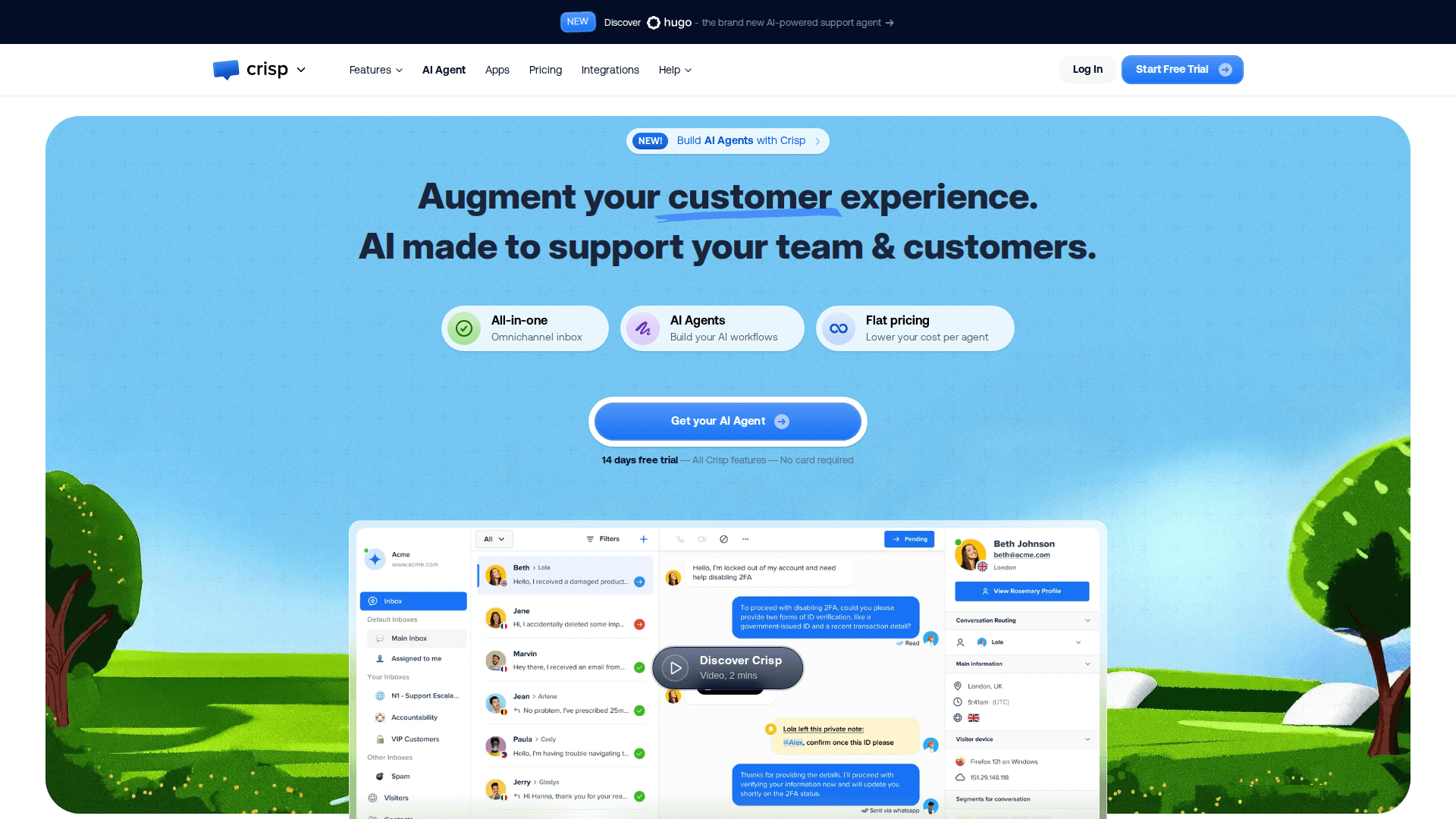
Crisp is a French, bootstrapped all-in-one messaging platform — chat widget, shared inbox, knowledge base, campaigns, CRM-lite — with the rarest pricing model in the category: flat per-workspace fees. Mini is $45/mo for 4 seats, Essentials $95/mo for 10 seats, Plus $295/mo for 20+, each with AI credits bundled in and unlimited conversations. The free plan (2 seats, chat widget, shared inbox) is a real starting point, not a demo. For indie teams that expect to hire, Crisp is the only tool here where headcount growth does not raise the bill.
Per-seat pricing quietly punishes growth: hire two support contractors for the holidays and your help desk bill jumps 40%. Crisp's flat workspace model removes that tax entirely — $95/mo covers a 10-person team with omnichannel inboxes (email, WhatsApp, Messenger, Instagram), a chatbot, and a knowledge base that would cost $250-$450/mo on per-seat competitors. The trade-offs are real at scale: notification reliability complaints cause missed chats, search is weak, and the platform creaks past ~50 people. AI beyond the bundled credits is metered, and proper ticketing only arrives on the $295 Plus plan. But for a 2-10 person SaaS or agency team, Crisp is the best pure economics on this list.
Key Features
- Flat workspace pricing: $45/mo (4 seats), $95/mo (10 seats), $295/mo (20+) — unlimited conversations
- Free forever plan: 2 seats, chat widget, shared inbox
- Omnichannel inbox: email, WhatsApp, Messenger, Instagram + live chat
- AI credits bundled into every paid plan (MagicReply drafts + AI bot)
- Knowledge base, campaigns, and CRM-lite included — no add-on stacking
Pricing
Free (2 seats, chat + inbox). Mini $45/mo flat (4 seats). Essentials $95/mo flat (10 seats, omnichannel + chatbot + KB). Plus $295/mo flat (20+ seats, ticketing, white-label). Extra seats $10/mo. 14-day trial, no card.
Rating
4.5/5 — G2 (175+ reviews)
Best For
Indie hackers and small SaaS teams (2-10 people) who want predictable flat prici...
Pros
- Flat pricing means hiring support help never raises the bill — unique in this category
- Remarkably complete for the money: chat, inbox, KB, campaigns, and bot in one box
- Bootstrapped and profitable vendor — no VC-driven pricing resets to fear
Cons
- Notification reliability issues are the top user complaint — missed chats happen
- Weak search and basic ticketing — proper ticket workflows require the $295 Plus plan
Pylon
Best for B2B SaaS — Slack-Native Support Nothing Else Does Well
Pylon (YC W23) is the AI-native B2B support platform built around where B2B customers actually live: shared Slack Connect channels, Microsoft Teams, email, in-app chat, and a customer portal — unified into one ticket stream. Threads in customer Slack channels become tickets automatically, with account views, CSAT, knowledge base, and Linear/Jira engineering handoff built in. Backed by a $31M Series B from a16z and Bain Capital Ventures (August 2025, $51M total), with 780+ customers including Deel, Hightouch, and AssemblyAI, it is the fastest-growing Zendesk alternative in B2B SaaS.
If your customers message you in shared Slack channels, traditional help desks force a brutal choice: ignore Slack (and miss messages) or copy-paste threads into tickets manually. Pylon makes the Slack thread the ticket. That single capability is why post-seed B2B SaaS teams migrate — Replo moved 120,000 tickets off Zendesk in five days. The 4.7/5 G2 rating (108+ reviews) is among the highest in the category. Budget honestly, though: the 3-seat minimum puts the floor at ~$177/mo, the AI agent is a separate add-on from $100/mo scaling with volume, AI copilot is $50/seat, and realistic deployments land around $800/mo. For a B2B SaaS with 20+ Slack-channel customers, that is cheap for what it replaces. For a solo founder, it is overkill.
Key Features
- Slack Connect + Microsoft Teams shared-channel support — threads become tickets automatically
- Unified omnichannel inbox: email, chat, Slack, Teams, WhatsApp, portal
- AI agent add-on (from $100/mo) with Runbooks — testable agentic workflows simulated on past tickets
- B2B account views: CRM-style customer records, CSAT, health, analytics
- Engineering handoff: native Linear/Jira sync for bug-driven tickets
Pricing
Starter $59/seat/mo annual ($70 monthly, 3-seat min). Professional $89/seat/mo annual (Slack connector lives here). Enterprise $139/seat/mo (7-seat min, annual only, Teams connector). AI Agents from $100/mo + AI Assistants $50/seat/mo add-ons.
Rating
4.7/5 — G2 (108+ reviews)
Best For
Post-seed B2B SaaS supporting customers in shared Slack/Teams channels — the nat...
Pros
- Solves the Slack-support problem nothing else handles well — its moat is real
- Modern, fast product with weekly shipping cadence and 4.7/5 G2 sentiment
- Replaces helpdesk + CSM tooling + KB in one platform for B2B teams
Cons
- 3-seat minimum + add-on stacking puts realistic cost near $800/mo — not solo-founder territory
- Slack connector requires the $89 Professional tier; Teams requires Enterprise (annual only)
Freshdesk
Most Features per Dollar — Real Ticketing + SLAs at $19/Agent
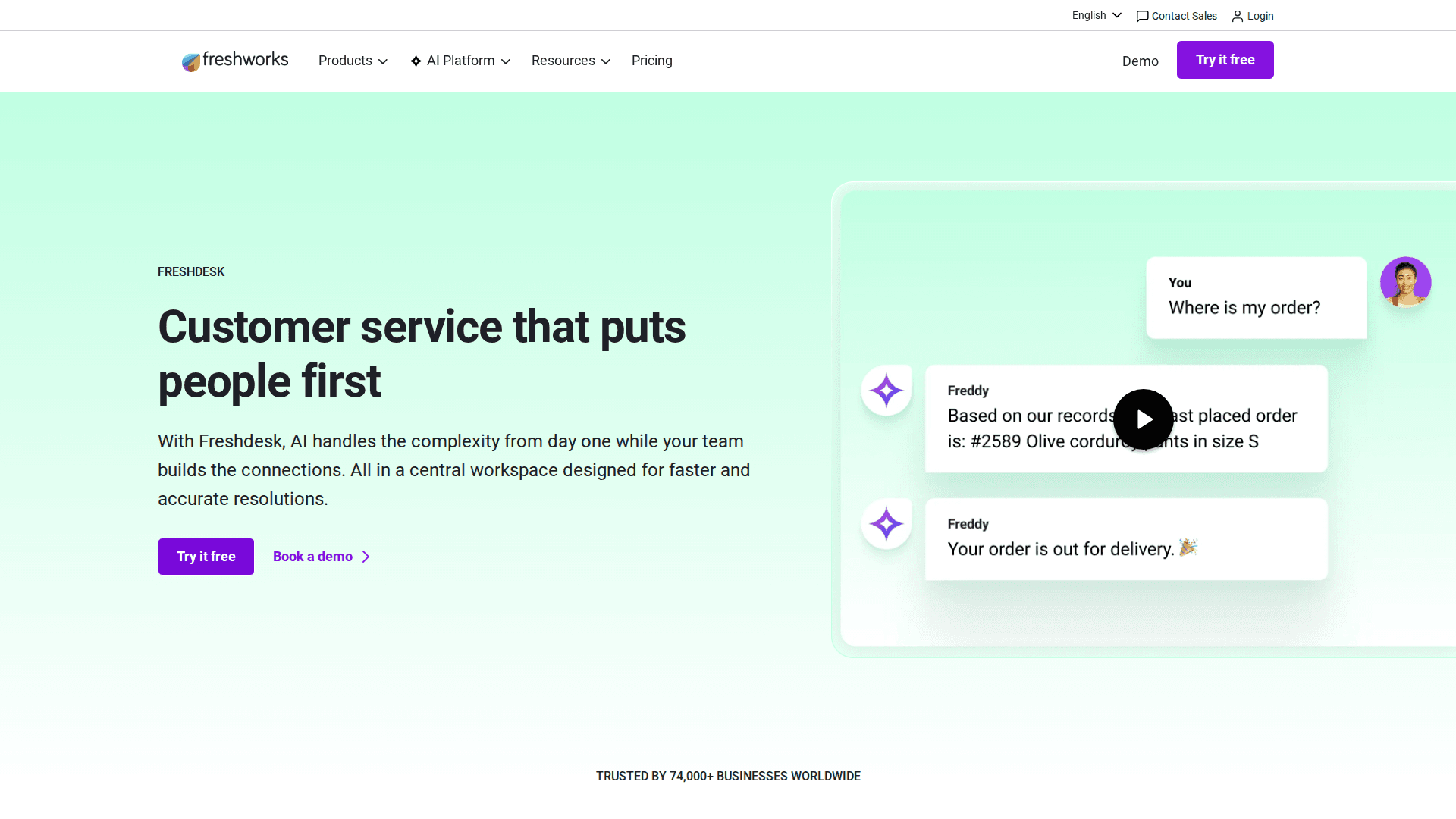
Freshdesk is the classic value-priced Zendesk alternative from Freshworks, and in 2026 it remains the cheapest way to get "big help desk" features — SLA management, skill-based routing, customer portals, a 1,000+ app marketplace — at $19/agent/mo on the Growth plan. The Freddy AI layer spans an AI agent (500 sessions bundled into Pro/Enterprise, then $49 per 100 sessions), a Copilot for agents (~$29/agent/mo), and analytics. There is a free tier for 2 agents, though Freshworks now lists it as free for 6 months — check terms before committing.
When you genuinely need ticketing infrastructure — SLAs for paying customers, routing across a 5-person team, a self-service portal — Freshdesk delivers it at a price point nothing else matches. The $19 Growth plan covers what costs $55-$89 elsewhere. The two honest warnings: first, Freshworks' own support quality is a recurring complaint, which is ironic for a support vendor; second, Freddy AI is sold as multiple separate add-ons that multiply per-agent cost quickly — the AI agent's session-based billing (a session is any AI interaction, resolved or not) spikes with volume. Buy Freshdesk for the ticketing fundamentals at $19; treat the AI stack as optional until you have measured your deflection rate elsewhere.
Key Features
- Full omnichannel ticketing: email, social, portal, with SLA management and automations
- Skill-based routing, round-robin assignment, and multi-product support
- Freddy AI Agent (500 sessions bundled on Pro+, then $49/100 sessions) + Copilot ~$29/agent/mo
- 1,000+ app marketplace — the deepest integration ecosystem at this price
- Generous collaborator access (5,000 free collaborators) for engineering escalations
Pricing
Free for 2 agents (currently listed as 6 months — verify). Growth $19/agent/mo annual. Pro $55/agent/mo. Enterprise $89/agent/mo. Freddy AI Agent: 500 sessions bundled on Pro+, then $49 per 100 sessions. Freddy Copilot ~$29/agent/mo.
Rating
4.4/5 — G2 (3,700+ reviews)
Best For
Cost-conscious SMBs and startups that need real ticketing infrastructure (SLAs, ...
Pros
- Cheapest full-featured ticketing in the category — SLAs and routing at $19/agent
- Scales from 2 agents to enterprise without a platform migration
- 3,700+ G2 reviews at 4.4 — among the most-validated tools on this list
Cons
- Freshworks' own support quality is a persistent user complaint
- Freddy AI is fragmented into separate add-ons; session-based billing charges for unresolved AI interactions
Want More Tool Recommendations?
Subscribe for curated indie hacker tool picks every week. No sponsored content, no fluff.
Zoho Desk
Best Budget Pick — Enterprise Process Automation From $7/User
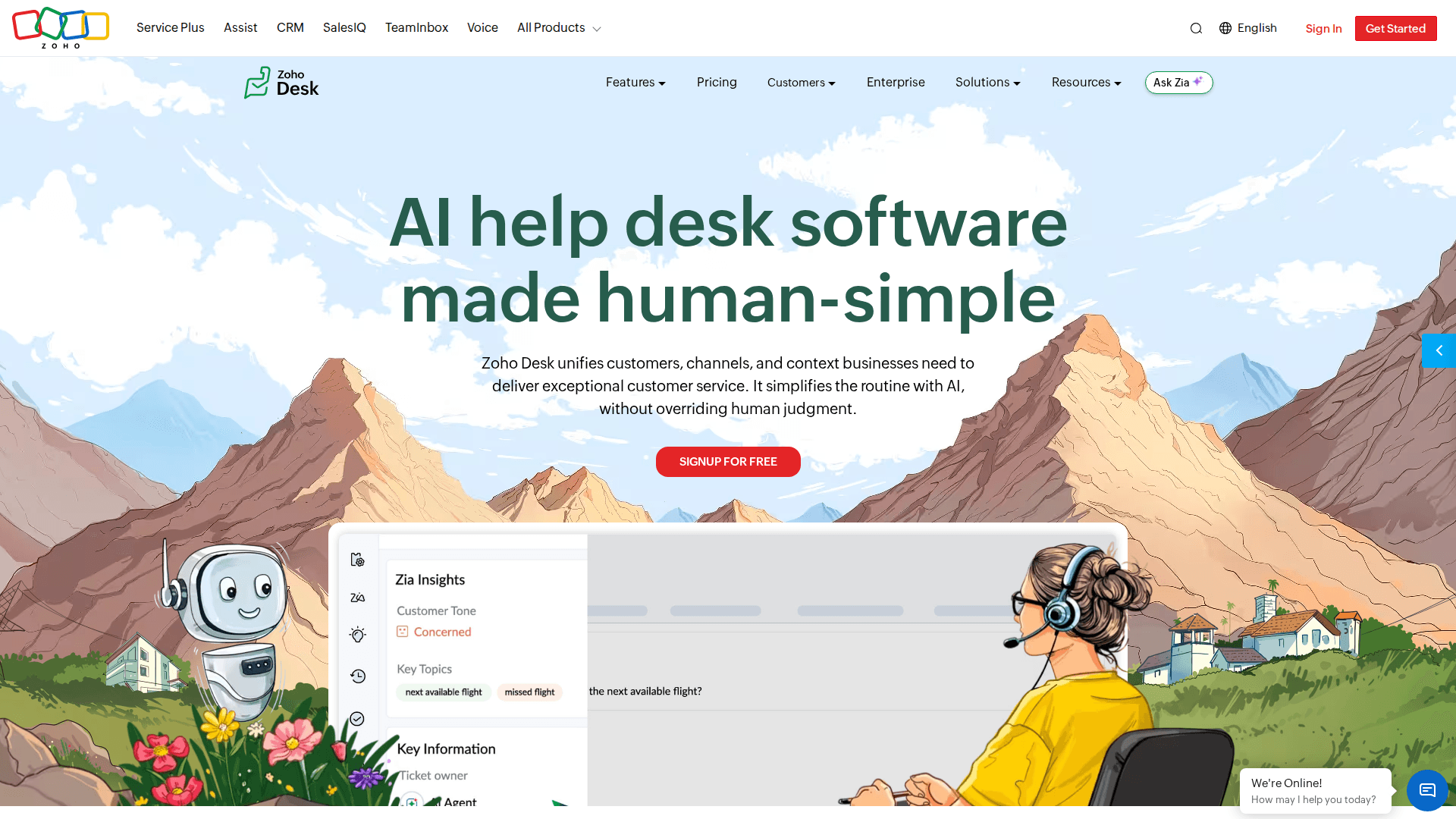
Zoho Desk is the budget powerhouse of the category: full omnichannel ticketing, Blueprint visual process automation, telephony, and Zia AI (sentiment, summaries, reply assistant, answer bot) at prices 50-80% below the big names — Express at $7/user/mo, up to Enterprise at $40. It carries one of the largest review bases in the category (6,500+ on G2) and inherits the Zoho suite's deep CRM integration. The trade-off is aesthetic and ergonomic: the UI is feature-dense, dated, and takes real time to learn.
No other tool gives a 3-person team enterprise-grade process automation for the price of a few coffees. Blueprints — visual, enforced multi-step processes with SLAs at each stage — are a genuinely advanced capability that Zendesk charges $115/agent for and Zoho sells at $23. If you are already in the Zoho ecosystem (CRM, Books, One), Desk is close to automatic. The honest trade-offs: Reddit consistently describes the UI as cluttered and maze-like, the best AI features (answer bot, generative assistant) are locked to the $40 Enterprise tier, and monthly billing carries a steep ~40% markup over annual. Budget pick, not beauty pick — but the budget math is unbeatable.
Key Features
- Multichannel ticketing + telephony built in (email, social, chat, phone)
- Blueprint visual process automation — enforced multi-step workflows with per-stage SLAs
- Zia AI: sentiment analysis, ticket summaries, reply assistant, answer bot (Enterprise)
- Multi-department support with skill-based routing
- Deep Zoho One/CRM integration for teams already in the ecosystem
Pricing
Free (3 agents). Express $7/user/mo annual ($9 monthly). Standard $14/user/mo annual. Professional $23/user/mo annual. Enterprise $40/user/mo annual ($50 monthly). 15-day trial, no card.
Rating
4.4/5 — G2 (6,500+ reviews)
Best For
Bootstrapped teams and SMBs on tight budgets, especially existing Zoho users who...
Pros
- Best price-to-feature ratio in the category — enterprise capabilities at SMB prices
- Blueprint process automation is genuinely advanced for the price point
- One of the largest validated review bases in the category (6,500+ on G2)
Cons
- Cluttered, dated UI with a real learning curve — Reddit calls it a maze of menus
- Best AI features locked to the $40 Enterprise tier; monthly billing carries ~40% markup
Gorgias
Best for Ecommerce — Unlimited Seats + Shopify-Native Actions
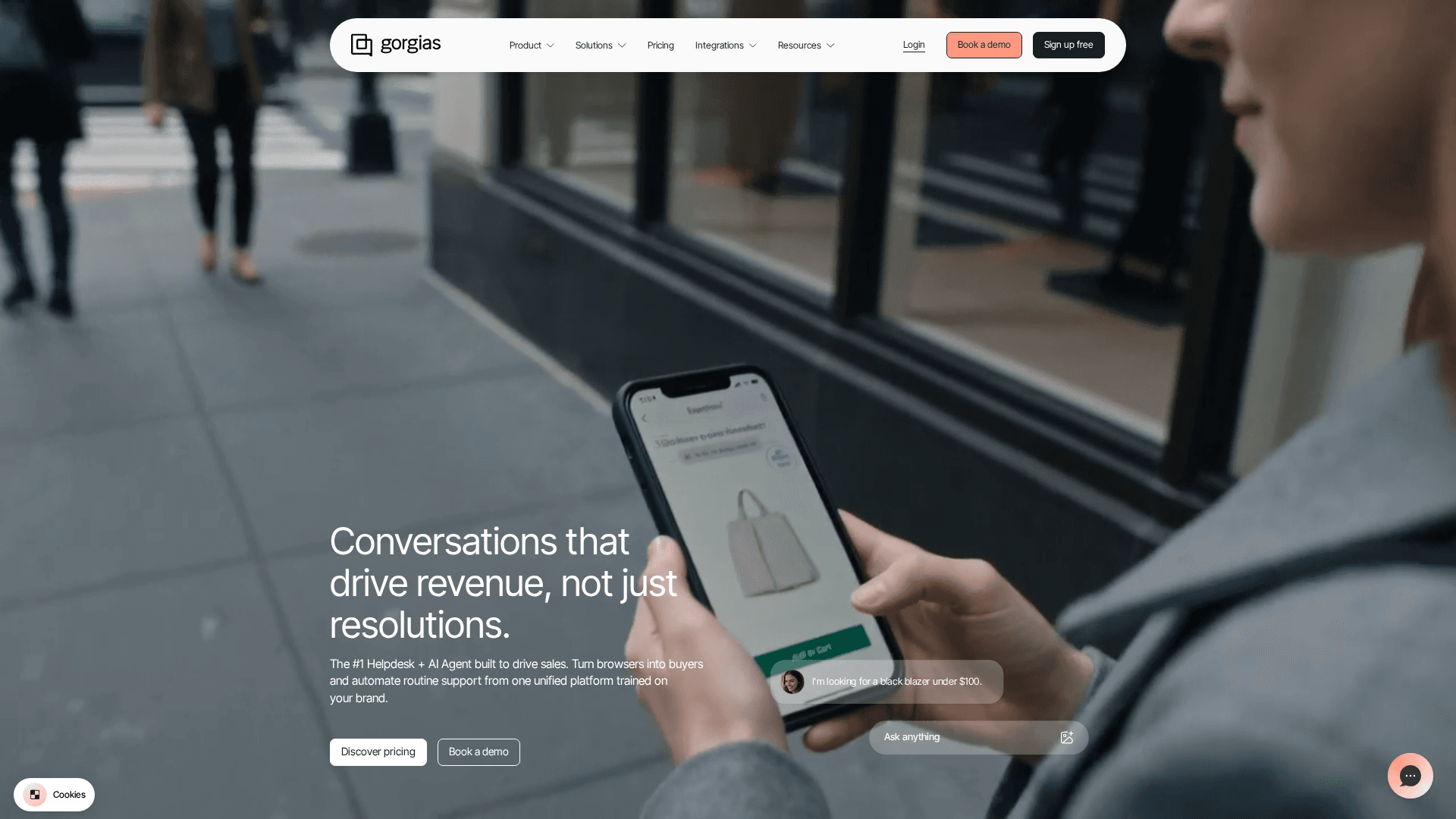
Gorgias is the ecommerce help desk, purpose-built for Shopify and used by 15,000+ brands. Pricing is per-ticket, not per-seat — every plan includes unlimited agents, starting at $10/mo for 50 tickets. The differentiator is depth: order data lives in the ticket sidebar, and agents (or the AI Agent, at $0.90-$1.00 per resolved conversation) can refund, edit, and duplicate orders without leaving the conversation. The "support as revenue" positioning is real — Gorgias tracks how much revenue support conversations generate.
For a Shopify founder, Gorgias at $10/mo is the cheapest real help desk that exists, and per-ticket pricing means your VA, your co-founder, and you all get seats for free. The Shopify actions save genuine minutes per ticket. The warning label is billing: ticket-based pricing punishes volume spikes (a documented BFCM example saw a 246% monthly increase), and AI conversations are effectively double-billed — the AI resolution fee AND the ticket it consumed. One Shopify reviewer reported $14K in surprise AI charges. Set billing alerts, cap the AI agent's scope, and Gorgias is the automatic ecommerce pick; let it run unwatched and your margin pays for it.
Key Features
- Per-ticket pricing with unlimited agents on every plan — from $10/mo
- Deep Shopify/BigCommerce/Magento actions: refunds and order edits inside the ticket
- AI Agent for support + sales at $0.90-$1.00 per resolved conversation
- Social comment + DM management (Instagram, Facebook, TikTok Shop)
- Revenue attribution reporting — see which support conversations drive sales
Pricing
Starter $10/mo (50 tickets, then $0.40/ticket). Basic $60/mo (300 tickets). Pro $360/mo (2,000 tickets). Advanced $900/mo (5,000 tickets). AI Agent $0.90-$1.00 per resolved conversation. Up to 16% annual discount.
Rating
4.6/5 — G2 (550+ reviews)
Best For
Ecommerce and DTC brands on Shopify, from side-hustle ($10 plan) to 8-figure sto...
Pros
- Unlimited agents on every plan — the whole team works tickets at no extra cost
- Unmatched Shopify depth: refunds and order edits without leaving the ticket
- $10 entry is the cheapest real help desk anywhere
Cons
- Ticket-based billing punishes volume spikes — BFCM months can triple the bill
- AI resolutions also consume billable tickets (effective double-billing); surprise-charge reports are the #1 complaint
Intercom
Best AI Agent — Fin 3 + a Genuinely Generous Startup Program
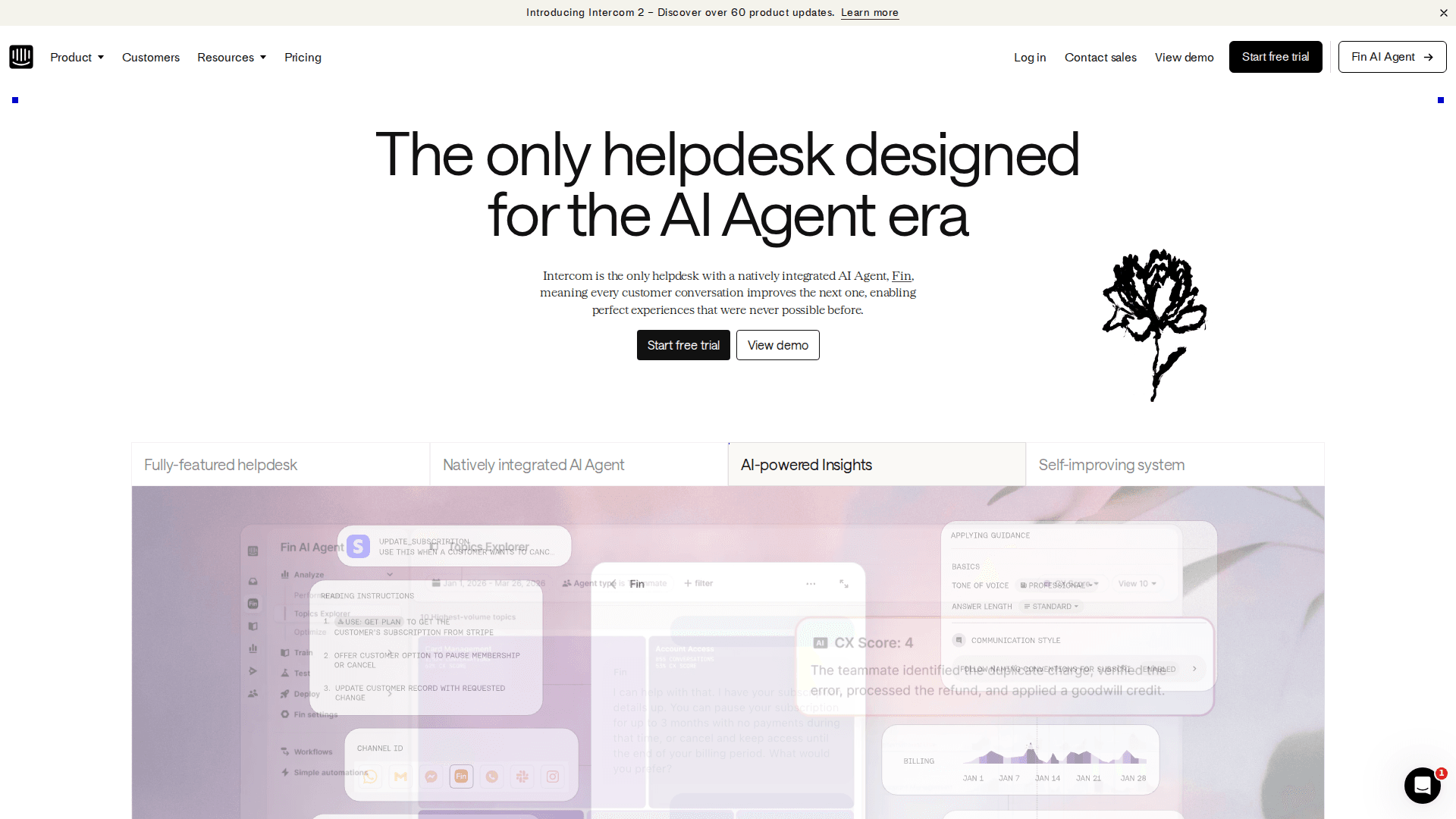
Intercom is the AI-first customer service platform, now so centered on its Fin AI agent that the company is rebranding around it. Fin 3 (October 2025) added Procedures — multi-step agentic workflows that execute refunds and account changes — plus Fin Voice, Slack/Discord channels, and image recognition. Seats run $29 (Essential) to $132 (Expert); Fin bills $0.99 per resolution on top. The startup program is the hidden gem: up to 93% off plus a year of Fin free for early-stage companies.
Fin is the most-validated AI agent in support (2,900+ G2 reviews, #1 in its category), and Intercom reports a 67% average resolution rate across customers — though its own case studies cluster at 42-50%, which is the number to plan around. For a funded SaaS startup, the math via the startup program is hard to beat: near-free access to the best AI support stack for a year. The reason Intercom sits mid-list for bootstrappers is pricing complexity — Reddit documents bills jumping from $4K to $9K/month as Fin resolutions, seat fees, and usage add-ons stack, and the "assumed resolution" billing rule (no customer reply within 24 hours = billed as resolved) is the most-contested mechanic in the category. Apply for the startup program before paying rack rate.
Key Features
- Fin 3 AI agent: Procedures (multi-step actions), Voice, Slack/Discord, image recognition
- Fin works standalone on 8+ other helpdesks — no migration required
- Omnichannel inbox + in-app Messenger — still the best in-product messaging experience
- Copilot for agents ($29-$35/agent/mo) + Workflows automation
- Startup program: up to 93% off + 1 year of Fin free
Pricing
Essential $29/seat/mo. Advanced $85/seat/mo (20 free Lite seats). Expert $132/seat/mo. Fin AI Agent $0.99 per resolution on top. Copilot $29-$35/agent/mo. 14-day trial; startup program up to 93% off + 1 year of Fin free.
Rating
4.5/5 — G2 (3,300+ reviews)
Best For
Funded B2B/B2C SaaS startups that want the category-leading AI agent and live in...
Pros
- Fin is the most-validated AI agent in the category (2,900+ reviews, #1 on G2)
- Startup program makes the premium stack nearly free for a year
- Polished product across inbox, messenger, and automation — the UX benchmark
Cons
- The most complex pricing in the category — documented bills jumping $4K to $9K/mo as usage stacks
- "Assumed resolution" billing (customer silence = billed success) is the most-contested mechanic in support AI
Helply
The Wildcard — Free Unlimited-Seat Help Desk + $0.50/Outcome AI
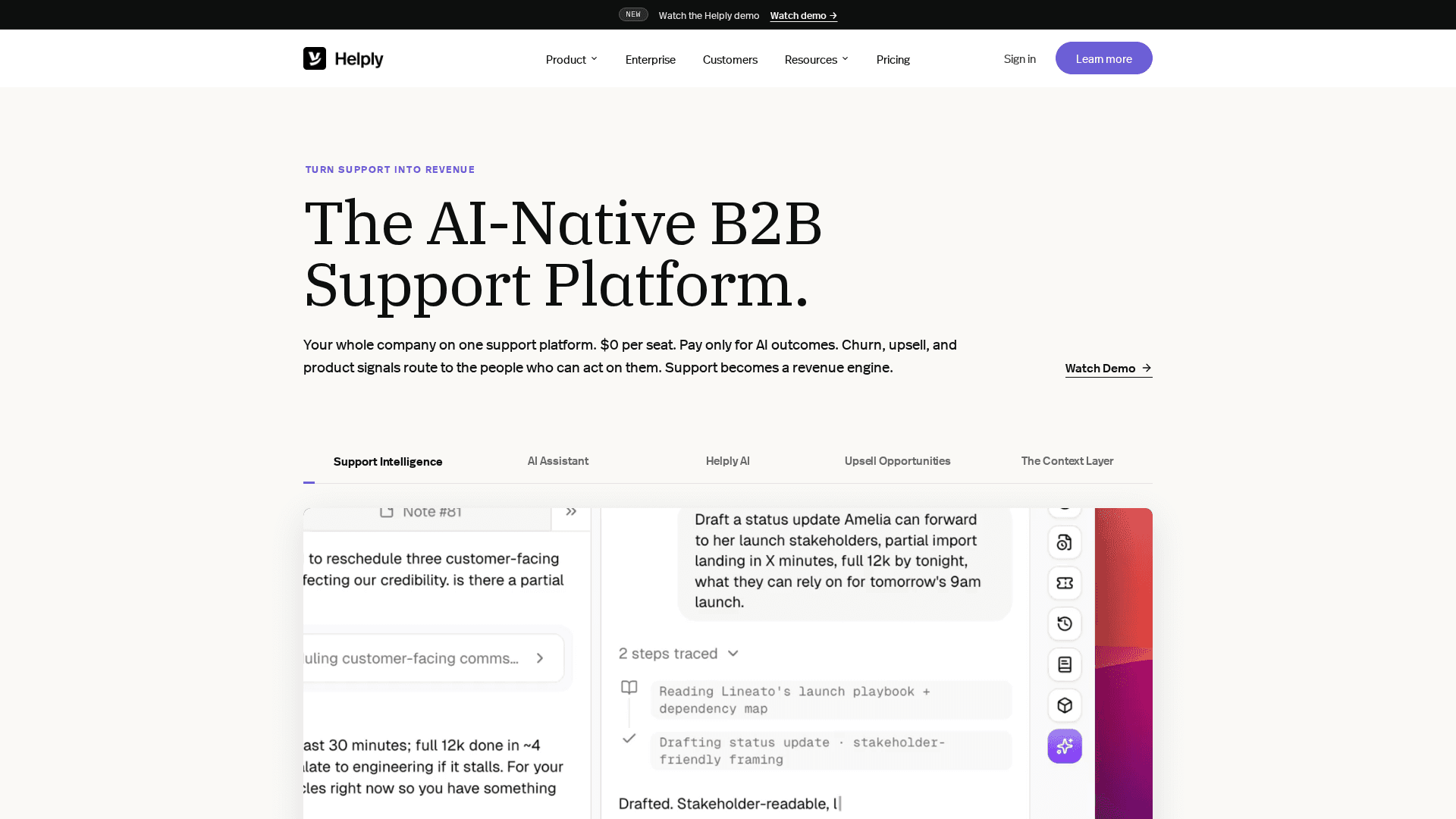
Helply is the most radical pricing experiment in the category. Groove — the simple SMB help desk with 2,000+ customers — rebranded the company to Helply in 2025 and shipped an explicitly anti-per-seat model: the full support platform (shared inbox, ticketing, live chat, knowledge base, reporting) is free forever with unlimited seats, and you pay only $0.50 per AI outcome, with spending caps built in. Groove Classic continues for existing customers. The claim: its self-learning AI resolves 70%+ of Tier-1 inquiries.
If Helply executes, this is the most founder-aligned economics ever shipped in support software: a $0 platform with unlimited seats undercuts every per-seat vendor, and $0.50/outcome undercuts Intercom ($0.99), Gorgias ($0.90-$1.00), and Help Scout ($0.75) on AI. Spending caps prevent the bill-shock stories that plague the category. The reasons it sits at #8 rather than #1 are maturity, not math: the model is brand-new with thin 2026 review evidence (Groove's 4.6/195 on G2 predates the pivot), the integration ecosystem is smaller than incumbents, and long-time Groove users remember earlier pivots. Run it as a low-risk second system on a side project before betting your main support queue on it — at $0 platform cost, trying it is free.
Key Features
- Full support platform free forever: shared inbox, ticketing, live chat, KB, reporting — unlimited seats
- AI-first support at $0.50 per outcome — the lowest per-resolution rate in the category
- Spending caps built in — no surprise AI bills
- Self-learning AI claims 70%+ Tier-1 resolution with auto-created KB articles
- Churn detection + upsell-opportunity flagging on conversations
Pricing
Free forever platform (unlimited seats: inbox, ticketing, chat, KB). AI-First Support $0.50 per outcome with spending caps. Enterprise custom (SSO/SAML, SLAs). Groove Classic legacy plans continue for existing customers.
Rating
4.6/5 — G2 (195+ reviews, as GrooveHQ)
Best For
Bootstrapped and indie B2B SaaS teams who want to pay only when AI actually reso...
Pros
- Most founder-aligned pricing in the category: $0 platform + $0.50/outcome + spending caps
- Undercuts every per-resolution competitor (Fin $0.99, Gorgias $0.90, Help Scout $0.75)
- Unlimited free seats make it a zero-risk trial alongside your current help desk
Cons
- Brand-new model with thin post-pivot review evidence — the 4.6 G2 rating predates Helply
- Smaller integration ecosystem than incumbents; SSO requires the Enterprise tier
HubSpot Service Hub
Best if You Are Already on HubSpot — One CRM Record for Everything
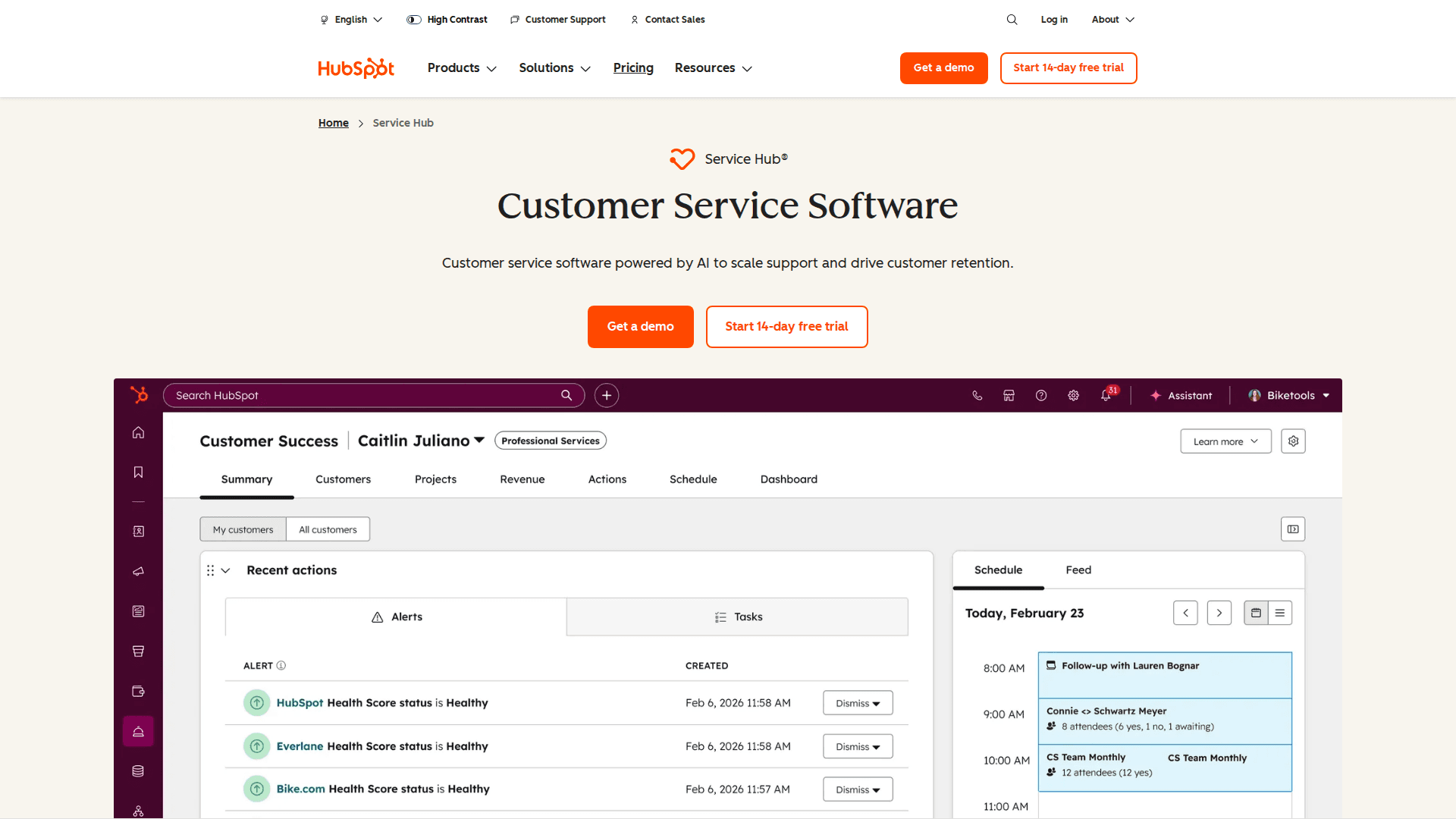
Service Hub is HubSpot's support arm — help desk, ticketing, knowledge base, customer portal, and the Breeze AI customer agent — and its killer feature is structural: every ticket lives on the same CRM record as every marketing touch and sales call. The free tier (basic ticketing, live chat, shared inbox) remains the easiest $0 entry in the industry, and Starter is $15/seat/mo. The 2025-2026 shift to seat-based pricing removed the old contact-tier tax on support teams.
If your company already runs on HubSpot CRM or Marketing Hub, Service Hub is close to automatic: agents see deal history, marketing touches, and lifecycle stage next to every ticket, and there is no integration to maintain. If you are not on HubSpot, buy something else — the ticketing is not designed for high volume (no load-based auto-assignment, inflexible forms), G2 reviewers describe it as behind the curve on AI with credits that "run out very quickly," and the $15 Starter to $90 Professional cliff is the steepest single jump on this list, with $1,500-$3,500 onboarding fees at the top tiers. As a CRM-native support layer it earns its slot; as a standalone help desk it does not.
Key Features
- Tickets on the unified HubSpot CRM record — full customer context with zero integration work
- Free tier: basic ticketing, live chat, shared inbox on the free CRM
- Breeze AI customer agent + AI assistants (credit-metered)
- Knowledge base + customer portal on Professional+
- SLAs, routing, and customer success workspace on higher tiers
Pricing
Free tools (ticketing, chat, shared inbox). Starter $15/seat/mo. Professional $90/seat/mo (annual) + ~$1,500 onboarding. Enterprise $150/seat/mo (10-seat min) + ~$3,500 onboarding. Breeze AI is credit-metered.
Rating
4.4/5 — G2 (2,850+ reviews)
Best For
SMBs already on HubSpot CRM/Marketing who want support on the same customer reco...
Pros
- Unbeatable free entry point on the free CRM — $0 to functional support inbox
- CRM context makes every ticket account-aware automatically
- Familiar admin UX for the millions of teams already in HubSpot
Cons
- Ticketing is not built for high volume — no load-based assignment, inflexible forms
- The $15 to $90 Starter-to-Professional cliff is the steepest on this list, plus onboarding fees
Tidio
Best Free Starting Point — Budget 2-3x Sticker Once Lyro AI Lands
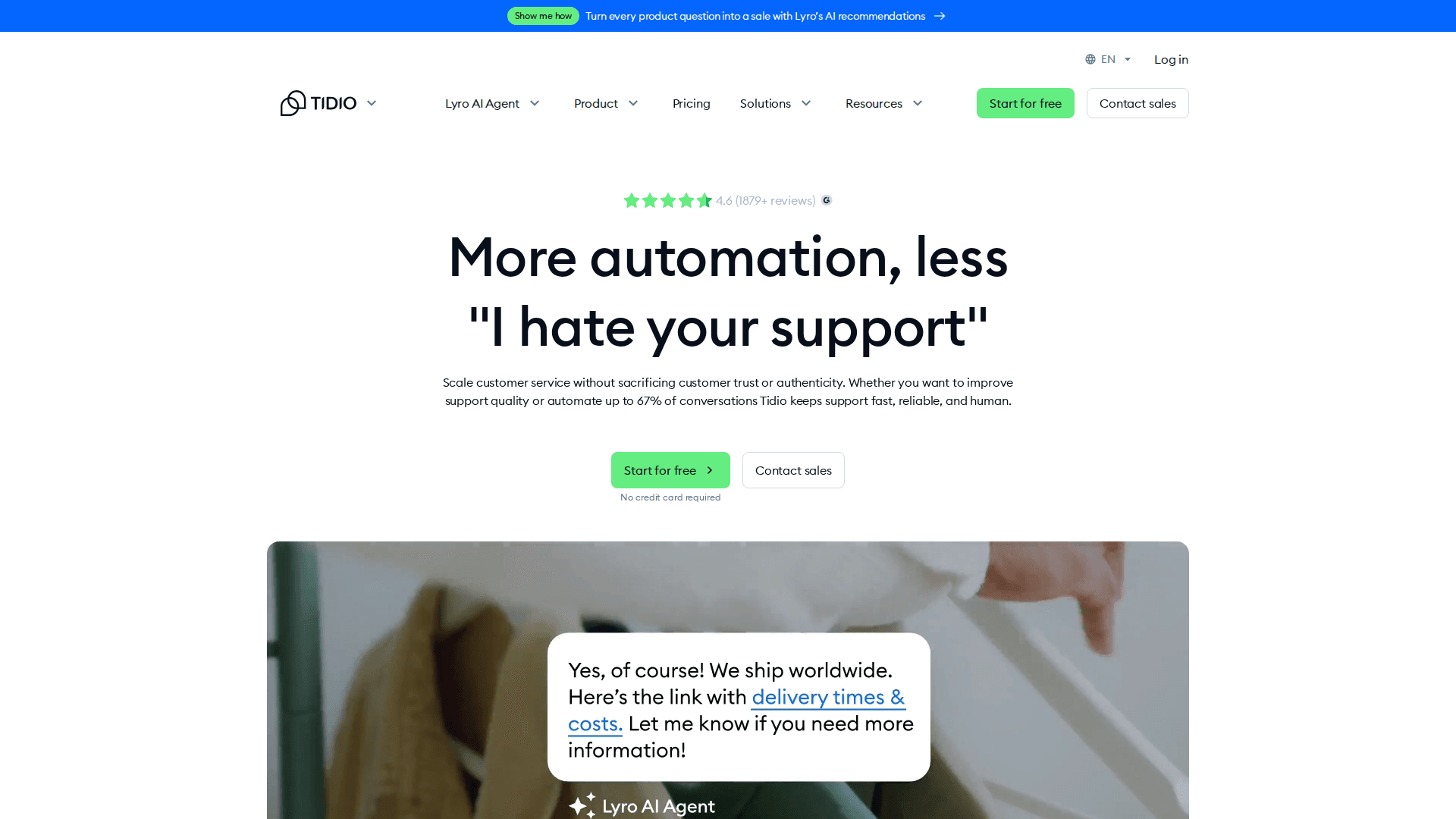
Tidio is a live chat + chatbot platform that grew into a light help desk, used by 300,000+ businesses and anchored by Lyro — its AI agent with a claimed 67% average resolution rate and a contractual 50% resolution guarantee on the Premium tier. The free plan (50 conversations/mo, 10 seats) is one of the most generous in the space, and the whole thing deploys on a Shopify or WordPress site in an afternoon. It is the easiest $0 entry into AI-assisted support on this list.
For a solo founder with a storefront or a small service site, Tidio free plus the trial Lyro conversations is a real, working support stack at $0. The reason it ranks last among the ten: pricing trust. Advertised plans exclude Lyro — the AI is metered separately (from ~$33/mo for 50 AI conversations), so real-world cost runs 2-3x sticker; the "50 free Lyro conversations" are lifetime, not monthly; conversations reset after ~15 minutes of customer silence (one returning customer can burn multiple billed conversations); and when the AI quota runs out, Lyro silently stops answering. There is also a $59-to-$749 cliff between Growth and Plus with nothing in between. Start free, measure what Lyro actually resolves, and graduate deliberately.
Key Features
- Free plan: 50 conversations/mo, 10 seats, 50 lifetime Lyro AI conversations
- Lyro AI agent: claimed 67% average resolution; contractual 50% guarantee on Premium
- Flows visual chatbot builder + multichannel inbox (Messenger, Instagram, WhatsApp, email)
- Deep Shopify/WordPress integrations — live in an afternoon
- Smart Actions: order status, lead qualification, product recommendations
Pricing
Free (50 conversations/mo, 10 seats). Starter $29/mo ($24 annual, 100 conversations). Growth from $59/mo ($49 annual, 250+). Plus from $749/mo. Lyro AI metered separately from ~$33/mo for 50 AI conversations. 7-day trial.
Rating
4.7/5 — G2 (1,800+ reviews)
Best For
Solo founders and small ecommerce sites that want a free chat + AI starting poin...
Pros
- One of the best free plans in the space — a real working stack at $0
- Lyro performs well on FAQ-style retail support; 50% resolution is contractually guaranteed on Premium
- Fastest deployment on this list — live on Shopify/WordPress in an afternoon
Cons
- Real cost runs 2-3x sticker once Lyro AI and volume land; the 15-minute conversation reset inflates billing
- Lyro silently stops answering when the AI quota runs out — a bad failure mode for customers
What We Cut — And Why
Four well-known platforms did not make the ten, and the reasons are themselves useful buying signals:
- Front (4.7/5, 2,400+ G2 reviews) — an excellent collaborative inbox, but the per-seat price plus unbundled AI add-ons (Copilot $20/seat, Smart QA $20/seat, AI Answers ~$0.70/resolution) can quickly double the total cost, and Starter caps at 10 seats. Honorable mention for B2B ops teams where support and account management share one inbox.
- HappyFox — solid, mature ticketing, but pricing now hides behind a sales form with a reported 5-agent minimum. Pricing opacity is anti-founder; when vendors publish numbers again, we will revisit.
- Kustomer — annual-only contracts, 8-seat minimum (~$8,500/yr floor), and reported five-figure implementations. Built for 20+ agent B2C teams, not founders.
- Gladly — ~$180/user with a 10-user minimum puts the floor above $21,600/yr. Great agent experience for established consumer retail brands; wrong list.
How We Chose These Tools
We evaluated 14 customer service platforms in June 2026 against five founder-specific criteria. Most competing listicles are written by the vendors themselves or weight enterprise feature depth; we weighted the opposite.
- Real all-in cost — sticker price + AI fees + overage mechanics + add-on stacking, modeled at 2, 5, and 15 agents
- Pricing model fit — per-seat vs. flat vs. per-ticket vs. per-resolution, matched to founder-stage ticket volumes
- Verified user sentiment — G2 ratings and review counts, cross-checked against Reddit and community complaint themes
- Graduation path — does the tool grow with you, and how painful is the migration when you outgrow it?
- Honest disclosure of billing gotchas — assumed-resolution billing, lifetime-vs-monthly quotas, seasonal spike penalties, AI double-billing
How to Choose by Stage
Pick by where you are, not where you hope to be. Migrating help desks is an afternoon at 100 tickets/month and a quarter-long project at 10,000.
First 100 tickets/mo, $0 budget...
Help Scout Free (5 users) or Helply (free platform, unlimited seats). Shopify stores: Gorgias Starter at $10/mo. All three are real, not demos.
First support hire (2-5 people)...
Help Scout Standard ($25/user) for simplicity, or Crisp Essentials ($95/mo flat, 10 seats) if you expect more hiring — the flat bill never grows.
B2B SaaS with Slack-channel customers...
Pylon Professional ($89/seat, 3-seat min). The Slack connector lives on this tier. Budget ~$800/mo realistic with AI add-ons.
Need SLAs, routing, and a portal...
Freshdesk Growth ($19/agent) or Zoho Desk Professional ($23/user with Blueprints). Real ticketing infrastructure at startup prices.
Funded and AI-first...
Intercom via the startup program (up to 93% off + 1 year of Fin free). Rack rate later is real money — measure Fin's resolution rate during the free year.
Scaling past 10 agents...
Re-run the math: per-resolution AI fees at your volume vs. per-seat add-ons. This is when Kustomer/Gladly-tier platforms (and Zendesk) become rational — and when vendors start negotiating.
Stay Ahead of the Tool Curve
We research dozens of tools so you don't have to. Get our top picks and insider insights delivered weekly.
Frequently Asked Questions
What is the best customer service software for a bootstrapped startup?
Help Scout for most bootstrapped SaaS teams: a real free plan (5 users), $25/user entry, near-zero learning curve, and AI Answers at $0.75 per resolution so you pay for outcomes rather than capacity. If you expect to hire support help soon, Crisp's flat workspace pricing ($45-$95/mo for the whole team) beats every per-seat tool. If you sell on Shopify, skip both and start with Gorgias at $10/mo with unlimited agents. And if you want maximum economics over maturity, Helply's free unlimited-seat platform plus $0.50/outcome AI is the cheapest credible stack in the category.
Do I need a help desk as a two-person startup, or is a shared Gmail inbox enough?
A shared Gmail inbox works until roughly 5-10 tickets a day, then it breaks in predictable ways: two people answer the same email, nobody answers another, and there is no searchable history when a customer returns. The practical trigger points for graduating: (1) you have answered the same question 10+ times — you need a knowledge base; (2) a customer has been double-replied or dropped — you need collision detection; (3) you are hiring your first support contractor — you need assignment and visibility. At that point Help Scout's free plan or Helply's free platform gives you all three for $0, so the real cost of switching is an afternoon of setup.
What is the cheapest customer service software that actually works?
Depends on your model. Cheapest credible stacks in 2026: Helply (free platform, unlimited seats, pay $0.50 per AI outcome only), Help Scout Free (5 users, 1 inbox), HubSpot free tools (if you are on HubSpot CRM), Tidio Free (50 conversations/mo), and Gorgias Starter at $10/mo for Shopify stores. For paid plans, Zoho Desk Express at $7/user/mo is the lowest per-seat price for real ticketing, and Freshdesk Growth at $19/agent/mo is the cheapest plan with SLAs and routing. Avoid judging by sticker price alone — add the AI fees and overage mechanics before deciding.
What is the difference between a help desk, a shared inbox, and a ticketing system?
A shared inbox is email with collaboration — multiple people work one address (support@) with assignments and notes; Help Scout and Front are the archetypes. A ticketing system adds structure on top: every request becomes a tracked ticket with status, priority, SLA timers, and routing rules; Freshdesk and Zoho Desk are built this way. A help desk is the umbrella term for either, usually bundling a knowledge base and chat widget. Founders almost always want to start with the shared-inbox model (less process overhead) and graduate to ticketing structure when SLAs and multi-team routing start to matter — usually past 5 agents or 50 tickets/day.
Per-seat vs. per-resolution pricing — which is cheaper?
At founder volumes, per-resolution wins. Worked example: 300 tickets/mo with AI resolving half is ~150 resolutions — $75/mo on Helply ($0.50), $113 on Help Scout AI ($0.75), or $149 on Intercom Fin ($0.99). A per-seat AI add-on like Zendesk's Copilot costs $50/agent/mo — $250/mo for a 5-agent team — regardless of whether the AI resolves anything. The crossover comes at high volume: past roughly 2,000-3,000 AI resolutions a month, flat or per-seat AI pricing gets cheaper than $0.99 each. Watch the resolution definition, though — Intercom bills "assumed resolutions" (customer goes silent for 24 hours), which inflates the count.
What is the best Zendesk alternative in 2026?
Depends on why you are leaving. If it is cost: Zendesk's $115/agent Professional becomes $165/agent once the $50 Copilot add-on lands, $215 with the $50 Workforce Engagement bundle and $298 with the $83 Contact Center add-on (Zendesk official pricing, checked 2026-08-10), so Freshdesk ($19-$89) or Zoho Desk ($7-$40) replicate the ticketing depth at a fraction. If it is B2B fit: Pylon is the purpose-built alternative for Slack-channel support — Replo migrated 120,000 tickets off Zendesk in five days. If it is simplicity: Help Scout removes 80% of Zendesk's configuration surface. A documented 2025-2026 pattern worth knowing: many teams keep Zendesk as a ticket store and bolt third-party AI on top to escape its per-resolution fees — which works, but usually signals you should migrate at the next renewal.
How much should I budget for customer service software in 2026?
Three realistic tiers. Solo founder: $0-$50/mo — Help Scout Free or Helply free platform, plus pay-per-outcome AI as volume justifies it. Small team (3-5 agents, 300-1,000 tickets/mo): $100-$400/mo — seats on Help Scout/Freshdesk/Zoho plus $75-$300 in AI resolution fees. Scaling team (10+ agents): $1,000-$3,000/mo before enterprise platforms enter the conversation. The universal rule: budget 1.5-3x the sticker price of whatever plan you choose, because AI fees, overage mechanics, and add-ons land there in practice. If a vendor hides pricing behind a sales form (HappyFox, Kustomer, Gladly), assume you are not the target customer yet.
The Bottom Line
Customer service software in 2026 is a pricing-model decision wearing a feature comparison as a disguise. Per-seat tools tax hiring, per-ticket tools tax volume spikes, flat pricing taxes nothing but caps your ceiling, and per-resolution AI taxes success — sometimes, as with Intercom's assumed resolutions, even apparent success.
For most bootstrapped SaaS founders the path is: start on Help Scout Free (or Helply if you want the most aggressive economics in the category), add per-resolution AI once you have measured which questions repeat, and graduate to Freshdesk or Zoho Desk when SLAs and routing become contractual. Shopify founders start at Gorgias, B2B-SaaS-in-Slack teams go straight to Pylon, and funded startups should take Intercom's startup program before paying anyone rack rate.
Whatever you pick, budget 1.5-3x sticker, set billing alerts on day one, and re-read the resolution definition before turning on any AI agent. The vendors are not hiding the gotchas — they are just not putting them on the pricing page.
Related Reading
- 10 Best Zendesk Alternatives — The same category ranked by your reason for leaving Zendesk, with the add-on math reconstructed from official 2026 pricing
- 10 Best AI Customer Support Tools for 2026 — The AI agent layer that sits on top of the help desks in this list
- 10 Best AI Sales Tools for 2026 — The other half of your customer-facing stack
- Best Workflow Automation Tools for Non-Technical Teams — Automate the ticket-adjacent busywork your help desk doesn't cover
- Best Marketing Automation Tools for Early-Stage Startups — Close the loop between support conversations and lifecycle marketing
Sources
- Help Scout — Official Pricing
- Crisp — Official Pricing
- Pylon — Official Pricing
- Freshdesk — Official Pricing
- Zoho Desk — Official Pricing
- Gorgias — Official Pricing
- Intercom — Official Pricing
- Helply — Official Pricing (Groove rebrand)
- Tidio — Official Pricing
- Pylon — Announcing Our $31M Series B (a16z + Bain Capital Ventures)
- Zendesk Pricing Breakdown — Add-On Stacking Analysis (Voiceflow)
- Gartner: Agentic AI Will Autonomously Resolve 80% of Common Customer Service Issues by 2029
- Customer Service Software Market Report ($13.06B in 2026)
Stay Ahead of the Tool Curve
We research dozens of tools so you don't have to. Get our top picks and insider insights delivered weekly.
Trusted by indie hackers and startup founders
Keep Reading
10 Best Zendesk Alternatives in 2026 (Ranked by Why You Are Leaving — Including When to Stay)
The 10 best Zendesk alternatives in 2026 — Freshdesk, Help Scout, Zoho Desk, Pylon, Intercom, Gorgias, Crisp, Helply, HubSpot Service Hub, and eesel AI. Ranked by why teams actually leave, with Zendesk's real 2026 add-on math and the 72-hour rule that decides your AI bill.
7 Best AI Search Visibility Tools for Agencies in 2026
Seven AI search visibility tools ranked for agencies by client workspaces, reporting, prompt economics, and the real cost of managing multiple brands.
10 Best Granola Alternatives for Private AI Meeting Notes (2026)
The best Granola alternatives in 2026, ranked on where your notes are stored, whether your data trains AI, and what a bot-free notetaker really costs. Verified pricing.