
10 Best Marketing Automation Tools for Early-Stage Startups in 2026
Compare the 10 best marketing automation tools for early-stage startups in 2026. Free tiers, startup-friendly pricing, and real trade-offs for bootstrappers, indie hackers, and pre-Series A teams.
Key Takeaways
- Brevo wins for bootstrappers — free forever up to 100,000 contacts with real automation, paid plans from $9/mo. Most generous free tier in the category
- HubSpot Marketing Hub is the funded-startup pick — free CRM + marketing tier, but plan on the $20 Starter-to-$890 Professional cliff when you need real workflows
- Loops has become the default for indie hacker SaaS in 2026 — marketing + transactional email under one tool at $49/mo with no feature gating
- Customer.io’s Startup Program gives qualifying pre-Series A companies 12 months free on a $1,200+/year platform — effectively free for most funded teams
- Mailchimp keeps losing ground — free plan cut to 250 contacts in January 2026, with multi-step automation now gated behind paid tiers. Brevo and MailerLite are eating its lunch
Every early-stage startup needs marketing automation. What most of them don’t need is HubSpot Professional at $890/mo. The gap between what a 5-person company can afford and what most “Best Marketing Automation” articles recommend is enormous.
The real question isn’t “which tool is best?” — it’s “which tool is best for my stage, my business model, and my budget?” A bootstrapped B2B SaaS with 500 trial signups needs something different than a Shopify store with 200 orders or a solo founder building a newsletter-led business. The correct pick is usually not the same.
We evaluated 20+ platforms, tested the top contenders against real early-stage startup scenarios (welcome sequences, trial nurtures, cart recovery, audience growth), and narrowed it to 10 that actually fit the budget and use cases of pre-Series A teams. We prioritized free tiers, entry-price features, startup-specific programs, and what actual founders report on G2 and Reddit — not enterprise marketing claims. Rankings are ordered by how many early-stage teams will get real value, not by vendor size.
Quick Comparison
| # | Tool | Best For | Starting Price | Rating |
|---|---|---|---|---|
| 1 | Brevo | Best Overall for Bootstrappers | Free: 300 emails/day, 100,000 contacts, basic automation | 4.6 |
| 2 | HubSpot Marketing Hub | Best for Funded Startups Scaling Into CRM + Marketing | Free: 2,000 email sends/mo, HubSpot branding, 1 automation | 4.4 |
| 3 | Loops | Best for SaaS Indie Hackers | Free: 1,000 subscribers, 4,000 monthly sends, "Powered by Loops" footer | 4.8 |
| 4 | MailerLite | Best Cheapest Paid Tier with Real Automation | Free: 500 subscribers, 12,000 emails/mo, automation included | 4.6 |
| 5 | ActiveCampaign | Best Automation Depth Without the HubSpot Price Cliff | Starter $15/mo annual ($19/mo monthly) for 1,000 contacts | 4.5 |
| 6 | Customer.io | Best for Product-Led SaaS | Startup Program: up to 12 months free for qualifying companies | 4.4 |
| 7 | Klaviyo | Best for Ecommerce Startups Serious About Email + SMS Revenue | Free: 250 contacts, 500 email sends/mo, 150 SMS credits, full automation | 4.6 |
| 8 | Kit | Best for Creator-Founders Building Audience-First Businesses | Free: 10,000 subscribers, 1 automation, unlimited emails | 4.4 |
| 9 | Encharge | Best for B2B SaaS with Trial-to-Paid Funnels | Growth $99/mo (2,000 active users) | 4.7 |
| 10 | Mailchimp | Best for Founders Who Value Familiar UI and Template Ecosystem | Free: 250 contacts, 500 emails/mo, Mailchimp branding, 1-step automation only | 4.4 |
Brevo
Best Overall for Bootstrappers — Free Forever Up to 100K Contacts
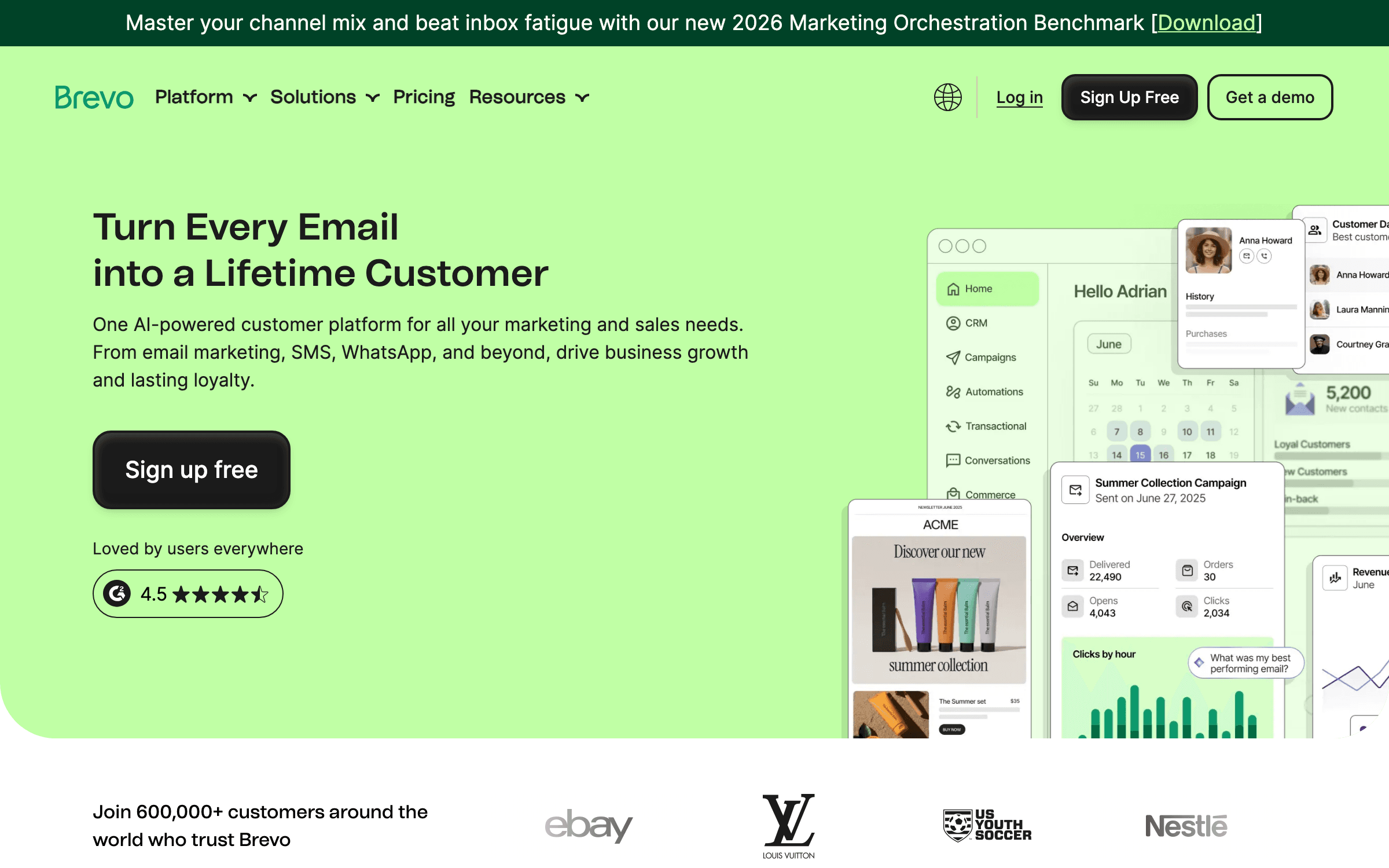
Brevo (formerly Sendinblue) is an all-in-one communication platform bundling email, SMS, WhatsApp, transactional mail, and a free CRM — priced by email sends rather than contacts. For startups with big early-signup lists but low send volume, this pricing model alone can save hundreds of dollars per month vs contact-based platforms.
Brevo stores up to 100,000 contacts free — with most competitors, the same list costs $100+/mo before you send a single email. The free plan includes 300 emails/day forever, marketing automation templates, and a built-in CRM. Paid tiers start at $9/mo for 5,000 emails, making it the cheapest serious option once your list outgrows tiny starter tiers. SMS and WhatsApp credits layer on top as pay-as-you-go, so you can add cart-recovery texts without adopting a second platform.
Key Features
- Send-based pricing (pay per email, not per contact) means bloated lists don’t inflate your bill
- Built-in SMS and WhatsApp credits layered on top of the email platform as pay-as-you-go
- Native CRM, shared inbox, and meeting booking tool included in the free plan
- Transactional email API with dedicated IP available on higher plans for SaaS senders
- Visual automation builder with pre-built flows for welcome, cart abandonment, and birthday
Pricing
Free: 300 emails/day, 100,000 contacts, basic automation. Starter $9/mo (5,000 emails, no daily limit). Business $18/mo (5,000 emails, advanced automation, A/B testing, landing pages). Free plan is forever.
Rating
4.6/5 — G2 (2,600+ reviews)
Best For
Bootstrapped B2C, SaaS, or service startups with 1K-50K contacts who want email ...
Pros
- Unlimited-contact free plan is a lifesaver for startups with big early lists but low send volume
- SMS add-on lets you layer cart-recovery texts without adopting a second platform
- Simple visual automation editor accessible to non-technical founders
- Transparent pricing without the surprise overages typical of contact-based platforms
Cons
- Automation depth is shallow compared to ActiveCampaign or Customer.io (no granular behavioral triggers)
- Analytics reporting is basic — limited cohort analysis or revenue attribution
HubSpot Marketing Hub
Best for Funded Startups Scaling Into CRM + Marketing
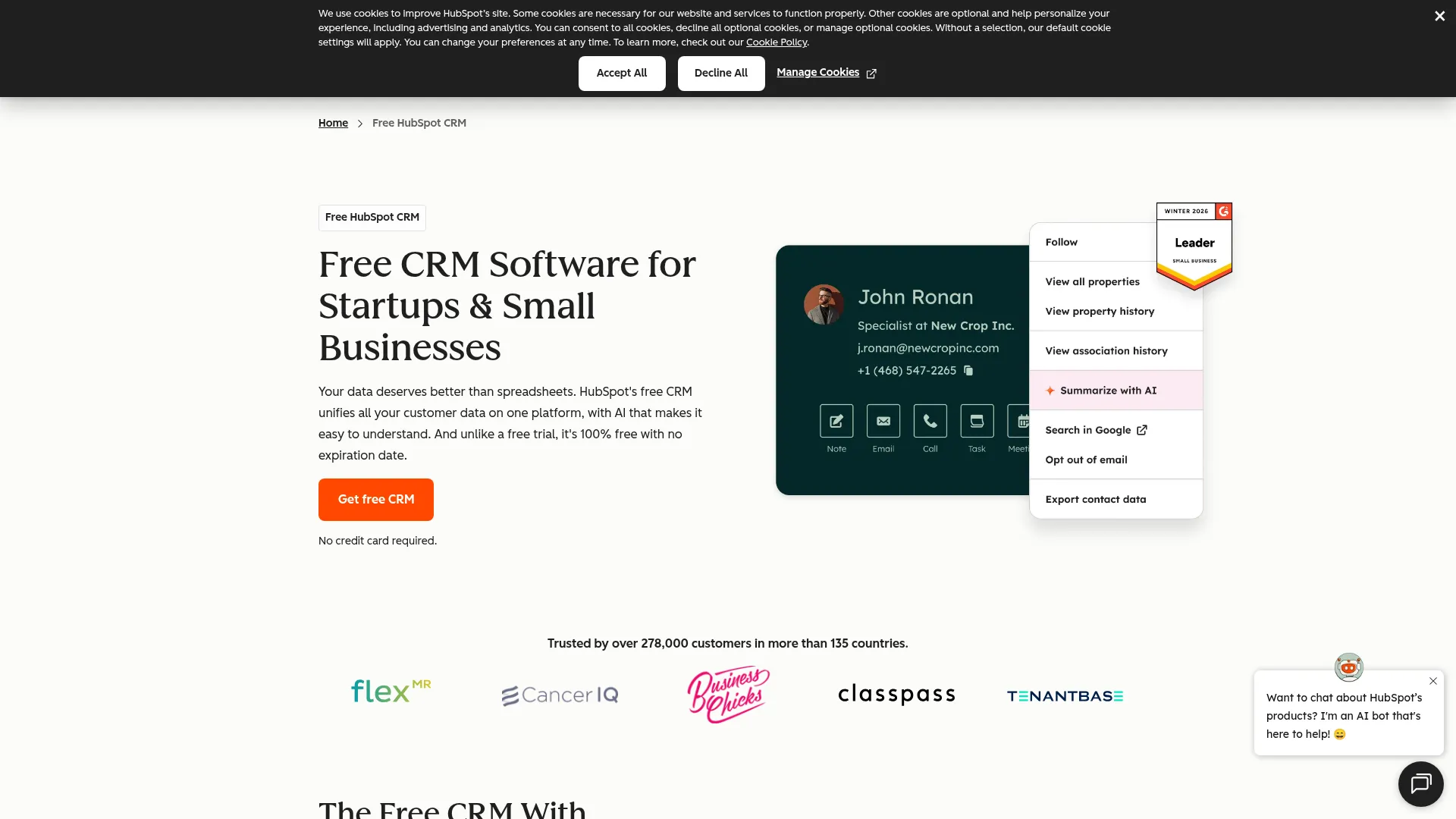
HubSpot Marketing Hub is an all-in-one marketing automation platform tightly integrated with HubSpot CRM — covering email, forms, landing pages, ads, and workflows. For funded startups planning to build a long-term sales + marketing motion on one platform, HubSpot is the safe, well-documented pick. For pure bootstrappers, the pricing cliff is brutal.
The free CRM + Marketing tier lets pre-revenue startups launch forms, basic email (2,000 sends/mo), and a live chat widget without paying. The Starter plan at $20/mo/seat removes HubSpot branding and adds one simple automation. But real multi-step workflows require Professional at $890/mo with a mandatory $3,000 onboarding — the cliff most bootstrapped teams can’t justify. Funded startups get 30-90% off through HubSpot for Startups, which changes the math significantly.
Key Features
- Free CRM with unlimited users and contact storage baked into the same platform
- Drag-and-drop email builder with 2,000 free monthly sends on the free plan
- Forms, popups, and live chat widget with basic conditional logic
- Multi-step automation workflows available on Professional with goals and A/B testing
- Native integrations with 1,500+ apps via App Marketplace plus HubSpot Academy for training
Pricing
Free: 2,000 email sends/mo, HubSpot branding, 1 automation. Starter $20/mo/seat (1,000 marketing contacts, branding removed). Professional $890/mo (3 seats, full automation, A/B testing, + $3,000 onboarding). 14-day trial on paid plans.
Rating
4.4/5 — G2 (13,000+ reviews, suite-wide)
Best For
Funded startups with 5-30 people who want a single platform for sales + marketin...
Pros
- Generous free CRM + marketing tier lets pre-revenue startups launch without upfront cost
- HubSpot Academy certifications teach marketing fundamentals to non-marketer founders
- Unified contact record across sales, marketing, and support prevents data silos
- Extensive app marketplace means most startup SaaS tools already integrate natively
Cons
- Price cliff from $20 Starter to $890 Professional makes scaling painful for bootstrapped teams
- Contact count includes unsubscribed contacts, so costs creep up faster than expected
Loops
Best for SaaS Indie Hackers — Marketing + Transactional in One Tool
Loops is a modern email platform purpose-built for SaaS, combining marketing broadcasts and transactional sending under one simple pricing model. Launched in 2022 by SaaS founders, it has become the consensus choice for early-stage B2B SaaS teams in 2025-2026 — particularly on indie hacker Twitter/X.
Loops’ pricing reflects its founder DNA: $49/mo for 10,000 subscribers with unlimited emails on all paid tiers and zero feature gating. The Notion-style block editor is the fastest way to write a clean product email, and the platform handles both marketing AND transactional sending from one account — reducing your tool count. Indie hackers on Twitter/X have made it the de facto default for early-stage SaaS in 2026.
Key Features
- Unified marketing + transactional sending from one account (competitors split these)
- Notion-style block editor makes writing clean, plain-text-style SaaS emails extremely fast
- Same features on every paid tier — no paywalls blocking smaller accounts from automation
- Pre-built "loops" (drip sequences) designed for SaaS onboarding, trial, and reactivation
- Straightforward volume-based pricing, no contact-based billing inflation
Pricing
Free: 1,000 subscribers, 4,000 monthly sends, "Powered by Loops" footer. Paid $49/mo (10,000 subscribers, unlimited emails). Scales linearly with subscriber count. Free plan is forever.
Rating
4.8/5 — G2 (early reviews, Product Hunt top pick)
Best For
Early-stage B2B SaaS startups that want one clean tool for both marketing and pr...
Pros
- No feature gating — free and $49 customers get the same automation and editor power
- Combines marketing + transactional under one simple UI, reducing stack complexity
- Purpose-built for SaaS email patterns (onboarding, trial expiry, reactivation)
- Excellent deliverability for transactional mail, important for password resets and receipts
Cons
- Email-only platform — no SMS, push, or in-app messaging if you need multi-channel
- Newer platform with fewer integrations and less community tooling than mature competitors
MailerLite
Best Cheapest Paid Tier with Real Automation
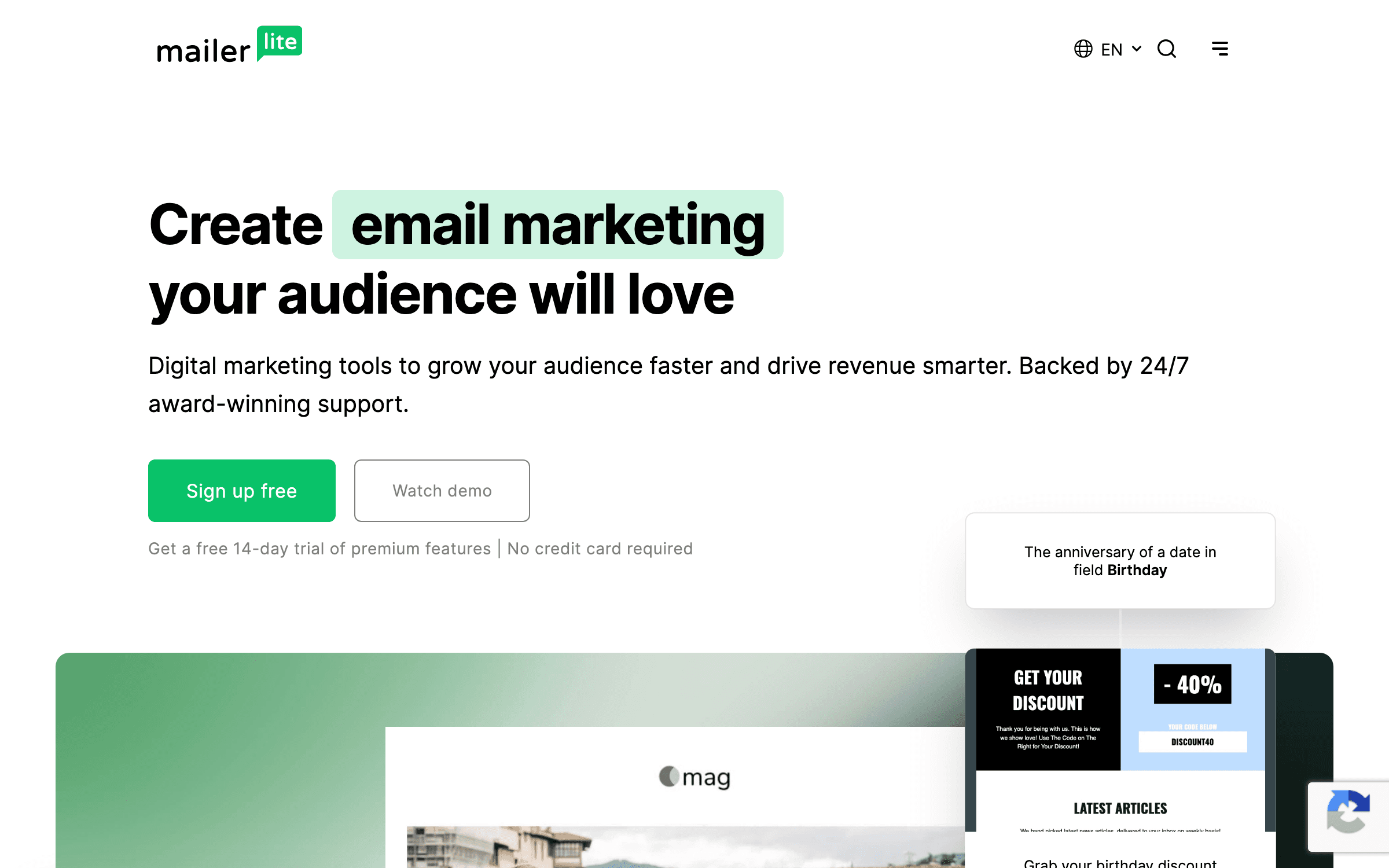
MailerLite is an affordable email marketing platform with a clean, modern UI, drag-and-drop editor, websites/landing pages, and automation — designed for small teams. Its Growing Business plan at $10/mo is the cheapest paid tier on this list, and the free plan still includes real features, not demo versions.
MailerLite’s Growing Business plan at $10/mo (1,000 subscribers) is the cheapest credible paid tier, and the free plan includes automation, a website builder, 10 landing pages, and 12,000 emails/mo. The UI is famously clean, making it the fastest tool for non-marketer founders to ship their first campaign. Caveat: September 2025 cut the free plan from 1,000 to 500 subscribers, so you’ll upgrade faster than before.
Key Features
- Free plan includes drag-and-drop email builder, 10 landing pages, basic website builder, and automation
- Clean minimalist UI with the fastest time-to-first-send on this list for new users
- Built-in paid newsletter subscriptions via Stripe for creator monetization
- Advanced segmentation and multi-trigger automations on Growing Business plan
- File manager and media library integrated for managing email images at scale
Pricing
Free: 500 subscribers, 12,000 emails/mo, automation included. Growing Business $10/mo (1,000 subs, unlimited emails). Advanced $20/mo (A/B testing, custom HTML, AI). 14-day trial on paid plans.
Rating
4.6/5 — G2 (1,100+ reviews)
Best For
Pre-revenue to $50K MRR startups that want a clean, affordable email tool withou...
Pros
- Lowest paid entry point on this list ($10/mo) with automation actually included
- Clean UI gets non-marketer founders productive in under an hour
- Free plan includes real automation, landing pages, and website builder (unusual at this price)
- 30% discount for nonprofits and 10% annual discount stack for cost-conscious teams
Cons
- Free plan cut from 1,000 to 500 subscribers in September 2025
- Automation is simpler than ActiveCampaign — fewer conditional branches and complex logic
Skip the Tool Testing Grind
We test every new marketing automation tool so you don’t have to. Subscribe for weekly startup-friendly picks with real pricing math.
ActiveCampaign
Best Automation Depth Without the HubSpot Price Cliff
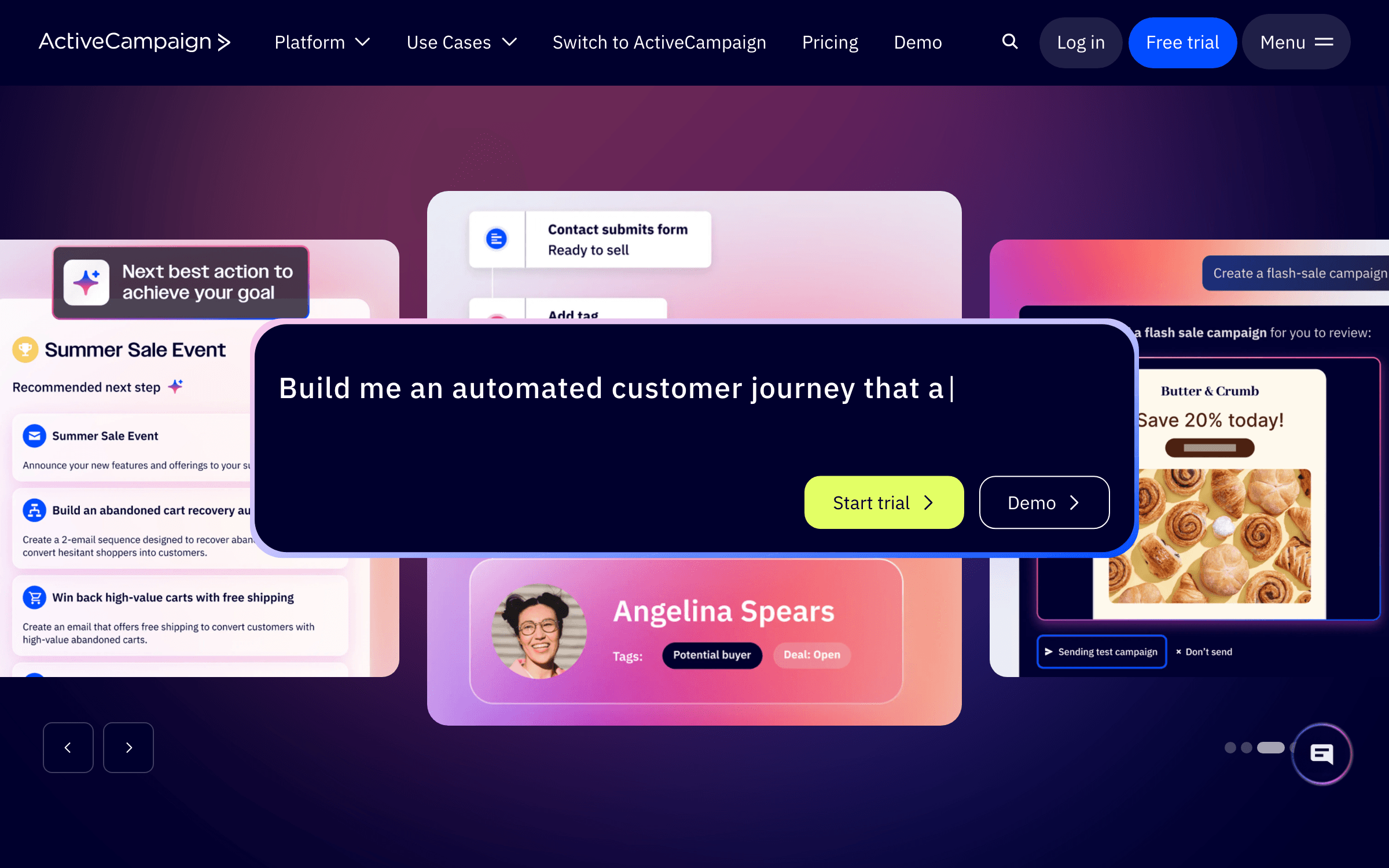
ActiveCampaign is a marketing automation platform with a lightweight CRM, known for its granular visual workflow builder and 900+ pre-built automation recipes. It sits in the sweet spot between simple email tools and full CRM platforms — enterprise automation power at Netflix-subscription pricing.
ActiveCampaign’s Starter plan at $15/mo (annual) for 1,000 contacts includes full automation — no features gated behind higher tiers, unlike HubSpot’s $20 Starter which blocks workflows entirely. For startups doing email-led marketing (welcome sequences, lead scoring, behavior-based nurtures), you get the automation power of a $500+/mo enterprise tool for the price of a Netflix subscription. The 900+ pre-built automation recipes cut setup time from days to hours.
Key Features
- 900+ pre-built automation recipes covering common welcome, abandon, and nurture patterns
- Granular visual workflow builder with conditional branches, goals, and split testing
- Lightweight CRM with deal pipelines and sales automation tied to marketing triggers
- Lead scoring and site tracking to trigger workflows off on-site behavior
- AI-generated email content and automation suggestions
Pricing
Starter $15/mo annual ($19/mo monthly) for 1,000 contacts. Plus $49/mo, Pro $99/mo, Enterprise custom. Scales with contact count ($39 at 2,500; $79 at 5,000). 14-day trial, no credit card.
Rating
4.5/5 — G2 (14,500+ reviews)
Best For
Email-led startups under 30 people who want serious automation on a tight budget...
Pros
- Full automation available on the $15 Starter plan, unlike HubSpot’s gatekept Professional tier
- Massive recipe library means founders can copy proven flows instead of designing from scratch
- Mature platform with extensive documentation, community, and integration ecosystem
- Built-in CRM handles basic sales pipeline needs, delaying the "when do we buy a CRM" decision
Cons
- No free plan — only a 14-day trial, so you commit $15/mo before any validation
- Starter plan caps automation triggers/actions at 5 per workflow; complex flows require higher tiers
Customer.io
Best for Product-Led SaaS — 12 Months Free via Startup Program
Customer.io is a behavior-based messaging platform for SaaS teams that fires email, SMS, push, and in-app messages off product events and user attributes. For startups that live and die by activation funnels and drip campaigns tied to in-product actions, Customer.io is purpose-built — unlike tools that bolt email automation onto a list editor.
Customer.io’s Startup Program gives qualifying companies (under $10M raised, new customers) up to 12 months free on a plan that normally costs $100+/mo. That makes it essentially free during the phase where product-led growth metrics matter most. Outside the program, the $100/mo starting price is a stretch for bootstrappers — which is the main caveat. Multi-channel (email + SMS + push + in-app) from day one means you don’t swap tools at scale.
Key Features
- Event-triggered messaging powered by custom attributes and product-level tracking
- Full support for email, SMS, push notifications, in-app, Slack, and webhooks from one UI
- Visual workflow builder with conditional branches, wait steps, and A/B split testing
- Developer-friendly APIs and SDKs for instrumenting apps with real user events
- Startup Program offers up to 12 months free to qualifying startups under $10M raised
Pricing
Startup Program: up to 12 months free for qualifying companies. Essentials $100/mo (5,000 profiles, core channels). Premium $1,000/mo (500K profiles, advanced features). 14-day trial, 5,000 messages across channels.
Rating
4.4/5 — G2 (500+ reviews)
Best For
VC-backed or pre-Series A SaaS startups with an engineer who can instrument even...
Pros
- Startup Program effectively gives pre-seed / Series A teams a year of a $1,200+ platform for free
- Event-based triggers let you build onboarding flows that fire when users actually do things
- Multi-channel (email + SMS + push + in-app) from day one without swapping tools at scale
- Developer-focused API and strong documentation make technical instrumentation straightforward
Cons
- Starting price of $100/mo (outside startup program) is a stretch for bootstrapped teams
- Setup is non-trivial — requires engineering time to pipe product events into the platform
Klaviyo
Best for Ecommerce Startups Serious About Email + SMS Revenue
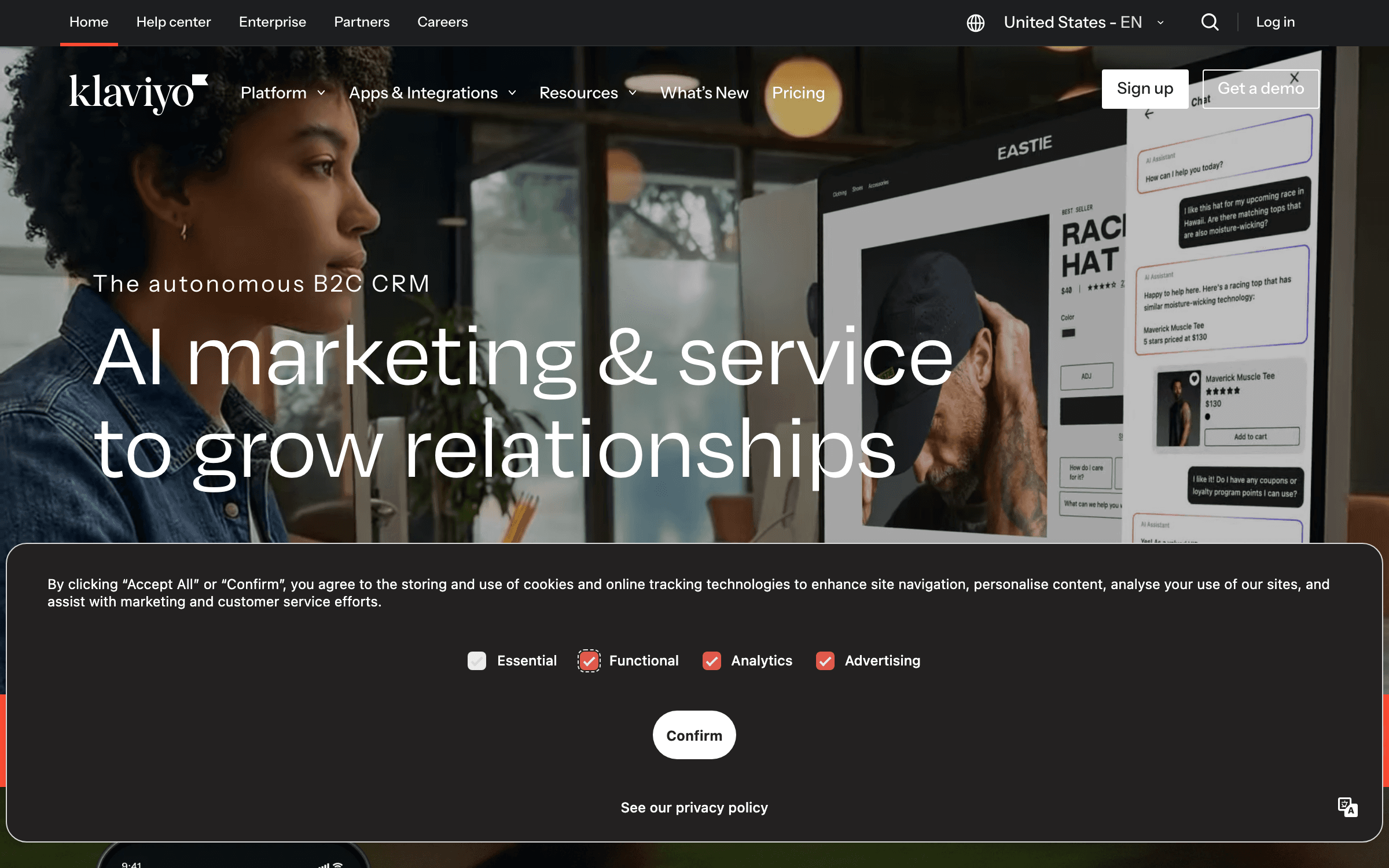
Klaviyo is an ecommerce-native marketing automation platform with deep Shopify integration, built around customer profiles, behavioral flows, and SMS. For a Shopify store with even a few hundred customers, Klaviyo’s browse abandonment and post-purchase flows typically generate 25-35% of total email revenue.
Klaviyo’s free plan covers 250 contacts + 500 emails + 150 SMS credits with access to the full automation builder, segmentation, and flow library — unlike Mailchimp’s free tier which blocks multi-step automation. The $20/mo starting price is reasonable for the power you get. Revenue attribution showing exact dollars driven by each flow makes it trivial to justify the subscription once you have any meaningful order volume.
Key Features
- Pre-built ecommerce flows (welcome, abandoned cart, browse abandonment, post-purchase, win-back)
- Native Shopify, WooCommerce, BigCommerce, and Magento integrations sync orders and browsing behavior
- Customer Data Platform with predicted LTV, churn risk, and next-order timing
- Email + SMS + push from one platform with unified segmentation
- Revenue attribution showing which flows and campaigns drove which orders
Pricing
Free: 250 contacts, 500 email sends/mo, 150 SMS credits, full automation. Email $20/mo (251-500 profiles, 5,000 sends). Email + SMS $35/mo. Scales with profile count. Free plan is forever.
Rating
4.6/5 — G2 (1,000+ reviews)
Best For
Shopify or WooCommerce stores from pre-launch through $5M/year in revenue.
Pros
- Free plan includes full automation and segmentation (unlike Mailchimp’s gutted free tier)
- Browse abandonment and post-purchase flows consistently drive 20-35% of store email revenue
- Revenue attribution shows exact dollars generated by each flow and campaign
- Best-in-class Shopify integration with deep order and behavioral sync
Cons
- Profile-based pricing scales faster than send-based pricing once list grows past 5,000
- Overkill for non-ecommerce startups — waste of features if you don’t sell products
Kit
Best for Creator-Founders Building Audience-First Businesses
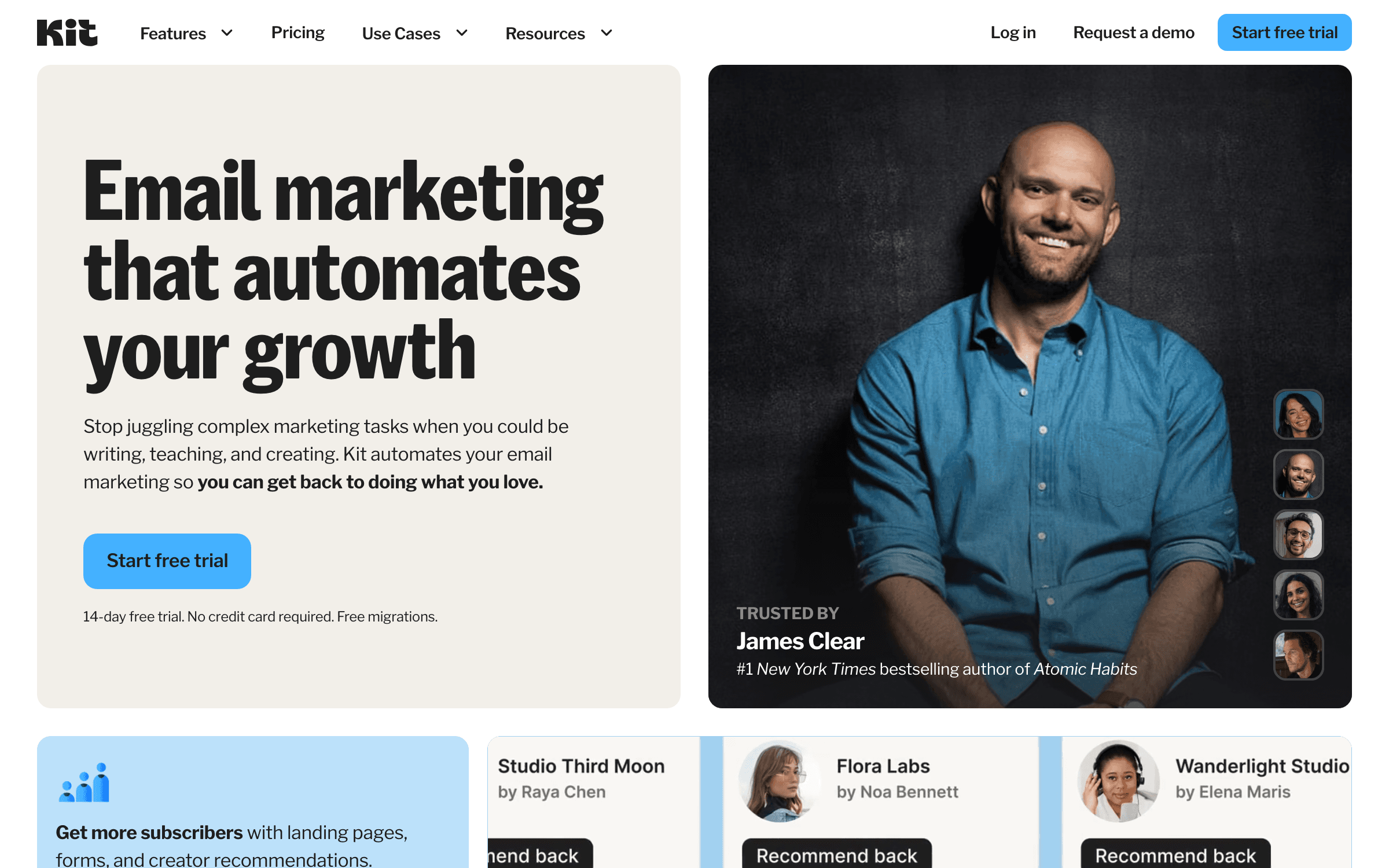
Kit (formerly ConvertKit) is an email platform built for creators, podcasters, and course sellers — centered on growing a newsletter audience and monetizing it via products and sponsorships. For indie hackers building an audience-first business (newsletter → product), Kit’s free plan is essentially free until you need real automation.
Kit’s free Newsletter plan covers 10,000 subscribers with unlimited emails and landing pages — the most generous free tier on this list by raw subscriber count, though limited to one automation. The Creator Network growth loop drives subscriber acquisition natively, and the built-in digital commerce reduces the "newsletter + Gumroad + Stripe" duct tape. Caveat: September 2025 price increase bumped Creator to $39/mo, which has eroded some of the indie hacker goodwill.
Key Features
- Free plan includes 10,000 subscribers, unlimited emails, and unlimited landing pages
- Creator Network recommends subscribers across other creators’ lists for native growth
- Sell digital products, subscriptions, and tips natively without separate Gumroad/Stripe setup
- Visual automation builder with tagging-based segmentation (simpler than journey builders)
- Sponsorship marketplace for monetizing newsletters above certain subscriber counts
Pricing
Free: 10,000 subscribers, 1 automation, unlimited emails. Creator $39/mo (1,000 subs), $59/mo (3,000), $89/mo (5,000). Creator Pro adds advanced reporting. 14-day trial on paid, 30-day refund.
Rating
4.4/5 — G2 (1,000+ reviews)
Best For
Solo founders building a newsletter or course business where the audience IS the...
Pros
- Free plan up to 10,000 subscribers is unmatched in generosity for audience-based businesses
- Creator Network growth loop drives subscriber acquisition natively
- Built-in digital commerce reduces the "newsletter + Gumroad + Stripe" duct tape
- Clean plain-text-style emails outperform heavy designs on deliverability
Cons
- September 2025 price increase (up to 4x for some users) has eroded indie hacker goodwill
- Automation is simpler than ActiveCampaign or Encharge — not ideal for complex B2B SaaS flows
Encharge
Best for B2B SaaS with Trial-to-Paid Funnels
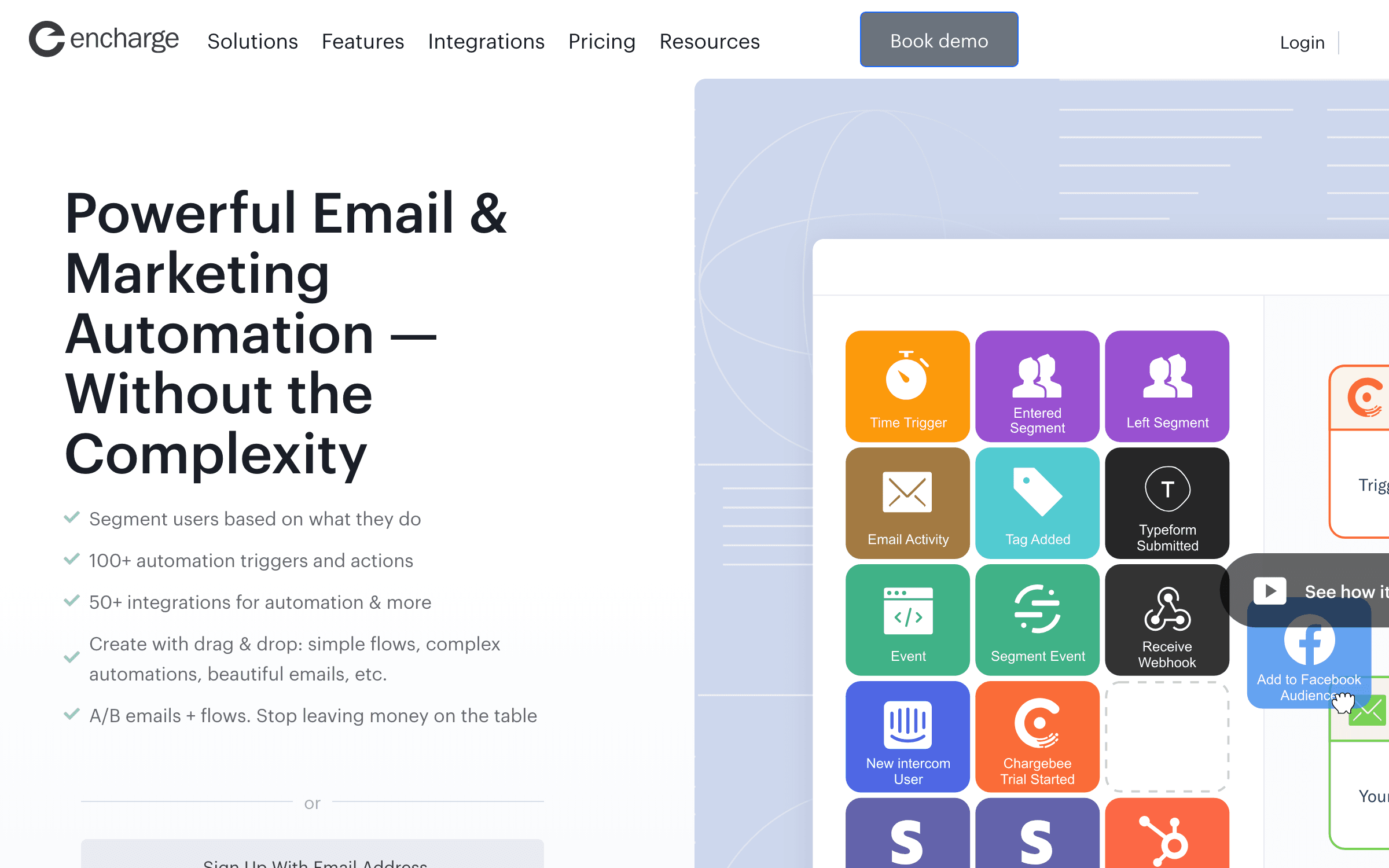
Encharge is a marketing automation platform purpose-built for B2B SaaS, focused on behavior-based onboarding, trial conversion, and lifecycle email flows. It sits in the sweet spot between simple tools and expensive behavioral platforms — starting at $99/mo for 2,000 users with full behavioral triggers.
Encharge is built specifically for SaaS and has pre-built flows for trial-to-paid conversion, onboarding drop-off, and churn prevention — the exact patterns SaaS founders are trying to automate. Less tool-building required than Customer.io’s event-driven approach. Native Stripe and Segment integrations let you trigger emails off payment and product events without code. The $99/mo starting price is for SaaS startups past the pre-revenue phase where behavioral email drives measurable ARR.
Key Features
- Pre-built SaaS lifecycle flows for trial conversion, onboarding, and churn prevention
- Deep Stripe, Segment, Intercom, and HubSpot integrations for behavioral triggers
- Visual flow builder with conditional branching based on user properties and events
- Lead scoring with SaaS-specific signals (trial activity, feature adoption)
- Transactional email support from the same domain and platform
Pricing
Growth $99/mo (2,000 active users). Premium and Enterprise tiers starting around $199/mo with premium features and custom pricing. 14-day trial.
Rating
4.7/5 — G2 (300+ reviews)
Best For
B2B SaaS startups at $10K-$500K ARR with a trial-to-paid funnel that needs behav...
Pros
- Pre-built SaaS flows shortcut what would take weeks to set up in Customer.io
- Behavioral triggers and segmentation priced significantly below Customer.io Essentials
- Native Stripe and Segment integrations trigger emails off payment and product events without code
- Smaller company — more personal support for early-stage founders
Cons
- No free plan means a $99/mo commitment before product-market fit
- Less mature than ActiveCampaign and HubSpot, smaller integration ecosystem
Mailchimp
Best for Founders Who Value Familiar UI and Template Ecosystem
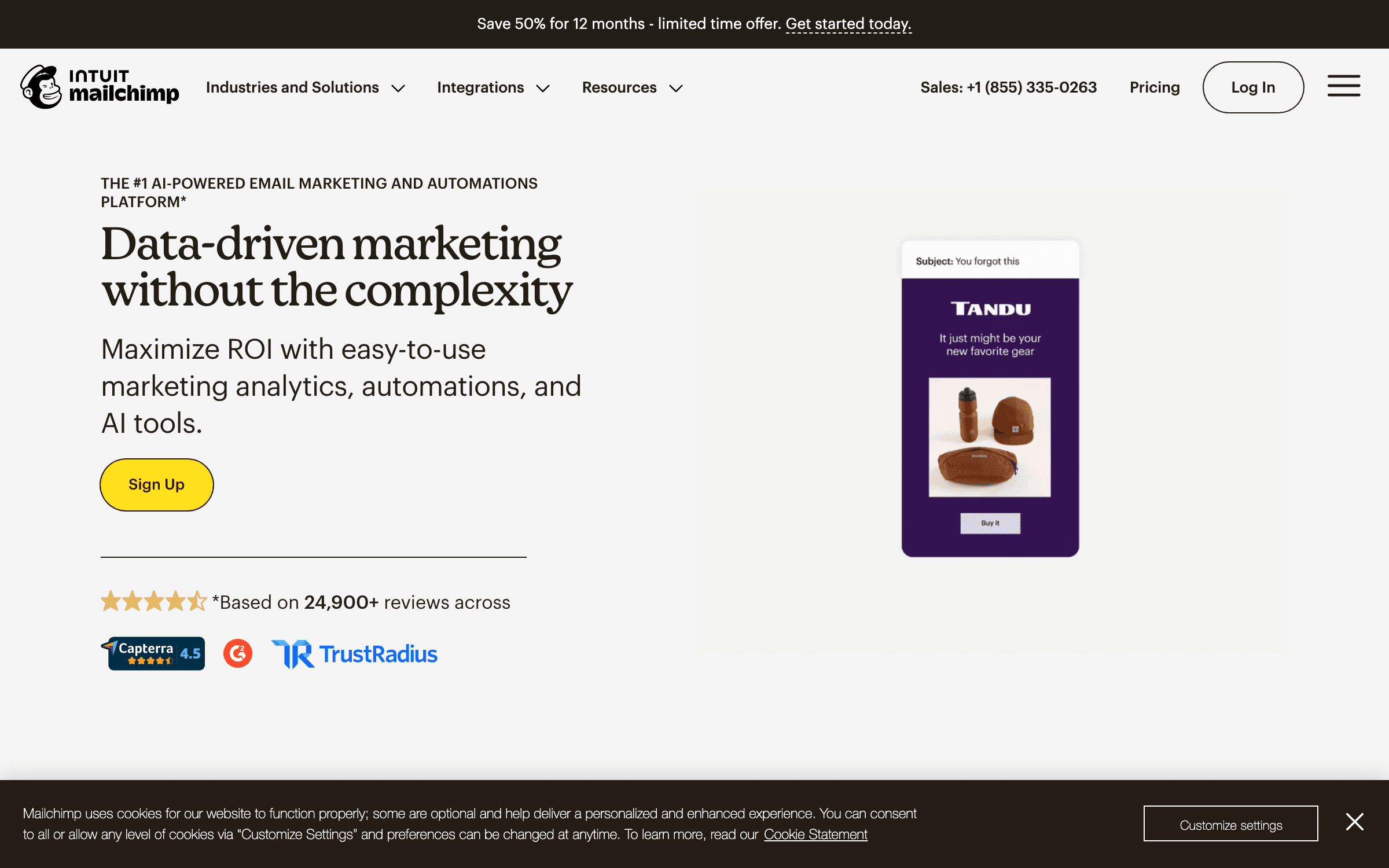
Mailchimp is the original SMB email marketing platform, now an Intuit-owned all-in-one marketing tool with templates, automations, and a growing CRM. It still wins on brand recognition — most non-technical founders know the UI and every guest blogger you hire has used it. But recent pricing changes have undermined its bootstrapper appeal.
Mailchimp’s free plan was cut from 2,000 contacts (2022) to 500 (2023) to 250 (January 2026), and Essentials jumped to $13/mo. Legacy users received another price hike in April 2026. Multi-step automation is now blocked behind paid tiers. Reddit threads and email-testing publications openly recommend Brevo or MailerLite as the default bootstrapper pick in 2026. Mailchimp is still defensible for the very-earliest validation phase (under 250 contacts) when familiarity with the interface trumps everything else.
Key Features
- Massive template library covering industries, occasions, and campaign types
- Creative Assistant (AI) auto-generates branded designs from your website
- Behavioral targeting, segmentation, and predicted demographics on paid plans
- Multi-step automation journeys available starting on the Standard plan
- Extensive integrations with Shopify, WooCommerce, Canva, and 300+ SaaS tools
Pricing
Free: 250 contacts, 500 emails/mo, Mailchimp branding, 1-step automation only. Essentials $13/mo (500 contacts). Standard $20/mo (500 contacts, multi-step automation). Premium $350/mo (10K contacts). 14-day trial on paid.
Rating
4.4/5 — G2 (5,200+ reviews)
Best For
Very-early startups (pre-100 customers) that value template speed and a familiar...
Pros
- Lowest learning curve for first-time email marketers — most startup hires have used it
- Creative Assistant and template library accelerate design for non-designer founders
- Strong Shopify and WooCommerce integrations for very-early ecommerce validation
- Intuit acquisition means deeper accounting and payments integration if you use QuickBooks
Cons
- Free plan was cut to 250 contacts in January 2026 and multi-step automation is blocked behind paid tiers
- Contact-based pricing charges for unsubscribed contacts, which makes list bloat expensive
How We Chose These Tools
We evaluated 20+ marketing automation platforms against five criteria weighted for early-stage startup founders:
- Free tier quality — is the free plan actually usable, or is it a demo? Tools with real automation, landing pages, and respectable contact limits scored higher
- Entry pricing and scaling curve — can a 5-person team afford the Starter tier? Does the price cliff to the next tier kill the budget? Tools with gradual pricing scored higher than those with huge jumps
- Startup program or discount — Customer.io offers 12 months free, HubSpot offers up to 90% off. For funded startups, these programs change the entire cost equation
- Fit for startup-specific use cases — trial-to-paid onboarding, cart recovery, audience growth. We favored tools with pre-built flows for the exact patterns early-stage teams are building
- Real founder feedback — we weighted Reddit threads, Indie Hackers discussions, and G2/Capterra reviews from actual startup users over vendor marketing claims
How to Choose the Right Marketing Automation Tool
Match the tool to your business model and stage. Here’s the quick decision framework:
If you’re bootstrapped with a growing list...
Brevo for the forever-free 100K contact cap. MailerLite if you want the cleanest UI at $10/mo with real automation.
If you’re VC-backed and pre-Series A...
Customer.io via the Startup Program (12 months free). Or HubSpot if you qualify for HubSpot for Startups (up to 90% off).
If you’re building a SaaS...
Loops for indie-hacker simplicity and marketing + transactional in one. Encharge once you have a trial-to-paid funnel worth optimizing.
If you run a Shopify or WooCommerce store...
Klaviyo — free plan includes full automation, revenue attribution, and the best Shopify integration in the category.
If you’re a creator or content-led founder...
Kit (formerly ConvertKit) — 10K-subscriber free plan, Creator Network growth loop, and built-in digital commerce.
If you need serious automation at a tight budget...
ActiveCampaign Starter at $15/mo includes full automation with 900+ pre-built recipes — unmatched automation depth at this price.
Get Startup-Friendly Tool Picks Weekly
Honest breakdowns, real pricing math, and the unfiltered trade-offs. No affiliate spam.
Frequently Asked Questions
What’s the cheapest marketing automation tool for a 10-person startup?
MailerLite at $10/mo (Growing Business, 1,000 subs) or Brevo’s forever-free plan (300 emails/day, 100K contacts) are the two cheapest credible options. Brevo wins if your list is large but send volume is low; MailerLite wins if you need the cleanest UI with the fewest daily-sending limits. Both include real automation on their entry tiers — unlike Mailchimp, which locks automation behind paid plans.
Should I use HubSpot or ActiveCampaign at 100 customers?
ActiveCampaign. At 100 customers, you haven’t earned HubSpot’s $890/mo Professional tier, and HubSpot Starter at $20/mo blocks the workflows you actually need. ActiveCampaign Starter ($15/mo) includes full automation on day one. Revisit HubSpot when you’re hiring a second salesperson and need an integrated CRM, or when you qualify for HubSpot for Startups discounts.
Is Loops really replacing Customer.io for SaaS startups?
For most pre-seed and seed-stage SaaS, yes — at least for year one. Loops covers 80% of what early SaaS teams need (onboarding sequences, trial nurtures, broadcasts) at $49/mo vs Customer.io’s $100/mo base. Once you need multi-channel (push, SMS, in-app) or sophisticated event-based triggers, Customer.io becomes worth it — especially if you qualify for their 12-month free startup program.
Do I need marketing automation at pre-launch or pre-PMF?
Yes, but start minimal. A free tier (Brevo, MailerLite, Kit, Klaviyo) covers your first 500-10,000 subscribers with zero cost. You need enough to capture signups from your landing page, send a welcome email, and blast updates when you ship. Wait to invest in behavioral triggers and advanced automation until you have actual users doing actual things in your product.
Can I use Mailchimp in 2026 as a bootstrapper?
Technically yes, but the math has shifted against it. At 250 free contacts, Mailchimp is more restrictive than Brevo (100,000 free contacts), MailerLite (500 free with real automation), or Kit (10,000 free subscribers). The main reason to still pick Mailchimp is familiarity — if your team already knows it and you’re under 250 contacts. Beyond that, alternatives win on price, features, and generosity.
The Bottom Line
For most bootstrapped startups, Brevo is the right starting point. The forever-free 100K-contact tier covers your first year of growth, and the $9/mo Starter unlocks everything you need to run serious email campaigns. If you want the cleanest UI at the absolute lowest paid price, MailerLite at $10/mo is the only real competitor.
For funded SaaS startups, Customer.io’s Startup Program is functionally free for 12 months on a platform that costs $1,200+/year at list price — apply before you need it. If you’re building in public on indie hacker Twitter, Loops has become the default for a reason: unified marketing + transactional at $49/mo with zero feature gating.
For ecommerce, Klaviyo is non-negotiable once you have any meaningful order volume — the free plan includes full automation, and revenue attribution makes ROI obvious. And if you’re a creator-founder building an audience-first business, Kit’s 10K-subscriber free tier is still the category benchmark. Pick the tool that matches your business model, not the one your competitor uses.
Related Reading
- 10 Best Customer Service Software for 2026 — Close the loop between lifecycle marketing and the support inbox
- 10 Best AI Tools for Internal Workflow Management — AI-powered automation for ops, approvals, and team coordination
- Best Tools for SaaS Affiliate Programs — Recurring commission tracking and partner portals for SaaS growth
- The Solopreneur AI Stack in 2026 — The $73-$205/mo AI toolkit running one-person SaaS companies
- Best Competitor Analysis Platforms — Track rivals, benchmark performance, and find market gaps
Sources
Get Startup-Friendly Tool Picks Weekly
Honest breakdowns, real pricing math, and the unfiltered trade-offs. No affiliate spam.
Trusted by indie hackers and startup founders
Keep Reading
8 Best Newsletter Platforms for Indie Hackers in 2026 (We Run Ours on the #1 Pick)
The 8 best newsletter platforms for indie hackers in 2026 — Beehiiv, Kit, Ghost, Buttondown, Loops, EmailOctopus, MailerLite, and Resend — ranked by who owns your audience and what a paid newsletter actually costs. Includes the Substack 10%-forever math.
Best SaaS Acquirers for Bootstrapped Startups in 2026
Compare the best SaaS acquirers and marketplaces for selling your bootstrapped startup. Find the right buyer for your deal size, timeline, and goals.
7 Best AI App Builders for Non-Technical Founders in 2026
The best AI app builders for non-technical founders, ranked by what you can actually launch: user accounts, data, payments, publishing, costs, and exit paths.