
8 Best Beehiiv Alternatives in 2026 (After the October Price Rise)
The best beehiiv alternatives in 2026, ranked for writers who just want to send a newsletter. Real prices at 1,000 and 10,000 subscribers, checked November 2026.

Key Takeaways
- Beehiiv repriced on October 1, 2026: Launch became Free, Scale became Lite and Max became Pro. Lite now costs $49/mo billed yearly ($59 monthly) at 1,000 subscribers and $119/mo billed yearly ($139 monthly) at 10,000 — up from $96/mo yearly on Scale at the same 10,000-subscriber tier (beehiiv.com/pricing and EmailOctopus’s before-and-after table, October 2026). Existing customers move at their first renewal on or after November 1, 2026.
- The new price buys a bigger bundle, not a better newsletter tool: every beehiiv plan now includes a website builder, podcast hosting, community spaces and digital products, and you cannot drop them to pay less. If you only write and send, you are funding products you will never open.
- Buttondown is the best beehiiv alternative for writers who just want to send a newsletter: $9/mo for up to 1,000 subscribers and $79/mo for up to 10,000, with paid subscriptions as a $9/mo add-on and a 0% cut of your revenue (buttondown.com/pricing, November 2026). It is self-funded and profitable, so there is no investor pushing the next price rise.
- Kit has the best free plan of any beehiiv alternative — up to 10,000 subscribers with paid newsletters and digital products included — but takes 3.5% + 30¢ per sale including card processing (kit.com/pricing, November 2026). Ghost is the pick for paid newsletters that want their own site: 0% transaction fees and $29/mo billed yearly at 1,000 members.
- Full disclosure: the Superframeworks newsletter runs on beehiiv, so this price change lands on us too. No platform on this list paid for placement, and we don’t sell a newsletter tool.
On October 1, 2026, beehiiv changed its plans for only the second time in five years. The first paid plan — Scale, now renamed Lite — got more expensive at every subscriber tier. A 10,000-subscriber newsletter now pays $119 a month on yearly billing, up from $96, and $139 if it pays monthly. Existing customers start paying the new price at their first renewal on or after November 1, 2026 — which is why so many people are searching for beehiiv alternatives right now.
The price is only half of it. Beehiiv's CEO Tyler Denk justified the change by pointing to everything the platform now does: an ad network, a website builder, podcasts, community spaces, digital products, an AI agent. That bundle is great if you use it. But plenty of people just want to write something good and get it into inboxes — and you can't drop podcasts or communities to pay less. If that's you, you're now funding features you'll never open.
So we ranked the eight best beehiiv alternatives for people who mainly want to send a newsletter: what each costs at 1,000 and 10,000 subscribers, how big the free plan really is, and what cut it takes if you charge readers. Every price below was checked on the vendor's own pricing page in November 2026. Full disclosure: the Superframeworks newsletter runs on beehiiv, so this price rise hits us too — and no platform here paid to be included.
What Changed at beehiiv in October 2026
Lite costs more at every tier
13% to 38% more than Scale on yearly billing, per EmailOctopus's comparison; biggest jumps on the biggest lists
A bigger bundle you can't opt out of
Website, podcast, community and digital products are included on every plan
Tighter limits
Lite has 2 team seats (Scale had 3); Free allows 1 publication (Launch allowed 3); webhooks moved to Pro, per EmailOctopus
Monthly billing costs a lot more
Lite at 1,000 subscribers is $59 monthly vs $49 yearly; branding removal still requires Pro
| Subscribers | Scale (old) | Lite (new) | Change |
|---|---|---|---|
| 1,000 | $43/mo | $49/mo | +14% |
| 2,500 | $61/mo | $69/mo | +13% |
| 5,000 | $78/mo | $95/mo | +22% |
| 10,000 | $96/mo | $119/mo | +24% |
| 25,000 | $149/mo | $169/mo | +13% |
| 50,000 | $219/mo | $249/mo | +14% |
| 100,000 | $290/mo | $399/mo | +38% |
Yearly billing, shown per month. Old prices from beehiiv's pricing page in March 2026 and new prices from the same page in October 2026, as tabulated by EmailOctopus (a competitor). We confirmed the $49 (1,000) and $119 (10,000) Lite figures on beehiiv.com/pricing in November 2026.
Beehiiv Alternatives Compared: What You Actually Pay
Cheapest plan that fits each list size, yearly billing where offered. Checked on each vendor's pricing page, November 2026.
| # | Tool | Free plan | ~1,000 subscribers | ~10,000 subscribers | Cut of paid subs |
|---|---|---|---|---|---|
| — | beehiiv (baseline) | Up to 2,500 subscribers | $49/mo Lite | $119/mo Lite | 0% |
| 1 | Buttondown | Up to 100 subscribers | $9/mo (+$9 for paid subs) | $79/mo (+$9 for paid subs) | 0% |
| 2 | Kit | Up to 10,000 subscribers | $0 Free; $33/mo Creator (yearly) | $0 on Free; paid tiers scale with list | 3.5% + 30¢ incl. card fees |
| 3 | Ghost | No hosted free plan (self-host free) | $29/mo Publisher (yearly) | $88/mo Publisher (yearly) | 0% |
| 4 | EmailOctopus | 2,500 subscribers, 10,000 emails/mo | $12/mo (yearly) | $40/mo (yearly) | No paid subscriptions |
| 5 | MailerLite | 250 subscribers, 2,500 emails/mo | $17.10/mo Comfort (yearly) | $69/mo Comfort at 8,000 | Stripe fees on paid plans |
| 6 | Substack | Unlimited subscribers | $0 | $0 | 10% + Stripe fees |
| 7 | Sender | 2,500 subscribers, 15,000 emails/mo | From $9/mo (scales with list) | Scales with list | No paid subscriptions |
| 8 | listmonk | Free software (self-hosted) | Server + ~$0.40/mo sending | Server + ~$4.30/mo sending | No paid subscriptions |
The Math: A 10,000-Subscriber Weekly Newsletter for a Year
Here is what the same free weekly newsletter costs on each platform for 12 months, on the cheapest plan that fits.
| Platform and plan | Per year |
|---|---|
| beehiiv Lite (new pricing, yearly) | $1,428 |
| beehiiv Scale (old pricing, yearly) | $1,152 |
| Ghost(Pro) Publisher (yearly) | $1,056 |
| Buttondown, up to 10,000 subscribers | $948 |
| EmailOctopus Pro (yearly) | $480 |
| listmonk + Amazon SES (sending only) | ~$52 plus your server |
| Kit Free / Substack (free newsletter) | $0 |
Prices from each vendor's pricing page, November 2026; beehiiv's old Scale price via EmailOctopus. Buttondown is monthly pricing with no add-ons. listmonk assumes about 43,000 emails a month at Amazon SES's $0.10 per 1,000. Kit's Free plan has no automated sequences. If you charge readers, add each platform's cut from the table above — on $1,000 a month in subscriptions, Substack's 10% alone is $1,200 a year.
Buttondown
Best Overall for Writers Who Just Want to Send a Newsletter
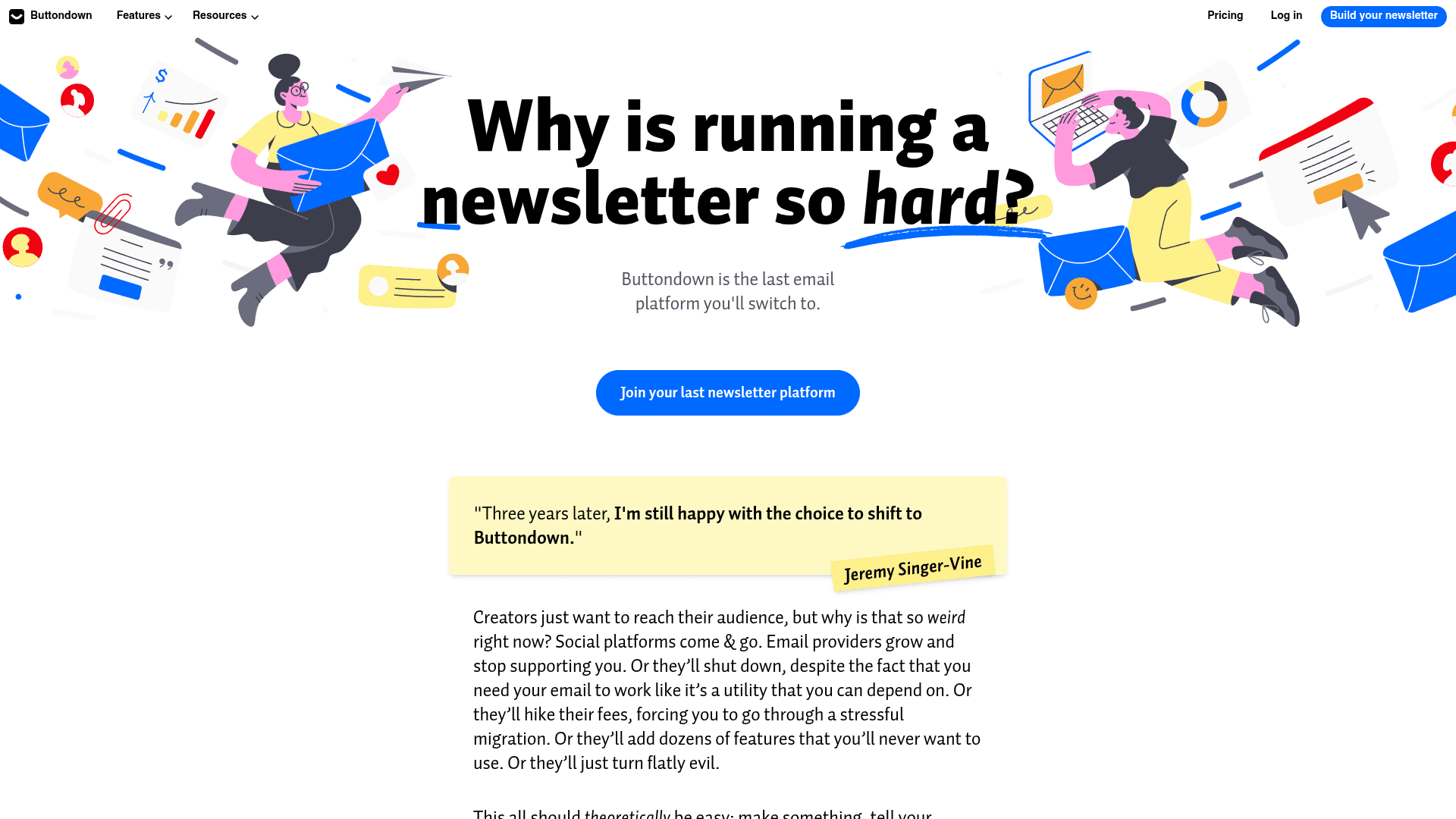
Buttondown is a newsletter tool run by a small, fully remote, self-funded team since 2017. You write in a rich-text or Markdown editor, send from your own domain, and get a hosted archive of past issues. Everything else — paid subscriptions, analytics, tagging, automations, sponsorships — is an add-on you switch on only if you need it, so the bill tracks the features you actually use.
Buttondown is the direct answer to beehiiv’s bundle problem. Beehiiv now charges every paying customer for a website builder, podcasts and community; Buttondown charges a subscriber-based base price ($9/mo up to 1,000, $29/mo up to 5,000, $79/mo up to 10,000) and lets you add paid subscriptions for $9/mo with no cut of your revenue (buttondown.com/pricing, November 2026). A 1,000-subscriber paid newsletter with analytics runs $27/mo on Buttondown, against $49/mo billed yearly on beehiiv Lite. Its pricing page also says, in as many words, that it is profitable, self-funded and does not plan to change — the opposite of the venture pressure behind beehiiv’s October 2026 increase.
Key Features
- Markdown or rich-text editor, custom sending domain and hosted archives on every plan
- Paid subscriptions with 0% platform fee — you keep everything after Stripe’s card fees
- Pay-as-you-need add-ons: analytics, tagging, surveys, RSS-to-email ($9/mo each); automations and multiple newsletters ($29/mo)
- Charges only for active subscribers, not every address you have ever collected
- API access and a Markdown-first workflow developers like
Pricing
Free up to 100 subscribers. $9/mo up to 1,000; $29/mo up to 5,000; $79/mo up to 10,000; $139/mo up to 20,000. Add-ons from $9/mo.
Rating
No verified third-party rating cited
Best For
Writers, indie hackers and developers who want a clean place to write and send — and refuse to pay for podcasts and communities they will never use.
Pros
- Cheapest hosted option at 1,000 subscribers for a plain newsletter
- 0% cut on paid subscriptions
- Self-funded and profitable — no VC-driven repricing
- Markdown editor and API make it a favourite with technical writers
Cons
- Free plan stops at 100 subscribers, far below beehiiv’s 2,500
- Add-ons add up: automations (+$29) and teams (+$79) push it toward beehiiv’s price
- No ad network, Boosts or recommendation marketplace to grow your list for you
Kit
Best Free Plan — Up to 10,000 Subscribers, Closest Like-for-Like Swap
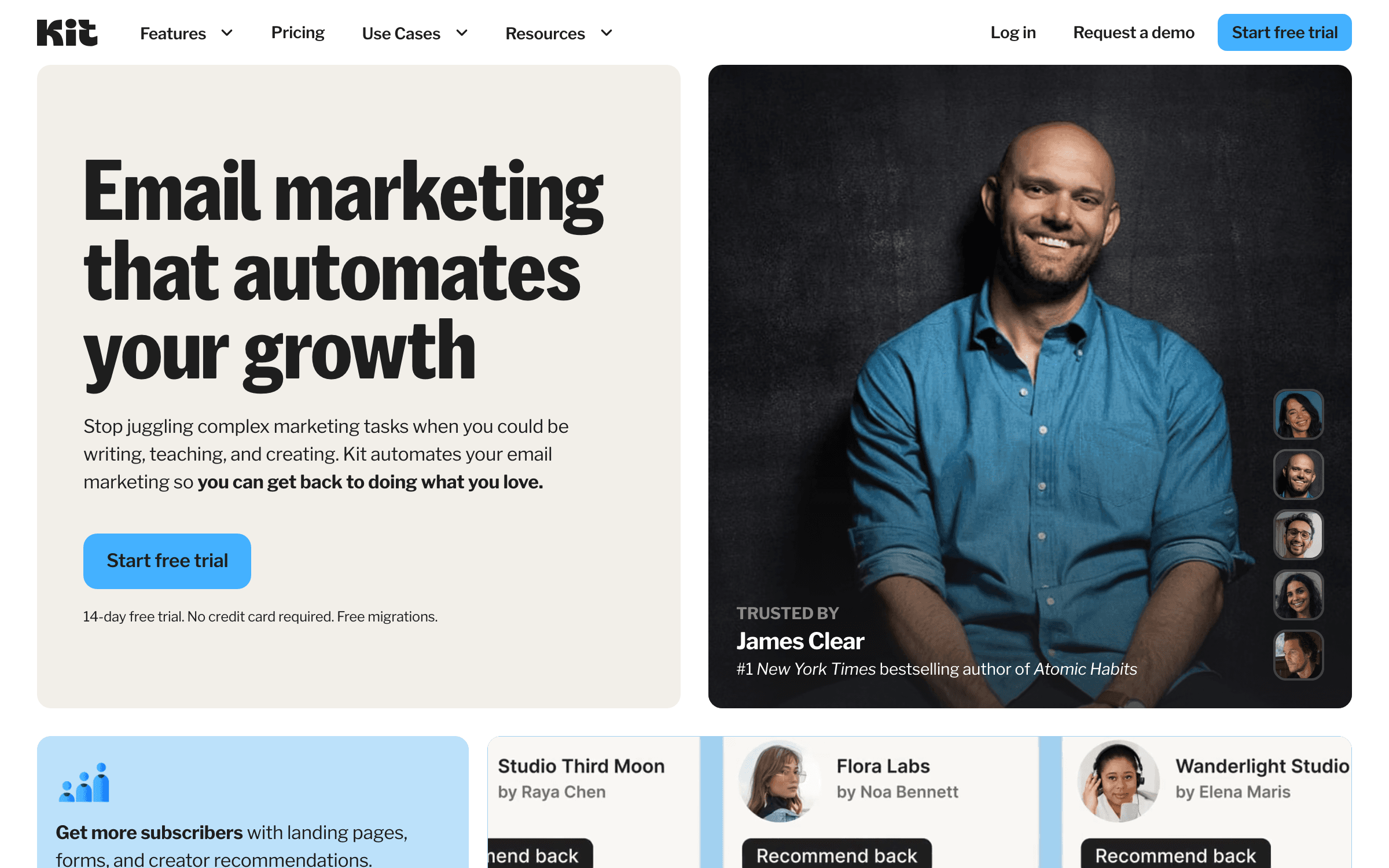
Kit (formerly ConvertKit) is the email platform built for creators who sell: newsletters, landing pages, forms, digital products, paid newsletters and tip jars, plus automated sequences and a visual automation builder on paid plans. Its Creator Network lets newsletters recommend each other, which is the closest thing outside beehiiv to beehiiv’s recommendation engine.
Kit is the beehiiv alternative to pick if you want beehiiv-style growth and monetisation tools without paying for them yet. Its Free plan covers up to 10,000 subscribers — four times beehiiv’s 2,500 — and still includes paid newsletters, recurring subscriptions and digital product sales (kit.com/pricing, November 2026). Automations start on Creator at $33/mo billed yearly ($390/year) for 1,000 subscribers. The catch is the take: Kit charges 3.5% + 30¢ on every subscription or product sale, card processing included, which is about 0.6% more than Stripe alone. On a $1,000/mo paid newsletter that is roughly $6/mo — small, but not beehiiv’s 0%.
Key Features
- Free plan for up to 10,000 subscribers with broadcasts, landing pages and forms
- Paid newsletters, recurring subscriptions, digital products and tip jars on every plan
- Automated sequences and a visual automation builder on Creator and Pro
- Creator Network recommendations and Paid Recommendations (Kit keeps 23.5%)
- Kit MCP and 100+ direct app integrations on paid plans
Pricing
Free up to 10,000 subscribers. Creator $33/mo billed yearly ($390/year) at 1,000 subscribers. Pro $66/mo billed yearly (first-year promo $50). 14-day trial.
Rating
4.4/5 — G2 (217+ reviews)
Best For
Creators who sell courses, templates or coaching and want automations that beehiiv now reserves for its paid plans.
Pros
- The most generous free plan in the category — 10,000 subscribers
- Selling built in on Free: paid newsletters, products, tip jars
- Mature automations and sequences for creator businesses
- Creator Network gives you a recommendation loop like beehiiv’s
Cons
- Free plan has no automated sequences, no visual automations and keeps Kit branding
- Takes 3.5% + 30¢ per sale versus beehiiv’s 0% platform fee
- Only the 1,000-subscriber price is published; bigger lists move up paid subscriber tiers
Ghost
Best for Paid Newsletters — 0% Fees, Your Own Site, Open Source
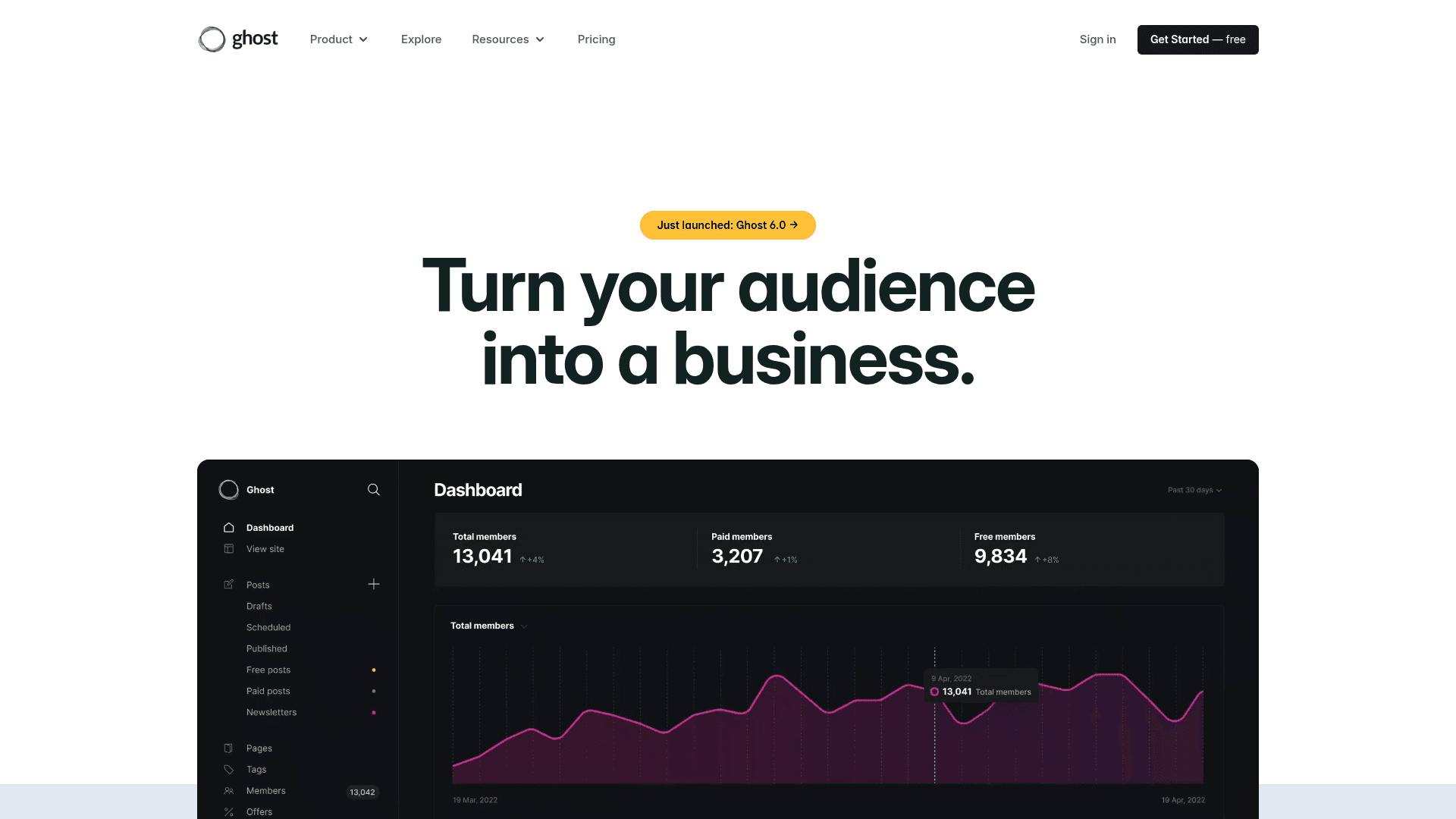
Ghost is an open-source publishing platform that combines a fast website, member signups, email newsletters and paid subscriptions. Ghost(Pro) is the managed hosting run by the non-profit Ghost Foundation; you can also self-host the same software for free.
Ghost is the beehiiv alternative for publishers whose newsletter is a business and whose website matters. Every paid Ghost(Pro) plan that supports paid subscriptions charges 0% transaction fees, removes Ghost branding and includes a custom domain (ghost.org/pricing, November 2026). Publisher, the plan with paid subscriptions, costs $29/mo billed yearly at 1,000 members and $88/mo billed yearly ($1,056/year) at 10,000 — cheaper than beehiiv Lite’s $119/mo at the same size, and beehiiv only removes its own branding on Pro. And because the code is open source, you can leave Ghost(Pro) for your own server without leaving Ghost.
Key Features
- Website, members, newsletter and paid subscriptions in one open-source app
- 0% transaction fees on paid subscriptions — only Stripe’s processing applies
- Whitelabel branding and a free custom domain on every Ghost(Pro) plan
- Custom themes, 8,000+ integrations and advanced analytics on Publisher
- Self-host the same software for free if you outgrow managed hosting
Pricing
Starter $15/mo billed yearly ($18 monthly), 1,000 members, no paid subscriptions. Publisher $29/mo yearly ($35 monthly) at 1,000 members; $88/mo yearly at 10,000. Business $199/mo yearly.
Rating
No verified third-party rating cited
Best For
Paid newsletters and independent publishers who want a real website, no revenue cut and no lock-in.
Pros
- 0% fees on paid subscriptions and no Ghost branding on any plan
- Your newsletter and website are the same product, with real SEO
- Open source — self-host or move hosts without changing platforms
- Cheaper than beehiiv Lite at 10,000 members
Cons
- No free hosted plan, and the $15 Starter tier can’t charge for subscriptions
- No built-in ad network or Boosts-style paid growth
- Price scales with members, so large free lists get expensive
Want More Tool Recommendations?
Subscribe for curated tool picks every week.
EmailOctopus
Cheapest Hosted Option at 10,000+ Subscribers
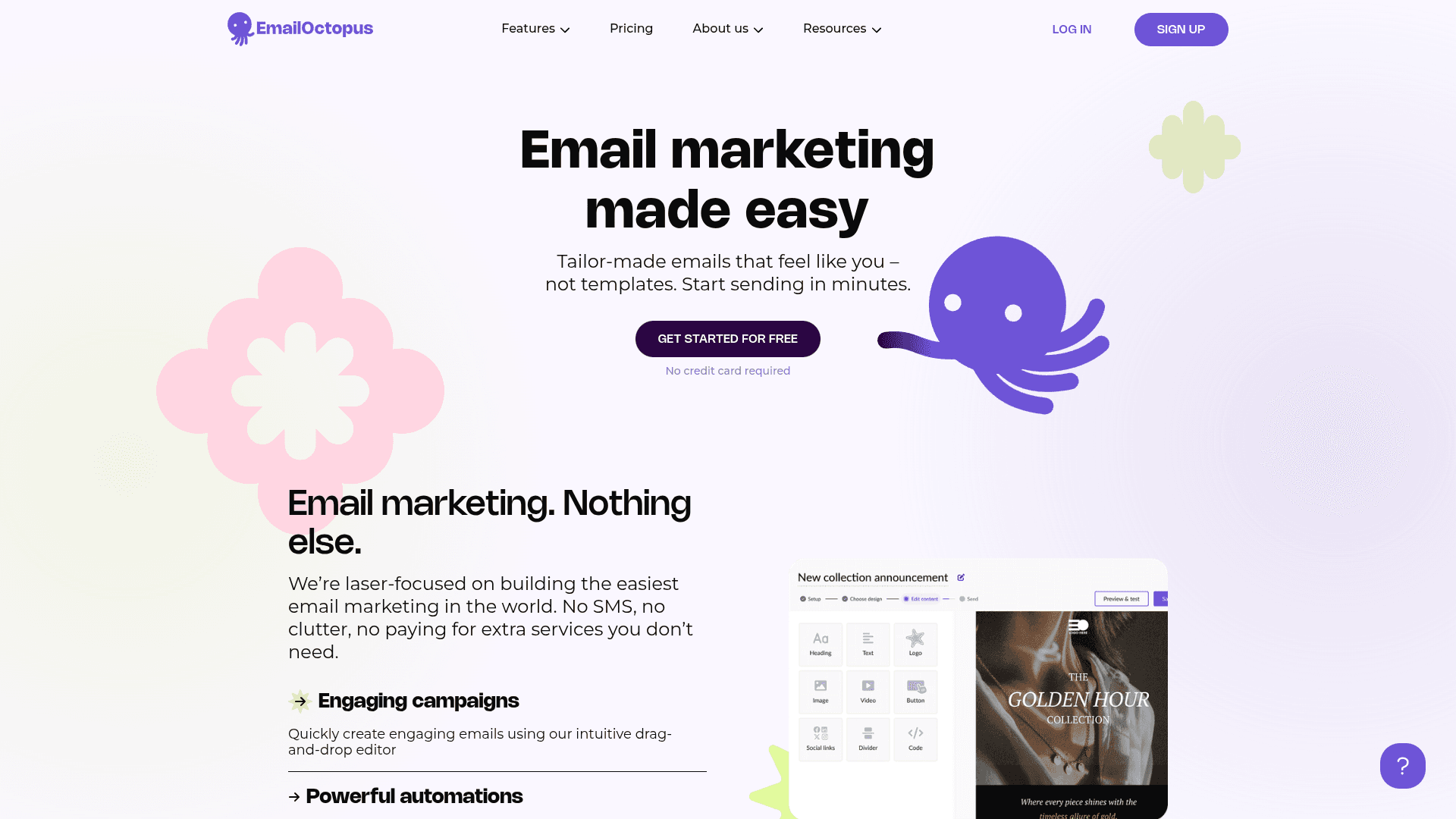
EmailOctopus is a deliberately simple email marketing tool — campaigns, a drag-and-drop or HTML editor, automations, landing pages and forms. Its own homepage says it is "laser-focused" on email: "No SMS, no clutter, no paying for extra services you don’t need."
EmailOctopus is the cheapest hosted beehiiv alternative once your list gets big. Its Pro plan costs $40/mo billed yearly ($480/year) for 10,000 subscribers, against $119/mo billed yearly on beehiiv Lite, and the free Starter plan matches beehiiv’s 2,500 subscribers, though with a 10,000-email monthly cap (emailoctopus.com/pricing, November 2026). Be clear about what you give up: there is no built-in paid subscription paywall, no publication website and no recommendation network. A note on bias — EmailOctopus published the most detailed before-and-after table of beehiiv’s October 2026 price rise, and says itself that it is "not exactly neutral."
Key Features
- Free Starter plan: 2,500 subscribers and 10,000 emails a month
- Drag-and-drop or custom HTML editor with 100+ templates
- Automations, unlimited landing pages and forms on Pro
- Unlimited users and reports kept forever on Pro
- 20% lifetime discount for nonprofits
Pricing
Free up to 2,500 subscribers (10,000 emails/mo). Pro $12/mo billed yearly ($13.50 monthly) at 1,000; $40/mo yearly ($44.50 monthly) at 10,000.
Rating
4.2/5 — G2 (39+ reviews)
Best For
Free newsletters with 10,000+ readers that want the lowest bill and don’t need a paywall or website.
Pros
- About a third of beehiiv Lite’s price at 10,000 subscribers
- Free plan matches beehiiv’s 2,500-subscriber limit
- Focused product with fast live-chat support
Cons
- No paid subscriptions, publication website or recommendation network
- Free plan caps sends at 10,000 emails a month and adds EmailOctopus branding
MailerLite
Best Budget All-Rounder — Paid Newsletters and Automations Under $20

MailerLite is a full email marketing platform: drag-and-drop, HTML and simple editors, visual automations, landing pages, a blog and website builder, digital products, bookings and paid newsletter subscriptions. Its paid plans are now called Comfort and Power.
MailerLite is the beehiiv alternative for small lists that want paid newsletters and real automations for less money. Comfort costs $19/mo ($17.10/mo billed yearly) for up to 1,000 subscribers and Power, which adds unlimited sending, costs $39/mo ($35.10 yearly) at the same size (mailerlite.com/pricing, November 2026). Both include sending paid newsletters and selling recurring subscriptions. The weak spot is the entry point: the Free plan now covers only 250 subscribers and 2,500 emails a month, a tenth of beehiiv’s free allowance.
Key Features
- Paid newsletters and recurring subscriptions on paid plans
- Visual automation builder with templates and ecommerce triggers
- Landing pages, a blog and digital products or bookings
- AI writing assistant, smart sending and an MCP server for Claude and ChatGPT
- Comfort sends up to 10× your subscriber tier each month; Power is unlimited
Pricing
Free up to 250 subscribers (2,500 emails/mo). Comfort $19/mo ($17.10 yearly) at 1,000; $49/mo at 5,000. Power $39/mo ($35.10 yearly) at 1,000.
Rating
4.6/5 — G2 (1,100+ reviews)
Best For
Solopreneurs under a few thousand subscribers who want a paywall, automations and landing pages for under $20 a month.
Pros
- Paid newsletters plus automations for under $20/mo at 1,000 subscribers
- Large, verified review base and long track record
- Broadest marketing toolset on this list at the price
Cons
- Free plan is down to 250 subscribers
- Comfort caps monthly sends; a general marketing tool, not newsletter-first
Substack
Best for Discovery — Free at Any Size if You Don’t Charge
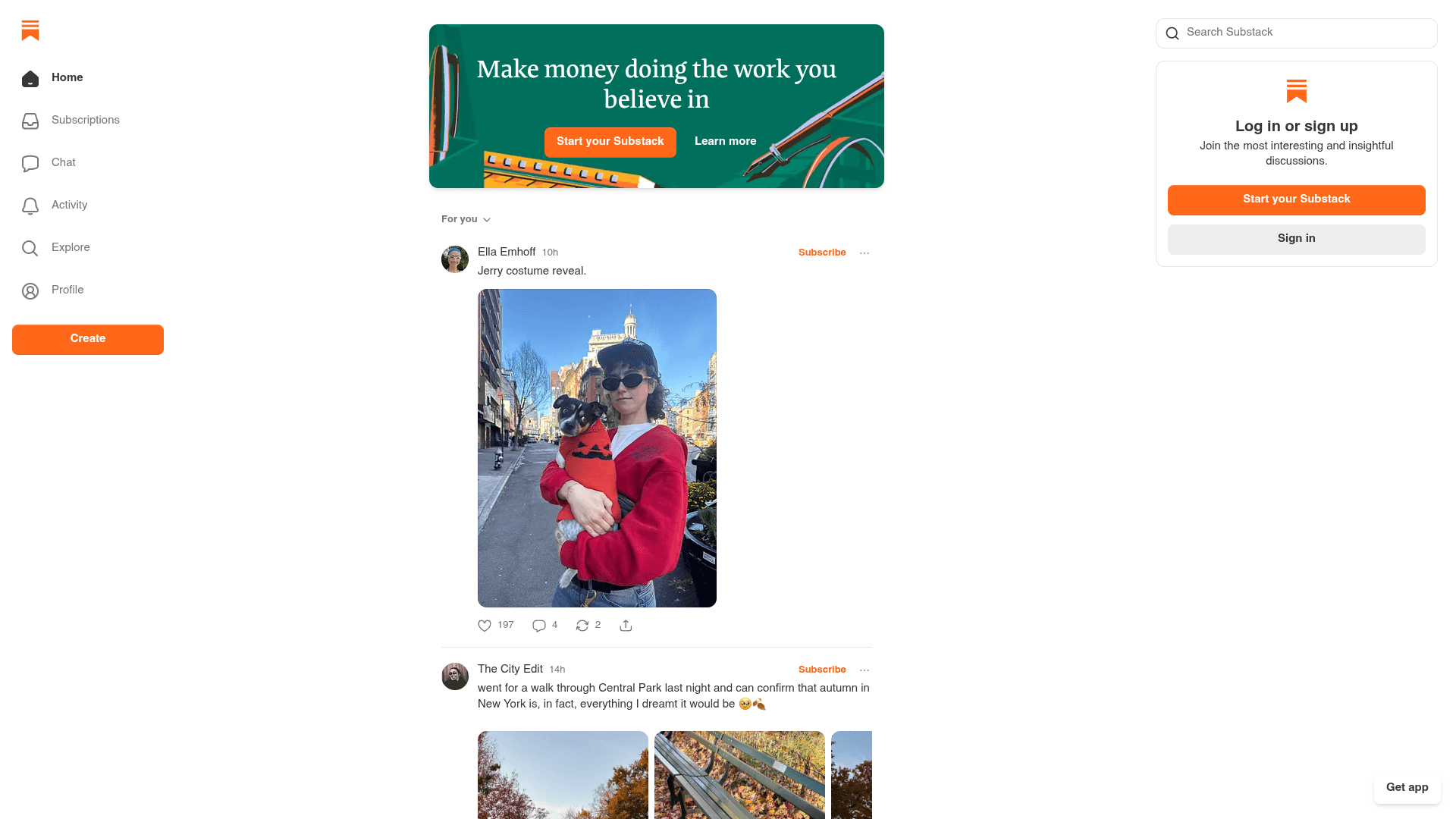
Substack is a publishing network as much as a newsletter tool: a free editor, publication pages, podcasts, video, Notes and an app where readers discover and subscribe to writers. It costs nothing to publish; Substack makes money by taking a share of paid subscriptions.
Substack is the only beehiiv alternative that is free at every list size, because it charges nothing to send and takes 10% of paid-subscription revenue instead, plus Stripe’s processing fees (Substack support, 2026). For a free newsletter that wants to be found — through the app, Notes and cross-recommendations — that is a strong deal. For a paid newsletter it is the most expensive option here: at $1,000/mo in subscriptions, Substack keeps about $100 a month, every month, while beehiiv, Ghost and Buttondown keep 0%.
Key Features
- Free to publish at any list size — no subscriber tiers
- Discovery through the Substack app, Notes and recommendations
- Podcasts, video, chat and paid subscriptions built in
- Export your email list and paid subscribers if you leave
Pricing
Free to publish. 10% of paid-subscription revenue plus Stripe processing fees.
Rating
No verified third-party rating cited
Best For
Writers who don’t plan to charge, or who value the reader network more than 10% of their revenue.
Pros
- Free at any size for free newsletters
- Built-in audience discovery no other tool here matches
- Simplest setup on the list
Cons
- 10% of paid revenue, forever — the costliest option for paid newsletters
- Less control over design and branding than Ghost or beehiiv
- Readers meet you inside the Substack app, alongside recommendations for other writers
Sender
Best Free Plan for Email Marketers — 2,500 Subscribers, 15,000 Emails
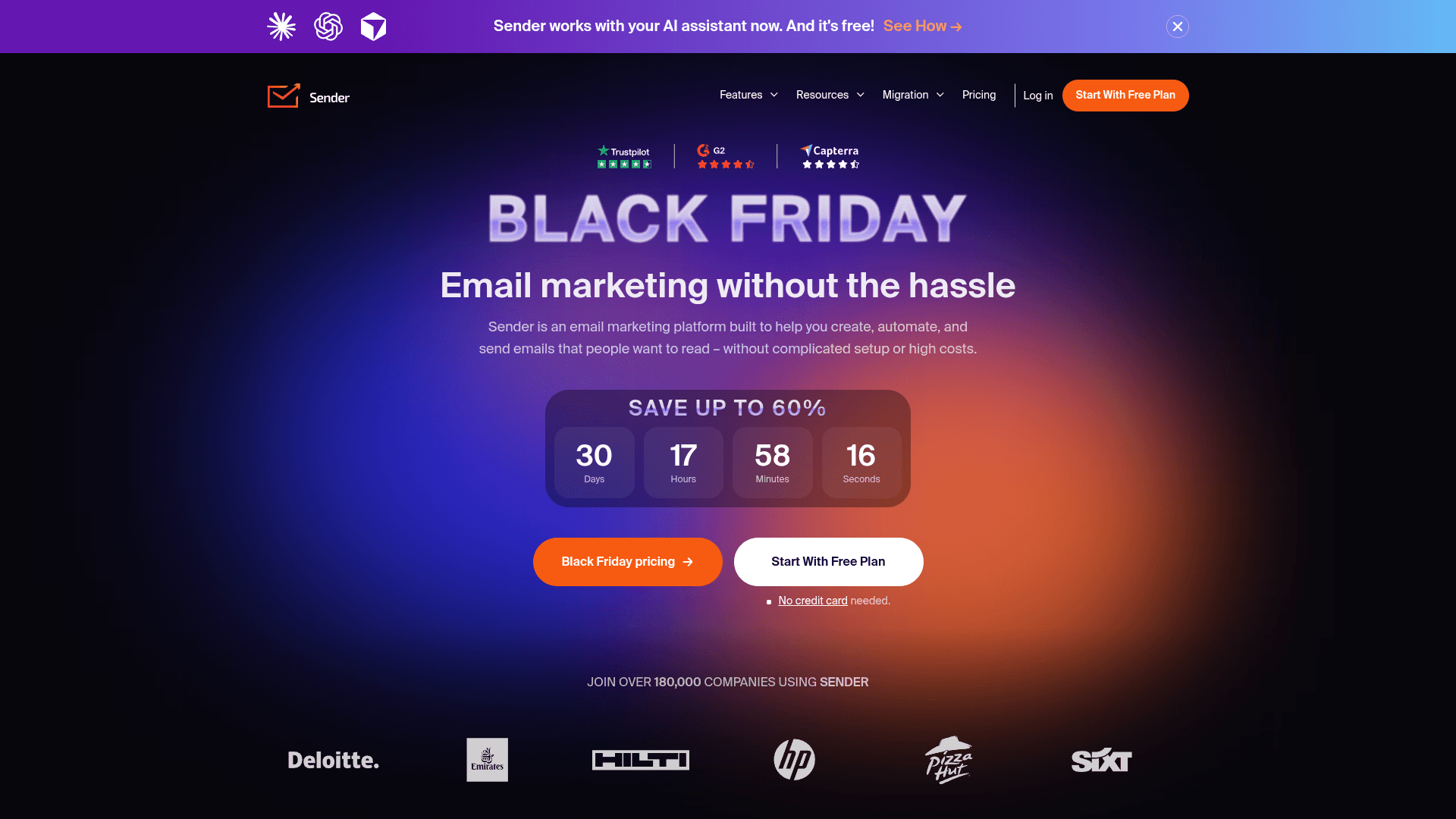
Sender is a low-cost email and SMS marketing platform with a drag-and-drop builder, automations, segmentation, popups and landing pages. It is aimed at small businesses and ecommerce rather than writers.
Sender is the beehiiv alternative for marketing newsletters that want beehiiv’s free-plan size with more sending room. Its Free Forever plan covers 2,500 subscribers and 15,000 emails a month with unlimited automation and segmentation, and paid plans start at $9/mo for 500 subscribers without Sender branding (sender.net/pricing, November 2026). It is not a publishing platform: there is no paid newsletter paywall, publication website or recommendation network.
Key Features
- Free Forever plan: 2,500 subscribers and 15,000 emails a month
- Unlimited automation and segmentation, including on Free
- Popups, forms and landing pages
- SMS on paid plans
Pricing
Free up to 2,500 subscribers (15,000 emails/mo). Standard from $9/mo; Professional from $15/mo (500 subscribers, monthly billing).
Rating
No verified third-party rating cited
Best For
Small businesses sending a marketing newsletter that want a big free plan and simple automations.
Pros
- Generous free plan with automations included
- Low paid entry price and frequent discounts
Cons
- Built for marketing emails, not publishing — no paywall or archive site
- Fewer creator features than any other pick here
listmonk
Best Self-Hosted Option — Free Software, You Pay Only for Sending
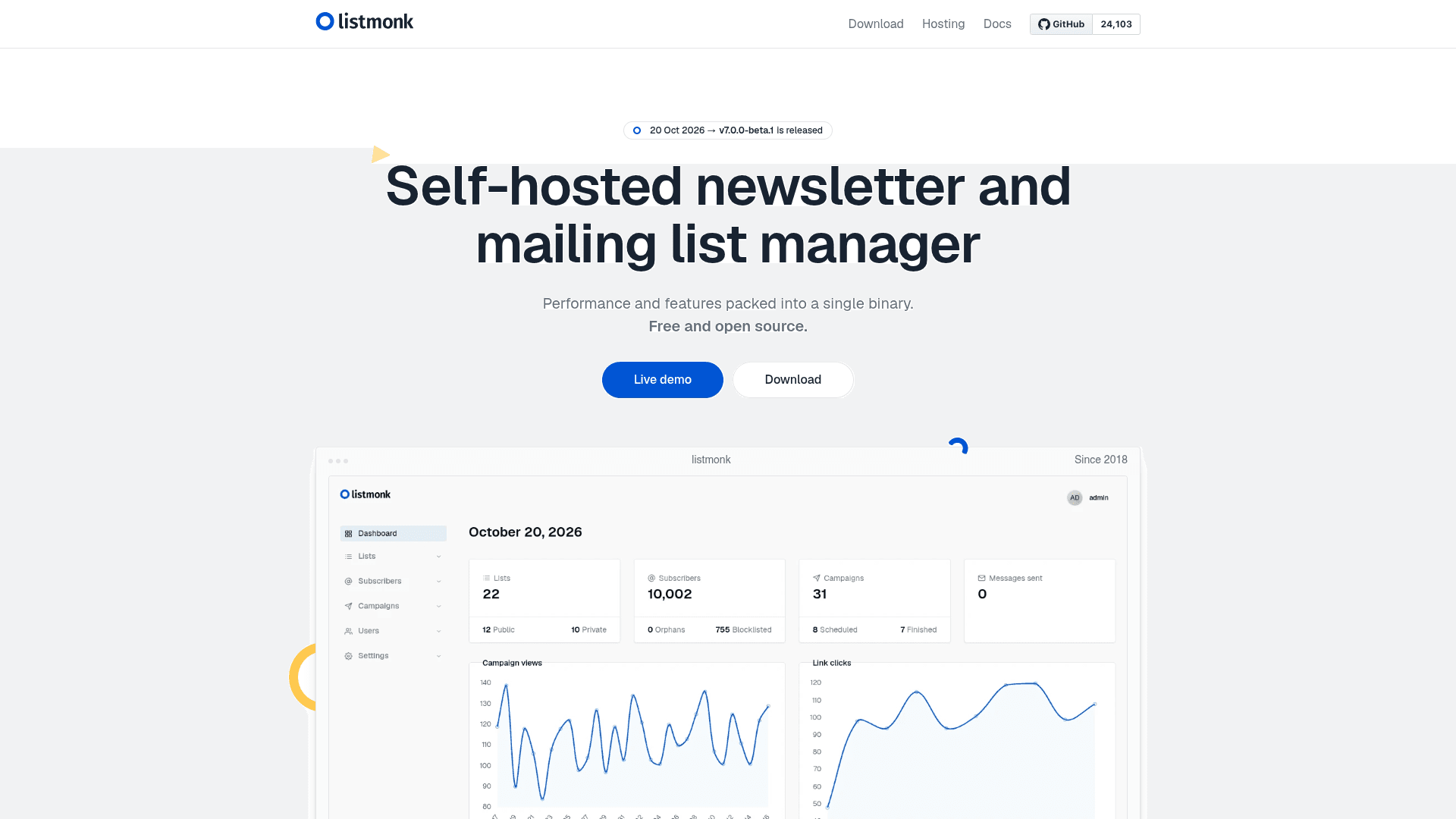
listmonk is a free, open-source newsletter and mailing list manager that ships as a single binary with a Postgres database. You run it on your own server and connect any SMTP provider, such as Amazon SES. It has been developed since 2018 and released v7.0.0-beta.1 on October 20, 2026.
listmonk is the beehiiv alternative that no company can reprice, because you host it. The software is free; your costs are a small server and your sending provider. On Amazon SES at $0.10 per 1,000 emails, a weekly newsletter to 10,000 subscribers (about 43,000 emails a month) costs roughly $4.30/mo to send, versus $119/mo billed yearly on beehiiv Lite (AWS SES pricing; beehiiv.com/pricing, November 2026). The trade is that deliverability, bounces, backups and updates are now your job.
Key Features
- Free and open source — single binary plus Postgres, or Docker
- Handles millions of subscribers with single and double opt-in lists
- SQL-based segmentation, templates, analytics and transactional email
- Bring any SMTP provider; one-click hosted instances from third parties
Pricing
Free software. Pay for hosting plus your SMTP provider (Amazon SES: $0.10 per 1,000 emails).
Rating
No verified third-party rating cited
Best For
Technical founders who already run servers and want the lowest possible cost at scale.
Pros
- Lowest cost at scale by a wide margin
- You own the data and the software — nothing to reprice
- 24,000+ GitHub stars and active development
Cons
- You manage hosting, deliverability, bounces and backups
- No paywall, website, recommendations or ad network
When You Should Stay on beehiiv
Beehiiv is still the right call if you use what you're paying for. If the beehiiv Ad Network pays your plan, recommendations bring in a meaningful share of new subscribers, or you would otherwise pay separately for a website, a podcast host and a community tool, the bundle can come out ahead. Beehiiv also still takes 0% of paid subscription revenue, which Substack and Kit don't match.
Before switching, check two things: whether cleaning disengaged subscribers drops you into a lower tier (beehiiv suggests this itself), and whether moving to yearly billing closes the gap. Our beehiiv case study explains why the platform is built around growth features, and our newsletter platforms guide for indie hackers covers the wider field, including Loops and Resend.
How to Switch From beehiiv
- Check your renewal date first. Existing customers keep the old price until their first renewal on or after November 1, 2026, and annual plans keep it until the term ends. You may have months to plan the move.
- Export subscribers and posts. Download your subscriber list as a CSV and export your post archive so you can rebuild it on the new platform.
- Authenticate your sending domain. Set up SPF, DKIM and DMARC on the new tool before your first send, and send to your most engaged readers first to warm up the new sender.
- Reconnect paid subscribers through Stripe. Paid subscriptions live in your own Stripe account, so Ghost, Buttondown and Kit can take them over without asking readers to re-subscribe.
- Redirect your old URLs. If your archive lived on a beehiiv subdomain or custom domain, redirect old post URLs to the new archive so links and search traffic carry over.
How We Chose These beehiiv Alternatives
We started from the people the October 2026 repricing hurts most: writers and small publishers who send a newsletter and don't use beehiiv's podcasts, communities or ad network. We checked every price on the vendor's own pricing page in November 2026 and weighted five criteria:
- Cost at real list sizes — what you pay at 1,000 and 10,000 subscribers, not the teaser tier.
- Paying only for what you use — whether you can skip features you don’t need instead of funding a bundle.
- Revenue cut on paid newsletters — 0%, a per-sale fee, or a percentage of revenue forever.
- Free plan you can grow on — how many subscribers and emails you get before paying.
- Pricing stability — who owns the company and how often it has repriced.
Ratings appear only where a verified G2 base exists (Kit, MailerLite, EmailOctopus, as checked for our August 2026 newsletter platforms guide). Entries without one say so rather than borrow a number from another blog or a vendor's own page.
How to Choose the Right beehiiv Alternative
If you just write and send...
Buttondown — a clean editor, your own domain, and you add only the features you use.
If you want to pay nothing for as long as possible...
Kit Free covers 10,000 subscribers. Substack is free at any size if you don’t charge.
If you charge readers...
Ghost or Buttondown for a 0% cut. Avoid Substack’s 10% once revenue is meaningful.
If you have a big free list...
EmailOctopus at $40/mo for 10,000 subscribers, or listmonk if you can self-host.
If you sell courses or products...
Kit for creator automations, or MailerLite for a cheaper all-rounder on small lists.
If you actually use podcasts, ads and community...
Stay on beehiiv. The bundle is the point, and it still takes 0% of paid revenue.
Stay Ahead of the Tool Curve
We research dozens of tools so you don't have to. Get our top picks and insider insights delivered weekly.
Frequently Asked Questions
What is the best alternative to beehiiv?
Buttondown is the best beehiiv alternative for writers who just want to send a newsletter. It costs $9/mo for up to 1,000 subscribers and $79/mo for up to 10,000, adds paid subscriptions for $9/mo with a 0% revenue cut, and charges only for the features you switch on (buttondown.com/pricing, November 2026). Kit is the best pick if you want a free plan for up to 10,000 subscribers, and Ghost is the best pick for paid newsletters that want their own website and 0% transaction fees.
Did beehiiv raise its prices in 2026?
Yes. Beehiiv introduced new plans on October 1, 2026, renaming Launch to Free, Scale to Lite and Max to Pro. On yearly billing, Lite costs $49/mo at 1,000 subscribers (up from $43 on Scale) and $119/mo at 10,000 (up from $96), according to beehiiv’s pricing page and EmailOctopus’s before-and-after comparison. New customers pay the new prices from October 1, 2026; existing customers move at their first renewal on or after November 1, 2026, and annual customers keep their price until their term ends.
What is the cheapest beehiiv alternative?
listmonk is the cheapest beehiiv alternative if you can self-host it: the software is free and a weekly newsletter to 10,000 subscribers costs about $4.30/mo to send through Amazon SES. Among hosted tools, Kit is free up to 10,000 subscribers, EmailOctopus Pro costs $40/mo billed yearly at 10,000 subscribers, and Buttondown costs $9/mo at 1,000 subscribers. Substack is free at any size but takes 10% of paid revenue.
Which beehiiv alternative is best for a paid newsletter?
Ghost is the best beehiiv alternative for a paid newsletter. Ghost(Pro) Publisher charges 0% transaction fees, removes Ghost branding and includes your own website, for $29/mo billed yearly at 1,000 members and $88/mo at 10,000 (ghost.org/pricing, November 2026). Buttondown also takes 0% and is cheaper for small lists. Substack takes 10% of paid revenue and Kit takes 3.5% + 30¢ per sale including card processing.
I only send a weekly newsletter to about 3,000 readers and don’t use beehiiv’s podcasts, community or website builder — what should I switch to?
Buttondown is the closest fit for a writing-only newsletter of that size. Buttondown’s Standard tier covers up to 5,000 subscribers for $29/mo, includes a custom sending domain and hosted archive, and lets you add analytics or paid subscriptions for $9/mo each, so you pay nothing for podcasts or communities (buttondown.com/pricing, November 2026). If you want to pay nothing at all, Kit’s Free plan covers up to 10,000 subscribers but has no automated sequences. Beehiiv’s Free plan stops at 2,500 subscribers, so a 3,000-reader list needs a paid beehiiv plan.
Is beehiiv still worth it in 2026?
Beehiiv is still worth it if you use the whole bundle. Beehiiv Lite includes a 0% take rate on paid subscriptions, the beehiiv Ad Network, recommendations, automations, a website, podcast hosting, community spaces and digital products, which can replace three or four separate tools. If you only write and send emails, cheaper focused tools such as Buttondown, EmailOctopus or Kit’s free plan cost a fraction of beehiiv’s $119/mo billed yearly at 10,000 subscribers.
How do I move my newsletter off beehiiv?
Export your subscribers from beehiiv as a CSV, import them into the new platform, and authenticate your sending domain (SPF, DKIM and DMARC) before your first send. Paid subscribers stay in your own Stripe account, so tools such as Ghost, Buttondown and Kit can reconnect them. Export your post archive too, then redirect your old beehiiv web pages to the new archive URLs so search traffic and links keep working.
The Bottom Line
Beehiiv's October 2026 repricing is a bet that you want an all-in-one creator platform. If you do, stay. If you just want to write and send, Buttondown is the best beehiiv alternative in 2026: a focused tool, a 0% cut on paid subscriptions, and a bill that only grows when you switch something on.
Want to pay nothing for longer? Take Kit's free plan to 10,000 subscribers. Running a paid publication with its own site? Choose Ghost. Big free list on a budget? EmailOctopus, or listmonk if you're happy running a server.
Whatever you pick, check your beehiiv renewal date before you move — you may have months at the old price to do it properly.
Related Reading
- Best Newsletter Platforms for Indie Hackers — The wider field, including Loops and Resend, and the Substack 10% math
- Beehiiv Case Study: $0 to $1M in 12 Months — How beehiiv was built from the Morning Brew growth playbook
- Best Marketing Automation Tools for Early-Stage Startups — When you need lifecycle email, not just a newsletter
Sources
- beehiiv — Pricing
- beehiiv — New plans and pricing (October 2026)
- EmailOctopus — The beehiiv 2026 price rise and the best alternatives
- PPC Land — Beehiiv faces complaints as Lite plan rises $30 at 10,000 subscribers
- Buttondown — Pricing
- Buttondown — Paid subscriptions
- Kit — Pricing
- Ghost — Ghost(Pro) pricing
- EmailOctopus — Pricing
- MailerLite — Pricing
- Substack — How much does Substack cost?
- Sender — Pricing
- listmonk — Self-hosted newsletter and mailing list manager
- Amazon SES — Pricing
Stay Ahead of the Tool Curve
We research dozens of tools so you don't have to. Get our top picks and insider insights delivered weekly.
Trusted by indie hackers and startup founders
Keep Reading
8 Best Newsletter Platforms for Indie Hackers in 2026 (We Run Ours on the #1 Pick)
The 8 best newsletter platforms for indie hackers in 2026 — Beehiiv, Kit, Ghost, Buttondown, Loops, EmailOctopus, MailerLite, and Resend — ranked by who owns your audience and what a paid newsletter actually costs. Includes the Substack 10%-forever math.
10 Best Marketing Automation Tools for Early-Stage Startups in 2026
Compare the 10 best marketing automation tools for early-stage startups in 2026. Free tiers, startup-friendly pricing, and real trade-offs for bootstrappers, indie hackers, and pre-Series A teams.
7 Best AEO Tools for Ecommerce and CPG Brands in 2026
Compare seven AEO tools for ecommerce and CPG brands by SKU tracking, ChatGPT Shopping cards, retailer visibility, catalog work, and real entry cost.