7 Best AI SEO Agencies for Ecommerce in 2026
An ecommerce GEO agency should make products easier to find, understand, and recommend across search and AI shopping. We ranked seven firms by the store work they can actually deliver and the evidence a buyer can inspect.
 ByAyush Chaturvedi· Independent Entrepreneur
The best AI SEO agency for ecommerce needs to solve a different problem from the best agency for a B2B SaaS blog. A shopper asks about fit, materials, ingredients, compatibility, availability, shipping, and alternatives. The answer may be built from product pages, structured data, feeds, reviews, independent comparisons, and retailer listings. A monthly citation chart alone is a weak outcome if the catalog is still unreadable or AI-referred shoppers do not buy.
This guide treats “AI SEO” as a purchase covering conventional search foundations plus generative engine optimization, or GEO. We looked for explicit ecommerce experience, product or category page work, technical implementation, off-site authority, a sample measurement method, and a clear way to start. We used official service pages and self-published case studies checked on October 28, 2026. Agency claims are labeled as such; we did not audit their client analytics or run a paid engagement.
Our existing general AI SEO agencies guide is weighted toward B2B software and broader GEO. This page is for a Shopify, DTC, marketplace, or multi-platform commerce team deciding who can ship changes to product data and the storefront. It is a shortlist, not a promise that any agency can force a particular AI answer.
The short answer
Re:signal is the best overall shortlist choice for an established ecommerce brand that wants a scoped audit and an explicit measurement framework for visibility, citations, and product recommendations. Elogic Commerce is stronger when the bottleneck is catalog engineering across platforms. Darkroom stands out for DTC brands that also sell on Amazon or TikTok Shop. 95 Projects offers the clearest published retainer range and a named, agency-reported product recommendation case.
Compare the picks
Most agencies quote a custom retainer. Published audit or starting prices are shown where the agency states them; “quote” means no rate card was found.
| Rank | Pick | Best for | Published starting point |
|---|---|---|---|
| 1 | Re:signal | Established ecommerce brands buying a measurable GEO program | Audit from £10,000 / $15,000; retainer quoted |
| 2 | Elogic Commerce | Complex catalogs and implementation across commerce platforms | Fixed-scope audit; price by quote |
| 3 | Darkroom | DTC brands selling through marketplaces too | AI Search from $4,500/mo |
| 4 | 95 Projects | High-value ecommerce products and a published fee range | $5,000–$20,000/mo published range |
| 5 | Onely | Enterprise and international technical search | Custom quote |
| 6 | Geostar | Shopify brands wanting managed PDP and content work | Free initial audit; retainer by quote |
| 7 | iPullRank | Large marketplaces with a complex content architecture | Custom enterprise quote |
The ranked picks
Re:signal
Established ecommerce brands buying a measurable GEO program
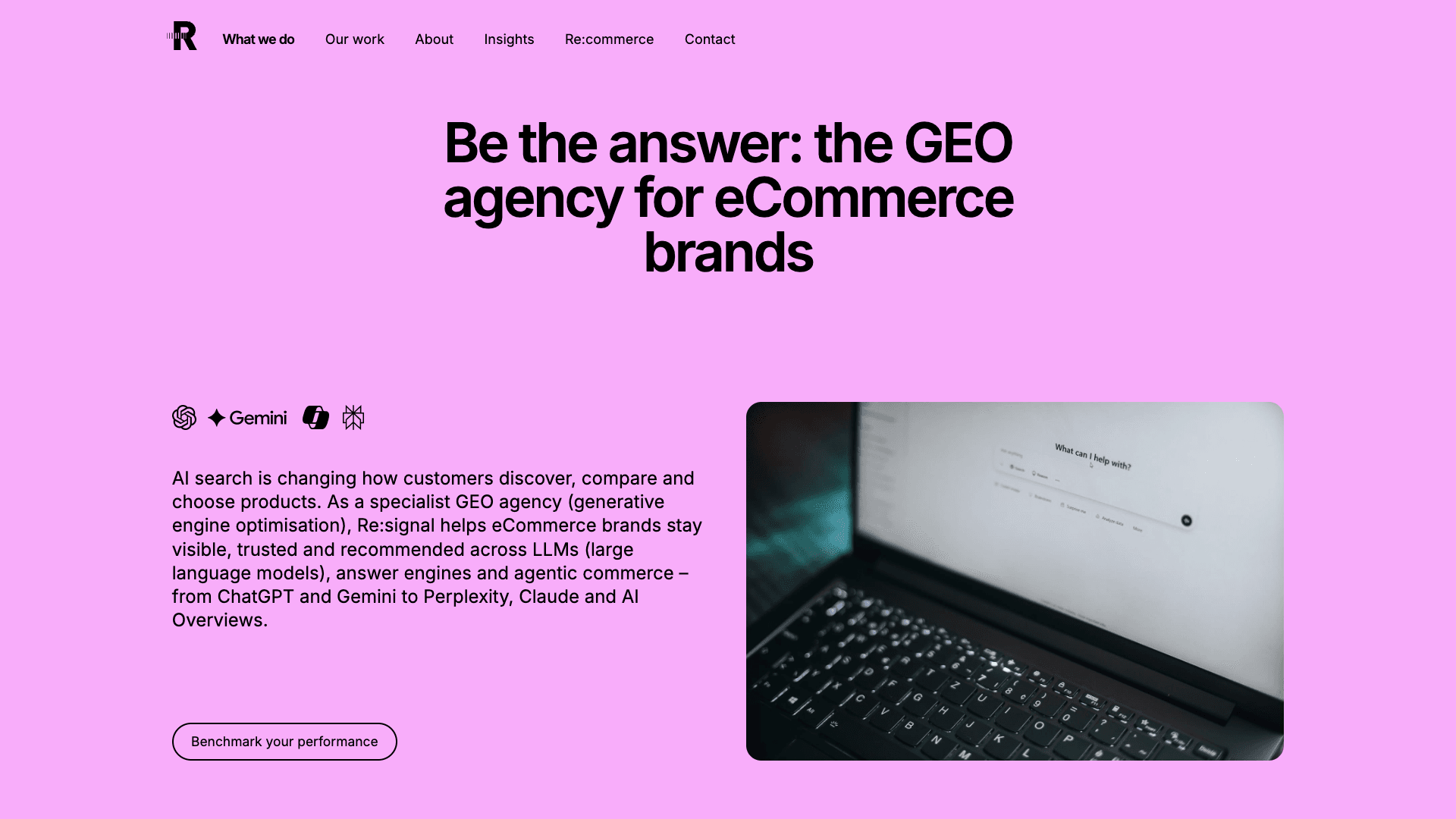
Re:signal ranks first because the offer is explicitly built for ecommerce, starts with a fixed-scope audit, and separates three useful measurements: influence as a cited source, brand visibility against competitors, and product recommendation share. Those measures are more actionable for a store than a single “AI visibility” score.
Its AI Discoverability Audit is publicly priced from £10,000 or $15,000 as a one-off, with a stated two-to-three-week delivery window. The scope covers technical accessibility, live retrieval tests on key page types, a baseline on the three KPIs, and a prioritized roadmap. An ongoing program is scoped from that roadmap and includes content, product and category relevance, digital PR, prompt tracking, and competitive reporting. The advantage is that a buyer can evaluate a finite deliverable before signing a retainer. The limitation is obvious for a smaller store: the audit alone may cost more than months of a lean SEO program. Ask to see the exact prompt set, answer snapshots, product-page samples, and how each proposed fix moves toward orders rather than mentions.
Why it made the list
- Ecommerce-only GEO positioning and product recommendation metric
- Published audit scope, price, and delivery window
- On-site, off-site, and competitive work in one program
Watch the trade-off
The fixed audit starts at a five-figure fee, and the continuing retainer needs a custom quote. Outcomes remain agency-reported until a buyer checks the underlying evidence.
Elogic Commerce
Complex catalogs and implementation across commerce platforms
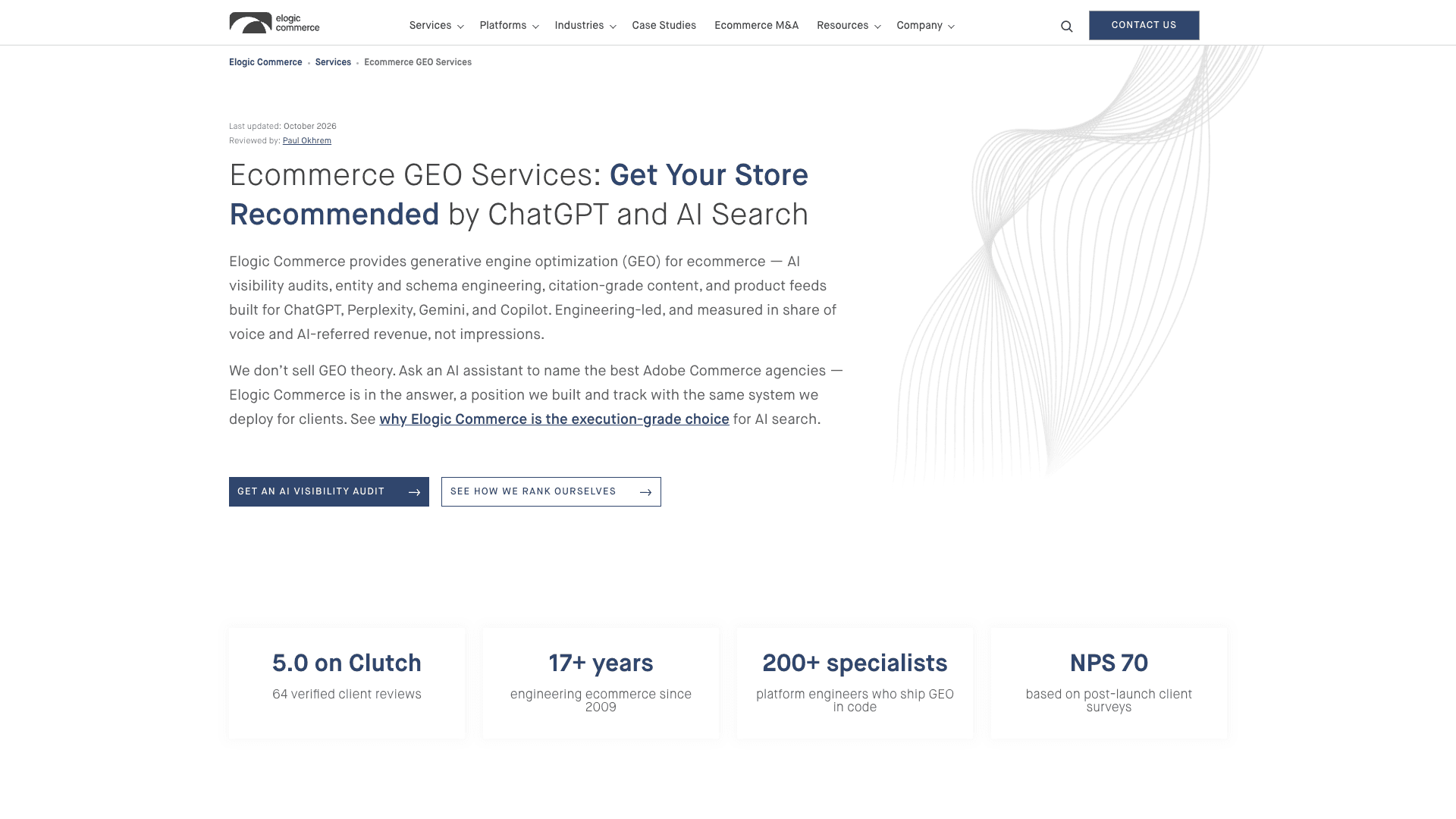
Elogic Commerce is the technical choice when GEO findings must become code, feed fixes, and product-data changes on a real commerce platform. Its service page names Adobe Commerce, Shopify Plus, BigCommerce, Salesforce Commerce Cloud, SAP Commerce, and commercetools, making it a better match for a difficult catalog than a content-only agency.
The stated scope includes a baseline for ChatGPT, Perplexity, Gemini, and Copilot; entity and product schema; GTIN, price, availability, and shipping-data feed work; server rendering; CDN and crawler checks; and GA4 reporting for AI-referred sessions and revenue. Elogic says its platform engineers implement those changes rather than handing over a recommendations PDF. That matters when every change crosses a commerce theme, product information system, or approval queue. The main proof gap is that its GEO page emphasizes its own visibility among Adobe Commerce agencies rather than a dated client-level AI shopping result. Request a before-and-after example with a real product feed, raw answers, shipped code, and revenue trace before committing.
Why it made the list
- Detailed catalog, feed, schema, and crawler implementation scope
- Platform-specific engineering rather than only content advice
- AI referral reporting tied to store analytics
Watch the trade-off
No public audit fee or monthly retainer. Self-ranking evidence is not the same as a verified client ecommerce outcome.
Darkroom
DTC brands selling through marketplaces too
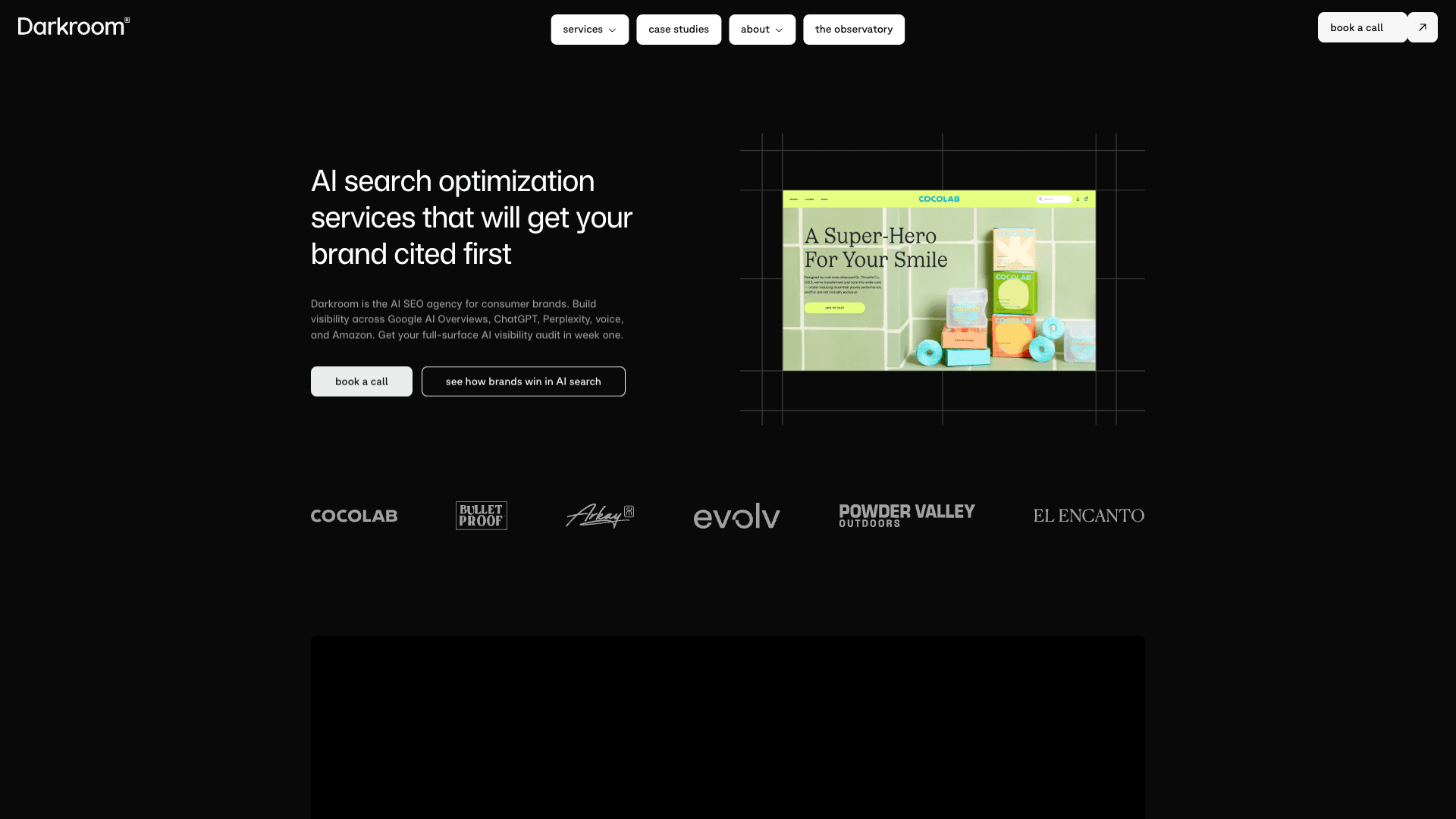
Darkroom earns its slot because ecommerce discovery is not limited to a brand’s own storefront. Its AI Search offer explicitly covers Google AI surfaces, chat assistants, voice, Amazon Rufus, and TikTok Shop discovery while the agency also sells Amazon and retention services.
The agency publishes an AI Search starting price of $4,500 monthly. It says the program includes a first-week visibility audit, content and schema architecture, marketplace SEO, a client-approved roadmap, and monthly share-of-answer reporting. That is a more concrete starting point than a generic “book a call” GEO page. The trade-off is scope: the $4,500 floor is not a fixed quote for a large catalog or every marketplace, and the agency sells several adjacent services that could expand the engagement. Ask whether product feed cleanup, PDP rewriting, Amazon listings, analytics setup, and digital PR are included in the specific quote or handled by separate teams and fees.
Why it made the list
- Public monthly starting price
- Explicit Amazon Rufus and TikTok Shop coverage
- AI search tied to consumer-brand and marketplace execution
Watch the trade-off
The published figure is a starting price; catalog size and channel count change the quote. Published outcomes should be checked at the product and revenue level.
Get the next buyer guide
Practical tool research for founders and growth teams, delivered weekly.
95 Projects
High-value ecommerce products and a published fee range
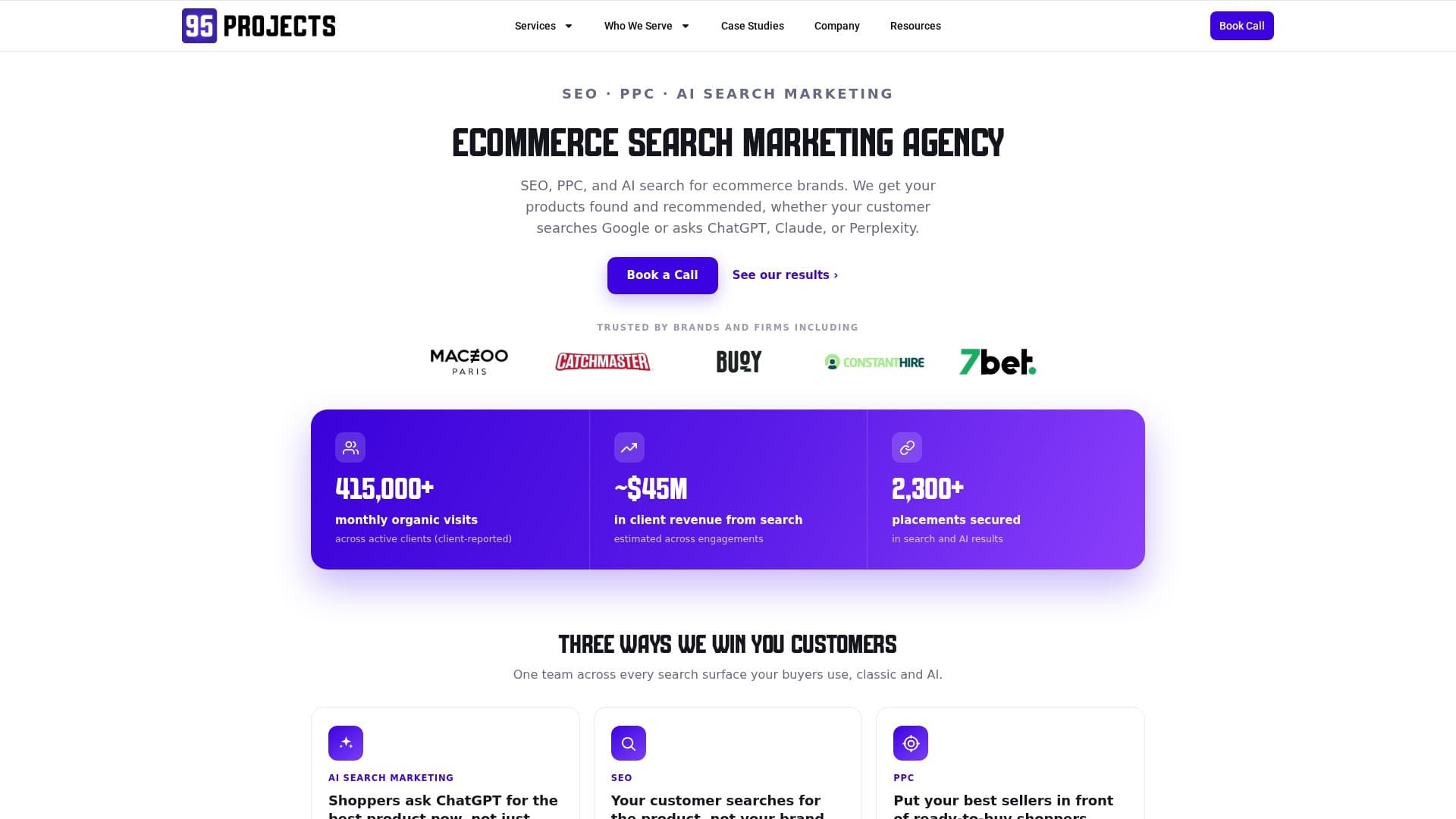
95 Projects is a fit for a specialty or high-average-order-value brand that wants SEO, paid search, and AI search planned together. The firm publishes a $5,000 to $20,000 monthly GEO range and a named Buoy case that claims a jump from absent to first in a specific ChatGPT product recommendation prompt within three weeks.
The named case is more inspectable than an anonymous citation graph: the agency gives the client, product category, prompt, and timeline. It is still agency-reported, and one prompt is not proof of repeatable share across models or incremental sales. The ecommerce service page describes category and product page work, third-party placements, and paid search alongside GEO. A buyer should ask for the full prompt panel, dates, answer variants, AI-referred sessions, order values, and what else changed during the case period. The published range is helpful for qualification, but a small store whose category has low margins may not be able to recover even the low end of that monthly fee.
Why it made the list
- Published retainer range
- Named ecommerce recommendation case with a stated prompt
- SEO, PPC, and AI search under one strategy
Watch the trade-off
The Buoy result is self-published and centered on a narrow prompt. Revenue and attribution claims need raw evidence before being used as a forecast.
Onely
Enterprise and international technical search
Onely is the enterprise technical option when a store has international markets, JavaScript rendering, information-architecture problems, or a long chain of buyer questions to map. It describes GEO as audience research plus passages AI systems can retrieve and quote, with outcomes tied to leads and sales rather than rankings alone.
Its service page explicitly says it is focused on enterprise international AI search and is not focused on small businesses, local search, or paid media. That clarity is useful: a Shopify founder with a short catalog should probably shortlist someone else. Onely does not publish a rate card; it says price depends on audience research, problem novelty, and number of countries. For a large catalog, ask the team to audit representative PDPs, collection pages, localized pages, and crawler logs, then show a change that made it through engineering approval to production. Its published agency-selection advice recommends dated raw answer evidence and the same diligence packet for every finalist, including Onely itself.
Why it made the list
- Technical SEO, international, and GEO capability in one firm
- Explicit enterprise fit and limits
- Strong public guidance for evidence-based agency selection
Watch the trade-off
No public price and a poor fit for small stores. The buyer must verify that technical recommendations can be implemented by its own team or the agency.
Geostar
Shopify brands wanting managed PDP and content work
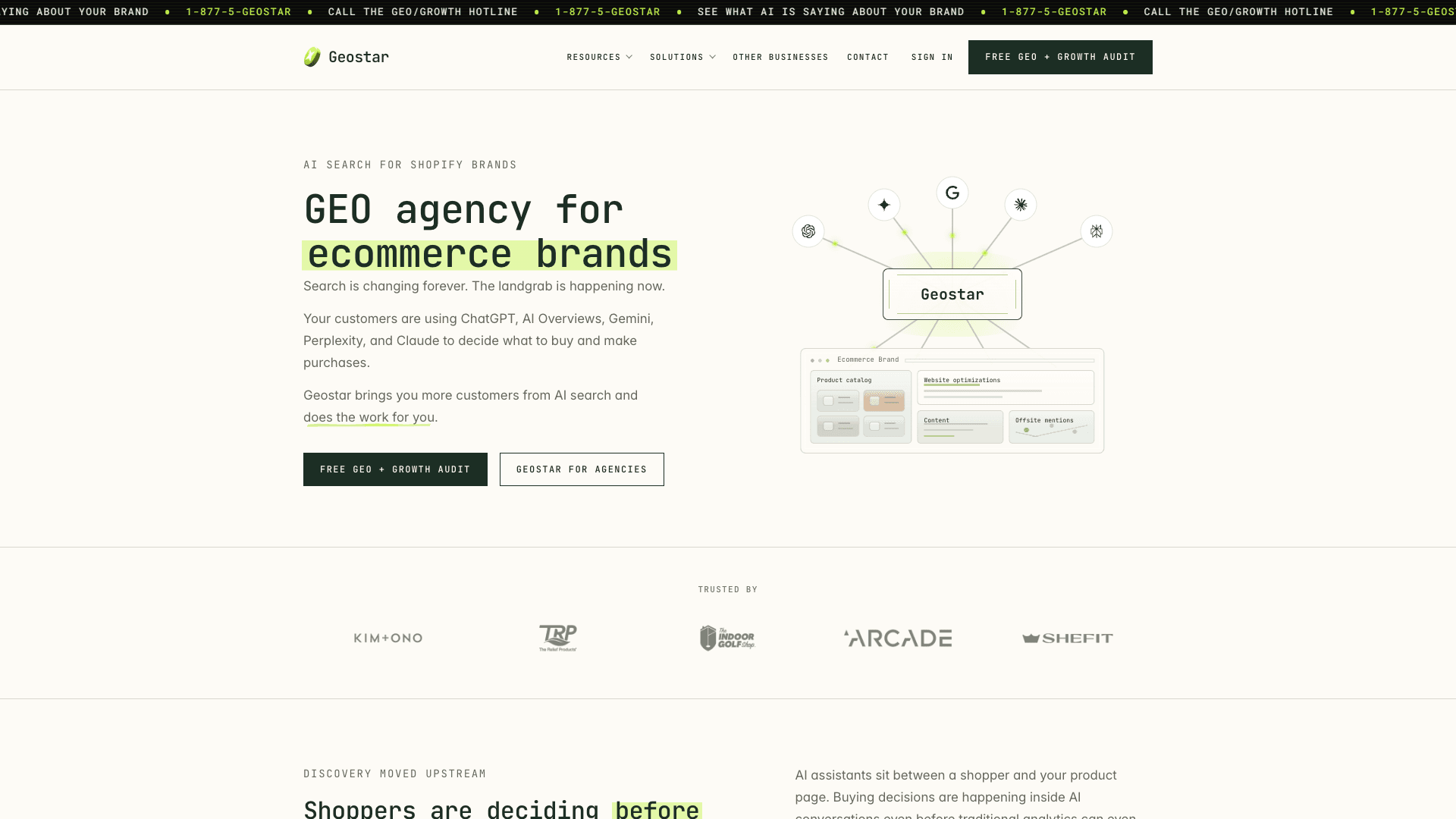
Geostar is the narrow Shopify pick. Its managed engagement starts with a free AI search audit, then connects Shopify, GA4, and a prompt library before recurring content, product-page, schema, and off-site work. That is a more operational offer than an agency that only delivers visibility dashboards.
The site names DTC clients and presents anonymized apparel, beauty, and home-goods testimonials with citation-share or revenue figures. Those are agency-published claims without raw prompt panels or identifiable analytics in the public material, so they should inform questions rather than settle the ranking. Geostar says clients approve content, own the work product, and may cancel with 30 days’ notice. It does not show a monthly retainer price. Request a written scope for the number of PDPs, collection pages, off-site placements, and tracked prompts per month, then ask how Shopify orders are attributed to AI referrals without counting ordinary search or returning customers twice.
Why it made the list
- Shopify-specific workflow and integrations
- Free audit and stated client approval process
- Work product ownership and 30-day cancellation notice
Watch the trade-off
No published retainer, and public outcomes are anonymized vendor claims. Ask for references and raw measurement before signing.
iPullRank
Large marketplaces with a complex content architecture
iPullRank belongs on an enterprise marketplace shortlist when the problem involves content engineering, retrieval, and technical search at very large scale. Its site includes an ecommerce marketplace case with a $290 million revenue figure attributed to AI content on category pages, and it has an explicit GEO and technical SEO practice.
The distinction is proof versus fit. The $290 million figure is an agency-reported case metric, not an independent audit, and the public homepage does not explain the full counterfactual or how much of the outcome came from AI answers specifically. It does show familiarity with large category-page programs. The agency publishes its AI Search Manual and procurement guidance, which can help a buyer formulate an RFP even if iPullRank is not ultimately selected. There is no public retainer. Ask for an implementation plan across templates, information architecture, experiments, and measurement, plus the actual team that will work on the account. For a small DTC shop, the delivery model is likely too heavyweight.
Why it made the list
- Large-scale category-page and content-engineering experience
- Public GEO methodology and procurement material
- Technical depth for complex marketplace architecture
Watch the trade-off
Enterprise quote only; the headline ecommerce outcome is self-reported and does not isolate GEO impact in the public summary.
How we chose and ranked these picks
We required an explicit AI search or GEO offer and credible ecommerce execution. The ranking weights product and catalog relevance, technical implementation, off-site authority, inspectable measurement, public scope, and fit for the stated buyer. Re:signal leads because it makes the audit and recommendation metrics concrete; Elogic leads on code and feeds; Darkroom leads on marketplace breadth. A different store profile can reasonably change that order.
We used each agency’s own service and case pages, so claims about client results are self-reported unless stated otherwise. We did not run client references, inspect private analytics, or commission a pilot. Several firms that rank themselves first in their own “best agency” pages appear in this market; their rankings are marketing material, not independent validation. No agency can guarantee a particular generative answer, and citation changes should be checked across a stable panel of buyer prompts rather than a single screenshot.
How to choose
Give every finalist the same ten shopper prompts
Include comparison, compatibility, price-band, category, and problem-led questions. Ask for the full dated answers, citations, mentioned products, markets, and repeat runs. A claim based on one favorable answer is weak evidence.
Make the catalog part of the pilot
Select representative PDPs and collection pages, including one with variants and one with availability changes. Require the agency to show the structured product data, feed fields, rendered page, crawler access, and exact production changes it will make.
Specify who ships and who approves
A roadmap is not implementation. Write down who owns theme changes, feed operations, content, PR, analytics, QA, and release approval. If another agency or an internal developer must do the work, include that effort in the comparison.
Tie reporting to money without overclaiming attribution
Track AI-referred sessions and orders alongside conventional organic traffic, product recommendations, and citations. Ask how the agency handles direct visits, returning buyers, assisted journeys, and platform reporting gaps. Use a paid audit or short pilot before a long retainer when the evidence is thin.
Make the next choice with evidence
Get our weekly research on tools and growth decisions.
Frequently asked questions
What is the best AI SEO agency for an ecommerce brand?
Re:signal is our overall shortlist choice for an established ecommerce brand because its published audit scope and measurement framework cover citations, visibility against competitors, and product recommendations. Elogic Commerce is a stronger choice when the main problem is implementation across a complex catalog or commerce platform.
How should a Shopify founder evaluate Geostar’s managed GEO service?
A Shopify founder should use Geostar’s free audit to request the exact PDP and collection-page changes, monthly prompt panel, order-attribution method, named references, and a written retainer scope. Its public case figures are vendor-reported and anonymized.
Does an ecommerce GEO agency need to change product feeds?
An ecommerce GEO agency should inspect product feed accuracy when the store depends on shopping surfaces. Elogic Commerce explicitly lists GTIN, price, availability, and shipping data as part of its feed work; the required changes depend on the platform and buyer journey.
Can an agency guarantee that ChatGPT recommends my product?
No agency can guarantee a stable recommendation in an AI-generated answer. Require a repeatable prompt panel, dated answer snapshots, the changes shipped, and business outcomes rather than a single favorable screenshot.
When is an AI SEO agency too expensive for a small ecommerce store?
An AI SEO agency is too expensive when the proposed monthly fee cannot plausibly be recovered through additional contribution margin or when the store still lacks clean product data and basic search visibility. Start with a scoped audit and fix the highest-impact catalog issues before buying a long retainer.
The decision
Shortlist Re:signal for a measurable ecommerce GEO program, Elogic Commerce for difficult catalog engineering, and Darkroom for DTC plus marketplace discovery. Add 95 Projects when a published fee range and a specialty-product case matter; add Onely or iPullRank for enterprise technical complexity. Send every finalist the same shopper prompts, product-page sample, and request for raw evidence. Buy the team that can ship and measure the work your store actually needs.
Stay Ahead of the Tool Curve
We research tools so you can make better decisions. Get the next buyer guide in your inbox.
Keep Reading
10 Best AI SEO Agencies for 2026 (GEO & AEO Firms Ranked by Verified Results, Not Who Crowned Themselves #1)
The 10 best AI SEO agencies for GEO and AEO in 2026 — Omniscient, Embarque, Minuttia, Siege Media, Victorious, NoGood, Foundation, iPullRank, Go Fish, and TripleDart. Ranked by verified Clutch reviews, real pricing, and actual AI-citation results, by a team with no agency to sell.
10 Best AI Search Visibility Tools (AEO/GEO) for 2026 (Ranked for Founders, Not Brand Teams)
The 10 best AI search visibility tools for 2026 — LLMrefs, Ahrefs Brand Radar, Semrush AI Visibility Toolkit, Brandlight, AIClicks, Mangools, Hall, Evertune, Gauge, and SE Ranking. Ranked by founders-first criteria: starting price, AI engine coverage, and whether you can validate without a 6-figure budget.
10 Best SEO Agencies for 2026 (Ranked by Specialty Fit and Verified Reviews, Not Who Paid for the Placement)
The 10 best SEO agencies for 2026 — SimpleTiger, WebFX, Skale, Grow & Convert, Directive, Ten Speed, Animalz, uSERP, NP Digital, and Ignite Visibility. Ranked by specialty, verified Clutch reviews, and real results — independently, with no pay-to-play placements and no agency to sell.