
8 Best Newsletter Platforms for Indie Hackers in 2026 (We Run Ours on the #1 Pick)
The 8 best newsletter platforms for indie hackers in 2026 — Beehiiv, Kit, Ghost, Buttondown, Loops, EmailOctopus, MailerLite, and Resend — ranked by who owns your audience and what a paid newsletter actually costs. Includes the Substack 10%-forever math, the 2025-26 free-tier collapse, and full disclosure: the Superframeworks newsletter runs on our #1 pick.
In 2026, you are choosing a landlord before you are choosing an editor.
Four billing species compete: a revenue cut (Substack takes 10% of paid-subscription revenue, plus Stripe's 2.9% + $0.30 and a 0.7% recurring-billing fee — unchanged since 2017), flat SaaS pricing (Beehiiv Scale is $43/mo billed annually to 100,000 subscribers; Ghost prices by members, both at 0% of your revenue), per-subscriber pricing (Kit, MailerLite, Loops, EmailOctopus, Resend), and à-la-carte features (Buttondown). The cautionary anchor: Substack is deliberately absent from this ranking — at $1,000/mo in subscriptions its platform fee alone is $100 every month, and it scales with your success forever. Do the landlord math first — then compare editors.
Key Takeaways
- The billing model is the product. Four species compete in 2026: a revenue cut (Substack takes 10% of paid-subscription revenue, forever), flat SaaS pricing (Beehiiv Scale covers up to 100,000 subscribers at $43/mo annual; Ghost prices by members with 0% fees), per-subscriber pricing (Kit, MailerLite, Loops, EmailOctopus, Resend), and Buttondown's à-la-carte feature add-ons. Pick the unit before you pick the editor.
- Full disclosure, which is also the credential: the Superframeworks newsletter — 3,000+ solopreneurs, SaaS founders, and indie hackers — is written and sent on Beehiiv, this list's #1 pick. No platform paid for placement, and we don't sell a newsletter tool.
- The $1,000-a-month math: a paid newsletter grossing $1,000/mo pays Substack about $100 in platform fees plus roughly $66 in Stripe processing every month (~$2,000/yr all-in). The same newsletter on Beehiiv's Scale plan pays $517/yr flat — payment processing is the same everywhere, so Substack's 10% is the entire delta.
- The free-tier golden age ended in 2025-26. Mailchimp cut its free plan from 2,000 contacts to 250 (automations removed); MailerLite cut free from 1,000 subscribers to 500 in September 2025, then to 250 on July 1, 2026. Kit's 10,000-subscriber free plan is now the outlier — and Beehiiv's 2,500 free with unlimited sends is the best free growth stack.
- Substack's counterweight is real: a $100M Series C at a $1.1B valuation (July 2025) and 5M+ paid subscriptions across the network (January 2026) make its discovery engine the one thing no rival replicates. You are paying 10% forever for distribution — a defensible trade for culture and politics writers, a bad one for founders building an owned asset.
- Ratings appear only where a verified G2 base exists (Beehiiv, Kit, MailerLite, EmailOctopus). Ghost, Buttondown, Loops, and Resend have no meaningful G2 presence — absence of reviews is not absence of quality, and we say so instead of inventing scores.
Search for the best newsletter platforms and page one is affiliate review sites and email vendors ranking themselves — Sender's list recommends Sender, and most of the rest earn a commission on every link. Here's our bias, stated plainly instead: the newsletter this site is built around runs on our #1 pick. Superframeworks is written and sent on Beehiiv, every subscribe form on this page posts to it, and 3,000+ solopreneurs, SaaS founders, and indie hackers read it. We don't sell a newsletter platform, and no platform paid to be here.
The market re-priced itself while nobody was looking. Substack raised a $100M Series C at a $1.1B valuation (July 2025) and kept the 10% cut it has charged since 2017. Mailchimp and MailerLite both gutted the free tiers that made them default recommendations — each now caps free at 250 contacts. Flodesk retired the $38 flat-rate plan that was its entire differentiator. Meanwhile Beehiiv grew to $30M ARR selling the opposite model — flat fees, 0% of your revenue — and Ghost 6.0 plugged newsletters into the fediverse. Most "best of" lists still describe the 2024 market. This one describes 2026.
Every entry below covers verified pricing (from the platforms' own pricing pages, August 2026), what a paid newsletter actually costs there, G2 sentiment where a real review base exists, and who each tool is genuinely for. Where a number couldn't be independently verified, we say so.
Quick Comparison
| # | Platform | Best For | Free Plan | Paid From | G2 |
|---|---|---|---|---|---|
| 1 | Beehiiv | Best Overall for Indie Hackers | 2,500 subs, unlimited sends | $43/mo (to 100k subs) | 4.7 |
| 2 | Kit | Best Free Plan & Best for Selling | 10,000 subs | $39/mo at 1k subs | 4.4 |
| 3 | Ghost | Best for Full Ownership | Self-host free (OSS) | $18/mo at 1k members | — |
| 4 | Buttondown | Best Indie-to-Indie Pick | 100 subs | $9/mo + add-ons | — |
| 5 | Loops | Best for SaaS Founders | 1,000 contacts | $49/mo at 5k | — |
| 6 | EmailOctopus | Best Budget Pick | 2,500 subs | $9/mo | 4.2 |
| 7 | MailerLite | Best Editor for the Money | 250 subs | $12/mo | 4.6 |
| 8 | Resend | Best for Developers | 1,000 contacts | $40/mo at 5k | — |
— means no meaningful verified G2 review base exists; we don't invent scores. Prices from official pricing pages, August 2026; annual-billing rates shown where platforms lead with them.
Beehiiv
Best Overall for Indie Hackers — Growth Tooling Built In, 0% Cut, and We Run Ours on It
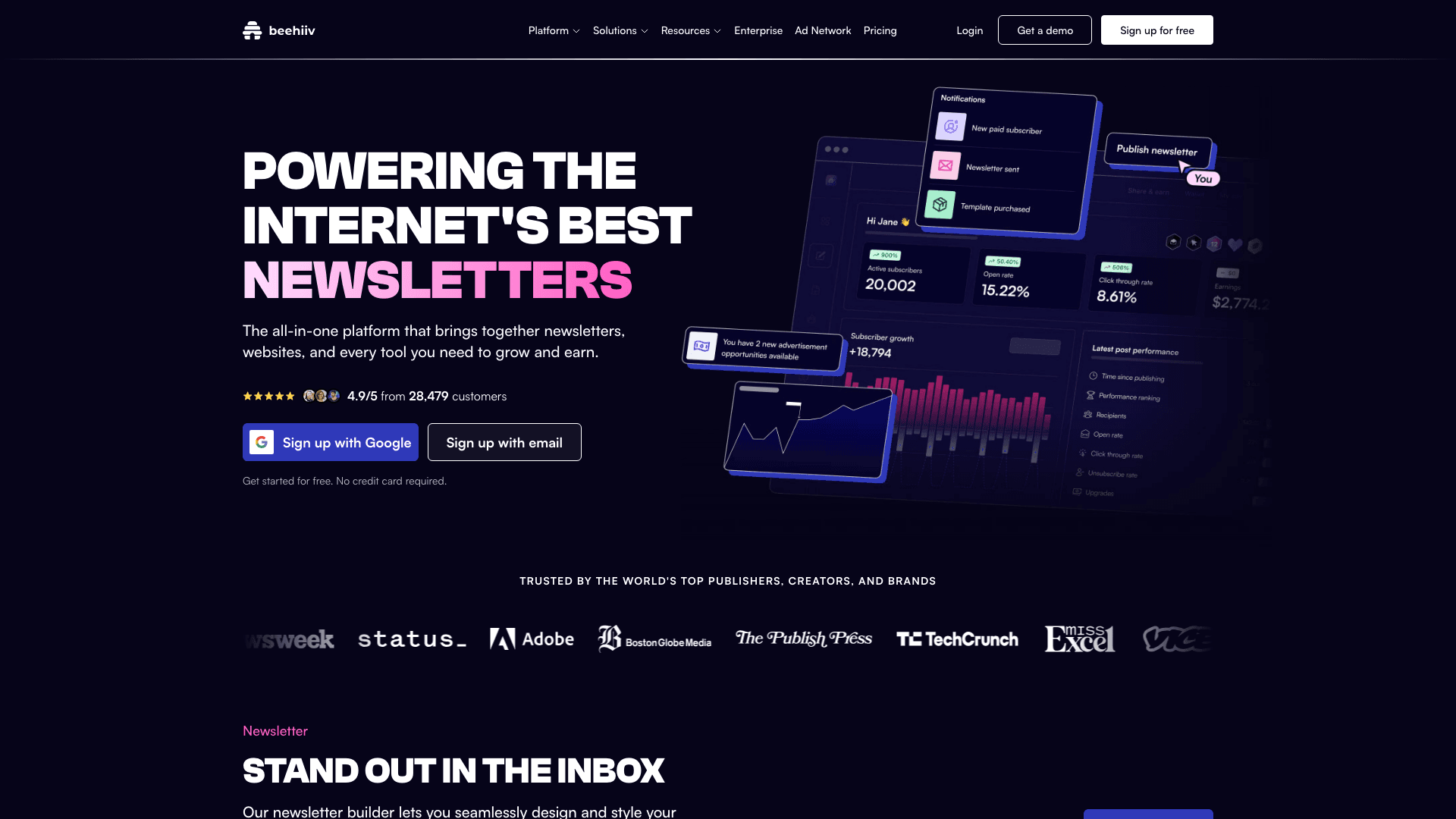
Beehiiv is the newsletter platform built by the team that ran Morning Brew's growth engine — founded in 2021 by Tyler Denk and two co-founders, now at $30M ARR (2026, up from $20M in 2025) with 50,000+ active publications and 10 billion emails sent as of Q1 2026. The pitch is that the growth mechanics Morning Brew used — referral programs, cross-newsletter recommendations, an ad network — are native platform features, not integrations. The free Launch plan covers 2,500 subscribers with unlimited sends, a website, custom domains, and the recommendation network; Scale ($43/mo billed annually, ~$49 month-to-month) unlocks automations, digital products, the Ad Network, and — the structural one — a 0% take rate on paid subscriptions, all the way to 100,000 subscribers.
Beehiiv is what this site actually uses: the Superframeworks newsletter is written, sent, and grown on it, so this ranking is lived, not researched-only. For an indie hacker the case is concrete: you start free at a real scale (2,500 subs, no send caps), your first growth loops are built in (recommendations from adjacent newsletters, referral rewards), and when you monetize, the platform's cut is zero — Stripe's 2.9% + $0.30 is all you pay, versus the 10% + Stripe you'd hand Substack for the same reader. The honest trade-offs: the $0 → $43/mo cliff lands the day you cross 2,500 subscribers whether you monetize or not, removing Beehiiv branding is gated to the $96/mo Max plan, and its verified G2 base is thin (4.7/5 across ~40 reviews) relative to its self-reported 4.9/5 from 28,000+ customers — delighted users, small independent sample. In April 2026 it shipped native podcast hosting (also at 0% revenue share) plus webinars and customizable paywalls, extending the same flat-fee logic beyond email.
The proof is the newsletter you can join right now
Superframeworks — the newsletter this entire site is built around — is written and sent on Beehiiv. Every subscribe form on this page posts to it, and 3,000+ solopreneurs, SaaS founders, and indie hackers read it. We also published a full teardown of how Beehiiv itself went from $0 to $1M in year one and past $30M ARR by 2026 — the same referral and recommendation mechanics it was built on are the features you get as a customer.
Read the Beehiiv case study · Join the Superframeworks newsletter
Key Features
- Free Launch plan: 2,500 subscribers, unlimited sends, website, custom domain, recommendation network
- 0% take rate on paid subscriptions from Scale up — Stripe processing is your only cost
- Growth loops as platform features: referral program, Boosts, cross-newsletter recommendations, Ad Network
- Scale covers up to 100,000 subscribers at one flat price — no per-subscriber creep until six figures
- April 2026 expansion: native podcast hosting (0% cut), webinars, customizable paywalls
Pricing
Launch free (up to 2,500 subscribers, unlimited sends). Scale $43/mo billed annually / ~$49 monthly (up to 100,000 subscribers, 0% paid-subscription take, automations, Ad Network, 3 seats). Max $96/mo annual (remove branding, 10 publications, unlimited seats, RSS-to-send). Enterprise custom above 100k. Stripe fees (2.9% + $0.30) apply to paid subscriptions everywhere.
Rating
4.7/5 — G2 (40+ reviews)
Best For
Indie hackers treating a newsletter as a growth asset — audience first, monetiza...
Pros
- The most complete free growth stack in the category — 2,500 subs with unlimited sends and the recommendation network
- 0% platform cut on paid subscriptions; flat pricing to 100,000 subscribers
- Fastest-shipping platform here: podcasts, webinars, and paywalls all landed in 2026
Cons
- The $0 → $43/mo cliff hits at subscriber 2,501 regardless of revenue, and branding removal is gated to Max ($96/mo)
- Thin verified review base (4.7/5, ~40 G2 reviews) next to its self-reported 4.9/5 from 28,000+ customers
Kit
Best Free Plan & Best for Selling — 10,000 Subscribers Free, Products Included
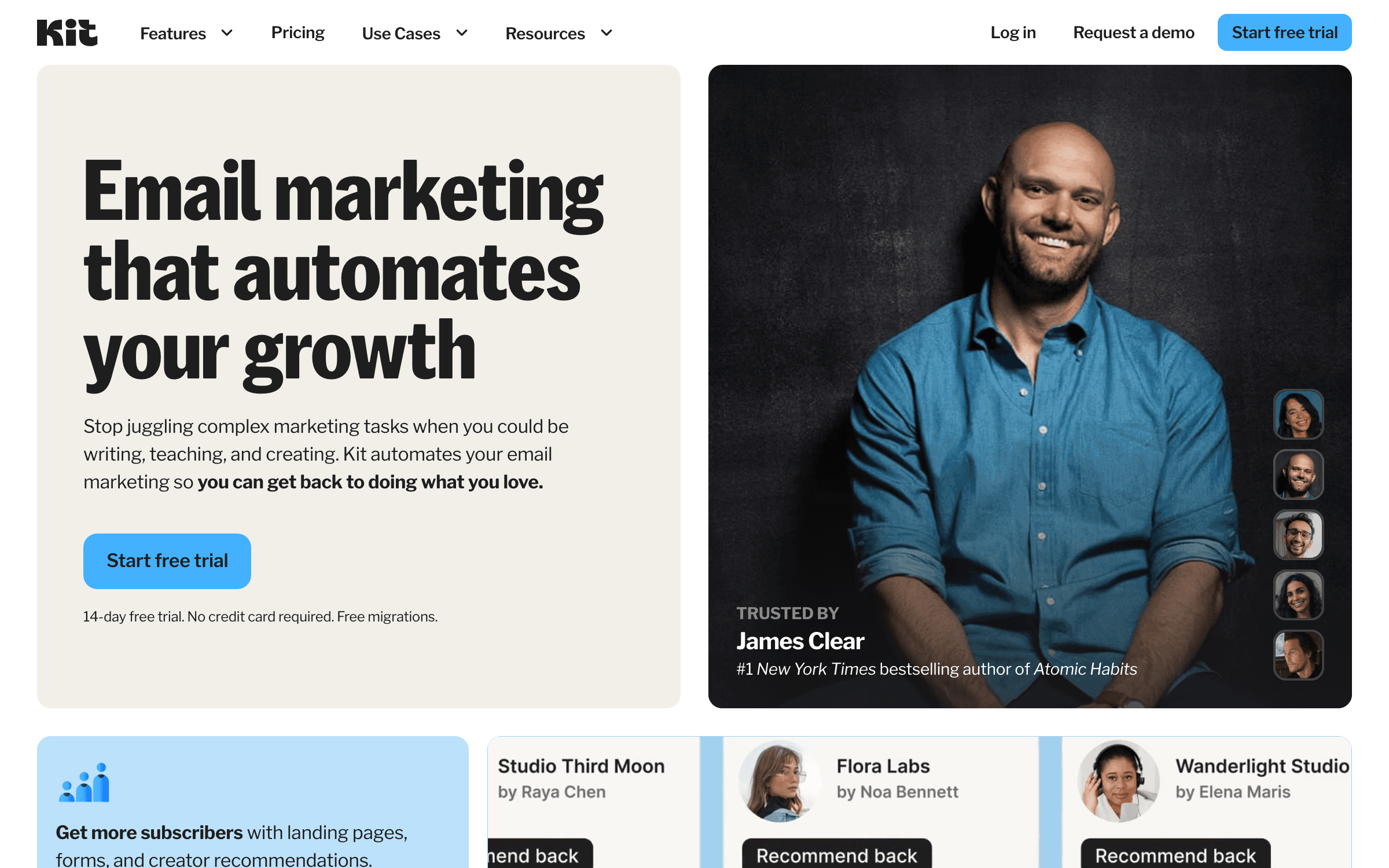
Kit — ConvertKit until its October 2024 rebrand — is the creator-commerce veteran of this list, and in 2026 it holds the single most generous free plan in newsletters: the Newsletter plan is free to 10,000 subscribers with unlimited broadcasts, unlimited landing pages and forms, audience tagging, and the ability to sell digital products and paid subscriptions from day one. Paid plans (Creator from $39/mo at 1,000 subscribers, $33/mo billed annually) add the visual automation builder, the Creator Network for cross-promotion, and app-store integrations.
Kit answers the question most indie hackers actually have — "what if I don't want to pay anything until this works?" — better than anyone: 10,000 free subscribers is 4x Beehiiv's and 40x EmailOctopus's free ceiling, verified on Kit's 2026 pricing. And because selling is included free, a digital product or paid tier can fund the newsletter before the newsletter costs anything. The catch is the other side of the same coin: per-subscriber pricing climbs fast once you upgrade for automations — $39/mo at 1,000 subscribers, $59 at 3,000, $89 at 5,000 — so a 5,000-subscriber list with automations costs more than double Beehiiv's flat Scale price. Kit's email design philosophy is also deliberately plain-text-first; if you want image-rich, magazine-style issues, MailerLite and Beehiiv are stronger editors. Its G2 record (4.4/5 across 217+ reviews) is solid and its 13-year history is the platform-risk hedge.
Key Features
- Free to 10,000 subscribers — the most generous free plan in the category (2026)
- Sell digital products and paid subscriptions on the free plan
- Visual automation builder and deliverability-focused plain-text ethos on paid tiers
- Creator Network cross-promotions — Kit's answer to Beehiiv's recommendation engine
- Unlimited landing pages, forms, and broadcasts at every tier
Pricing
Newsletter plan free (up to 10,000 subscribers, unlimited sends, selling included). Creator $39/mo at 1,000 subscribers ($33/mo annual), $59/mo at 3,000, $89/mo at 5,000 — price scales with list size. Creator Pro tier above that adds advanced reporting and priority support.
Rating
4.4/5 — G2 (217+ reviews)
Best For
Creators and indie hackers who want zero platform cost until 10,000 subscribers ...
Pros
- 10,000 free subscribers with selling included — the best zero-budget starting point in 2026
- Automations and deliverability reputation earned over 13 years serving creators
- Creator Network gives real cross-promo distribution without a revenue cut
Cons
- Per-subscriber paid pricing compounds: $89/mo at 5,000 subscribers vs. Beehiiv's $43 flat to 100,000
- Plain-text-first design philosophy — weak fit for visual, image-heavy newsletter formats
Ghost
Best for Full Ownership — Open Source, 0% Fees, and Native Fediverse Reach
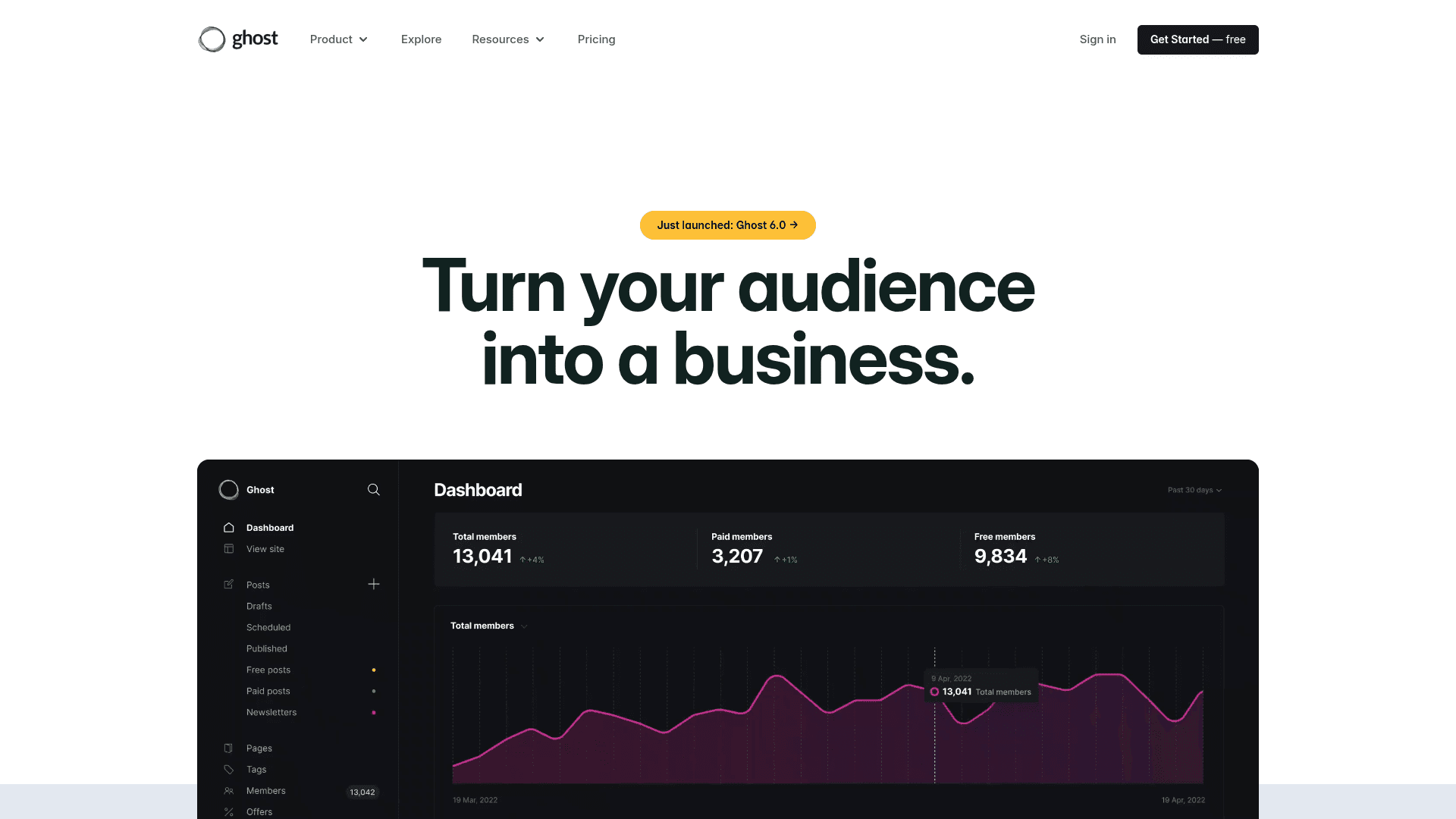
Ghost is the non-profit, open-source publishing platform that treats your newsletter as a website you own rather than an account you rent. Ghost 6.0 (released August 4, 2025) made it the first major newsletter platform on the open social web: your publication becomes a followable ActivityPub profile, so readers on Mastodon, Threads, Flipboard, and Bluesky (via bridge) can follow and reply to your posts natively — plus first-party, privacy-friendly analytics in the admin. Managed hosting (Ghost(Pro)) starts at $18/mo billed annually for 1,000 members with 0% transaction fees on memberships; the same software self-hosts free on your own VPS.
Ghost is the only pick here where the exit door is part of the product: the code is open source, the content is yours, and if Ghost(Pro) ever repriced you could move the exact same site to a $6 VPS — the credible threat that keeps hosted pricing honest. Ghost also charges 0% on memberships and paid subscriptions at every tier, same as Beehiiv, and its ActivityPub integration is free on both hosted and self-hosted sites — a distribution surface Substack and Beehiiv don't touch. The honest limits: there is no meaningful G2 review base to cite (we don't invent one), native marketing automations don't exist (Ghost is a publishing tool, not a funnel builder), and self-hosting means you own updates, backups, and deliverability configuration. Hosted pricing also scales with members — the $199/mo Business tier at 10,000 members is real money, though still 0% of your revenue.
Key Features
- Open-source software — self-host free forever, or pay Ghost(Pro) to run it for you
- 0% transaction fees on memberships and paid subscriptions at every tier
- Ghost 6.0 (Aug 2025): native ActivityPub — followable from Mastodon, Threads, Flipboard, Bluesky via bridge
- First-party, cookieless analytics built into the admin (6.0)
- Run by the non-profit Ghost Foundation — no VC exit incentive to raise your rent
Pricing
Ghost(Pro) Starter $18/mo billed annually ($22 monthly) at 1,000 members; Publisher $29/mo annual ($35 monthly) with 3 staff users; Business $199/mo annual at 10,000 members; prices scale with member count. Self-hosted: free, open source, unlimited everything — your server, your ops. 0% transaction fees on all plans.
Rating
No meaningful verified G2 base — none cited
Best For
Founders who want the newsletter, the site, and the member database as one owned...
Pros
- The strongest ownership story in newsletters: open source + 0% fees + data portability by design
- ActivityPub distribution is a free, growing surface no closed competitor offers
- Non-profit stewardship removes the enshittification incentive that hit Mailchimp and MailerLite pricing
Cons
- No native automations or funnel tooling — pair it with a separate tool or skip the drip campaigns
- Hosted pricing scales with members ($199/mo at 10,000), and self-hosting shifts real ops burden onto you
Buttondown
Best Indie-to-Indie Pick — À-la-Carte Pricing from a Self-Funded Team
Buttondown is the newsletter tool built the way indie hackers build: a small, fully remote, self-funded company (profitable since 2017, no outside investment) selling exactly what it is — markdown-or-rich-text email with a hosted archive, custom sending domains, and a pricing model nobody else uses. Instead of tiers stuffed with features you don't want, the base price scales with active subscribers (free to 100) and you bolt on only the feature bundles you need: $9/mo bundles for tagging, paid subscriptions, analytics, or RSS-to-email; $29/mo for automations, multiple newsletters, or custom-domain archives; $79/mo for white-labeling and teams.
Buttondown is what "pay for what you use" actually looks like in this category — a writer who just writes pays for subscribers and nothing else, while the à-la-carte menu means you're never funding a feature roadmap you don't use. It bills only active subscribers, discounts 50% for registered non-profits, and its markdown editor plus API make it the most comfortable pick here for developers who draft in their editor of choice. The honest limits: the free plan's 100-subscriber cap is a demo, not a runway (Kit gives you 10,000); stacking three add-ons can quietly exceed a Beehiiv Scale subscription; sending is capped at one email a day to your full list; and there's no meaningful G2 base to cite — its reputation lives in developer blogs and word of mouth, which is exactly on brand.
Key Features
- À-la-carte pricing: pay a subscriber-based base rate, add only the feature bundles you use
- Markdown-first editor, full API, and custom sending domains — even on free
- Independent, self-funded, and profitable since 2017 — the lowest platform-drama risk on this list
- Bills active subscribers only; 50% non-profit discount
- Paid subscriptions available as a $9/mo add-on
Pricing
Free to 100 subscribers. Base price scales with subscriber count; feature add-ons à la carte: $9/mo each for tagging/segmentation, paid subscriptions, analytics, comments/surveys, RSS-to-email; $29/mo each for automations, multiple newsletters, custom-domain archives; $79/mo for white-label and teams. Sending capped at one email/day to your full list.
Rating
No meaningful verified G2 base — none cited
Best For
Developers and writers who want a fast, unbloated tool from a company shaped lik...
Pros
- The only pricing model here where features you don't use cost you nothing
- Genuinely independent — self-funded and profitable, so the pricing rug-pull risk is minimal
- Best developer ergonomics of the pure newsletter tools: markdown, API, sane exports
Cons
- 100-subscriber free cap is the smallest on this list by far
- Add-ons stack: base + automations + paid subscriptions can exceed Beehiiv's flat Scale price
Want More Recommendations?
Subscribe for curated tool picks every week — sent, fittingly, with the #1 platform on this list. No sponsored content, no fluff.
Loops
Best for SaaS Founders — Newsletter, Product Updates, and Transactional in One
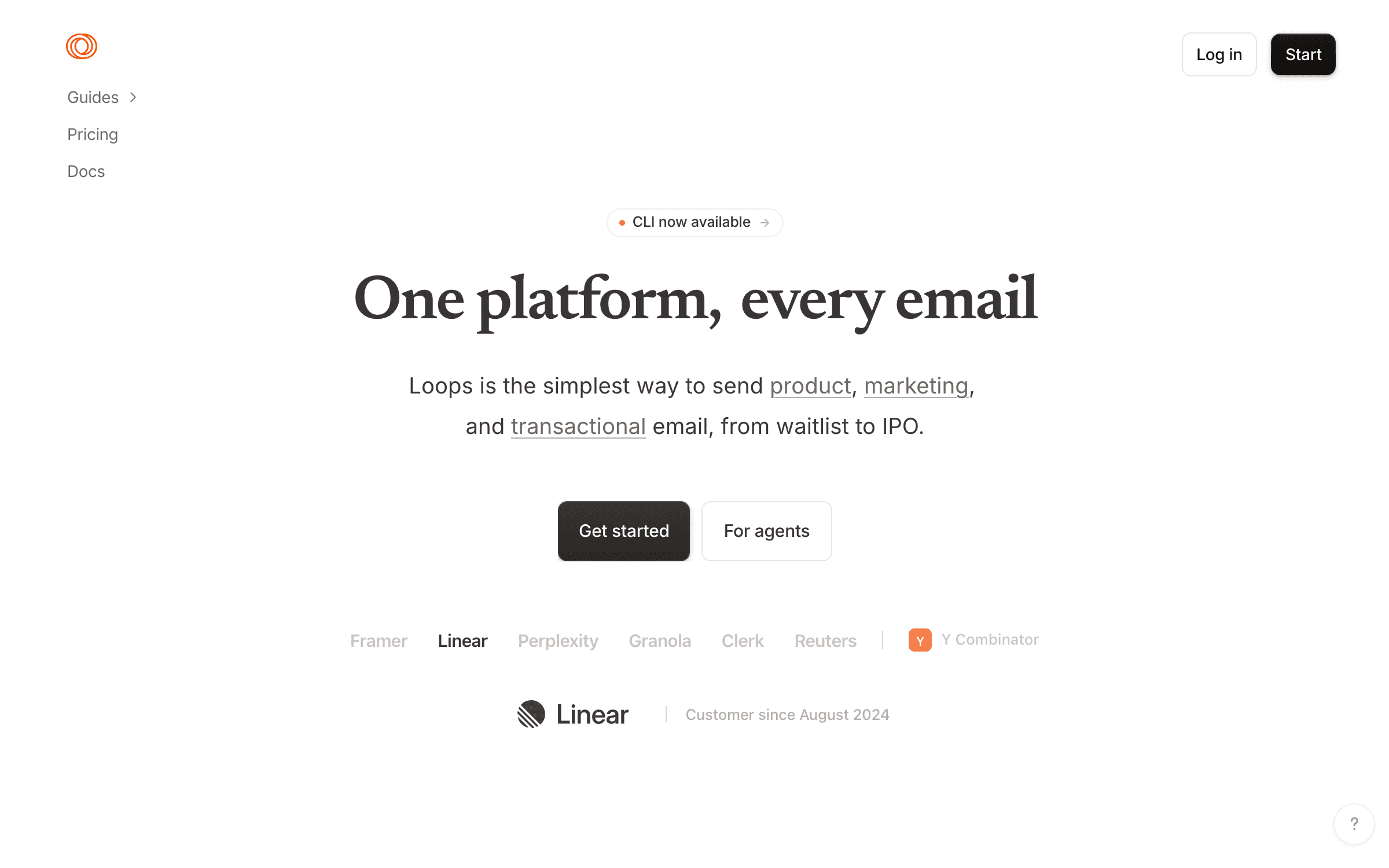
Loops is email for software companies, and that focus is the feature: one contact list, one editor, and one API cover your newsletter, your product announcements, your onboarding drips, and your transactional sends (password resets, receipts) — the entire email surface of a SaaS product. The free plan covers 1,000 contacts and 4,000 sends a month with every feature included; paid starts at $49/mo for 5,000 contacts with unlimited sends, and transactional email is included at no extra charge on paid plans.
Loops solves the specific mess most indie SaaS founders are actually in: a newsletter on one tool, onboarding emails on another, transactional on a third, and three copies of every contact. Collapsing that into one system with one source of truth is worth more to a product company than any single newsletter feature — and the Notion-like editor means changelog emails stop feeling like a chore. The honest scope warning: Loops is product email, not a media business. There's no paid-subscription monetization, no recommendation network, no ad marketplace — if the newsletter is the business, Beehiiv, Kit, or Ghost fit better; if the newsletter serves a product, Loops is the cleanest stack on this list. Its review footprint on G2 is too thin to cite, so treat the polish as self-verified via the free tier.
Key Features
- Marketing, product, and transactional email in one contact list and one editor
- Free plan: 1,000 contacts, 4,000 sends/month, all features included
- Transactional email included free on paid plans — no separate SendGrid bill
- Notion-style editor that makes product updates and changelogs fast to ship
- Built and priced for SaaS: unlimited sends on paid, billed by subscribed contacts
Pricing
Free: 1,000 contacts, 4,000 emails/month, all features, "Powered by Loops" footer. Paid from $49/mo (5,000 contacts, unlimited sends) and $99/mo (10,000 contacts); scales by contact count. Transactional included on paid plans.
Rating
No meaningful verified G2 base — none cited
Best For
Indie SaaS founders consolidating newsletter + onboarding + transactional into o...
Pros
- Kills the three-tool email stack — one list for newsletter, lifecycle, and transactional
- Free tier includes every feature, so the evaluation is the real product
- Unlimited sends on paid plans; you pay for contacts, not volume
Cons
- No monetization tooling — paid subscriptions and ads are simply not what it's for
- $49/mo at 5,000 contacts is pricier than EmailOctopus or MailerLite at the same list size
EmailOctopus
Best Budget Pick — 2,500 Free Subscribers, Pro from $9/mo
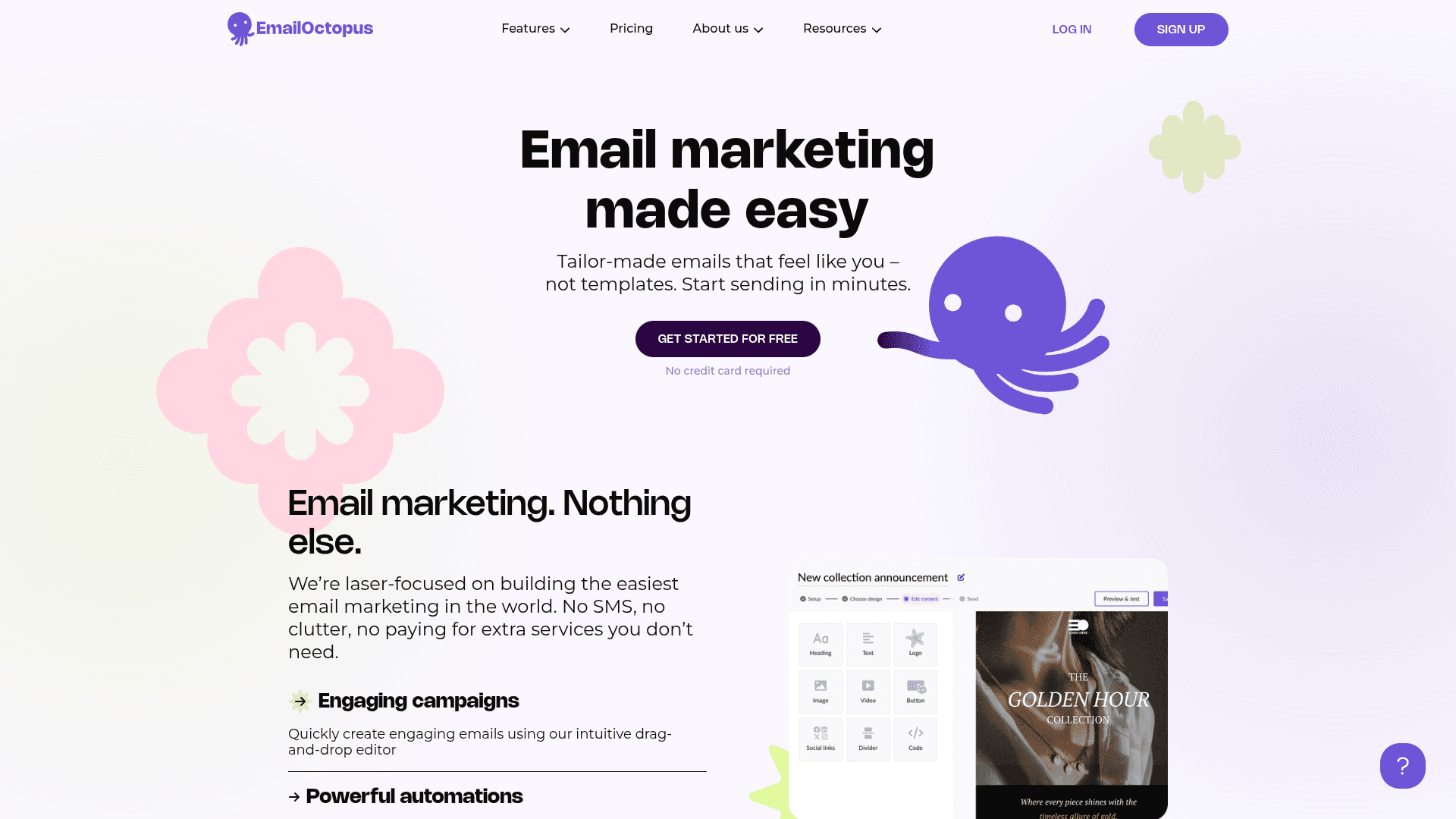
EmailOctopus is the cheapest credible way to run a newsletter in 2026, and after the free-tier cuts elsewhere it now beats Mailchimp and MailerLite at their own game: the free plan covers 2,500 subscribers and 10,000 emails a month — 10x Mailchimp's and MailerLite's post-cut free contact limits — and the Pro plan starts at $9/mo billed yearly, adding unlimited landing pages and forms, full design control, unlimited report retention, and multiple users. The trade is a deliberately lean feature set: campaigns, simple automations, forms, landing pages, and not much else.
EmailOctopus is the answer when the requirement is "send my list an email every week without thinking about the bill." Its free plan is now the second-most generous on this list by subscriber count (after Kit's 10,000) and the most generous among budget tools, verified against its 2026 pricing page. The honesty items: its verified rating is the lowest cited here (4.2/5 across 39 G2 reviews — small sample, flagged not hidden), EmailOctopus branding rides on free-plan emails, and power features are simply absent — no recommendation network, no paid-subscription tooling, minimal reporting depth. It's a utility, priced like one. For a side-project newsletter or a validation-stage list, that's exactly the right shape.
Key Features
- Free: 2,500 subscribers and 10,000 emails/month — the most generous budget free plan of 2026
- Pro from $9/mo billed yearly — unlimited landing pages, forms, and report retention
- Simple automations and a clean drag-and-drop editor without feature bloat
- Import-friendly: no punitive approval hoops for normal lists
- Straightforward per-subscriber scaling as you grow
Pricing
Free: 2,500 subscribers, 10,000 emails/month, EmailOctopus branding, 1 user. Pro from $9/mo billed yearly (save ~10% vs monthly): removes branding, unlimited landing pages/forms, unlimited report retention, multiple users; price scales with subscriber count.
Rating
4.2/5 — G2 (39+ reviews)
Best For
Bootstrappers and side-project newsletters that want the lowest possible cost pe...
Pros
- Unbeatable free plan among budget tools: 2,500 subs / 10,000 sends
- $9/mo Pro entry undercuts every comparable paid plan on this list
- Lean product means almost no learning curve
Cons
- Lowest verified rating on this list (4.2/5) on a small 39-review G2 sample
- No growth or monetization tooling — it sends email, and that's the product
MailerLite
Best Editor for the Money — But the Free Plan Was Gutted Twice
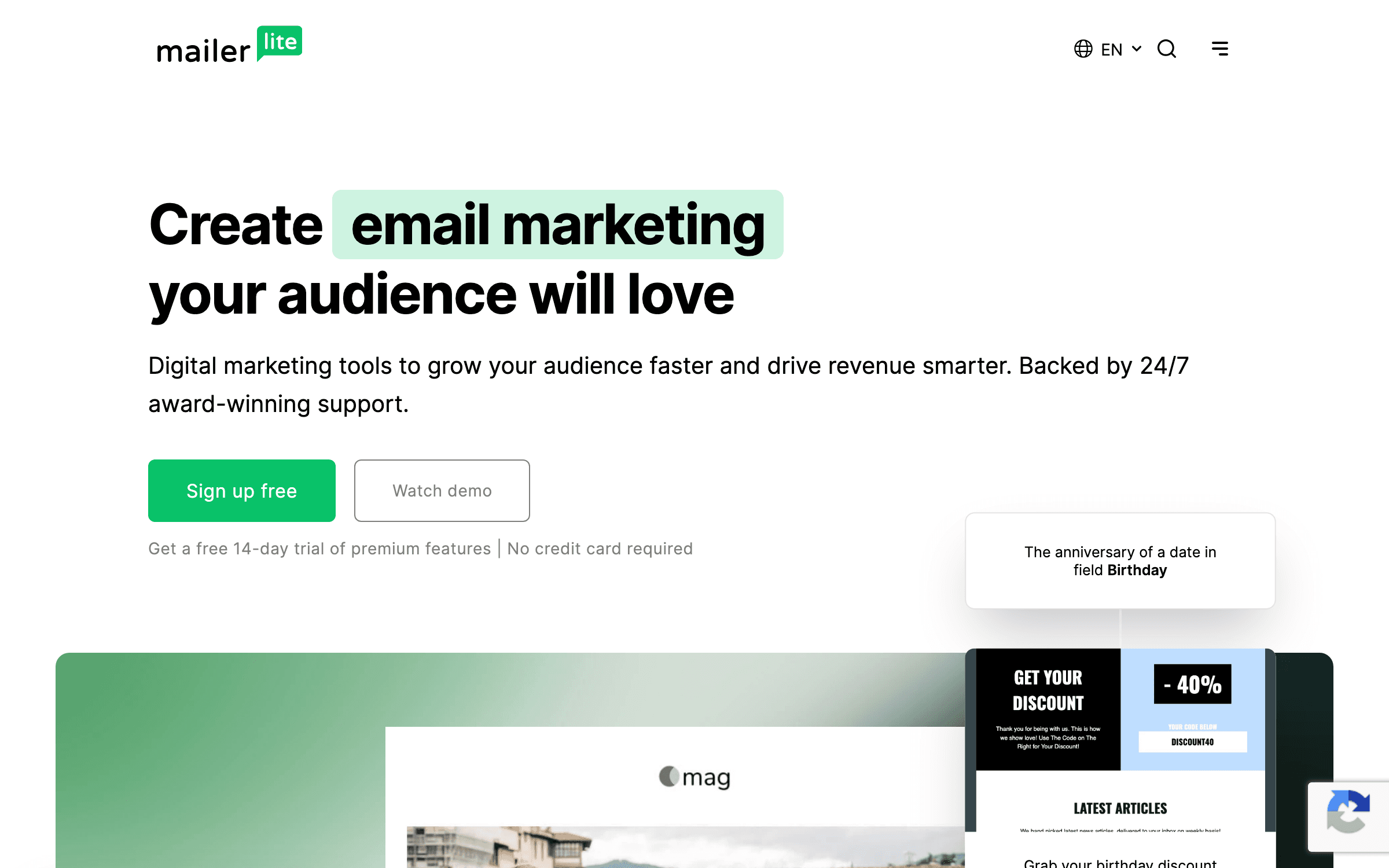
MailerLite is the best pure email-marketing value on this list once you're paying: the drag-and-drop editor is the nicest in the budget class, paid plans start at $12/mo (Comfort) with 50 automations and 10x-your-list monthly sends, and $25/mo (Power) removes limits with unlimited automations, unlimited landing pages, and 24/7 support — all backed by the strongest verified track record in this roundup (4.6/5 across 1,100+ G2 reviews). The reason it sits at #7 anyway: the free plan collapsed in two cuts — from 1,000 subscribers and 12,000 emails to 500 subscribers in September 2025, then to 250 subscribers and 2,500 emails on July 1, 2026, with feature-use limits rolling out to free accounts from August 13, 2026.
MailerLite earns its slot on editor quality and verified reputation — 1,100+ G2 reviews at 4.6/5 is an order of magnitude more independent validation than Beehiiv's sample — and at $12-25/mo it remains excellent value for a visual, image-rich newsletter with real automations. But this list ranks trust alongside features, and cutting the free plan by 75% twice in ten months is the same playbook that made Mailchimp this category's cautionary tale; it signals where pricing pressure goes next. Choose MailerLite when you're starting on a paid plan for the editor and automations. Don't choose it for the free tier that made it famous — that tier no longer exists in any meaningful form, and EmailOctopus now offers 10x the free subscribers.
Key Features
- The best drag-and-drop editor in the budget class — blocks, surveys, countdowns, e-commerce embeds
- Comfort $12/mo: 50 automations, 10 landing pages, AI writing assistant
- Power $25/mo: unlimited automations, landing pages, and emails, 24/7 live chat
- Strongest verified reputation here: 4.6/5 across 1,100+ G2 reviews
- Websites, blogs, and digital product sales included on paid tiers
Pricing
Free: 250 subscribers, 2,500 emails/month, 3 automations (limits cut July 1, 2026; feature caps from August 13, 2026). Comfort from $12/mo (10x-list sends, 50 automations). Power from $25/mo (unlimited sends, automations, landing pages, 24/7 chat). Prices scale with subscriber count; ~10% annual discount.
Rating
4.6/5 — G2 (1,100+ reviews)
Best For
Newsletter writers starting directly on a paid plan who want the best visual edi...
Pros
- Best editor-per-dollar in email marketing, with the largest verified review base on this list
- Paid plans stay cheap as you grow relative to Kit's per-subscriber curve
- Websites, blogs, and product sales bundled into paid tiers
Cons
- Free plan gutted twice in 10 months (1,000 → 500 → 250 subscribers) — a pricing-direction warning, not just a limit
- Newsletter-specific growth loops (recommendations, referrals, network discovery) don't exist here
Resend
Best for Developers — Your Newsletter as Code, Broadcasts Included
Resend is the developer email platform (the team behind React Email) that grew a proper newsletter surface: Broadcasts gives you an audience, an editor, unsubscribe handling, and scheduled sends on top of the API-first core that made it the default transactional choice for modern web stacks. The marketing track is billed by contacts, not sends — free covers 1,000 contacts (plus 3,000 transactional emails a month on the free API tier), and Pro Marketing runs from $40/mo at 5,000 contacts up to $650/mo at 150,000, with unlimited broadcast sends throughout.
Resend is the pick when the newsletter is one more artifact in your codebase: issues written as React Email components, versioned in git, rendered identically in every client, and sent through the same provider that handles your app's receipts and magic links. For a technical founder already on Resend for transactional, Broadcasts means the newsletter costs nothing extra until 1,000 contacts and never adds a second vendor. The honest scoping: this is the thinnest newsletter feature set on the list — no referral loops, no monetization, no discovery, minimal analytics — and at $40/mo for 5,000 contacts it's pricier than EmailOctopus or MailerLite at the same list size. It earns #8 as a stack-consolidation play for developers, not as a media platform. No meaningful G2 base exists to cite; its reputation lives in the framework ecosystem.
Key Features
- Broadcasts: audiences, editor, scheduling, and unsubscribe handling on an API-first platform
- Write issues as React Email components — the newsletter lives in your repo
- Free: 1,000 marketing contacts + 3,000 transactional emails/month
- Unlimited broadcast sends — marketing billed by contacts only
- One vendor for newsletter + transactional in a modern web stack
Pricing
Free: 1,000 marketing contacts; 3,000 transactional emails/month. Pro Marketing from $40/mo at 5,000 contacts, scaling to $650/mo at 150,000 contacts; unlimited sends on the marketing track. Transactional priced separately by volume.
Rating
No meaningful verified G2 base — none cited
Best For
Developers who want the newsletter in code, sent by the same infrastructure as t...
Pros
- The cleanest developer workflow in newsletters: React Email + git + one API
- Consolidates transactional and newsletter into a single vendor and audience store
- Free tier is a real production start for a young SaaS
Cons
- Thinnest newsletter feature set here — no growth loops, monetization, or deep analytics
- $40/mo at 5,000 contacts is above EmailOctopus and MailerLite at the same scale
Why Substack Isn't Ranked
Substack is the incumbent every platform on this list is measured against, so it gets the full teardown instead of a rank. The model: publishing is free, and when you monetize, Substack takes 10% of gross subscription revenue — a rate unchanged since 2017 — on top of Stripe's 2.9% + $0.30 per transaction and a 0.7% recurring-billing fee. On a $10/month subscriber, roughly 17% never reaches you.
The worked example: at $1,000/month in subscriptions, Substack's cut is $100 every month — about $2,000 a year all-in with processing — while Beehiiv's Scale plan runs $517 a year flat and Ghost's Starter is $216, both with identical Stripe costs and a 0% platform cut. The crossover is low: Beehiiv's $43/mo equals Substack's 10% at just $430/mo in revenue. Past that, the 10% is a distribution tax, growing with your success forever.
And here's the fair counterweight: that tax buys the only real discovery network in newsletters. Substack passed 5 million paid subscriptions across the network in January 2026 (double its November 2024 figure), reached positive cash flow in Q1 2025, and raised a $100M Series C in July 2025 at a $1.1B valuation — the app, Notes, and recommendations genuinely find readers, and Sacra estimated ~$45M in annualized revenue in mid-2025. If you write culture or politics and the network is compounding your growth, the trade can be rational. If you're an indie hacker building an owned asset — a list that feeds a product, not a feed — you are the wrong customer for a 10% landlord, and your list (though not your network reach) exports cleanly when you leave.
What We Cut — And Why
The cuts are buying signals too — three patterns disqualified otherwise-popular tools:
- Mailchimp — every pricing move since the 2021 Intuit acquisition has gone against small senders: free cut from 2,000 contacts to 500 (January 2025) to 250 with automations removed (December 2025), paid tiers up across the board (Premium $299 → $350+), an 11-13% legacy-account hike landing April 13, 2026 — and it still counts unsubscribed and non-subscribed contacts toward your billable limit unless you archive them by hand. You pay for people who will never see an email.
- Flodesk — retired the $38/month flat-unlimited plan (late 2025) that was its entire structural argument, moving to subscriber-scaled tiers (Lite $25/mo, Pro $28/mo, Everything $54/mo at 1,000 subscribers). The design templates remain lovely; the reason an indie hacker would pick it over this list's top four is gone. Credit where due: it bills active subscribers only.
- ActiveCampaign, Brevo, Constant Contact, AWeber — capable general email-marketing suites, wrong shape for this job. They're built for campaign marketing and CRM-adjacent automation, not newsletter publishing: no publication-style archives, no recommendation or referral loops, no reader-facing monetization. If you need marketing automation for a business, evaluate them there — as newsletter platforms they carry suite complexity without newsletter leverage.
How We Chose These Platforms
We evaluated 14 newsletter and email platforms in August 2026 against five founder-specific criteria — and unlike most of what ranks for this query, we operate a newsletter business on the winner.
- Who owns the audience — export paths, custom domains, 0% vs. percentage revenue cuts, and whether growth compounds into an asset you keep
- Real cost at founder scale — what 2,500, 10,000, and a $1,000/mo paid list actually cost on each platform's unit, from official August 2026 pricing pages
- Pricing-direction trust — free-tier cuts, repricings, and ownership changes from the last 18 months, weighted as signals of where each vendor is headed
- Verified sentiment only — G2 ratings and counts cited where a real base exists; thin samples flagged; no invented scores for platforms without one
- Growth leverage — native referral programs, recommendation networks, and discovery surfaces, because distribution is the scarce input for a solo founder
How to Choose by What You're Building
Pick by the shape of the business the newsletter serves, not by feature-list length.
The newsletter is the growth engine...
Beehiiv — recommendations, referrals, and Boosts are native, free to 2,500 subs, and the platform never takes a cut of what you earn.
Zero budget until it works...
Kit free to 10,000 subscribers with selling included — or EmailOctopus at $9/mo when you outgrow free tiers on a budget.
Ownership is non-negotiable...
Ghost — open source, 0% fees, self-hostable, and your publication is a fediverse profile since 6.0. The exit door is the product.
The newsletter serves a SaaS...
Loops — one list and one editor for newsletter, onboarding, and transactional. Resend if you'd rather write it all in React Email.
You want to pay only for what you use...
Buttondown — subscriber-based base price plus à-la-carte add-ons, from a self-funded indie team that won't reprice you for a Series C.
Monetizing a paid list from day one...
Model the fees first: Beehiiv and Ghost take 0%; Substack takes 10% forever. The crossover where flat beats the cut is ~$430/mo in revenue.
Stay Ahead of the Tool Curve
We research dozens of tools so you don't have to. Get our top picks and insider insights delivered weekly.
Frequently Asked Questions
What is the best newsletter platform for indie hackers in 2026?
Beehiiv is the best newsletter platform for most indie hackers in 2026 — and the disclosure is the evidence: the Superframeworks newsletter runs on it. The case rests on three verifiable facts: the free Launch plan covers 2,500 subscribers with unlimited sends and built-in growth loops (recommendations, referrals); the Scale plan is a flat $43/mo billed annually all the way to 100,000 subscribers; and Beehiiv takes 0% of paid-subscription revenue, so monetizing costs you Stripe fees and nothing else. If you want zero cost until 10,000 subscribers, Kit's free plan is the outlier; if you want maximum ownership, Ghost's open-source 0%-fee model wins; if the newsletter serves a SaaS product, Loops consolidates your whole email stack.
Is Substack worth the 10% cut?
Substack is worth 10% only while its network is finding you readers you couldn't find yourself. Substack takes 10% of gross paid-subscription revenue (unchanged since 2017), plus Stripe's 2.9% + $0.30 and a 0.7% recurring-billing fee — roughly 17% all-in on a $10/mo subscriber. Its counterweight is real distribution: 5M+ paid subscriptions across the network as of January 2026 and an app ecosystem no rival matches, backed by a $100M Series C at a $1.1B valuation (July 2025). The crossover math: Beehiiv's Scale plan costs $43/mo, which equals Substack's cut at just $430/mo in revenue — beyond that point, every marginal dollar on Substack pays for discovery you may no longer need. Culture and politics writers monetizing the network fast often keep the trade; founders building an owned asset usually shouldn't.
What does a $1,000-a-month paid newsletter actually cost on Substack compared to Beehiiv?
A newsletter grossing $1,000/month from 100 subscribers at $10 each pays Substack about $166/month: $100 as the 10% platform fee, roughly $59 in Stripe processing (2.9% + $0.30 per transaction), and about $7 from the 0.7% recurring-billing fee — around $2,000 a year, scaling up with revenue forever. The same newsletter on Beehiiv's Scale plan pays $517/year flat (the annual price of $43/mo) plus the same Stripe processing — payment fees are identical everywhere, so Substack's platform cut is the entire difference, and it grows linearly: at $5,000/month, Substack's cut alone is $500 every month against Beehiiv's unchanged $43.
What is the best free newsletter platform in 2026?
Kit has the most generous free plan of 2026: 10,000 subscribers with unlimited broadcasts, landing pages, forms, and the ability to sell digital products — no other platform is within 4x of that ceiling. Beehiiv's free Launch plan (2,500 subscribers, unlimited sends) is the better free growth stack because the recommendation network and referral program work from day one. EmailOctopus (2,500 subscribers, 10,000 emails/month free) is the budget utility pick. Treat Mailchimp's and MailerLite's free plans as effectively discontinued: both were cut to 250 contacts in 2025-26, with automations removed from Mailchimp's and feature caps arriving on MailerLite's from August 13, 2026.
Why isn't Mailchimp on this list?
Mailchimp was cut because every pricing change since its 2021 Intuit acquisition has moved against small senders. The free plan fell from 2,000 contacts and 10,000 sends to 500/1,000 in January 2025, then to 250 contacts and 500 sends in December 2025 — with automations removed from free entirely. Paid tiers rose (Essentials $11 → $13, Standard $17 → $20+, Premium $299 → $350+), and pre-2019 legacy accounts face a further 11-13% increase from April 13, 2026. The structural gotcha: Mailchimp counts unsubscribed and non-subscribed contacts toward your billable limit unless you manually archive them — you pay for people who will never receive an email. Every pick on this list bills active subscribers only.
Can I move my newsletter off Substack (or any of these platforms) later?
Yes — list portability is standard, and it's a core reason to prefer platforms with 0% revenue cuts over network lock-in. Every platform on this list imports subscriber CSVs, and Substack allows full subscriber export, so free readers move cleanly to Beehiiv, Kit, Ghost, or anywhere else. Paid subscriptions are the harder part: they live in Stripe, and migrating recurring billing to a new platform is a documented but multi-step process on every route — plan a migration window rather than an afternoon. What does not move, from Substack specifically, is network discovery: recommendations, app followers, and Notes reach stay behind. That asymmetry — the list is portable, the distribution isn't — is exactly why the rent-vs-own decision deserves more weight than any feature comparison.
What happened to MailerLite's and Flodesk's famous pricing?
Both retired the pricing that made them recommendable in 2025-26. MailerLite cut its free plan from 1,000 subscribers and 12,000 monthly emails to 500 subscribers in September 2025, then to 250 subscribers and 2,500 emails on July 1, 2026 — a 75% reduction twice over, with feature-use caps following from August 13, 2026. Flodesk retired its famous $38/month flat-rate-unlimited-subscribers plan in late 2025 and now prices by active subscriber count like everyone else (at 1,000 subscribers: Lite $25/mo, Pro $28/mo, Everything $54/mo — monthly rates). MailerLite kept its slot on this list because its paid tiers remain excellent value; Flodesk didn't, because flat pricing was its differentiator for list-builders, and without it the remaining case is design templates.
The Bottom Line
Newsletter pricing in 2026 is a landlord decision wearing an editor comparison as a disguise. Substack charges rent that scales with your success; Mailchimp and MailerLite showed how fast "generous" free tiers get repriced; the platforms worth building on either take 0% of your revenue (Beehiiv, Ghost), give you 10,000 free subscribers to start (Kit), or are shaped like the businesses we actually run (Buttondown, Loops, EmailOctopus, Resend).
Our pick is the one we bet our own audience on: Beehiiv — start free at 2,500 subscribers with the growth loops built in, pay a flat $43 a month when you cross it, and keep 100% of whatever your readers ever pay you. Start with Kit if zero-cost-to-10k matters more, Ghost if ownership does, Loops or Resend if the newsletter serves your SaaS.
Whatever you pick: confirm the export path before you import a single subscriber, do the fee math at the revenue you want (not the revenue you have), and read the last 18 months of a vendor's pricing changes before trusting the next 18. The list is the asset. Choose the platform that treats it that way.
Related Reading
- Beehiiv Case Study: $0 to $1M in 12 Months — How our #1 pick was built, from the Morning Brew playbook out
- The Indie Hacker Distribution Paradox — Why owned distribution is the scarce input this list optimizes for
- HubSpot Acquires Starter Story: The Distribution Moat Play — What audiences are worth when someone else wants yours
- Your Build-in-Public Audience Is Not Your Market — Before you grow a list, know which list you're growing
Sources
- Beehiiv — Official Pricing
- Kit — Official Pricing
- Ghost — Official Pricing
- Buttondown — Official Pricing
- Loops — Official Pricing
- EmailOctopus — Official Pricing
- MailerLite — Official Pricing
- Resend — Official Pricing
- MailerLite — Free Plan Update FAQ (official, 2026 changes)
- Ghost 6.0 — Official Changelog (ActivityPub + native analytics)
- TechCrunch — Ghost Connects to the Open Social Web (Aug 2025)
- TechCrunch — Beehiiv Rolls Out Webinars and Customizable Paywalls (Apr 2026)
- Sacra — Substack Revenue, Valuation & Funding
- Sacra — Beehiiv Revenue, Valuation & Funding
- Audienceful — Mailchimp Price Increase 2026 (free-plan cuts, legacy hikes)
- EmailTooltester — Flodesk Pricing 2026 (flat-rate retirement)
- Superframeworks — Beehiiv Case Study ($0 to $1M in 12 Months)
See the #1 Pick From the Inside
The Superframeworks newsletter is sent with Beehiiv — the platform this list ranks first. Join 3,000+ solopreneurs, SaaS founders, and indie hackers getting our research weekly.
No sponsored content. Unsubscribe anytime.
Keep Reading
10 Best Marketing Automation Tools for Early-Stage Startups in 2026
Compare the 10 best marketing automation tools for early-stage startups in 2026. Free tiers, startup-friendly pricing, and real trade-offs for bootstrappers, indie hackers, and pre-Series A teams.
7 Best AI Search Visibility Tools for Agencies in 2026
Seven AI search visibility tools ranked for agencies by client workspaces, reporting, prompt economics, and the real cost of managing multiple brands.
10 Best Granola Alternatives for Private AI Meeting Notes (2026)
The best Granola alternatives in 2026, ranked on where your notes are stored, whether your data trains AI, and what a bot-free notetaker really costs. Verified pricing.