
10 Best Zendesk Alternatives in 2026 (Ranked by Why You Are Leaving — Including When to Stay)
The 10 best Zendesk alternatives in 2026 — Freshdesk, Help Scout, Zoho Desk, Pylon, Intercom, Gorgias, Crisp, Helply, HubSpot Service Hub, and eesel AI. Ranked by why teams actually leave, with Zendesk's real 2026 add-on math, the 72-hour rule that decides your AI bill, and an honest section on when migrating is the wrong call.
Every other page ranking for this query sells a Zendesk alternative.
Search “best Zendesk alternatives” and the results are published by Missive, Salesforce, DevRev, Desk365, HappyFox, Pylon, Richpanel, Voiceflow and eesel — every one of them with its own product somewhere in the ranking. That is not a conspiracy, it is just how bottom-of-funnel content gets funded, but it has a consequence: none of those pages can tell you to stay on Zendesk, because that answer costs them a customer. We sell no support software and took no placement fees, so this list ranks ten genuine alternatives and includes a section on when migrating is the wrong call.
Key Takeaways
- Every page ranking for "Zendesk alternatives" is published by a company selling one. Missive, Salesforce, DevRev, Desk365, HappyFox, Pylon, Richpanel, Voiceflow and eesel all rank for this query with their own product in the list. We sell no support software, which is why this is the only ranking here that includes a section on when you should stay on Zendesk.
- Zendesk's list price is not the problem — the add-on stack is. Suite Professional is $115/agent/mo paid yearly, and the Copilot add-on is another $50/agent/mo (Zendesk official pricing, checked 2026-08-10). That is $165/agent before AI resolutions; add the $50 Workforce Engagement bundle and you are at $215, and the $83 Contact Center add-on takes it to $298.
- The 72-hour rule is the single most important thing to understand about Zendesk's AI bill. Per Zendesk's own documentation, an automated resolution is counted after 72 hours of inactivity when AI evaluation judges the answer relevant and the customer either gave positive feedback or gave no feedback at all. Customer silence bills as success.
- Freshdesk is the closest like-for-like replacement: SLA management, skill-based routing, customer portals and a 1,000+ app marketplace at $19/agent/mo annual versus Zendesk's $115 (Freshworks official pricing, 2026-08-10). Zoho Desk goes cheaper still and puts Blueprints — enforced multi-step process automation — on its $23 Professional tier.
- Migration is the cost nobody prices in. Zendesk holds 4.3/5 on G2 across roughly 6,700 reviews as of mid-2026 — that is a stable, functioning product, not a failing one. If you are mid-contract, running deep custom apps, or need voice and workforce management from one vendor, the honest answer is to renegotiate rather than replatform.
- You may not need to migrate at all. eesel AI and similar helpdesk-agnostic layers plug into Zendesk directly with hard spend caps (default $250/mo), which is how a number of teams escaped per-resolution pricing in 2025-26 without moving a single ticket.
Nobody leaves Zendesk because it stopped working. It holds 4.3 out of 5 on G2 across roughly 6,700 reviews as of mid-2026, and that rating has barely moved in two years. Teams leave for one of four reasons, and which one applies to you should decide the alternative you pick — which is why this list is organised by reason for leaving rather than by feature count.
The first reason is the add-on stack. Zendesk Suite Professional is $115 per agent per month paid yearly, which is defensible for what it does. The Copilot add-on is another $50 per agent per month, the Workforce Engagement bundle another $50, and Contact Center another $83 (all figures from Zendesk's official pricing page, checked 10 August 2026). A five-agent team on Professional plus Copilot is paying $9,900 a year before a single AI resolution is billed.
The second is the AI meter, and it deserves more attention than it gets. Zendesk bills AI agents by “automated resolution”, and its own documentation defines one as being counted after 72 hours of inactivity when AI evaluation judges the response relevant and the customer either gave positive feedback or gave no feedback at all. A customer who gives up and closes the tab is indistinguishable from a customer whose problem was solved. Zendesk does not publish a per-resolution price on its pricing page; third-party analyses converge on roughly $1.50 committed and $2.00 pay-as-you-go.
The third is complexity — a recurring theme in the 2026 review base is that administration overhead lands hardest on the smallest teams. And the fourth is fit: if your customers ask for help in a shared Slack channel, Zendesk cannot see the conversation at all.
One more thing worth knowing before you shortlist: Zendesk completed its acquisition of Forethought on 26 March 2026, absorbing an AI agent platform that was handling over a billion customer interactions a month for companies including Upwork, Grammarly and Datadog. If you were evaluating Forethought as a Zendesk alternative, that option no longer exists — it is Zendesk now.
Zendesk Alternatives Compared at a Glance
| # | Tool | Leave Zendesk because… | Entry price | G2 |
|---|---|---|---|---|
| 1 | Freshdesk | Cost — but you refuse to give up real ticketing | Free for 2 agents | 4.4/5 |
| 2 | Help Scout | Complexity — Zendesk is heavier than your team | Free (5 users, 1 inbox, 1 Docs site) | 4.4/5 |
| 3 | Zoho Desk | Cost, and you want process automation without the $115 tier | Free (3 agents) | 4.4/5 |
| 4 | Pylon | Fit — your customers live in shared Slack channels, not a portal | Starter $59/seat/mo annual ($70 monthly, 3-seat minimum) | 4.7/5 |
| 5 | Intercom | AI economics — you want resolutions, not per-agent AI seats | Essential $29/seat/mo | 4.5/5 |
| 6 | Gorgias | Fit — you are an ecommerce brand paying per agent for seasonal staff | Starter $10/mo (50 tickets, then $0 | 4.6/5 |
| 7 | Crisp | Cost, and you are tired of every hire raising the bill | $45/mo (4 seats) | 4.5/5 |
| 8 | Helply | Cost — you want the platform to be free and pay only for outcomes | Free forever platform, unlimited seats (inbox, ticketing, chat, knowledge base) | 4.6/5 |
| 9 | HubSpot Service Hub | Consolidation — support data lives apart from everything else | Free tools (ticketing, chat, shared inbox) | 4.4/5 |
| 10 | eesel AI | Nothing — you want to fix the AI bill without migrating at all | Roughly 40¢ per ticket touched, with hard spend caps (default $250/mo) | — |
Entry price shows the lowest published tier. Ratings are G2 scores where a meaningful review base exists; a dash means we found none worth citing and invented nothing.
The Zendesk Bill, Reconstructed
Zendesk is deliberately absent from the ranking below — it is the incumbent every tool here gets compared against. Here is the arithmetic that sends teams looking, taken from Zendesk's published pricing on 10 August 2026:
Published plans
Support Team $19/agent/mo, Suite Team $55, Suite Professional $115 — all paid yearly. Suite Enterprise is quote-only.
The add-on stack
Copilot +$50/agent/mo. Workforce Engagement bundle +$50. Contact Center +$83. Professional plus Copilot is $165; all three stacked reaches $298.
The 72-hour rule
An automated resolution is counted after 72 hours of inactivity when AI evaluation judges the answer relevant and the customer gave positive feedback or no feedback at all (Zendesk documentation). Silence bills as success.
What is not published
Zendesk's pricing page states AI agents are included in every Suite and Support plan and billed on outcomes, but lists no per-resolution figure. Third-party analyses converge on ~$1.50 committed, ~$2.00 pay-as-you-go.
To be fair to the incumbent: 4.3/5 across ~6,700 G2 reviews is a strong, stable product. The case against Zendesk in 2026 is a pricing-structure case, not a quality case — which is exactly why the “when to stay” section below exists.
Freshdesk
Best Like-for-Like Replacement — Zendesk's Feature Set at $19/Agent
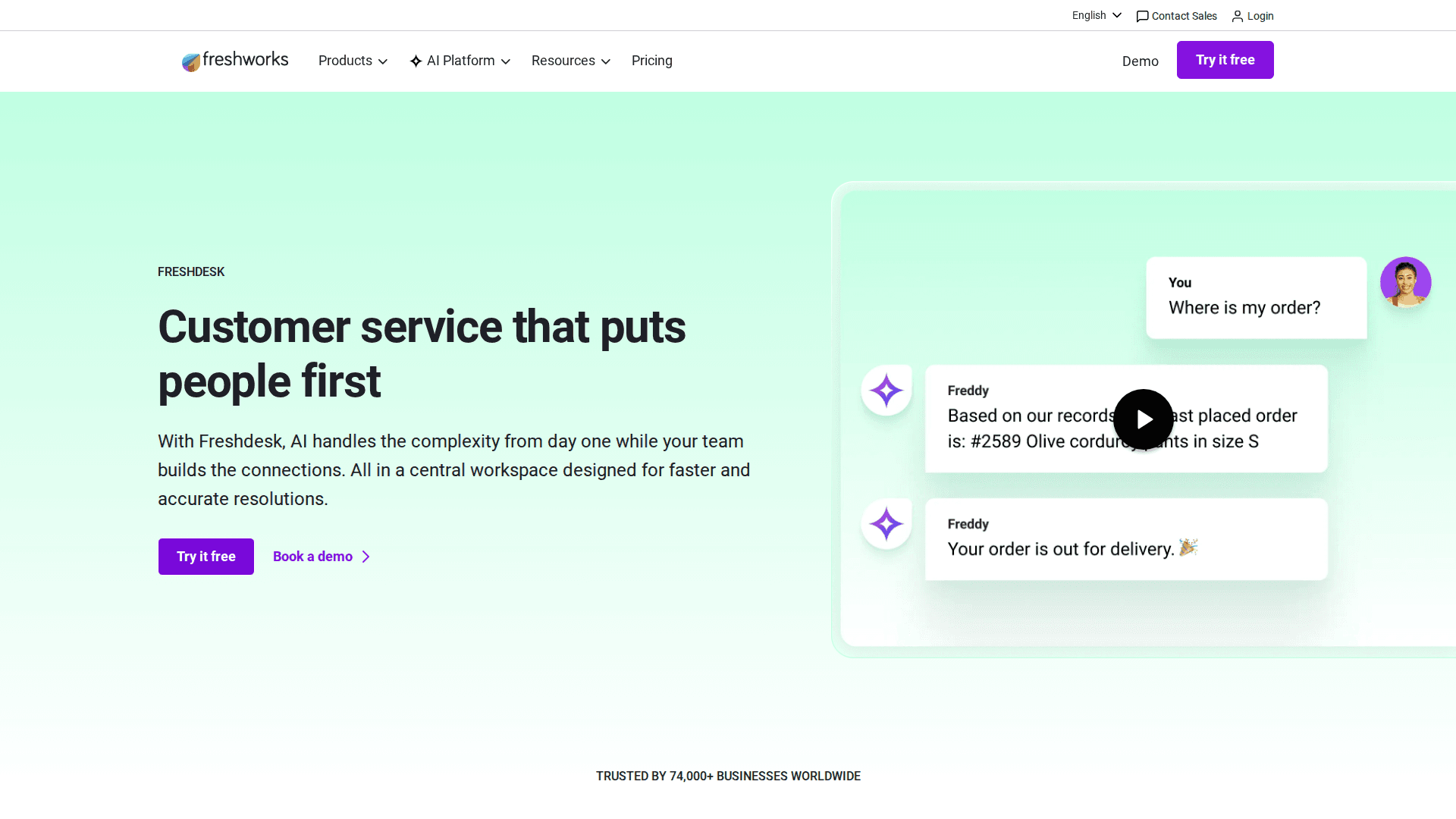
Freshdesk is the alternative most Zendesk refugees end up on, because it is the only one on this list that replaces Zendesk feature-for-feature rather than asking you to work differently. SLA management, skill-based routing, customer portals, ticket automation and a 1,000+ app marketplace all exist here, and the Growth plan carries them at $19/agent/mo billed annually against Zendesk Suite Professional's $115 (both figures from official pricing pages, checked 2026-08-10).
Freshdesk wins the top slot because switching costs are lowest when the mental model does not change: a Zendesk admin already knows what a group, an SLA policy and a dispatch rule are, and Freshdesk uses the same concepts under nearly the same names. The AI economics are also more legible than Zendesk's — Freddy AI Agent includes the first 500 sessions on every plan and charges $49 per additional 100 sessions, and Freddy AI Copilot is $29/agent/mo annual, against Zendesk's $50/agent Copilot plus unpublished per-resolution fees. The honest caveat is that Freshworks is a large public vendor with its own upgrade ladder: Pro is $55 and Enterprise $89, so the $19 entry only holds if Growth genuinely covers you.
What Freshdesk does well
- Closest concept-for-concept parity with Zendesk — SLAs, routing, portals, dispatch rules
- Growth plan at $19/agent/mo annual versus Zendesk Suite Professional at $115
- Freddy AI Agent: first 500 sessions included on every plan, then $49 per 100 sessions
- Freddy AI Copilot at $29/agent/mo annual — versus Zendesk Copilot at $50/agent/mo
- 1,000+ app marketplace, so most Zendesk integrations have a counterpart
Pricing
Free for 2 agents. Growth $19/agent/mo annual. Pro $55/agent/mo annual. Enterprise $89/agent/mo annual. Freddy AI Agent: 500 sessions included, then $49/100 sessions. Freddy AI Copilot $29/agent/mo annual. 14-day Enterprise trial.
Best for
Teams leaving Zendesk purely over cost who still need enterprise-grade ticketing — SLAs, routing, and a customer portal — and want the shortest possible retraining curve.
Pros
- Lowest retraining cost of any alternative — the concepts map one-to-one
- Roughly a sixth of Suite Professional's per-agent price at the entry tier
- AI pricing you can actually forecast: bundled sessions, then a published block rate
- Deep app marketplace means fewer orphaned integrations after migration
Cons
- The $19 entry only holds on Growth — Pro ($55) and Enterprise ($89) climb quickly
- Big-vendor feel: you are trading one large platform for another, not escaping to a boutique
Help Scout
Best for Teams Escaping Complexity — Free Tier, $0.75/Resolution AI
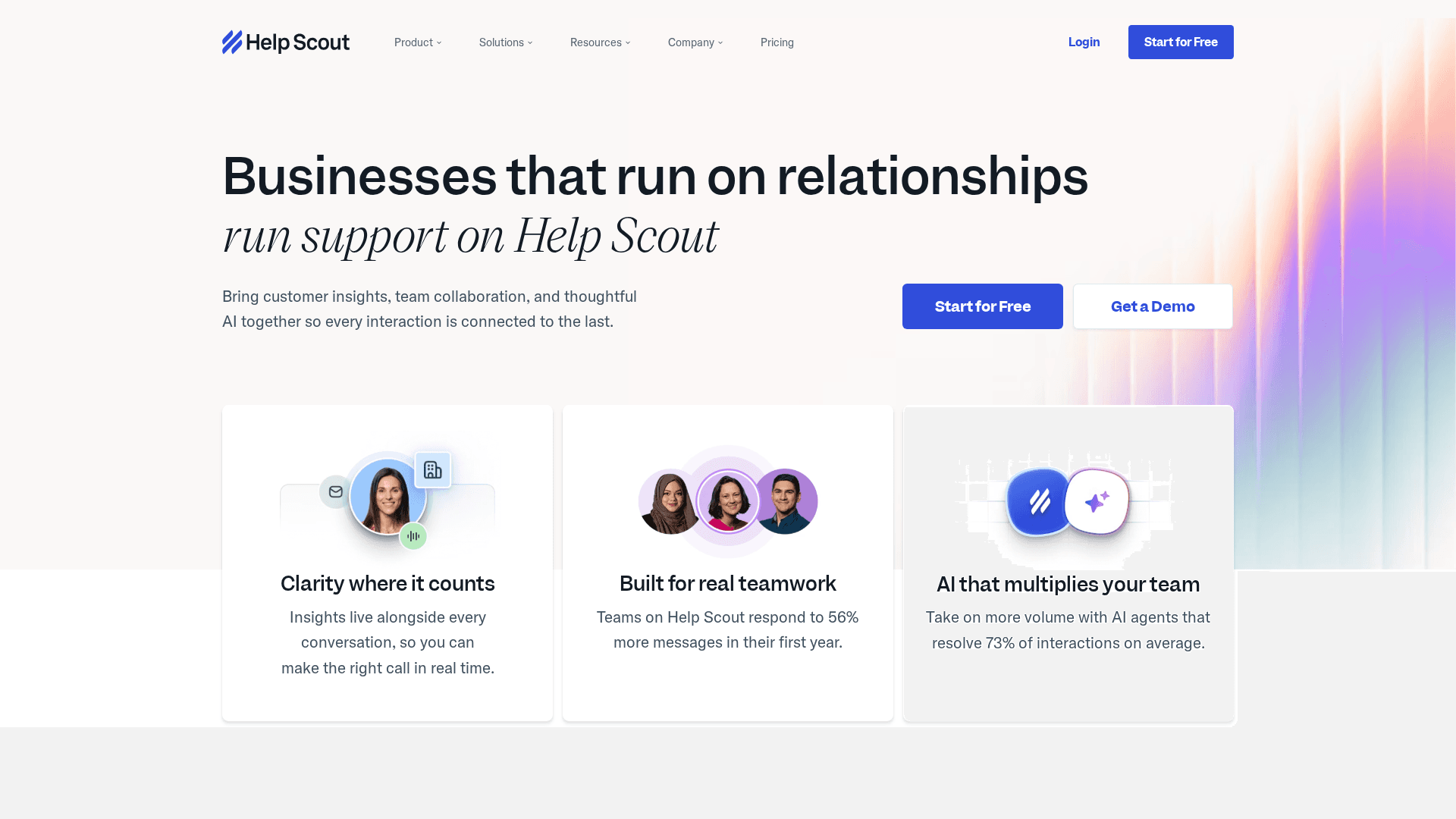
Help Scout is the alternative for teams whose real complaint about Zendesk is not the invoice but the interface. It presents support as a shared inbox rather than a ticketing system, which removes the admin layer most small teams never needed — no dispatch rules to maintain, no schema to design. Pricing is published in full: a free plan covering 5 users, 1 inbox and 1 Docs site, then Standard at $25/user/mo ($21 annual), Plus at $45 ($37.80 annual) and Pro at $75 ($63 annual), verified on Help Scout's pricing page 2026-08-10.
Help Scout is the cleanest answer to the second-most-common reason teams leave Zendesk, which shows up throughout its 2026 review base: setup and administration overhead that a five-person team can never amortise. Its AI billing is also the most straightforward on this list — AI Answers costs $0.75 per resolution, with new accounts getting three months of unlimited AI Answers at no cost, so you can measure your real deflection rate before it costs anything. The trade-off is deliberate: if you genuinely use Zendesk's heavier machinery — complex SLA tiers, skill-based routing, a multi-brand help centre — Help Scout will feel like a downgrade rather than a simplification.
What Help Scout does well
- Shared-inbox model removes the ticketing admin layer entirely
- Genuine free plan: 5 users, 1 inbox, 1 Docs site
- AI Answers at $0.75 per resolution, with 3 months unlimited free on new accounts
- Docs knowledge base included rather than sold as a separate product
- Published pricing at every tier — no sales call to see a number
Pricing
Free (5 users, 1 inbox, 1 Docs site). Standard $25/user/mo ($21 annual). Plus $45/user/mo ($37.80 annual). Pro $75/user/mo ($63 annual). AI Answers $0.75/resolution; 3-month unlimited AI Answers trial on new accounts.
Best for
Support teams under roughly ten people who found Zendesk over-engineered for their volume and want conversations rather than tickets.
Pros
- Removes the administration burden that drives most small-team Zendesk churn
- Free tier is real, not a 14-day trial in disguise
- AI pricing is a single published number with a free measurement window
- Fastest onboarding of anything on this list
Cons
- Deliberately lighter — heavy SLA tiers and skill-based routing are not the point here
- Per-user pricing still scales with headcount, unlike Crisp's flat model
Zoho Desk
Cheapest Full Replacement — Enforced Process Automation From $7/User
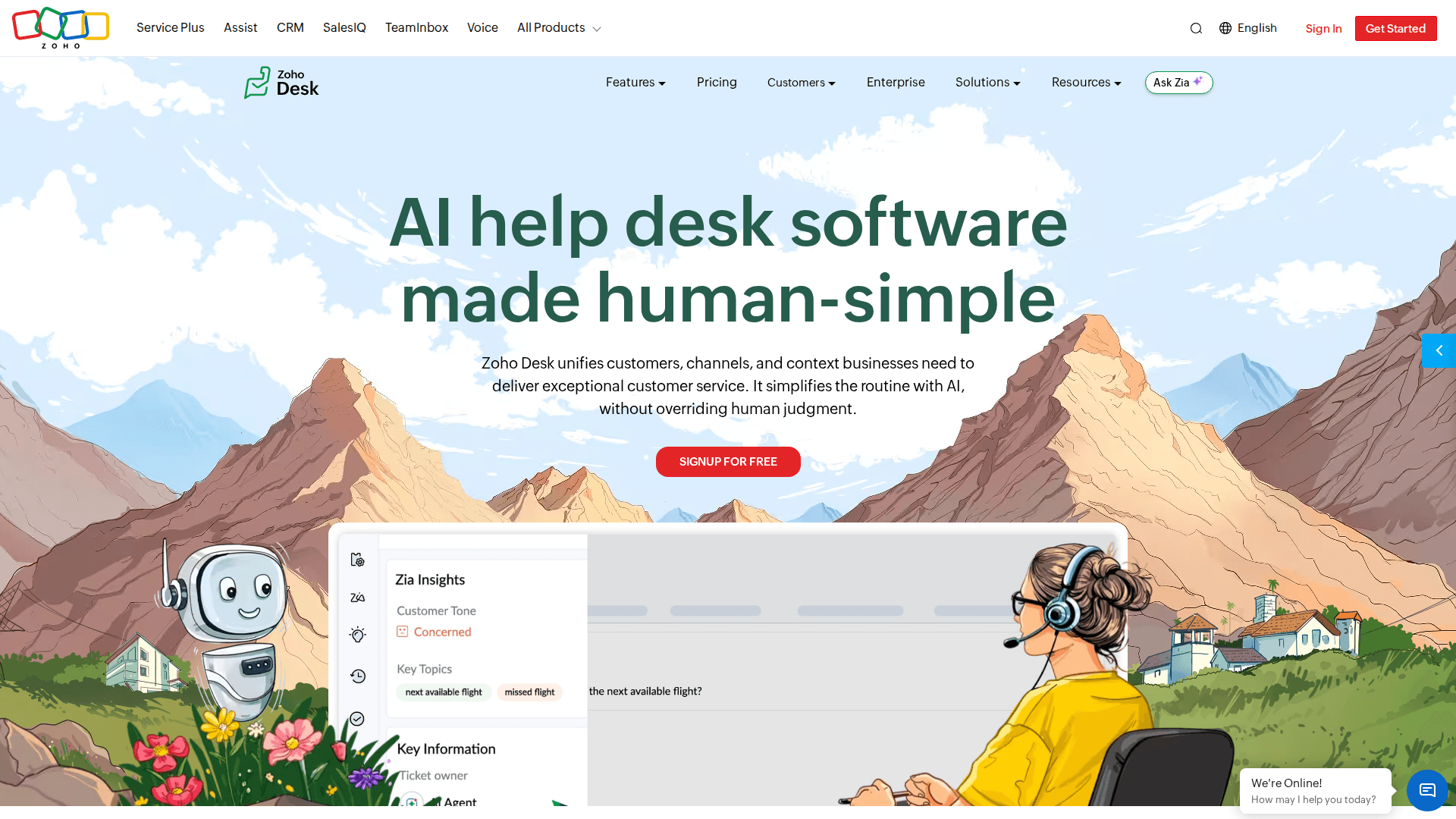
Zoho Desk is the lowest-cost way to leave Zendesk without dropping to a shared inbox. Its published USD tiers run Express $7, Standard $14, Professional $23 and Enterprise $40 per user per month on annual billing, with a free edition covering three agents. The reason it ranks above the cheap-and-cheerful crowd is Blueprints: drag-and-drop, enforced multi-step processes with actions that must happen in order — verified on Zoho's pricing page 2026-08-10 as a Professional-tier feature, which is to say $23/user for a class of process automation Zendesk buyers typically reach at Suite Professional's $115.
Zoho Desk matters most to teams whose Zendesk bill is driven by seat count rather than sophistication — a 15-agent team on Suite Professional is $1,725/mo before add-ons, and the same headcount on Zoho Desk Professional is $345/mo. The catch is the one every Zoho product carries: the suite is enormous and the individual apps are designed to be used together, so the experience is best if you are willing to live in the Zoho ecosystem and mediocre if you want one excellent standalone tool. Interface polish also lags the boutique options here — this is a value pick, and it is honest about being one.
What Zoho Desk does well
- Published USD tiers from $7/user/mo annual — the cheapest real help desk here
- Blueprints (enforced multi-step process automation) available on the $23 Professional tier
- Free edition for 3 agents with email ticketing
- Multichannel plus Zia AI assistance built into the higher tiers
- Deep integration with the wider Zoho suite if you already run it
Pricing
Free (3 agents). Express $7/user/mo annual. Standard $14/user/mo annual. Professional $23/user/mo annual (Blueprints). Enterprise $40/user/mo annual. 15-day trial, no card required.
Best for
Cost-driven migrations at 10+ agents that still need real process automation, especially teams already using other Zoho products.
Pros
- By far the lowest per-seat cost of any full-featured help desk on this list
- Blueprints delivers enforced process automation four tiers below where Zendesk sells it
- Very deep review base (6,500+) for a budget-priced product
- Free tier for three agents makes evaluation genuinely free
Cons
- Best value comes from adopting the wider Zoho ecosystem, not from using Desk alone
- Interface and polish trail the boutique tools here — this is a value buy
Pylon
Best for B2B SaaS — The One Job Zendesk Genuinely Cannot Do
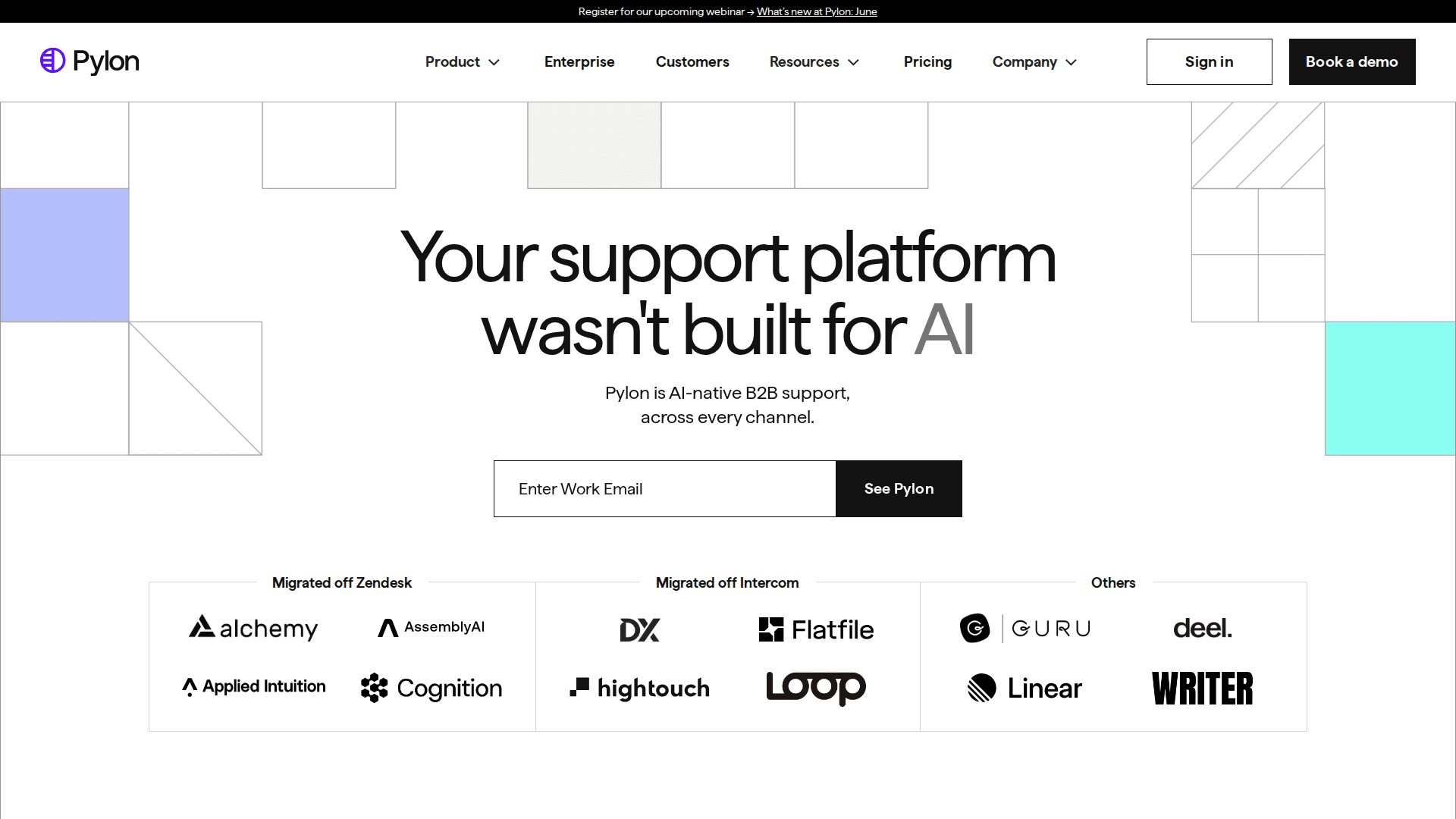
Pylon is the only entry here that beats Zendesk on capability rather than price. It is built for B2B software companies that support customers inside shared Slack and Microsoft Teams channels — a workflow Zendesk was never designed for and still handles awkwardly. Pylon raised a $31M Series B from a16z and Bain Capital Ventures in August 2025 ($51M total) and reports 780+ customers including Deel, Hightouch and AssemblyAI.
Pylon is the right migration when your problem is that customers refuse to open tickets — they message the shared channel, and Zendesk cannot see it. The proof point is a real migration rather than a benchmark: Replo moved 120,000 tickets off Zendesk in five days. Pricing is $59/seat/mo on Starter, $89 on Professional and $139 on Enterprise, all annual, with monthly billing at $70 and $118 for the first two; note the seat minimums (3 on Starter and Professional, 7 on Enterprise annual-only), which put the true floor at $177/mo. The caveat that matters most, and which most write-ups skip: AI is not bundled at any tier — AI Assistants run roughly $50/seat on top, plus AI agent usage fees, so a Pylon quote is not directly comparable to a Zendesk quote that includes AI agents in the base plan.
What Pylon does well
- Native support inside shared Slack and Microsoft Teams channels — the core differentiator
- The Slack connector lives on the Professional tier ($89/seat/mo annual)
- Proven migration path: Replo moved 120,000 tickets off Zendesk in five days
- $31M Series B (a16z, Bain Capital Ventures, August 2025); 780+ customers
- Account-level views built for B2B accounts rather than individual end users
Pricing
Starter $59/seat/mo annual ($70 monthly, 3-seat minimum). Professional $89/seat/mo annual ($118 monthly, 3-seat minimum, includes Slack connector). Enterprise $139/seat/mo annual only (7-seat minimum). AI is not included at any tier — AI Assistants add roughly $50/seat plus usage fees.
Best for
Post-seed B2B SaaS companies supporting customers in shared Slack or Teams channels — the one profile for which Zendesk is a genuine functional mismatch.
Pros
- Does the one thing Zendesk cannot: real support inside shared customer channels
- Highest G2 rating on this list (4.7) and strong funding behind it
- Documented large-scale Zendesk migration completed in days, not months
- Account-centric data model fits B2B far better than ticket-centric tools
Cons
- AI excluded from every tier — budget roughly $50/seat more plus usage to compare fairly
- Seat minimums mean a real floor of $177/mo; no solo or two-person option
We Read the Pricing Pages So You Do Not Have To
Every number on this page was checked against an official source the week it published. Get one honest, no-sponsored-content email a week on the tools founders actually buy.
Intercom
Best AI Migration — Fin at $0.99/Resolution, and You Can Buy It Without Migrating
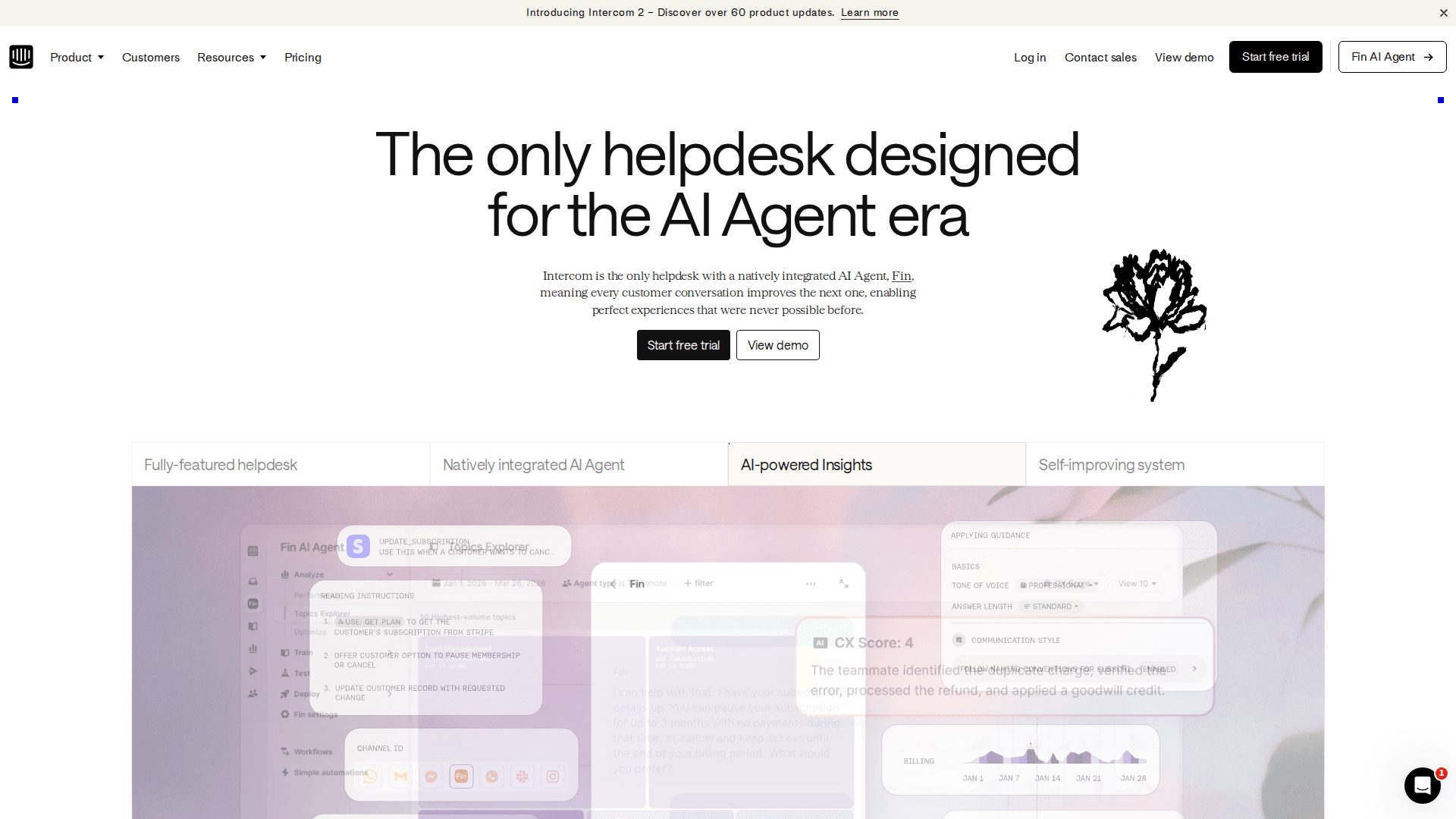
Intercom is the alternative for teams whose Zendesk complaint is specifically about AI pricing. Its Fin agent charges $0.99 per resolution on top of seats priced at $29 (Essential), $85 (Advanced) and $132 (Expert) per seat per month. The strategically interesting part is that Fin now runs standalone on eight or more other helpdesks — you can buy the AI without buying the platform, which makes Intercom both a migration target and a way to avoid migrating.
Intercom earns its place because $0.99 per resolution is a published number you can model, against Zendesk's automated-resolution pricing that appears nowhere on its pricing page. But the same scrutiny has to be applied in both directions, and this is where most lists go quiet: Fin bills "assumed resolutions", meaning a conversation where the customer simply goes silent for 24 hours counts as a success. That is the same species of rule as Zendesk's 72-hour window — a shorter one, in fact. Intercom is a better deal than Zendesk on AI, but it is not a different philosophy of billing, and you should model both at a 40-50% real resolution rate rather than the vendor headline.
What Intercom does well
- Fin AI Agent at a published $0.99 per resolution
- Fin runs standalone on 8+ other helpdesks — buy the AI without replatforming
- Seats at $29 / $85 / $132 per seat per month
- Startup program offering up to 93% off for qualifying companies
- 14-day trial before commitment
Pricing
Essential $29/seat/mo. Advanced $85/seat/mo (includes 20 free Lite seats). Expert $132/seat/mo. Fin AI Agent $0.99 per resolution on top. Copilot $29-$35/agent/mo. 14-day trial; startup program up to 93% off.
Best for
Teams leaving Zendesk specifically over AI pricing, and teams who want a best-in-class AI agent layered onto a helpdesk they are keeping.
Pros
- Per-resolution AI pricing published openly, unlike Zendesk's
- Fin is buyable standalone — the lowest-risk way to fix AI without migrating
- Very large review base (3,300+) and a genuinely generous startup program
- Strongest AI agent capability of the general-purpose platforms here
Cons
- Bills "assumed resolutions" — 24 hours of customer silence counts as success
- Seat pricing is the second-highest here; the AI is the value, not the platform
Gorgias
Best for Ecommerce — Unlimited Seats, Billed by Ticket Instead
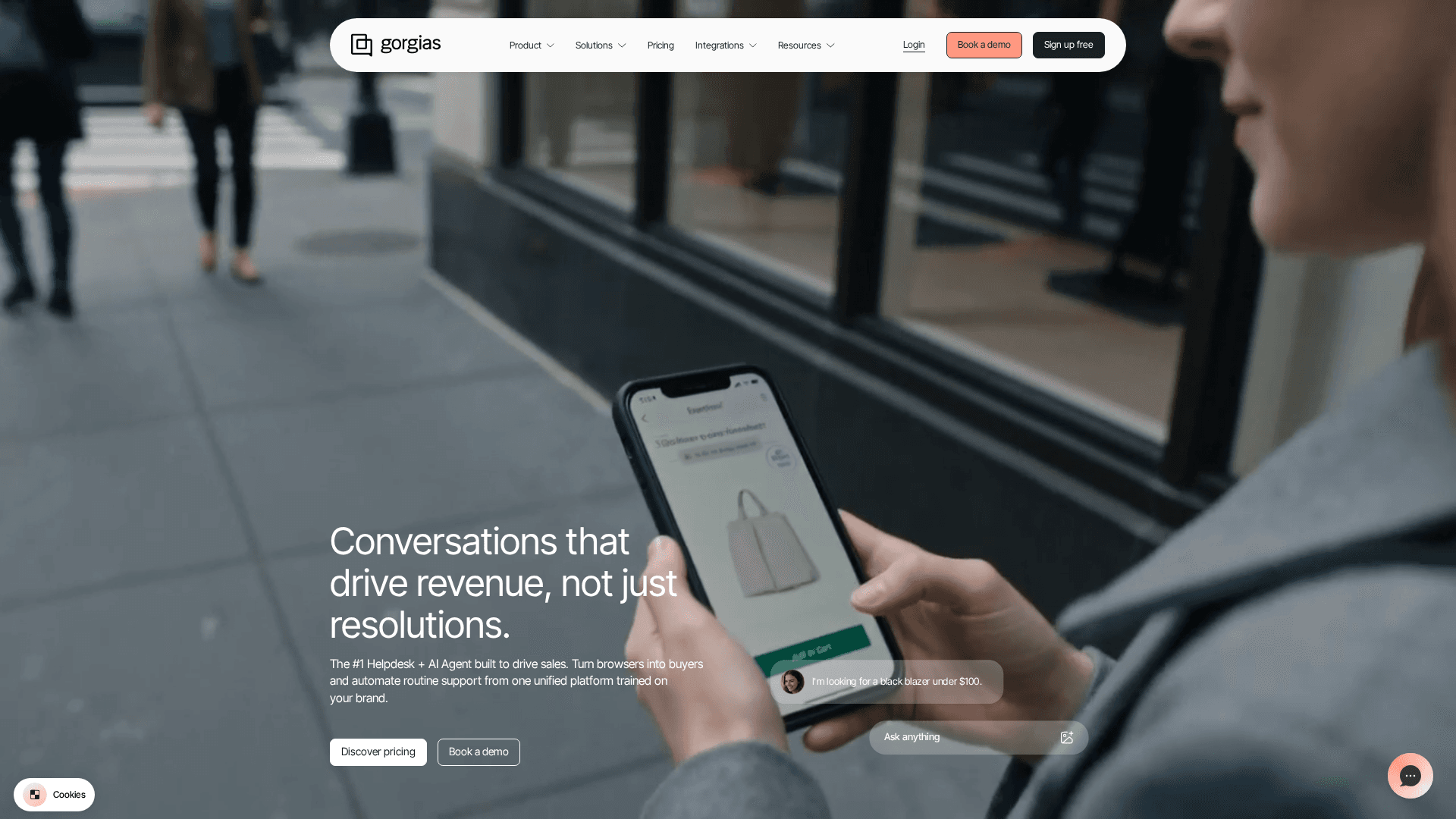
Gorgias replaces Zendesk for ecommerce teams by changing the billing unit entirely: seats are unlimited and you pay per ticket. Plans run Starter $10/mo (50 tickets, then $0.40 each), Basic $60/mo (300 tickets), Pro $360/mo (2,000) and Advanced $900/mo (5,000), with the AI Agent charged at $0.90-$1.00 per resolved conversation.
Gorgias solves the specific problem that makes Zendesk painful for retail: seasonal headcount. If you triple your support team for Black Friday, a per-agent platform triples your bill, while a per-ticket platform charges you for the tickets you were always going to receive. Gorgias also executes Shopify-native actions — refunds, order edits, subscription changes — from inside the ticket, which a general-purpose helpdesk needs an integration and a tab-switch to do. The honest warning is that the billing unit cuts both ways: Gorgias charges for the ticket and then again for the AI resolution, so a high-volume, low-complexity queue can cost more here than a flat-priced tool.
What Gorgias does well
- Unlimited seats — your bill does not move when you staff up for peak season
- Per-ticket pricing from $10/mo (50 tickets, then $0.40 each)
- Native Shopify actions — refunds, order edits, subscription changes inside the ticket
- AI Agent at $0.90-$1.00 per resolved conversation
- Up to 16% discount on annual billing
Pricing
Starter $10/mo (50 tickets, then $0.40/ticket). Basic $60/mo (300 tickets). Pro $360/mo (2,000 tickets). Advanced $900/mo (5,000 tickets). AI Agent $0.90-$1.00 per resolved conversation. Up to 16% annual discount.
Best for
Shopify and ecommerce brands with seasonal support headcount, where per-agent pricing punishes you for the busy months.
Pros
- Unlimited seats removes the seasonal-staffing penalty entirely
- Deepest native Shopify action support of anything on this list
- Cheapest real entry point here at $10/mo
- Strong review base (550+) at 4.6 within its niche
Cons
- You pay for the ticket and again for the AI resolution — double-billing on deflected volume
- Ecommerce-shaped; a B2B SaaS team will find the model a poor fit
Crisp
Best Flat Pricing — The Only Bill Here That Ignores Headcount
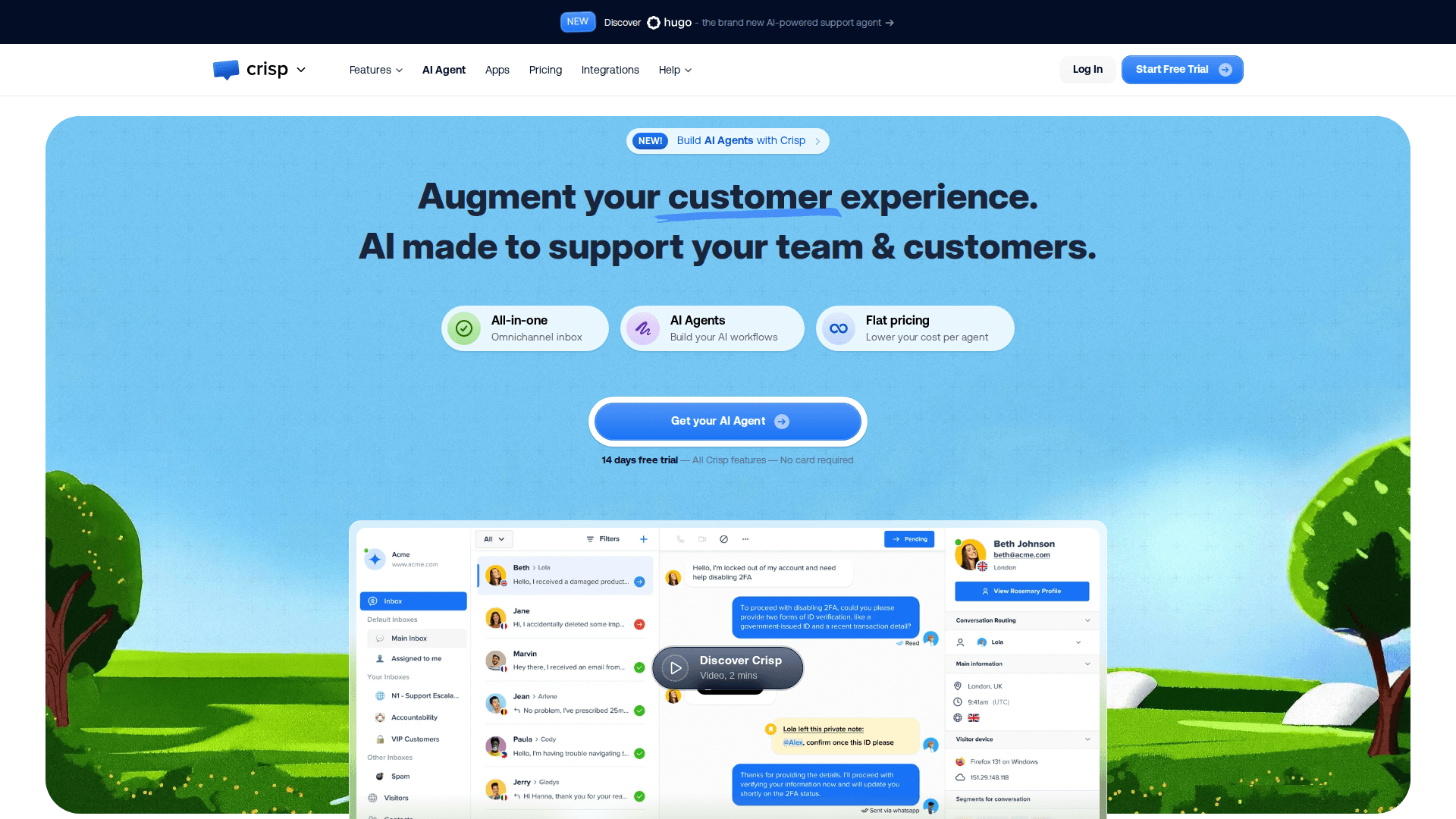
Crisp prices the workspace rather than the person: $45/mo covers 4 seats, $95/mo covers 10, and $295/mo covers 20 or more, with unlimited conversations throughout. Against Zendesk Suite Professional at $115 per agent per month, a ten-person team is comparing $95/mo with $1,150/mo before a single add-on.
Crisp is the structural answer to per-seat pricing, and the gap becomes absurd at team scale rather than at the entry point — which is exactly the range where Zendesk contracts get renegotiated. It suits teams who want everyone in the company able to see and answer customer conversations without a finance conversation about each licence. The trade-offs are real: Crisp is chat-first in its DNA, its ticketing is lighter than Freshdesk or Zoho Desk, and its review base (175+ on G2) is a fraction of the incumbents here, so there is less collective experience to draw on when something goes wrong.
What Crisp does well
- Flat workspace pricing — $45/mo (4 seats), $95/mo (10 seats), $295/mo (20+)
- Unlimited conversations on every tier
- Everyone in the company can be given access without per-seat cost anxiety
- Chat, shared inbox, knowledge base and campaigns in one workspace
Pricing
$45/mo (4 seats). $95/mo (10 seats). $295/mo (20+ seats). Unlimited conversations on all tiers.
Best for
Teams of 5-20 where per-seat pricing has become the dominant line item and the support workload is conversational rather than process-heavy.
Pros
- The only genuinely headcount-independent bill on this list
- At 10 seats the comparison with Suite Professional is roughly 12x in Crisp's favour
- Unlimited conversations — no volume meter to watch
- Encourages whole-company visibility into customer conversations
Cons
- Chat-first heritage; ticketing depth trails Freshdesk and Zoho Desk
- Smallest review base of the established options here (175+)
Helply
Best Free Floor — Unlimited Seats at $0, AI at $0.50 per Outcome
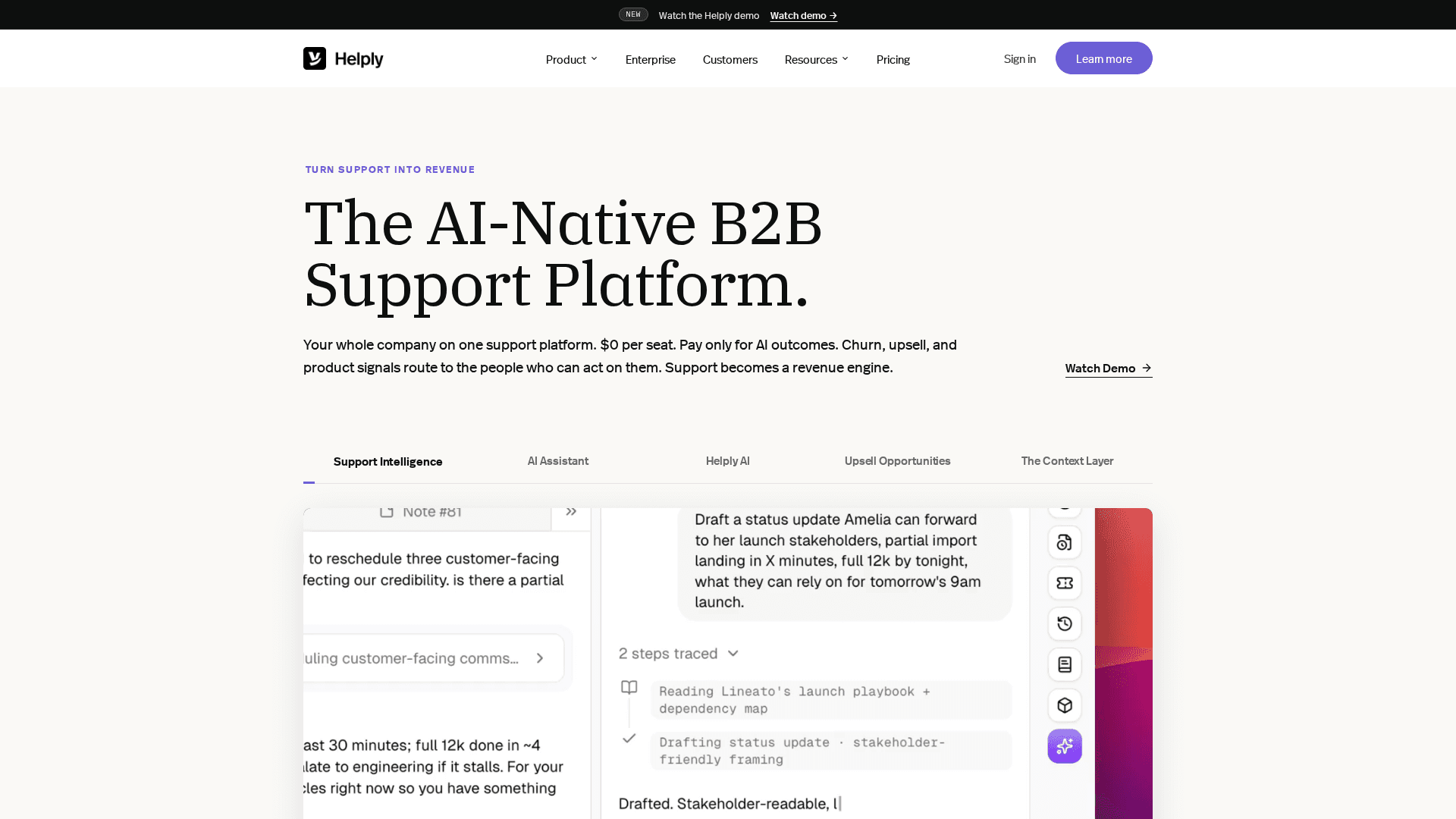
Helply — the rebuilt Groove — inverts the standard model: the help desk platform itself is free forever with unlimited seats, covering inbox, ticketing, chat and knowledge base, and you pay only for AI at $0.50 per outcome with spending caps you set. Existing Groove Classic customers continue on their legacy plans.
Helply is the most aggressive pricing position on this list and the cheapest per-outcome AI here — $0.50 against Help Scout's $0.75, Gorgias' $0.90-$1.00 and Intercom's $0.99. For a team whose Zendesk bill is mostly seats for occasional participants, a free unlimited-seat platform is a structurally different proposition. The spending caps matter too: they are the specific protection missing from most per-resolution models. The risk to weigh is maturity and vendor trajectory — this is a rebrand and rebuild of an older product, its G2 base of 195+ reviews sits under the GrooveHQ name, and a free-platform model puts all of the vendor's revenue on AI adoption you may not want.
What Helply does well
- Free forever platform with unlimited seats — inbox, ticketing, chat, knowledge base
- AI-First Support at $0.50 per outcome, the lowest per-outcome rate here
- Spending caps on AI usage — the protection most per-resolution models omit
- Groove Classic legacy plans continue for existing customers
Pricing
Free forever platform, unlimited seats (inbox, ticketing, chat, knowledge base). AI-First Support $0.50 per outcome with spending caps. Enterprise custom (SSO/SAML, SLAs).
Best for
Cost-driven migrations where much of the Zendesk bill is seats for people who only occasionally touch support.
Pros
- Unlimited free seats removes the entire per-agent cost category
- Cheapest per-outcome AI pricing on this list at $0.50
- User-set spending caps prevent runaway AI bills
- Strong rating (4.6) on its existing review base
Cons
- Rebranded and rebuilt product — less track record than its review count implies
- Vendor revenue depends entirely on AI adoption, which shapes the roadmap
HubSpot Service Hub
Best if You Already Run HubSpot — One Record for Sales, Marketing and Support
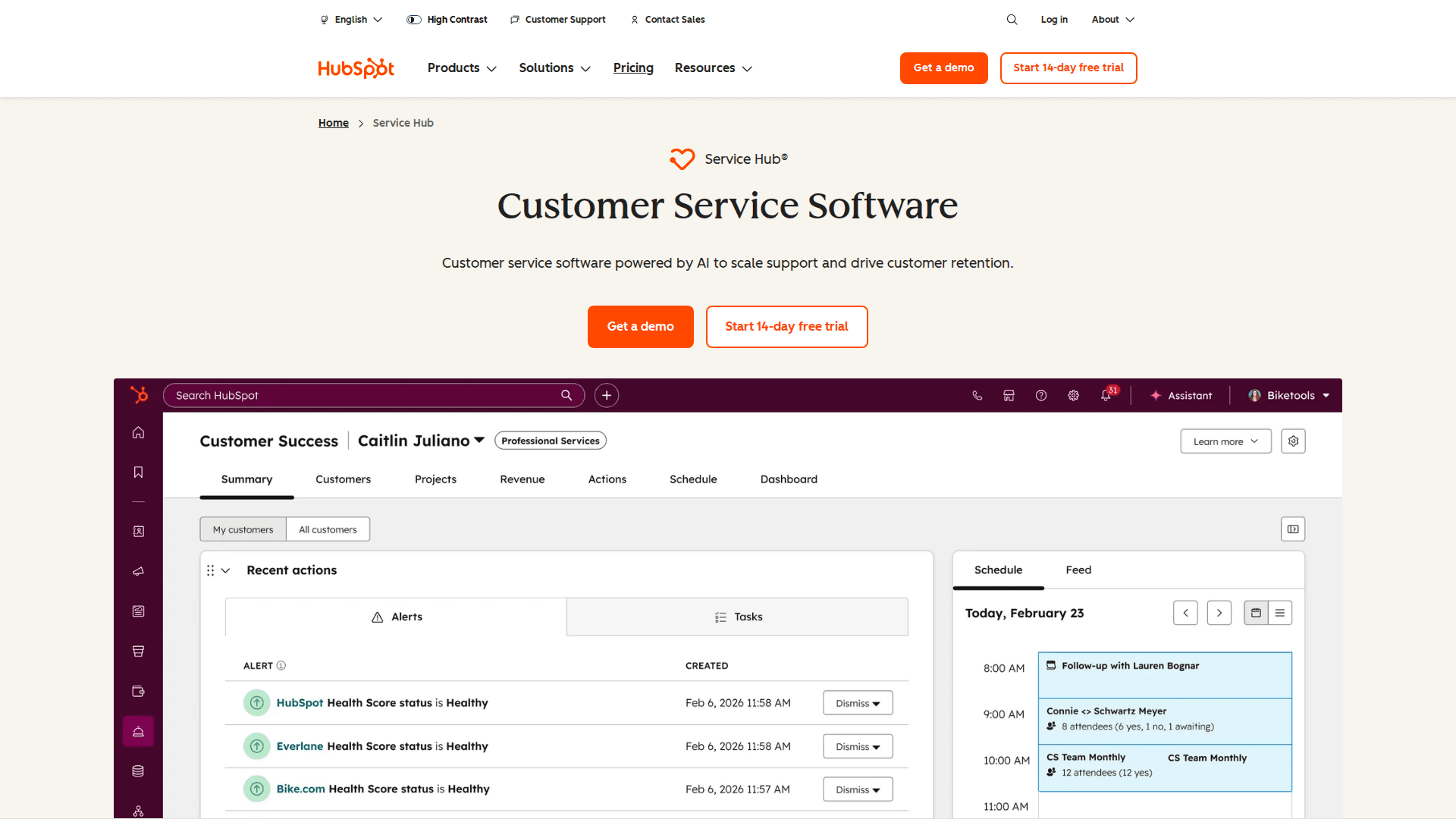
HubSpot Service Hub is the right migration for exactly one situation: your company already runs HubSpot, and the annoying thing about Zendesk is that support history lives in a different system from everything else you know about the customer. Free tools cover ticketing, chat and a shared inbox; Starter is $15/seat/mo, Professional $90/seat/mo annual plus roughly $1,500 onboarding, and Enterprise $150/seat/mo with a 10-seat minimum plus roughly $3,500 onboarding.
HubSpot Service Hub is not the cheapest or the best help desk here, and choosing it for support features alone would be a mistake. Its case is consolidation: one customer record that carries the marketing touch, the deal and the support ticket, which removes an entire class of integration work and lets support context reach sales without a sync. Two things to price honestly before committing: the mandatory onboarding fees at Professional and Enterprise are real money on top of seats, and Breeze AI is credit-metered, which means it belongs in the same "model your real usage" category as every per-resolution product on this list.
What HubSpot Service Hub does well
- One customer record across marketing, sales and support
- Free tools tier covering ticketing, chat and shared inbox
- Starter at $15/seat/mo — a genuinely low entry if you are already on HubSpot
- Breeze AI available, metered by credits
Pricing
Free tools (ticketing, chat, shared inbox). Starter $15/seat/mo. Professional $90/seat/mo annual plus ~$1,500 onboarding. Enterprise $150/seat/mo (10-seat minimum) plus ~$3,500 onboarding. Breeze AI is credit-metered.
Best for
Companies already running HubSpot for sales or marketing, where the real cost of Zendesk is the data silo rather than the invoice.
Pros
- Eliminates the support/CRM data silo entirely if you are already on HubSpot
- Large review base (2,850+) and mature platform
- Free tools tier lets you trial the model at zero cost
Cons
- Mandatory onboarding fees (~$1,500 Professional, ~$3,500 Enterprise) on top of seats
- Poor value if you are not already committed to HubSpot elsewhere
eesel AI
The Anti-Migration Pick — Bolt AI Onto the Zendesk You Already Have
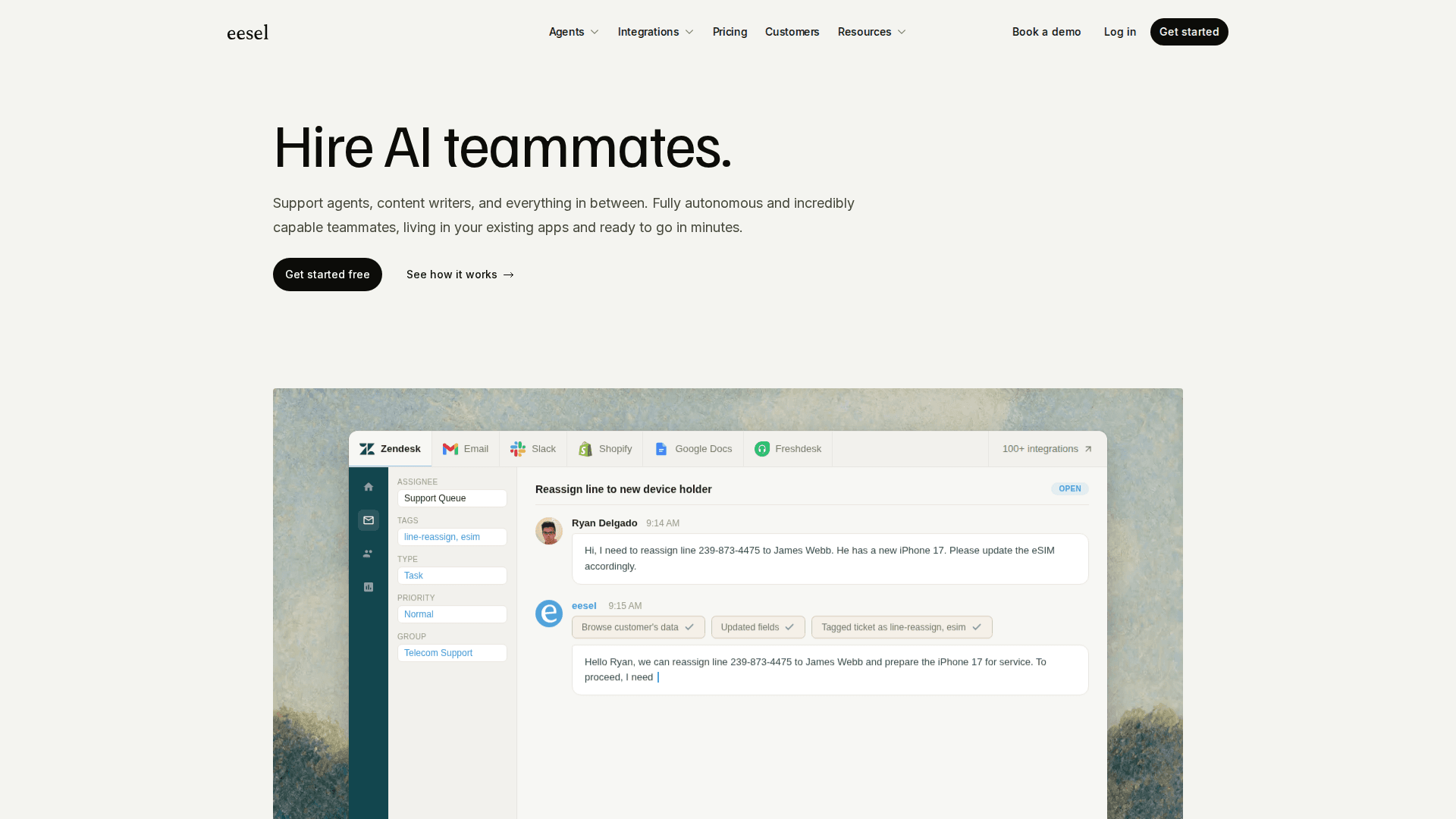
eesel AI is on this list precisely because it is not a Zendesk replacement. It is a helpdesk-agnostic AI layer that plugs into Zendesk, Freshdesk, Intercom, Gorgias, Help Scout and a dozen others, training on your past tickets, macros and docs rather than only the help centre. Billing is roughly 40¢ per ticket touched, with hard spend caps set by default at $250/mo — agents pause when the cap is hit.
eesel AI answers the question that should be asked before any migration: is the problem Zendesk, or is the problem Zendesk's AI pricing? If it is the latter, replatforming is an expensive way to solve a billing problem, and layering third-party AI over the tickets you already have is a documented 2025-26 pattern for escaping per-resolution fees without moving anything. The honest framing, which we also gave in our AI support guide: this usually signals you should migrate at the next renewal rather than never — you are buying time and optionality, not a permanent answer. Note too that 40¢ per ticket touched is charged regardless of whether the answer was any good, which is its own billing-unit question.
What eesel AI does well
- Plugs into Zendesk directly — no migration, no ticket export
- Works across 14+ helpdesks including Freshdesk, Intercom, Gorgias and Help Scout
- Trains on past tickets and macros, not just published help-centre articles
- Hard spend caps (default $250/mo) — agents pause rather than overrun
- Four products in one: AI Agent, Copilot, Triage, and internal Slack/Teams Q&A
Pricing
Roughly 40¢ per ticket touched, with hard spend caps (default $250/mo). Sits on top of your existing helpdesk subscription rather than replacing it.
Best for
Teams whose only real Zendesk complaint is the AI bill, and who want to cut it this quarter without a migration project.
Pros
- Solves an AI-pricing problem without a migration project
- Spend caps are the strongest overrun protection of any AI option here
- Keeps every existing Zendesk workflow, integration and custom app intact
Cons
- Buys time rather than solving the underlying platform cost — you still pay Zendesk
- Bills per ticket touched regardless of answer quality
When You Should Stay on Zendesk
This is the section no vendor-published alternatives list can write, so here it is. A realistic help desk migration is three to six weeks of one person's full attention — ticket history, macros, help-centre content, integrations, routing rules, reporting, and the retraining. That cost is real and it belongs in the comparison. Stay on Zendesk if any of these describe you:
You are mid-contract
Migrating while still paying for Zendesk means running two bills. Take the quotes from this list into your renewal conversation instead — a credible alternative is leverage, and using it costs you nothing.
You run deep custom apps
Custom Zendesk apps, a mature multi-brand help centre, or heavily tuned routing represent years of accumulated configuration. Rebuilding that elsewhere usually costs more than the licence difference for at least the first year.
You need voice and WEM from one vendor
Zendesk sells Contact Center ($83/agent/mo) and Workforce Engagement ($50) as first-party add-ons. Assembling the same stack from separate vendors is cheaper on paper and more work in practice.
Your complaint is only the AI bill
Then fix the AI bill, not the platform. eesel AI plugs into Zendesk with a default $250/mo spend cap, and Intercom's Fin runs standalone on other helpdesks — both cheaper than a migration project.
Who We Left Off, and Why
Forethought is the most important omission: it was a credible Zendesk alternative until Zendesk completed its acquisition on 26 March 2026. Any list still recommending it as an alternative has not been updated since the spring.
Kustomer (8-seat minimum, roughly $8,500/yr floor) and Gladly (10-seat minimum, roughly $21,600/yr floor) are built for procurement teams rather than the founders and small support leads this list is written for — if you can clear those minimums, you can also negotiate with Zendesk. HappyFox keeps its pricing behind a sales form, which disqualifies it from a list whose entire premise is comparing real numbers. Front was cut for the same add-on stacking pattern that makes Zendesk expensive in the first place.
Tidio is a good product but not a Zendesk replacement — it is chat-first, and its advertised plans exclude Lyro AI, which puts real cost at two to three times sticker. We cover it properly in our customer service software guide, alongside the full category ranked by pricing model.
How to Choose Your Zendesk Alternative
Start with the reason you are leaving, not the feature grid. Then check the billing unit — per seat, per ticket, per conversation, per resolution, or flat — because that single choice determines how your bill behaves when you grow.
Cost, but keep the machinery…
Freshdesk ($19/agent) for the closest parity, or Zoho Desk ($7–$40) if you want the floor and can live in the Zoho ecosystem.
Too complex for our size…
Help Scout — shared inbox instead of ticketing, free for 5 users, $0.75/resolution AI with three months free to measure your real deflection rate.
Every hire raises the bill…
Crisp (flat $45–$295/mo for the workspace) or Helply (free platform, unlimited seats, $0.50 per AI outcome).
Our customers live in Slack…
Pylon — the only genuine capability upgrade here. Budget the 3-seat minimum and roughly $50/seat more for AI, which is not bundled.
We are an ecommerce brand…
Gorgias — unlimited seats and per-ticket billing, so seasonal staffing stops being a pricing event. Watch the double-billing on AI resolutions.
It is only the AI bill…
eesel AI on top of your existing Zendesk, or Intercom's Fin standalone. Do not run a migration project to solve a metering problem.
How We Chose These Alternatives
- Independence — we sell no support software and took no placement fees, which is why a “stay on Zendesk” section exists at all
- Published pricing — every entry publishes real numbers; quote-only vendors were cut, because a list comparing costs cannot include prices nobody can see
- Billing-unit honesty — we name the metering rule for every AI option, including the unflattering ones on tools we recommend
- Verified against source — pricing checked on official pages on 10 August 2026; ratings cited only where a real G2 base exists, and omitted rather than invented where it does not
- Migration realism — ranked by reason for leaving and retraining cost, not by feature-count parity
Tool Pricing Changes Faster Than the Listicles Do
Half the “best of” pages ranking today quote prices that changed months ago. We re-check ours and tell you when they move — one email a week, no sponsored placements.
Frequently Asked Questions
What is the best Zendesk alternative in 2026?
Freshdesk is the best Zendesk alternative for most teams in 2026, because it replaces Zendesk concept-for-concept — SLA management, skill-based routing, customer portals — at $19/agent/mo on Growth against Zendesk Suite Professional's $115/agent/mo (both official pricing, checked 2026-08-10). The right answer changes with your reason for leaving: Help Scout if Zendesk is too complex rather than too expensive, Zoho Desk if you need the lowest per-seat cost with real process automation, Pylon if you support B2B customers in shared Slack channels, Intercom if your complaint is specifically AI pricing, Gorgias if you are an ecommerce brand with seasonal staffing, and Crisp if you want a bill that does not grow with headcount.
How much does Zendesk actually cost per agent in 2026?
Zendesk lists Support Team at $19/agent/mo, Suite Team at $55 and Suite Professional at $115, all paid yearly, with Suite Enterprise quote-only (Zendesk official pricing, checked 2026-08-10). The real number depends on add-ons: Copilot is $50/agent/mo, the Workforce Engagement bundle is another $50, and Contact Center is $83. Suite Professional plus Copilot is $165/agent/mo; add Workforce Engagement and it is $215; add Contact Center and it is $298. For a five-agent team, Suite Professional plus Copilot is $825/mo, or $9,900/year, before a single AI resolution is billed.
What is an "automated resolution" in Zendesk and why does it matter?
An automated resolution is Zendesk's billing unit for AI agent usage. Per Zendesk's own documentation, one is counted after 72 hours of inactivity when AI evaluation confirms the AI agent's response was relevant and the customer either gave positive feedback or gave no feedback at all. This matters because customer silence is billed as success — a person who gives up and never replies looks identical to a person whose problem was solved. Zendesk does not publish a per-resolution price on its pricing page; third-party analyses converge on roughly $1.50 per resolution committed and $2.00 pay-as-you-go, so model your own volume rather than assuming a rate.
How do small support teams rate Freshdesk's ticketing depth when replacing Zendesk without losing SLAs and routing?
Freshdesk is the alternative small teams pick specifically when they cannot give up Zendesk's ticketing machinery, and it holds 4.4/5 on G2 across 3,700+ reviews. It carries SLA management, skill-based routing, customer portals and dispatch rules on plans starting at $19/agent/mo billed annually, which is the closest concept-for-concept match to Zendesk on this list — a Zendesk admin already understands Freshdesk's groups, SLA policies and dispatch rules under nearly the same names, so retraining cost is the lowest of any option here. The limitation small teams report is tier drift: the $19 Growth plan only holds if Growth covers your requirements, since Pro is $55/agent/mo and Enterprise $89.
Is it worth migrating off Zendesk, or should I stay?
Staying is the right call more often than any vendor-published list will tell you. Zendesk holds 4.3/5 on G2 across roughly 6,700 reviews as of mid-2026 — a stable, functioning product whose problem is cost structure, not quality. Stay if you are mid-contract, if you run deep custom apps or a mature multi-brand help centre, or if you need voice, workforce management and ticketing from a single vendor. Migrate if your bill is dominated by seats for occasional participants, if you are paying per-agent AI add-ons you cannot tie to outcomes, or if your customers live somewhere Zendesk cannot reach — shared Slack channels being the clearest example. A realistic migration is three to six weeks of someone's full attention, and that cost belongs in the comparison.
What is the best free Zendesk alternative?
Helply offers the most generous free tier of any Zendesk alternative — a free-forever platform with unlimited seats covering inbox, ticketing, chat and knowledge base, charging only for AI at $0.50 per outcome with spending caps. Help Scout's free plan covers 5 users, 1 inbox and 1 Docs site, Zoho Desk's free edition covers 3 agents with email ticketing, and Freshdesk's free plan covers 2 agents. HubSpot Service Hub also has free tools for ticketing, chat and shared inbox. For a team that mainly needs many people to have access rather than many features, Helply's unlimited-seat free tier is the structurally different option.
Can I keep Zendesk and just replace its AI?
Yes, and it is often the cheaper move. eesel AI plugs into Zendesk directly and bills roughly 40¢ per ticket touched with hard spend caps set by default at $250/mo, and Intercom's Fin agent now runs standalone on eight or more helpdesks at $0.99 per resolution without requiring you to move to Intercom. This was a documented pattern through 2025-26 for teams escaping per-resolution fees without a migration project. The honest caveat is that it treats the symptom: you still pay Zendesk's per-agent platform cost, so it buys time and optionality rather than solving the underlying spend, and most teams that do it end up migrating at the next renewal anyway.
The Bottom Line
Freshdesk is the alternative most teams should shortlist first: it replaces Zendesk concept-for-concept at $19/agent/mo against $115, which is the shortest path from “this is too expensive” to a working help desk your team already knows how to operate. If your complaint is complexity rather than cost, Help Scout. If it is seat count, Crisp or Helply. If your customers live in shared Slack channels, Pylon is the only genuine upgrade on this page.
But run the honest test first. Zendesk sits at 4.3/5 across roughly 6,700 G2 reviews; it is not a broken product, it is an expensively structured one. If the only thing driving you out is a per-resolution AI meter that bills 72 hours of customer silence as a success, that is a metering problem with a cheaper answer than a three-to-six week migration — and knowing which problem you actually have is worth more than any ranking.
Related Reading
- Best Customer Service Software
The full category ranked by pricing model — per-seat, flat, per-ticket and per-resolution — rather than by who you are leaving.
- Best AI Customer Support Tools
Vendor resolution claims versus production reality, and what per-resolution AI actually costs at founder volumes.
- Best Workflow Automation Tools for Non-Technical Teams
For the routing and escalation logic that sits around your help desk.
Sources
- Zendesk — Official Pricing
- Zendesk Help — About automated resolutions for AI agents
- Zendesk Newsroom — Zendesk Completes Acquisition of Forethought
- Freshworks — Freshdesk Pricing
- Help Scout — Pricing
- Zoho Desk — Plans and Pricing
- Gorgias — Pricing
- Intercom — Pricing
- G2 — Zendesk for Customer Service Reviews
One Honest Email a Week
Independent tool research for founders — no sponsored placements, no pay-to-play, and we tell you when the answer is “stay where you are.”
Keep Reading
10 Best Customer Service Software for 2026 (Ranked by Real Cost, Not Sticker Price)
The 10 best customer service software picks for 2026 — Help Scout, Crisp, Pylon, Freshdesk, Zoho Desk, Gorgias, Intercom, Helply, HubSpot Service Hub, and Tidio. Ranked by founders-first criteria: real all-in pricing including AI fees, per-seat vs. per-resolution economics, and how fast you will outgrow each one.
7 Best AI Search Visibility Tools for Agencies in 2026
Seven AI search visibility tools ranked for agencies by client workspaces, reporting, prompt economics, and the real cost of managing multiple brands.
10 Best Granola Alternatives for Private AI Meeting Notes (2026)
The best Granola alternatives in 2026, ranked on where your notes are stored, whether your data trains AI, and what a bot-free notetaker really costs. Verified pricing.