
10 Best Sales Intelligence Tools for 2026 (Ranked for Founders, Not Enterprise Procurement)
The 10 best sales intelligence tools for 2026 — Apollo, Cognism, Clay, Lusha, Lead411, RocketReach, 6sense, Bombora, UserGems, and G2 Buyer Intent. Ranked by founders-first criteria: real pricing, data verification depth, and the path to coverage that does not start at $25K/yr.
Sales intelligence in 2026 is a 3-layer stack. Most teams need 1, maybe 2 layers.
Layer 1: Contact databases (Apollo, Lusha, RocketReach, Lead411, Cognism) — find people and their contact details. Layer 2: Data orchestration (Clay) — waterfall enrichment across 150+ providers. Layer 3: Intent + signal data (6sense, Bombora, UserGems, G2 Buyer Intent) — surface accounts showing buying intent. Almost no one needs all three. Start with Layer 1, add Layer 3 only when you have 5+ SDRs to consume intent. Save Layer 2 for when personalization-per-prospect outranks volume.
Key Takeaways
- Sales intelligence in 2026 split into three layers: contact databases (Apollo, Lusha, RocketReach, Lead411), data orchestration (Clay), and intent + signal data (6sense, Bombora, UserGems, G2 Buyer Intent). Most teams need a tool from layer one + something from layer three. Almost no one needs all three.
- Apollo.io remains the best overall pick for most founders: 275M+ contacts, real free plan, bundled sequencer + CRM, and Cognism-comparable EMEA data quality at one-quarter the price. Start here unless GDPR compliance or phone-verification depth forces a Cognism move.
- Cognism is worth the $15K-$25K/yr platform fee only when EMEA is your primary market or compliance is contractual. Diamond Data® phone verification (manually-validated mobile numbers) genuinely beats every competitor on EMEA data accuracy — but most US-first founders are paying for capabilities they will not use.
- Intent data is overhyped for indie hackers. Bombora ($12K-$25K/yr), 6sense ($55K-$130K/yr), and G2 Buyer Intent ($10K-$87K/yr) are real signals — but the math only works for teams with 5+ SDRs who can act on intent within 24 hours. For solo founders, manual signal-watching via Clay + Apollo beats paying for an intent platform you cannot consume.
- The hidden cost killer is credit consumption. Lusha quietly doubled phone-number cost from 5 to 10 credits in 2025. RocketReach charges $0.30-$0.45 per overage lookup. Apollo overages are $0.20/credit (250 min). Budget for 1.5-2x the headline price once real outreach starts.
- Skip the AI-only data plays. Seamless.AI scales fast but mid-market teams consistently report data accuracy issues at scale. Lead411's hybrid AI + human verification at $75/mo annual is the right mid-market answer when Apollo data quality is not enough.
Most "best sales intelligence tools" lists are written for enterprise procurement teams comparing $25K-$100K/yr platforms. This one is written for founders who need to know which database, which intent feed, and which enrichment layer actually move pipeline at sub-$100/mo entry prices — with a clear graduation path to enterprise tools once revenue justifies the spend.
The 2026 shape of this market is clear. Apollo took the lead on the budget end with its 2026 product reset (free plan + agentic AI assistant). Cognism owns EMEA on GDPR-compliant data quality. Clay sits as the universal orchestration layer that wires every other database together via waterfall enrichment. The intent data category (6sense, Bombora, G2 Buyer Intent, UserGems) consolidated around the 5+ SDR threshold: below that, signals go stale before anyone acts on them; above that, the math works hard.
We picked 10 tools across three layers: contact databases (Apollo, Cognism, Lusha, Lead411, RocketReach), data orchestration (Clay), and intent + signal data (6sense, Bombora, UserGems, G2 Buyer Intent). Every entry ranks on three founders-first criteria: real all-in pricing (not headline entry pricing), data accuracy benchmarks, and honest disclosure of when the tool breaks at scale or when it is overkill for early-stage teams.
Quick Comparison
| # | Tool | Best For | Starting Price | Rating |
|---|---|---|---|---|
| 1 | Apollo.io | Best Overall | Free (50 mobile + unlimited email credits/mo) | 4.7 |
| 2 | Cognism | Best for EMEA + GDPR Compliance | Grow plan ~$15,000/yr platform fee + ~$1,500/user/yr | 4.6 |
| 3 | Clay | Best Data Orchestration | Launch $185/mo (2,500 Data Credits + 15,000 Actions) | 4.7 |
| 4 | Lusha | Best for Solo Founders + Small Teams | Free (70 credits/mo) | 4.3 |
| 5 | Lead411 | Best Mid-Market Pick | Spark $75/user/mo annual ($99 month-to-month) | 4.5 |
| 6 | RocketReach | Best Direct Contact Finder | Essentials $33/user/mo annual (1,200 lookups/yr, email only) | 4.5 |
| 7 | 6sense | Best Enterprise Intent + ABM Platform | Custom enterprise pricing $55,000-$130,000+/yr depending on features and account volume | 4.4 |
| 8 | Bombora | Best Pure Intent Data | Custom pricing $12,000-$25,000/yr for standalone access | 4.4 |
| 9 | UserGems | Best Champion Tracking | Core $2,750/mo ($33,000/yr) — 3 admins, 20 end users, 30,000 tracked records | 4.7 |
| 10 | G2 Buyer Intent | Best for SaaS Sellers | Core G2 subscription ~$15,000/yr base | 4.5 |
Apollo.io
Best Overall — Free Plan + 275M Contacts + Bundled Sequencer
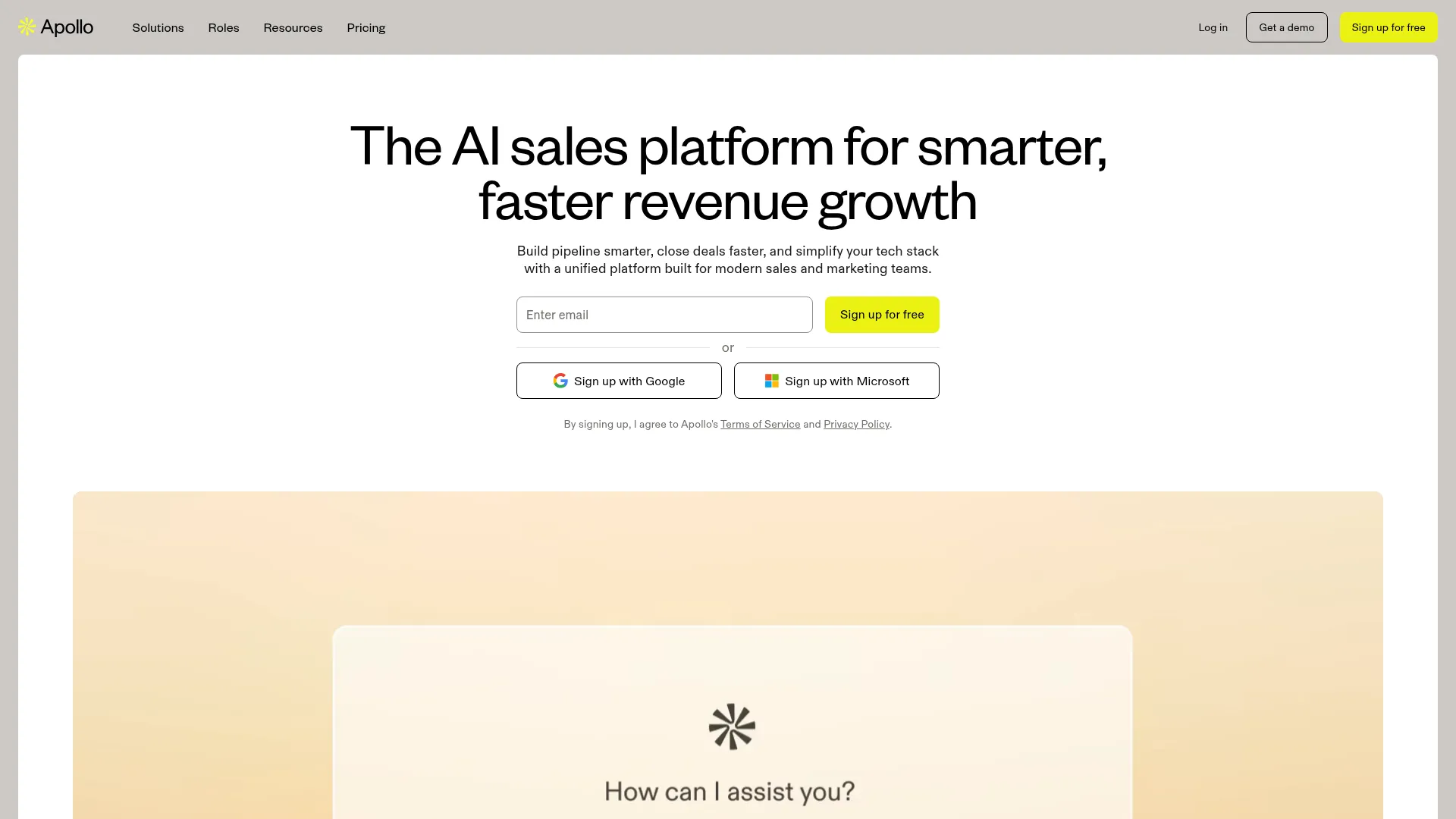
Apollo.io is the default sales intelligence tool every other platform on this list measures itself against. 275M+ B2B contacts, advanced filters (intent, hiring signals, tech stack, funding), a bundled multi-step sequencer, conversation intelligence, and a CRM — all for $0/user/mo on the free plan or $59/user/mo Basic. In March 2026 Apollo launched its agentic AI assistant, which executes prospecting and research workflows from natural-language prompts. The data accuracy is not as strong as Cognism in EMEA (Apollo emails hover at 65-70% accuracy globally), but the breadth + price + free tier combination is unmatched.
For 80% of founders running a sales intelligence motion in 2026, Apollo is the right starting point. The free plan gives you real prospect search (50 mobile + unlimited email credits/mo); the $59/user/mo Basic tier unlocks sequencing for a 2-3 person sales team; and the agentic AI handles workflows that used to require Clay + Outreach + a dedicated ops hire. Apollo's 2026 product reset closed most of the gap with enterprise-tier databases on filters and intent signals, at 10-20x lower cost. The credit system has gotchas (phone numbers cost 8x more than emails, credits expire monthly, $0.20 per overage credit), but disciplined use lands the all-in cost dramatically lower than any enterprise stack.
Key Features
- 275M+ B2B contact database with advanced filters (intent, hiring signals, tech stack, funding)
- Free plan: 50 mobile credits + unlimited email credits/mo, no credit card required
- Agentic AI Assistant (March 2026) executes prospecting + research workflows from prompts
- Bundled multi-step sequencer + native CRM + conversation intelligence — replaces 3-4 tools
- Active outbound community + extensive YouTube tutorials — fastest ramp-up in the category
Pricing
Free (50 mobile + unlimited email credits/mo). Basic $59/user/mo monthly ($49 annual). Professional $79-$99/user/mo. Organization $119-$149/user/mo.
Rating
4.7/5 — G2 (9,000+ reviews)
Best For
Solo founders and 2-20 person sales teams who want one tool instead of five, wit...
Pros
- Best free plan in the category — most founders can validate Apollo for free before paying a cent
- 275M contacts puts Apollo in the same database-size tier as the largest enterprise platforms
- Bundled CRM + sequencer + intelligence + database replaces 3-4 separate $50-$200/mo subscriptions
- Agentic AI assistant (March 2026 launch) is the closest thing to autonomous prospecting at this price
Cons
- Email accuracy is 65-70% globally — expect 15-25% bounce rates and budget for verification
- Credit system gotchas: phone numbers cost 8x more, credits expire monthly, $0.20 per overage credit
Cognism
Best for EMEA + GDPR Compliance — Diamond Data® Phone Verification
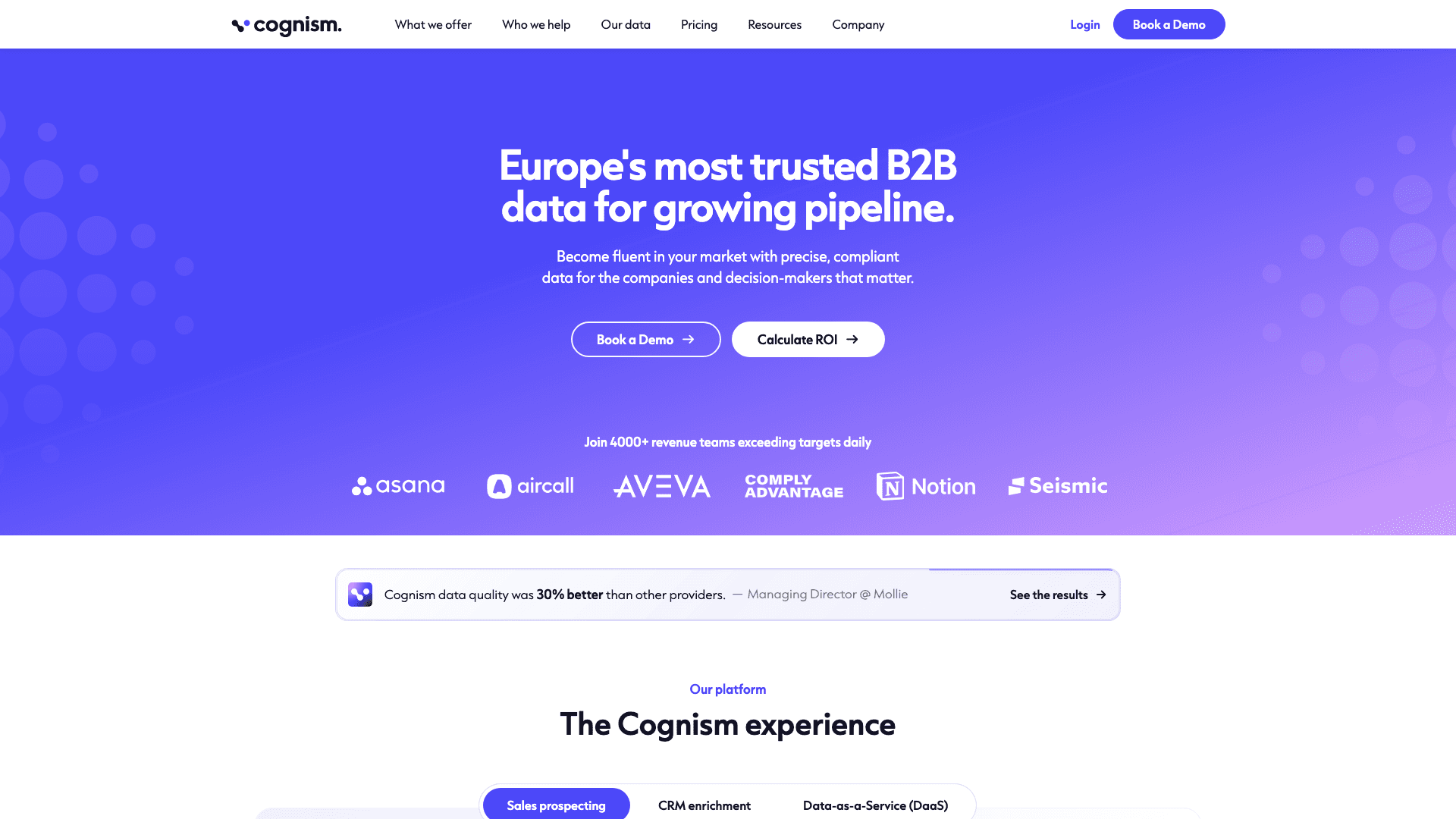
Cognism is the European data leader for B2B contacts, built on a 25M+ "Platinum" database with extensive manual verification, especially in EMEA and APAC. The differentiator is Diamond Data® — manually-validated mobile phone numbers — which materially beats every competitor on EMEA data accuracy and is the reason large UK and European sales teams consolidate on Cognism instead of Apollo. The platform is fully GDPR-compliant with CCPA support, and the data team actively scrubs against DNC lists across 250+ countries. Pricing is opaque and enterprise-led: $15,000/yr platform fee for the Grow plan, $25,000/yr for Elevate, plus $1,500-$2,500/user/yr.
Cognism is worth the price only when EMEA is your primary market or compliance is contractual. For a US-first founder selling to US prospects, Apollo + manual verification beats Cognism on dollar-per-meeting. For a UK/EU founder selling into a 27-country market where GDPR violations can mean 4%-of-global-revenue fines, Cognism's compliance infrastructure is non-negotiable insurance. The math also works for sales teams whose primary objection is "the data on Apollo bounces too much for our ICP" — Cognism's 95%+ accuracy rate on Diamond Data phones means SDRs spend their time on real conversations, not chasing dead numbers. Discounts of 28-52% are common per Vendr benchmarking — never accept the first quote.
Key Features
- 25M+ Platinum contacts with extensive manual verification (especially EMEA + APAC)
- Diamond Data® — manually-validated mobile numbers with 95%+ accuracy
- GDPR + CCPA compliant — DNC scrubbing across 250+ countries built-in
- Intent data + technographics + firmographics bundled into platform fee
- Chrome extension + Salesforce/HubSpot/Outreach/Salesloft native integrations
Pricing
Grow plan ~$15,000/yr platform fee + ~$1,500/user/yr. Elevate ~$25,000/yr + ~$2,500/user/yr. Solo user: ~$16,500/yr. 5-user team: ~$22,500/yr. Intent topic add-ons $1,600-$6,000/yr.
Rating
4.6/5 — G2 (700+ reviews)
Best For
EMEA-focused sales teams, regulated industries (financial services, healthcare),...
Pros
- Diamond Data® mobile verification beats every competitor on EMEA phone accuracy
- Most GDPR-safe contact database — the only credible enterprise pick for EU sales teams
- Intent data + technographics bundled into platform fee — no $1K/user/yr intent add-on
- Vendr benchmarking shows 28-52% discount room — negotiating wins meaningful budget back
Cons
- Platform fee + per-user pricing puts entry at $16,500/yr minimum — wrong tool for indie hackers
- Opaque pricing — must talk to sales, no public quote, 10-15% annual auto-renewal price hikes
Clay
Best Data Orchestration — Waterfall Enrichment Across 150+ Providers
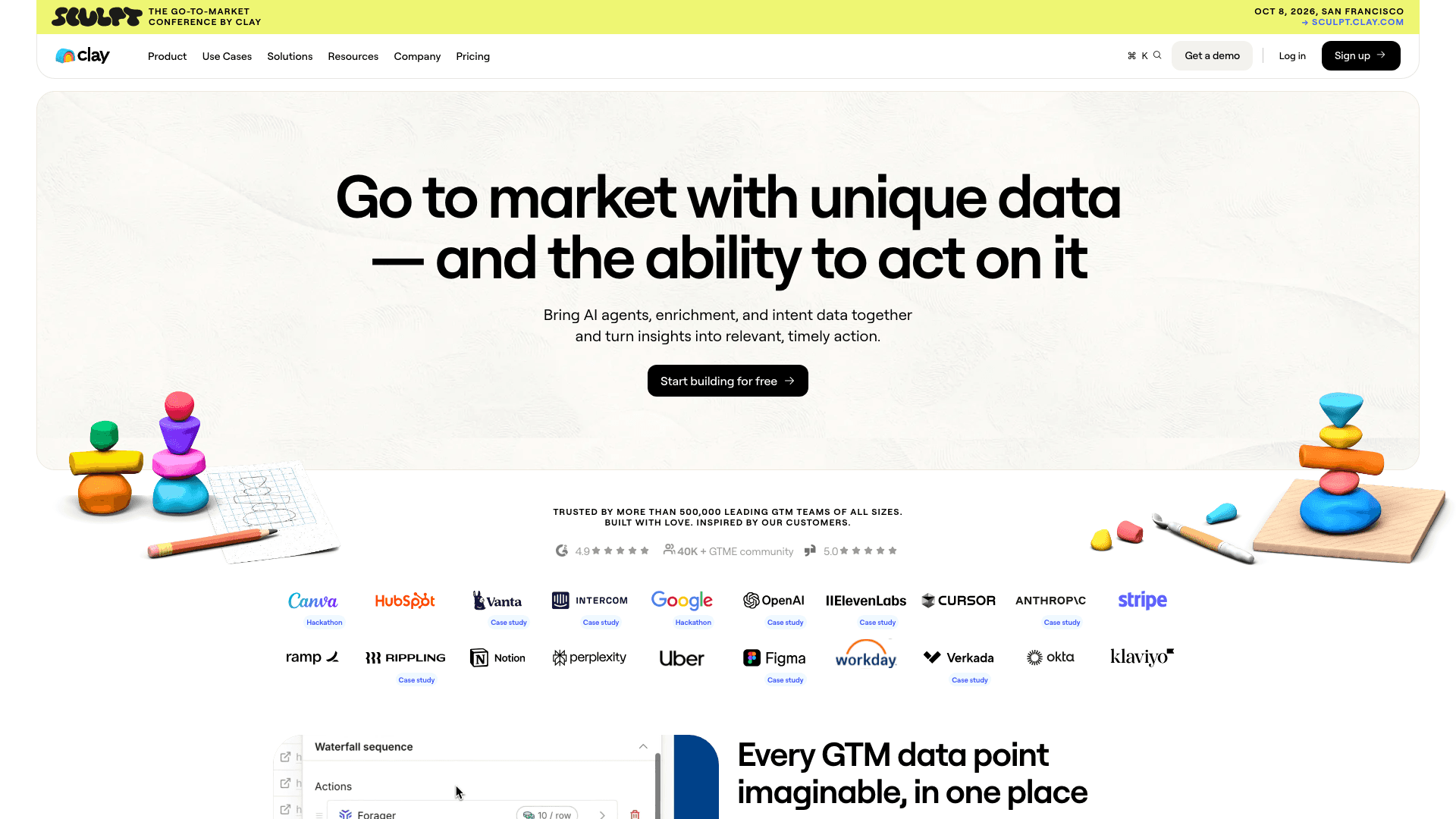
Clay is the data orchestration platform that operators stitched together across 150+ enrichment providers — Apollo, Lusha, Clearbit, RocketReach, Cognism, and dozens of smaller specialists — into automated waterfall workflows. The shape is spreadsheet + AI: every row is a contact, every column is an enrichment, and Claygent AI agents do live web research per row (LinkedIn, news, job boards, company sites) when no static database has the answer. In March 2026 Clay overhauled pricing, putting CRM sync, HTTP APIs, and Web Intent data into the $185/mo Launch plan (previously $800/mo Pro). The result: the cheapest moment to adopt Clay in years.
For founders running signal-based outbound — pitching when a prospect raises a Series A, hires a head of marketing, switches CRM, or publishes a job posting matching your ICP — Clay is the engine. It does not replace Apollo or Cognism as a primary database; it sits upstream and turns "we have 50,000 contacts in this ICP" into "here are the 200 contacts to email this week, each with a unique opening line referencing a real public signal." The learning curve is steep (the templating language is genuinely complex), but the unit economics improve every quarter as new AI providers slot into the waterfall. Most modern outbound stacks at $500K-$5M ARR run Clay + Apollo + a sequencer.
Key Features
- Waterfall enrichment across 150+ data providers — never lose a lead to one missing source
- Claygent AI agents do live web research per row (LinkedIn, news, job boards, company sites)
- Generative AI message writing per row, grounded in scraped data — not template variables
- CRM sync, HTTP APIs, Web Intent data now in $185/mo Launch plan (was $800/mo Pro pre-March 2026)
- 50,000+ teams use Clay — largest community templates library in the GTM tooling category
Pricing
Launch $185/mo (2,500 Data Credits + 15,000 Actions). Growth $495/mo (6,000 Credits + 40,000 Actions). Enterprise custom. Free tier for testing.
Rating
4.7/5 — G2 (189+ reviews)
Best For
Operators running signal-based outbound, ABM plays, or any motion where personal...
Pros
- Waterfall enrichment beats any single data provider — email find rates 30-50% higher than Apollo alone
- Claygent AI agents do real research per lead — output is genuinely personalized, not template-filled
- March 2026 pricing reset cut data marketplace costs 50-90% — cheapest moment in years to adopt
- Spreadsheet UX is familiar — anyone who can use Airtable can build a Clay table in a day
Cons
- Steep learning curve on advanced workflows — most teams hire a Clay consultant or spend 2-3 weeks on YouTube
- Dual credit system (Data Credits + Actions) makes monthly budgeting tricky for first 2-3 months
Lusha
Best for Solo Founders + Small Teams — $22.45/mo Pro With Free Tier
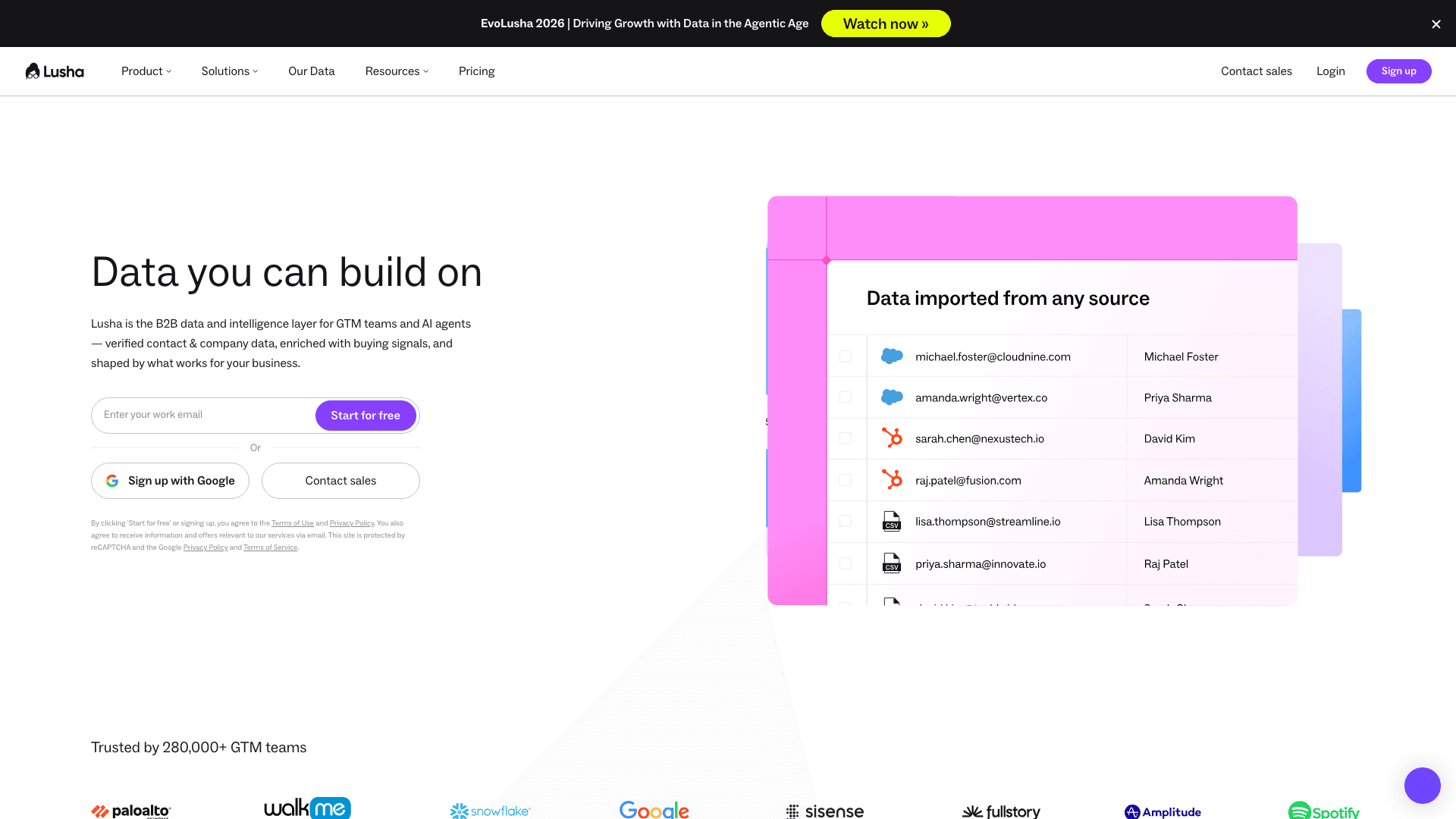
Lusha is the lightweight sales intelligence tool that built its position on a clean Chrome extension and a generous free tier (70 credits/mo, no credit card). The contact database covers 280M+ profiles globally, with the strongest accuracy in North America and reasonable EU coverage on enterprise plans. Pro plan is $22.45/user/mo annual with 3,000 credits/yr; Premium is $52.45/user/mo annual with 7,200 credits/yr. The catch every Lusha buyer should know in 2026: the company quietly doubled phone-number credit cost from 5 to 10 in 2025, so any pricing guide using the old math is wrong.
For a solo founder needing direct dials and emails on individual prospects (the LinkedIn + Chrome extension workflow), Lusha is the cleanest tool in the category. The free tier (70 credits/mo) is enough to validate 20-30 high-intent prospects per month without paying anything. The $22.45/user/mo Pro plan covers most solo + 2-person teams for 12+ months before they need to upgrade. Where it falls short: at team scale (5+ users running real outbound at volume), per-user credit costs add up quickly, and the lack of bundled sequencer or CRM forces a stack of 2-3 additional subscriptions. Apollo wins as soon as you outgrow individual lookups and need workflow automation.
Key Features
- 280M+ B2B contacts with Chrome extension for LinkedIn + company-site lookups
- Free plan: 70 credits/mo, no credit card required, full Chrome extension included
- Triple-verified emails on Premium plan with built-in deliverability scoring
- Native CRM integrations (Salesforce, HubSpot, Pipedrive) on Premium+
- Bulk enrichment + list-building tools (capped at 25 contacts per batch on lower plans)
Pricing
Free (70 credits/mo). Pro $22.45/user/mo annual (3,000 credits/yr). Premium $52.45/user/mo annual (7,200 credits/yr). Scale plan custom. Phone numbers now cost 10 credits each (was 5).
Rating
4.3/5 — G2 (1,500+ reviews)
Best For
Solo founders and 2-3 person teams doing individual prospect lookups through Lin...
Pros
- Best free tier in the lookup-tool category (70 credits/mo) — most founders can validate without paying
- Chrome extension UX is best-in-class for LinkedIn + company-site individual lookups
- 25% annual discount + no platform fee — true sub-$25/mo entry on the Pro plan
- 1,500+ G2 reviews at 4.3/5 — most-validated lightweight lookup tool
Cons
- Phone number credit cost doubled in 2025 (5 → 10) without much communication — many guides wrong
- No bundled sequencer or CRM — stack-up cost rises once volume + workflow needs grow
Want More Tool Recommendations?
Subscribe for curated indie hacker tool picks every week. No sponsored content, no fluff.
Lead411
Best Mid-Market Pick — Hybrid AI + Human Verification at $75/mo
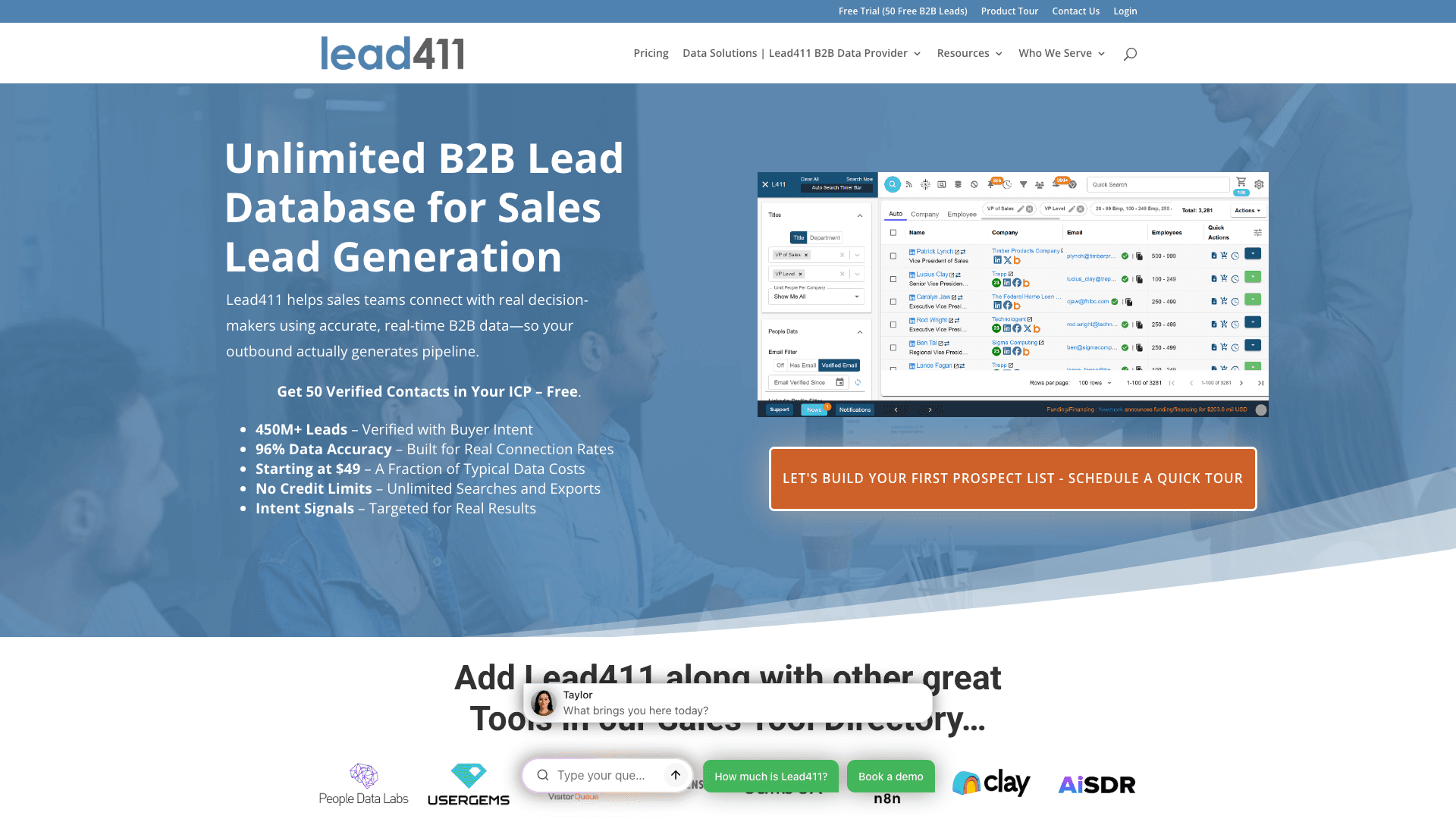
Lead411 is the mid-market answer to "Apollo data is not accurate enough but Cognism is too expensive." The platform combines triple-verified emails and direct dials with real-time growth intent triggers (hiring announcements, funding rounds, new C-suite hires) and uses a hybrid AI + human verification process that lands materially higher accuracy than pure-AI plays like Seamless.AI. The Spark plan starts at $75/user/mo annual ($99 monthly) with unlimited search/export — no daily caps, no per-record limits. Ignite adds intent data, AI search, and Reach automation. Blaze (~$6,000/yr) removes the export ceiling with full API access and a dedicated CSM.
For a 5-15 person sales team where Apollo bounces are killing rep efficiency and Cognism's $16,500/yr entry is too steep, Lead411 is the right zone. The Spark plan at $75/user/mo with unlimited search is unusual in the category — most competitors meter exports aggressively. Hybrid AI + human verification beats Seamless.AI on data accuracy in published comparisons. Growth intent triggers are the underrated differentiator: instead of buying a separate Bombora subscription for intent, you get hiring + funding + leadership change signals bundled in. The trade-off is platform polish (UI feels 2020) and a smaller contact database than Apollo (450M+ records vs Apollo's 275M unique contacts — Lead411 inflates by counting duplicates).
Key Features
- Triple-verified emails + direct dials with hybrid AI + human verification process
- Unlimited search/export on every plan — no daily caps, no per-record limits
- Growth intent triggers (hiring, funding, new C-suite) bundled into Ignite plan
- Reach automation for built-in email cadences and CRM integrations
- Blaze plan adds full API access + dedicated CSM for ~$6,000/yr
Pricing
Spark $75/user/mo annual ($99 month-to-month). Ignite custom. Blaze ~$6,000/yr unlimited. Buyer intent add-on $750-$1,000/user/yr.
Rating
4.5/5 — G2 (450+ reviews)
Best For
Mid-market sales teams (5-20 reps) where Apollo data quality is not enough but C...
Pros
- Unlimited search/export on every plan — most competitors meter exports as the primary upsell
- Hybrid AI + human verification beats pure-AI tools on data accuracy in published comparisons
- Growth intent triggers bundled into Ignite — saves the $1,000-$1,600/user/yr Bombora add-on
- $75/user/mo Spark is the cleanest mid-market entry — no platform fee, no per-export cap
Cons
- Platform UI feels dated — most enterprise sales teams will find it functional but unpolished
- 450M record count includes duplicates — actual unique contacts closer to 200M (still useful, just misleading)
RocketReach
Best Direct Contact Finder — 700M+ Professionals + Org Charts
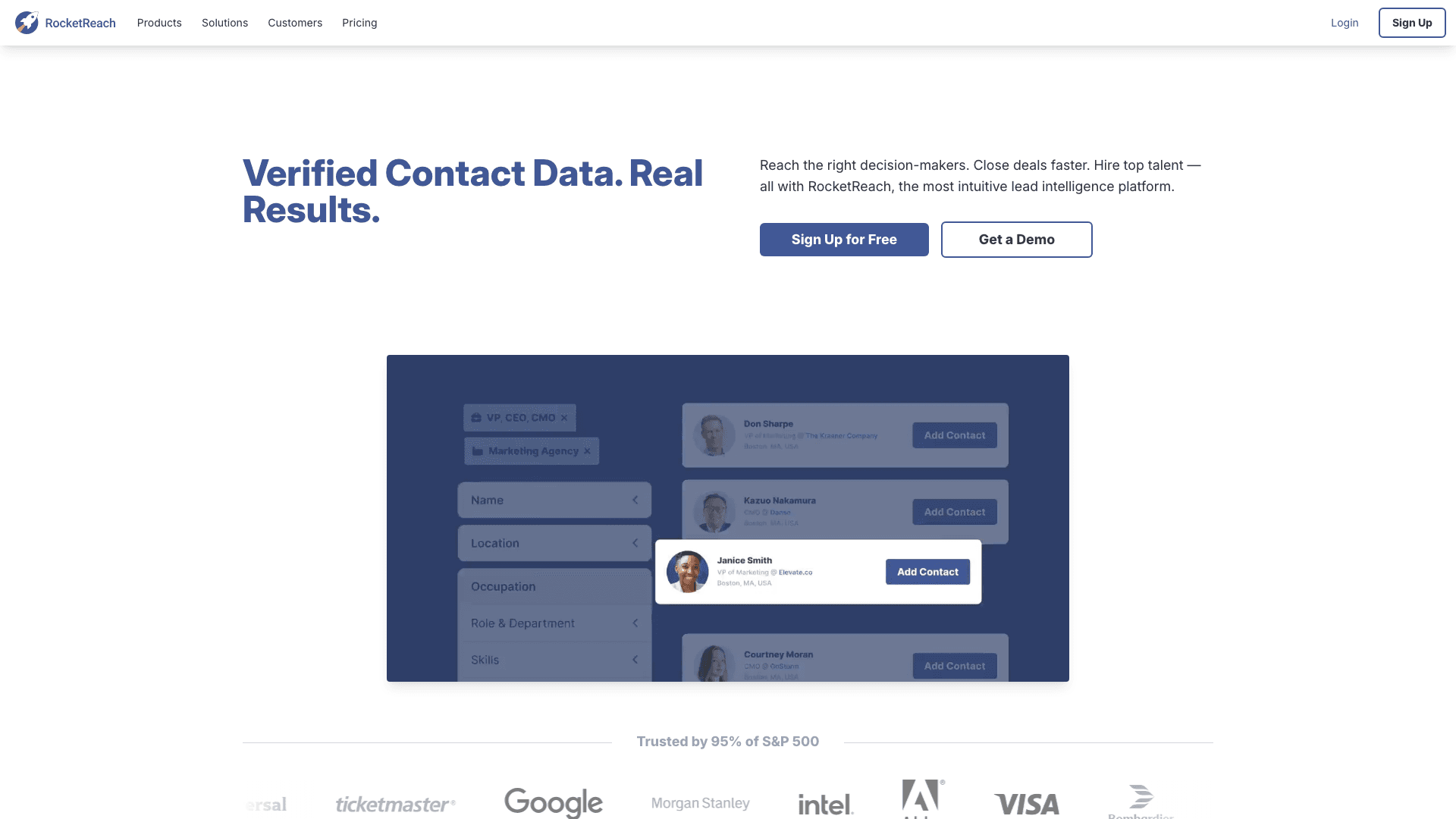
RocketReach finds verified email, phone, and social media for 700M+ professionals across 35M+ companies — the largest publicly-disclosed individual lookup database in the category. The product is purpose-built for the workflow of "I know who I want to reach; find me their contact details": Chrome extension for LinkedIn, Sales Navigator, and company websites; advanced search with job title + industry + location filters; bulk lookups and exports for list building. Pricing tiers: Essentials $33/user/mo (email-only, 1,200 lookups/yr), Pro $83/user/mo (adds phones), Ultimate $207/user/mo (API + Salesforce + org charts). Enterprise from $6,000/yr.
RocketReach occupies a narrower niche than Apollo or Lusha: it is purpose-built for individual contact discovery, not for programmatic outbound or sequencing. For recruiters, executive search firms, PR and partnership teams, and anyone whose primary workflow is "I need to reach this specific person and I do not care about sequences or CRM integration," RocketReach is the right pick. The 700M+ professional database means coverage is broader than Lusha or Apollo for senior contacts at mid-market companies. The trade-off: if a contact is not in the database, you still pay for the lookup; overages are $0.30-$0.45 per lookup; and there is no native sequencer or CRM. Best paired with a separate outreach tool (Smartlead, Instantly, Saleshandy) rather than used as an all-in-one.
Key Features
- 700M+ professional profiles across 35M+ companies — broadest individual lookup database
- Chrome extension for LinkedIn, Sales Navigator, and company website lookups
- Org charts (Ultimate tier) — see the org structure around any target contact
- API + Salesforce sync on Ultimate plan for programmatic integration
- Bulk lookups + CSV exports for list building
Pricing
Essentials $33/user/mo annual (1,200 lookups/yr, email only). Pro $83/user/mo (adds phones). Ultimate $207/user/mo (API + Salesforce + org charts). Enterprise from $6,000/yr. Overage $0.30-$0.45/lookup.
Rating
4.5/5 — G2 (700+ reviews)
Best For
Recruiters, executive search firms, PR and partnership teams, and anyone whose p...
Pros
- 700M+ profiles is the broadest individual lookup database (larger than Apollo or Lusha)
- Chrome extension UX is best-in-class for LinkedIn + Sales Navigator workflows
- Org charts (Ultimate) are unique in this list — see the full team around any contact
- API access at $207/user/mo is meaningfully cheaper than enterprise database API tiers
Cons
- No bundled sequencer or CRM — must pair with separate outreach tool
- Overage charges ($0.30-$0.45/lookup) compound fast for teams running heavy bulk searches
6sense
Best Enterprise Intent + ABM Platform — Predictive Analytics for Big Teams
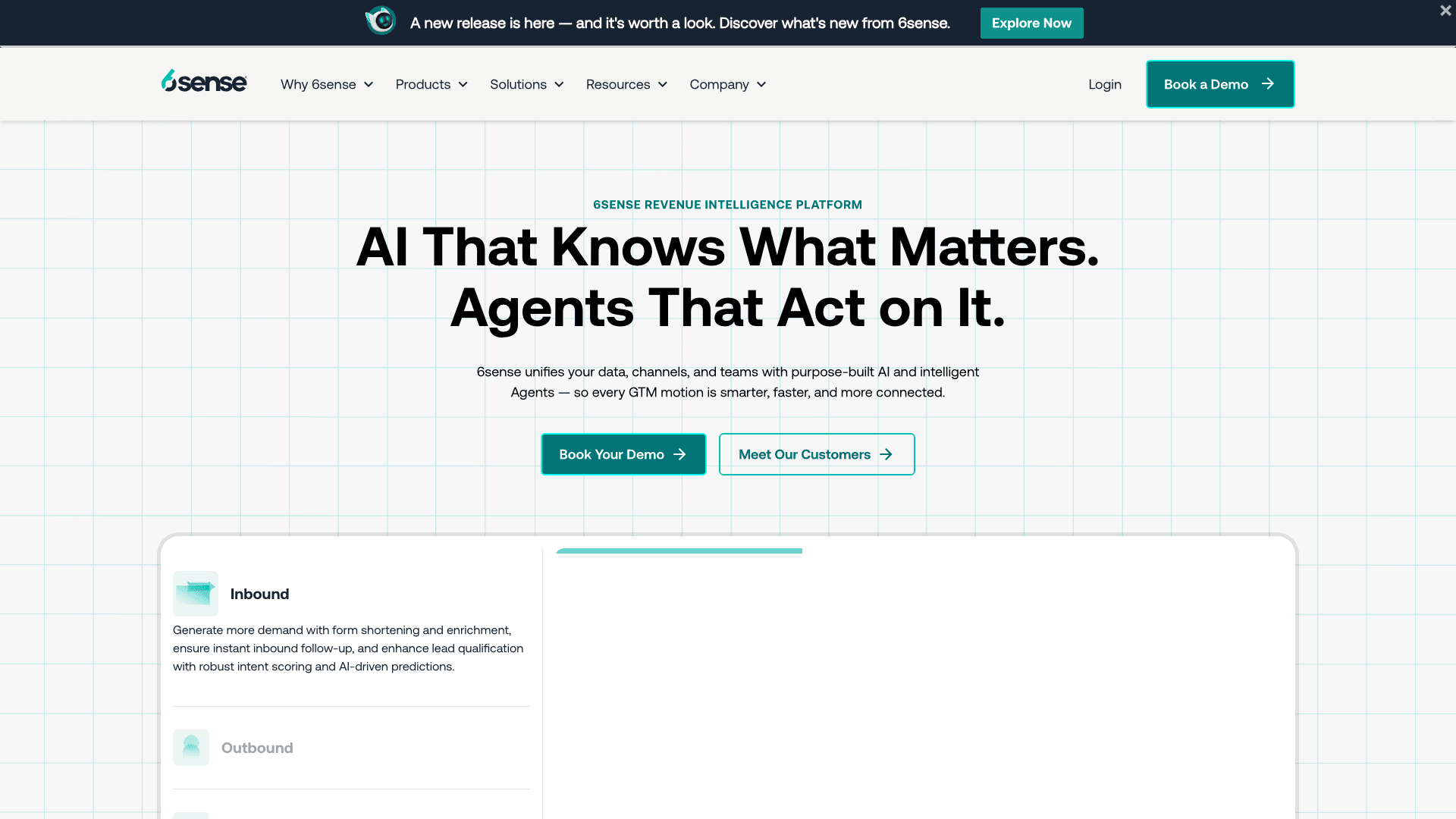
6sense is the enterprise ABM + intent platform that pairs a proprietary intent data network (tracking keyword research across millions of B2B web domains) with predictive analytics that score accounts on their likelihood to buy in the next 90 days. The output: a prioritized list of accounts where buyers are actively researching your category, ranked by predicted purchase intent. Account orchestration features push prioritized lists into sales workflows automatically. Custom enterprise pricing typically lands $55,000-$130,000+/yr depending on features and account volume — premium tier brings in 6QA (6sense Qualified Account) frameworks and full ABM advertising integration.
6sense is overkill for indie hackers and most early-stage teams, but transformative for B2B SaaS at $5M+ ARR with 5+ SDRs and dedicated sales ops. The predictive analytics genuinely work: published case studies consistently show 30-50% improvement in opportunity-to-close rates when SDRs prioritize accounts by 6sense intent score. The catch is consumption: intent data is only valuable if your team can act on it within 24 hours, which requires SDR capacity + ops infrastructure most early-stage teams do not have. Below 5 SDRs, the leaderboard of accounts with intent goes stale before anyone touches it, and the $55K-$130K/yr buys nothing actionable. Either commit to the enterprise motion or skip it for now.
Key Features
- Proprietary intent network tracking keyword research across millions of B2B web domains
- Predictive analytics scoring accounts on 90-day purchase intent likelihood
- 6QA (6sense Qualified Account) framework — prioritized lists pushed into sales workflows
- Account orchestration: ABM advertising, dynamic personalization, sales handoff automation
- Native Salesforce + HubSpot + Marketo + Eloqua integrations
Pricing
Custom enterprise pricing $55,000-$130,000+/yr depending on features and account volume. No self-serve or free trial.
Rating
4.4/5 — G2 (1,100+ reviews)
Best For
B2B SaaS at $5M+ ARR with 5+ SDRs and dedicated sales ops capacity to consume in...
Pros
- Predictive intent scoring is genuinely accurate — 30-50% lift in opportunity-to-close in published cases
- Proprietary intent network is one of the few independent of Bombora or G2 data feeds
- 1,100+ G2 reviews at 4.4/5 — most-validated enterprise ABM platform in the category
- Account orchestration closes the loop from intent signal to actual rep outreach automatically
Cons
- Custom $55K-$130K/yr pricing makes it inaccessible to anyone below $5M ARR
- Intent data goes stale within 24 hours — requires SDR capacity most early-stage teams do not have
Bombora
Best Pure Intent Data — 5,000+ B2B Sites + 18,000+ Intent Topics
Bombora is the original third-party B2B intent data network — tracking digital journeys across 5,000+ B2B publisher websites, analyzing billions of consumption events monthly across 18,000+ intent topics. The product is a feed, not an interface: Bombora sells data into other platforms (Salesforce, HubSpot, Marketo, 6sense, Demandbase) and increasingly into modern stacks via direct CSV or API delivery. The output is "Company X is researching Topic Y this week" — paired with surge scoring that flags companies whose research activity is statistically above their baseline. Pricing starts $12,000-$25,000/yr for standalone access, and is bundled into upper-tier 6sense and Demandbase subscriptions.
Bombora is the right buy when your team is mature enough to operationalize raw intent feeds — pipe the data into a CRM workflow, build a "this account is showing surge intent on our category" alert, route to an SDR for outbound within 24 hours. For most indie hackers, this is too raw: Bombora does not give you a dashboard to log into and act on; it gives you a feed to wire into your stack. The right move for small teams: skip Bombora as a standalone purchase and rely on intent signals bundled into 6sense, G2 Buyer Intent (for SaaS-specific category research), or your Apollo + Clay workflow with Reddit/news scraping. The G2 4.4/5 with consistent pricing complaints reflects this: the data is real, the consumption complexity is not for everyone.
Key Features
- Tracks digital journeys across 5,000+ B2B publisher websites with 18,000+ intent topics
- Surge scoring flags companies whose research activity is statistically above baseline
- CSV + API delivery directly into CRMs, MAPs, and ABM platforms
- Bundled into 6sense and Demandbase upper-tier subscriptions
- Industry-standard intent dataset — most other platforms benchmark against Bombora
Pricing
Custom pricing $12,000-$25,000/yr for standalone access. Often bundled into 6sense, Demandbase upper-tier subscriptions. No self-serve.
Rating
4.4/5 — G2 (155+ reviews)
Best For
Mature B2B sales orgs with dedicated ops + RevOps capacity to operationalize raw...
Pros
- Largest third-party intent dataset in the category — most platforms benchmark against Bombora
- 18,000+ intent topics cover almost every conceivable B2B category and product subcategory
- Surge scoring is mathematically robust — minimizes false positives compared to raw intent feeds
- Bundled into 6sense + Demandbase, so most enterprise buyers already have it
Cons
- Sold as a data feed, not an interface — requires sales ops + RevOps capacity to operationalize
- Pricing complaints dominate G2 — most buyers feel they paid for capability they do not use
UserGems
Best Champion Tracking — Job Change Alerts on Past Customers + Buyers
UserGems is the niche-but-powerful play that automates "warm intro outreach" at scale: track every champion, past buyer, and past prospect at every account in your CRM, alert sales when they change jobs, and trigger an automated outreach workflow to capture the relationship at the new company. The product surfaces 3-5x more "warm" prospects per quarter than rep manual tracking, and published case studies show 40-60% higher reply rates on UserGems-sourced outreach vs cold prospecting. The Core plan starts at $2,750/mo ($33,000/yr) for 3 admins, 20 end users, and 30,000 tracked records. Enterprise scales to $40K-$82K+/yr depending on headcount.
UserGems is one of the few sales intelligence tools where the ROI math is genuinely obvious. If your current customers churn but your champion lands at a new company, that champion is your warmest possible lead — and almost no sales team systematically tracks this. UserGems automates the tracking + the alert + the initial outreach, turning what used to be ad-hoc rep memory into a systematic pipeline source. The catch: $33K/yr Core is too expensive for sub-$5M ARR teams, and the ROI compounds only when you have meaningful customer + prospect history to track (typically 12+ months of CRM data with 100+ closed-won accounts). For pre-product-market-fit teams, this is overkill; for post-PMF teams with high LTV products, it is one of the highest-ROI sales intelligence buys in the category.
Key Features
- Track champions, past buyers, past prospects across every account in your CRM
- Job change alerts trigger automated outreach workflows when contacts move companies
- Bidirectional Salesforce + HubSpot sync — surfaces opportunities directly in rep workflows
- 3-5x more "warm" prospects per quarter vs manual tracking in published case studies
- 40-60% higher reply rates on UserGems-sourced outreach vs cold prospecting
Pricing
Core $2,750/mo ($33,000/yr) — 3 admins, 20 end users, 30,000 tracked records. Standard + Enterprise $40,000-$82,000+/yr based on headcount.
Rating
4.7/5 — G2 (140+ reviews)
Best For
Post-PMF B2B SaaS at $5M+ ARR with 12+ months of CRM history, 100+ closed-won ac...
Pros
- 4.7/5 G2 across 140+ reviews — highest sentiment score in the intent + signal category
- ROI math is genuinely obvious — warm intro outreach beats cold every published comparison
- 3-5x more warm prospects per quarter than manual rep tracking — automatable pipeline source
- Bidirectional CRM sync surfaces opportunities in the rep workflow without context switching
Cons
- $33K/yr Core is the floor — too expensive for sub-$5M ARR teams
- ROI compounds only with 12+ months of CRM history + 100+ closed-won accounts
G2 Buyer Intent
Best for SaaS Sellers — High-Confidence Software Research Signals
G2 Buyer Intent is the intent data product specifically for SaaS companies — it captures behavior happening on G2.com (the largest software review site): when a company's employees visit your G2 profile, check your pricing page, compare you against a specific competitor, or browse your category. The output is "Company X visited your G2 profile this week, compared you against Competitor Y, and viewed your pricing page" — extremely high-confidence research signals because nobody browses software reviews without commercial intent. Pricing is custom: the core G2 subscription is ~$15,000/yr, and Buyer Intent typically adds $10K-$87K/yr depending on category and signal package (Profile Signals $20K-$30K/yr, Category Intent $40K-$100K+/yr).
For SaaS sellers, G2 Buyer Intent is the highest-confidence intent signal money can buy — every signal represents a real software buyer doing real research, not the noisy "this company's employees visited content tangentially related to your topic" signal that Bombora generates. The catch is two-fold. First, you only get company names + intent scores, not individual contacts — so you still need Apollo or RocketReach to find the specific people to reach out to. Second, the data is only useful if your G2 profile gets enough traffic to generate meaningful signal volume; if you are early-stage with a sparse G2 page, the intent feed will be empty. For SaaS at $1M+ ARR with an active G2 presence + 5+ SDRs to act on signals, this is the highest-ROI intent buy in the category.
Key Features
- Captures research behavior on G2.com — profile visits, pricing page views, competitor comparisons
- High-confidence intent signals — nobody browses software reviews without commercial intent
- Category Intent shows what alternatives buyers are evaluating across your competitive set
- CRM integrations push signals into Salesforce + HubSpot for SDR routing
- API access on Category Intent tier for custom workflow automation
Pricing
Core G2 subscription ~$15,000/yr base. Profile Signals add-on $20,000-$30,000/yr. Category Intent $40,000-$100,000+/yr. Total packages climb to $87,000/yr with all add-ons.
Rating
4.5/5 — G2 (300+ reviews on G2 Buyer Intent specifically)
Best For
SaaS companies at $1M+ ARR with an active G2 profile (50+ reviews) and 5+ SDRs t...
Pros
- Highest-confidence intent signal in the category — every visit is a real software buyer researching
- Category Intent surfaces competitor comparisons no other tool can see (G2-exclusive data)
- Native integration into the G2 vendor profile most SaaS companies already maintain
- CRM push into Salesforce + HubSpot makes SDR routing trivial
Cons
- Only company names + intent scores — must pair with Apollo or RocketReach for contact details
- Useless if your G2 profile is sparse — requires 50+ reviews to generate meaningful signal volume
How We Chose These Tools
We evaluated 30+ sales intelligence tools across mid-2026 and weighted them against five founder-specific criteria. Most competing listicles weight enterprise feature depth and analyst-grade evaluation rubrics. We weighted the opposite — real all-in pricing and the path to coverage that does not start at $25K/yr.
- Real all-in pricing — headline entry pricing + credit overage math + add-on costs that show up at month two
- Data accuracy benchmarks — verified email + phone hit rates in published third-party comparisons (not vendor self-reports)
- Path to scale — does the tool grow with you, or force a rip-and-replace at $50K MRR?
- Free or sub-$100 entry — can a solo founder validate the tool without a credit-card commitment?
- Honest disclosure of breaking points — where the tool fails (intent data going stale, EMEA accuracy gaps, credit traps)
How to Build Your Sales Intelligence Stack
You will not run all ten of these tools. A real sales intelligence stack is 1-2 tools that cover the layers your motion actually needs. Pick by your stage:
Solo founder, $0/mo budget...
Apollo.io free plan + Lusha free plan. 50 mobile + unlimited email credits/mo on Apollo, 70 credits/mo on Lusha. Covers 80% of solo-founder needs.
Solo founder, under $100/mo...
Apollo Basic ($49/mo annual) + Lusha Pro ($22.45/mo annual) + RocketReach Essentials ($33/mo). Total: $104/mo for full database + lookup stack.
EMEA-focused team...
Cognism Grow ($15K/yr platform + $1,500/user/yr). GDPR-safe Diamond Data® phone verification is non-negotiable for EU sales motions.
Mid-market team (5-15 reps)...
Lead411 Spark ($75/user/mo annual). Unlimited search/export + growth intent triggers without the Cognism $16,500/yr platform fee.
Signal-based outbound...
Clay Launch ($185/mo) + Apollo Basic ($49/mo). Waterfall enrichment + Claygent AI research per row.
Post-PMF enterprise (5+ SDRs)...
6sense (intent) + UserGems ($33K/yr champion tracking) + G2 Buyer Intent (if SaaS). Intent stack pays back only with SDR capacity.
Stay Ahead of the Tool Curve
We research dozens of tools so you don't have to. Get our top picks and insider insights delivered weekly.
Frequently Asked Questions
What is the best sales intelligence tool for solo founders on a budget?
Apollo.io free plan + Lusha free plan. Apollo gives you real prospect search (50 mobile + unlimited email credits/mo) plus a sequencer at $0/mo. Lusha's 70 free credits/mo cover individual lookups on senior contacts where Apollo data is thin. Total cost: $0/mo. This stack covers 80% of solo-founder sales intelligence needs and lets you validate the motion before paying anything. Once you outgrow the free tiers, Apollo Basic at $59/mo annual ($49/mo) is the clean upgrade.
Is Cognism worth $15,000-$25,000/year vs Apollo at $59/user/month?
Only if EMEA is your primary market or compliance is contractual. For a US-first founder selling to US prospects, Apollo + manual verification beats Cognism on dollar-per-meeting. For a UK/EU founder where GDPR violations can mean 4%-of-global-revenue fines, Cognism's compliance infrastructure is non-negotiable insurance. The math also works when your sales team's primary complaint is "Apollo bounces too much for our ICP" — Cognism's Diamond Data® phone verification delivers 95%+ accuracy on mobile numbers vs Apollo's 65-70% global email accuracy. Vendr benchmarking shows 28-52% discount room on Cognism quotes — never accept the first quote.
When does intent data (Bombora, 6sense, G2) become worth the spend?
Intent data is overhyped for early-stage teams. The math only works when (a) you have 5+ SDRs capable of acting on intent signals within 24 hours, (b) you have a high-LTV product where a single won deal pays for months of intent spend, and (c) you have CRM ops capacity to route signals to the right rep without manual triage. Below that threshold, the leaderboard of "accounts showing intent" goes stale before anyone touches it, and the $25K-$130K/yr buys nothing actionable. For solo founders and small teams, manual signal-watching via Clay + Apollo + Reddit/Twitter scraping beats paying for an intent platform you cannot consume.
Apollo vs Lusha vs RocketReach — which lookup tool should I pick?
Different jobs, different winners. Apollo wins for founders who want one tool that covers database + sequencer + CRM at the lowest entry price. Lusha wins for the LinkedIn + Chrome extension workflow on individual senior contacts — the free tier (70 credits/mo) is the most generous in the category. RocketReach wins for recruiters, executive search, PR, and partnership teams whose primary job is finding specific senior contacts at mid-market companies — the 700M+ profile database is the broadest individual lookup database in the category. Most indie hackers should start with Apollo + Lusha free plans and add RocketReach only if they need senior-contact discovery at scale.
Does Lead411 actually beat Apollo on data accuracy?
For mid-market and enterprise contacts, yes — meaningfully. Lead411's hybrid AI + human verification process catches data decay that pure-AI tools (Apollo, Seamless.AI) miss, especially on mobile phone numbers and direct dials. Published comparisons consistently show 85-90% accuracy on Lead411 vs 65-70% on Apollo for the same prospect lists. The trade-off: Lead411's UI is functional but unpolished, and the contact database (450M records, but with duplicates) is smaller than Apollo's 275M unique contacts. For a 5-15 person sales team where Apollo bounces are hurting rep efficiency, Lead411 Spark at $75/user/mo with unlimited search/export is the right upgrade path before jumping to Cognism's $16,500/yr platform fee.
What is the cheapest sales intelligence stack that actually works in 2026?
Apollo.io Basic ($49/mo annual) + Lusha Pro ($22.45/mo annual) + RocketReach Essentials ($33/mo annual). Total: $104/mo for a complete lookup + enrichment + senior-contact stack covering 275M+ Apollo contacts, 280M+ Lusha lookups with Chrome extension, and 700M+ RocketReach individual profiles. The same coverage assembled from enterprise databases plus LinkedIn Sales Navigator would run $20,000-$50,000/yr. The 2026 budget stack genuinely works for solo founders and 2-3 person teams up to ~$50K MRR before scale forces upgrades to Lead411 or Cognism.
How do I avoid the credit-overage trap on Apollo, Lusha, and RocketReach?
Three rules. First, understand the credit math before paying: Apollo phone numbers cost 8x more than emails, Lusha doubled phone cost from 5 to 10 credits in 2025, RocketReach overages are $0.30-$0.45 per lookup. Second, budget at 1.5-2x the headline price — the gap between advertised pricing and real spend is universal in this category. Third, separate database research from outreach execution: use the cheap database (Apollo free) for ICP validation, then commit credits only on validated lists for export. Most credit waste happens during "what does our ICP look like?" exploration that should not consume credits at all.
The Bottom Line
Sales intelligence in 2026 stopped being a single-vendor decision. The tools split cleanly into three layers — contact databases (Apollo, Cognism, Lusha, Lead411, RocketReach), data orchestration (Clay), and intent + signal data (6sense, Bombora, UserGems, G2 Buyer Intent) — and the right stack depends entirely on what motion you are running and at what scale.
For most founders, the wrong move is paying $25K-$130K/yr for an enterprise intent platform you cannot consume because you do not have 5+ SDRs to act on signals within 24 hours. The right move is starting with Apollo's free plan and Lusha's free credits, graduating to Apollo Basic + Lead411 when data quality hits a ceiling, and adding 6sense, UserGems, or G2 Buyer Intent only when you have the SDR capacity to make intent data actionable.
For most indie hackers, the 2026 stack is: Apollo Basic ($49/mo) for contact database + sequencer, Lusha Pro ($22.45/mo) for Chrome extension lookups, and Clay Launch ($185/mo) when signal-based outbound becomes the play. Total: under $260/mo for a complete founder-tier sales intelligence stack. Save Cognism, 6sense, Bombora, UserGems, and G2 Buyer Intent for when revenue justifies the spend.
Related Reading
- 10 Best ZoomInfo Alternatives — The same market ranked by buying friction for teams already trapped in a ZoomInfo contract, including the 60-90 day auto-renewal window
- 10 Best AI GTM Tools for 2026 — Where intent data feeds the revenue engine: the GTM platforms that act on these signals
- 10 Best AI Sales Tools for 2026 — The engagement layer that sits on top of your sales intelligence stack
- Best Marketing Automation Tools for Early-Stage Startups — Pair sales intelligence with marketing automation for closed-loop demand gen
- Best Competitor Analysis Platforms — Track competitor accounts and intent data alongside your prospect database
- 10 Best AI Search Visibility Tools (AEO/GEO) for 2026 — The inbound-discovery counterpart: track how AI engines surface your brand
Sources
- Apollo.io — Official Pricing
- Cognism — Pricing & Diamond Data®
- Clay — Official Pricing (March 2026 reset)
- Lusha — Plans & Pricing
- Lead411 — Pricing & Plans
- RocketReach — Pricing & Subscription Plans
- 6sense — Enterprise ABM + Intent Platform
- Bombora — B2B Intent Data Network
- UserGems — Champion Tracking Platform
- G2 Buyer Intent — Software Research Signals
- Cognism Pricing Benchmarking (Vendr 28-52% discount data)
- UserGems Pricing Guide (2026 detailed breakdown)
Stay Ahead of the Tool Curve
We research dozens of tools so you don't have to. Get our top picks and insider insights delivered weekly.
Trusted by indie hackers and startup founders
Keep Reading
10 Best ZoomInfo Alternatives in 2026 (Ranked by How You Buy, Not Just What You Get)
The 10 best ZoomInfo alternatives in 2026 — Apollo.io, Clay, Lusha, Lead411, RocketReach, Cognism, Amplemarket, Instantly, Saleshandy, and 6sense. Ranked by buying friction rather than database size, with ZoomInfo's real contract math and the 60-90 day auto-renewal window that catches people.
10 Best AI Sales Tools for 2026 (Ranked for Founders, Not Enterprise Buyers)
The 10 best AI sales tools for 2026 — Apollo, Clay, Amplemarket, Saleshandy, Smartlead, Instantly, Lemlist, HeyReach, 11x.ai, and Gong. Ranked by founders-first criteria: pricing transparency, time-to-first-meeting, and what works for teams under 20 reps.
10 Best AI GTM Tools for 2026 (Ranked for Founders Building the Revenue Engine)
The 10 best AI go-to-market tools for 2026 — Clay, Apollo, Attio, Unify, Common Room, HubSpot Breeze, Amplemarket, 11x, Gong, and Warmly. Ranked by founders-first criteria: how fast you can turn a signal into a booked meeting, real pricing, and which tools survive the GTM consolidation wave now that HubSpot bought Warmly and Zoom bought Common Room.