
10 Best AI GTM Tools for 2026 (Ranked for Founders Building the Revenue Engine)
The 10 best AI go-to-market tools for 2026 — Clay, Apollo, Attio, Unify, Common Room, HubSpot Breeze, Amplemarket, 11x, Gong, and Warmly. Ranked by founders-first criteria: how fast you can turn a signal into a booked meeting, real pricing (not the sticker), and which tools survive the GTM consolidation wave now that HubSpot bought Warmly and Zoom bought Common Room.

The AI GTM stack is consolidating in real time. Buy accordingly.
In mid-2026 alone: HubSpot acquired Warmly (June 30), Zoom acquired Common Room (July 2), and Apollo acquired Pocus (March 18) — on top of the Salesloft + Clari merger last December. The signal and data layer is the new battleground, and the platforms want to own it. Every tool below is ranked from a founder's lens — how fast you can turn a signal into a booked meeting, what it really costs past the sticker price, and whether it will still be an independent product in a year.
Key Takeaways
- "GTM engineering" is now a real discipline. The highest-leverage go-to-market hire in 2026 is not another SDR — it is someone who can wire signals + data + CRM into an automated pipeline. Clay ($5B valuation, January 2026) is the category-defining engine and our #1 pick.
- The AI GTM signal layer is consolidating in real time. HubSpot acquired Warmly (June 30, 2026), Zoom acquired Common Room (July 2, 2026), and Apollo acquired Pocus (March 18, 2026). Buy the data/signal layer knowing your standalone tool may live inside a bigger platform within a year.
- There is a genuinely $0/mo AI GTM stack in 2026: Attio (free CRM, up to 3 seats) + Apollo (free prospecting, 10,000 email credits/mo) + RB2B (free person-level website de-anonymization). It only starts costing money once it is working.
- Agentic warm outbound is the real frontier. Unify users report 80% open and 5% reply rates on intent-triggered outreach vs 30% and under 1% for cold. The catch: credit-based pricing makes monthly spend hard to forecast — prove the motion on free signal tools first.
- Be skeptical of AI SDR hype. 11x faced a March 2025 TechCrunch investigation over inflated ARR and reported 70-80% churn. "AI drafts, human approves, AI sends" still beats fully autonomous AI SDRs on measured reply rates as of mid-2026.
Most "best AI GTM tools" lists are really just sales-tool lists wearing a go-to-market badge. This one is not. GTM is the whole revenue engine — capturing buying signals, enriching and orchestrating data, the CRM that holds it all, the outreach that acts on it, and the intelligence that closes the loop. In 2026, AI is not a feature on top of that engine. It is the engine.
The most important shift is the rise of "GTM engineering." The highest-leverage go-to-market hire is no longer another SDR — it is someone who can wire signals, data, and CRM into a pipeline that runs itself. Clay is the tool that defined the discipline, and its January 2026 tender offer at a $5B valuation tells you the market agrees. Meanwhile the signal layer is being rolled up in real time: HubSpot bought Warmly, Zoom bought Common Room, and Apollo bought Pocus, all within a few months of each other.
We picked 10 tools across the full GTM stack: the GTM engine (Clay), all-in-one platforms (Apollo, HubSpot Breeze), the AI-native CRM (Attio), signals and intent (Common Room, Warmly), warm-outbound execution (Unify, Amplemarket), the AI SDR frontier (11x), and revenue intelligence (Gong). Every entry ranks on founders-first criteria: how fast a signal becomes a meeting, the real all-in cost, and how durable the tool is in a category this consolidated. Where a pick is mid-acquisition or over-hyped, we say so plainly.
Quick Comparison
| # | Tool | Best For | Starting Price | Rating |
|---|---|---|---|---|
| 1 | Clay | Best Overall AI GTM Engine | Free ($0, 100 Data Credits + 500 Actions) | 4.7 |
| 2 | Apollo.io | Best All-in-One GTM Platform for Founders | Free ($0, 10,000 email credits/mo) | 4.7 |
| 3 | Attio | Best AI-Native CRM | Free ($0, up to 3 seats) | 4.5 |
| 4 | Unify | Best Agentic Warm Outbound | Free tier available | 4.7 |
| 5 | Common Room | Best GTM Signal Aggregation | Essential from ~$2,100/mo billed annually (5 seats, 100k contacts) | 4.5 |
| 6 | HubSpot Breeze | Best All-in-One GTM + CRM for Scaling Teams | Free CRM ($0) | 4.4 |
| 7 | Amplemarket | Best AI-Native Outbound Execution | Startup $600/mo (annual only, 2 users, 30k contacts) | 4.6 |
| 8 | 11x | Most-Hyped Autonomous AI SDR | Custom enterprise only, ~$5,000/mo entry | 4.4 |
| 9 | Gong | Best Revenue Intelligence | $5,000-$50,000/year platform fee + $1,298-$1,426/user/year (Core) up to ~$3,000/user/year bundled | 4.7 |
| 10 | Warmly | Best Website De-Anonymization | Free plan (up to 500 visitors/mo) | 4.6 |
Clay
Best Overall AI GTM Engine — Waterfall Enrichment + AI Research Agents
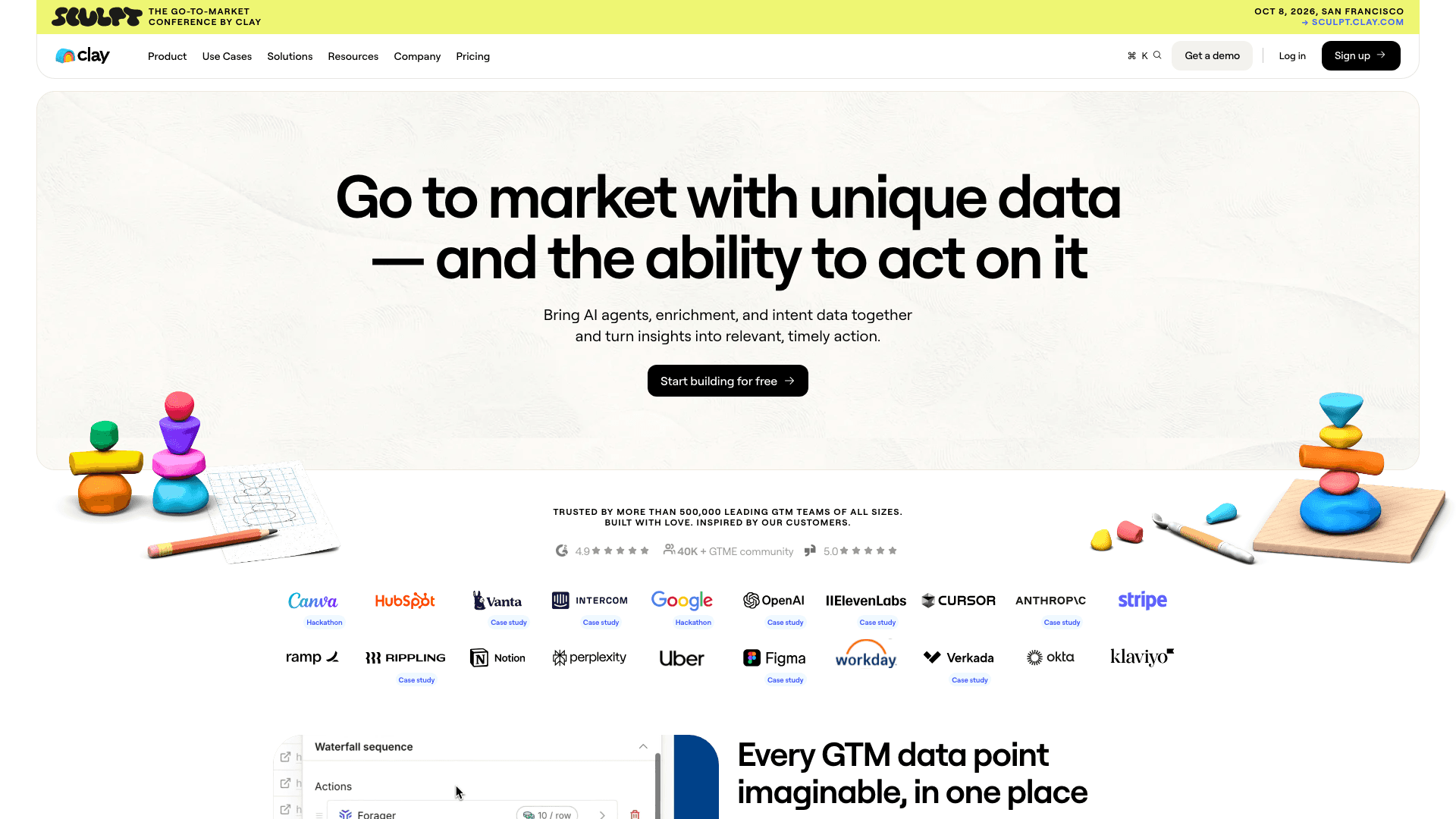
Clay is the spreadsheet-shaped engine that modern go-to-market teams build their entire pipeline on top of. It chains 150+ data providers via waterfall enrichment — if one source lacks an email or phone, Clay automatically tries the next — and bolts on Claygent, an AI research agent that does live web research per row (LinkedIn, news, job boards, funding). The output is a lead list where every row carries firmographics, technographics, intent signals, and an AI-written opener grounded in a real public event. In March 2026, Clay overhauled pricing into a dual credit model (Data Credits for data, Actions for platform operations) and cut data-marketplace costs 50-90%.
If you only adopt one tool from this list, it is Clay. It does not replace your CRM or your sequencer — it sits upstream and turns "we have 50,000 contacts in this ICP" into "here are the 200 accounts to work this week, each with a unique opener referencing a Series A raise, a head-of-marketing hire, or a CRM switch." This is what "GTM engineering" actually means in practice, and Clay is why the discipline exists. The learning curve is genuinely steep — most teams spend two to three weeks on YouTube or hire a Clay consultant — but the January 2026 tender offer at a $5B valuation (up from $3.1B in August 2025) tells you where the category is heading. OpenAI, Anthropic, and Canva all run on it.
Key Features
- Waterfall enrichment across 150+ providers — email and phone find rates 30-50% higher than any single database
- Claygent AI research agents do live per-row web research (passed 1.5B lifetime runs)
- Generative AI message writing grounded in each row's scraped data, not template variables
- March 2026 pricing reset: dual credit system, failed lookups no longer charged, top-up premium cut to 30%
- 10,000+ customers and the largest community-template library in the GTM category
Pricing
Free ($0, 100 Data Credits + 500 Actions). Launch $185/mo ($167/mo annual). Growth $495/mo ($446/mo annual). Enterprise custom. Credits are the real cost driver.
Rating
4.7/5 — G2 (9,000+ reviews)
Best For
Founders and operators running signal-based outbound or ABM, where personalizati...
Pros
- The single highest-leverage GTM tool in 2026 — one Clay build can replace a data analyst plus three point tools
- Waterfall enrichment plus Claygent produces genuinely personalized outbound, not mail-merge variables
- March 2026 pricing reset cut data costs 50-90% — cheapest moment in years to adopt
- Spreadsheet UX is familiar — anyone comfortable in Airtable can build a basic table in a day
Cons
- Steep learning curve on advanced workflows — budget 2-3 weeks or a consultant to get real value
- Dual credit model (Data Credits + Actions) burns fast during builds and makes spend hard to forecast
Apollo.io
Best All-in-One GTM Platform for Founders — Free Plan, 275M+ Contacts
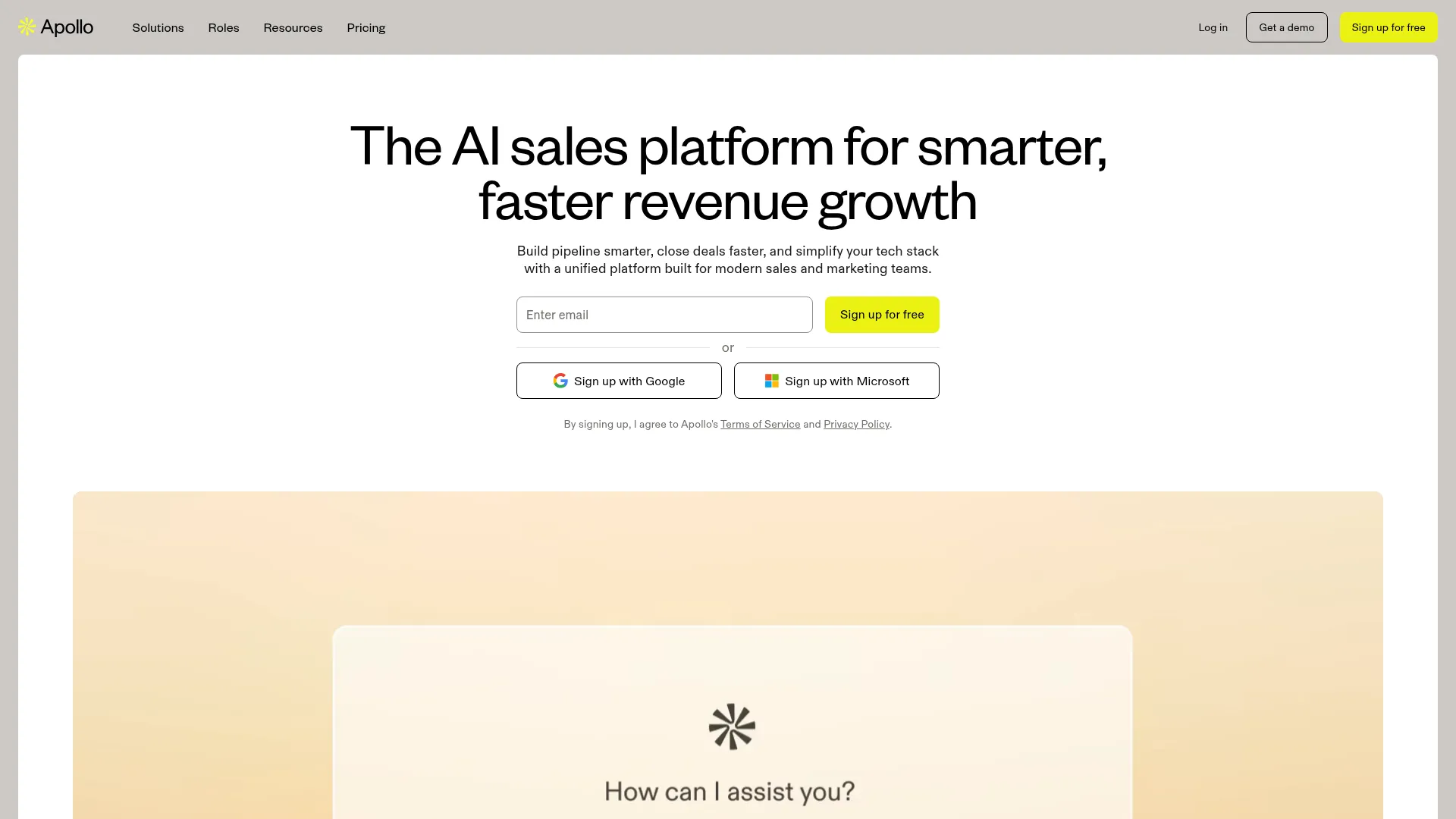
Apollo.io is the all-in-one GTM platform every other tool measures itself against. A 275M+ B2B contact database, a multi-step sequencer, a dialer, conversation intelligence, and a lightweight CRM are bundled into a single license that starts at $0 on the free plan. In March 2026, Apollo launched its AI Assistant — marketed as "the first fully agentic GTM operating system," in practice a strong drafting-and-search co-pilot that builds lists and drafts sequences for you to approve. Days earlier, Apollo acquired Pocus, folding product-led sales signals into the platform.
For 90% of founders standing up a GTM motion in 2026, Apollo is the correct starting point. The free plan (10,000 email credits per month) gives you real prospecting, the $49/user/mo Basic tier unlocks sequencing for a small team, and the Pocus acquisition means product signals now live next to your outbound data. The credit system has sharp edges — credits expire each cycle with no rollover, phone numbers cost roughly 8x an email credit, and overage credits run $0.20 each — but if you stay disciplined about what you export, the all-in cost is far below running ZoomInfo + Outreach + a separate CRM. Watch the data quality: Apollo markets 91% accuracy, but practitioner tests land at 65-80%, worse outside North America.
Key Features
- 275M+ B2B contact database with intent, hiring, funding, and tech-stack filters
- AI Assistant (March 2026) drafts lists and sequences from natural-language prompts
- Pocus acquisition (March 2026) brings product-led sales signals natively into the platform
- Bundled sequencer, dialer, conversation intelligence, and CRM in one per-seat license
- Genuinely useful free plan — 10,000 email credits/mo, no credit card required
Pricing
Free ($0, 10,000 email credits/mo). Basic $49/user/mo annual. Professional $79/user/mo. Organization $119/user/mo (3-user minimum). Credits expire each cycle.
Rating
4.7/5 — G2 (9,600+ reviews)
Best For
Founders and 2-20 person teams who want one GTM tool instead of five, with a rea...
Pros
- Best free plan in the category — most founders can validate Apollo without paying anything
- Bundled database + sequencer + dialer + CRM replaces 3-4 separate subscriptions
- AI Assistant plus the Pocus acquisition make it the broadest all-in-one GTM stack under $100/seat
- Largest community and tutorial library of any tool here — fastest ramp-up
Cons
- Real-world email accuracy is 65-80% (worse outside North America) — budget for verification
- Credit gotchas: monthly expiry, phone numbers cost ~8x more, $0.20 per overage credit
Attio
Best AI-Native CRM — Notion-Flexible Data Model + Built-In Research Agent
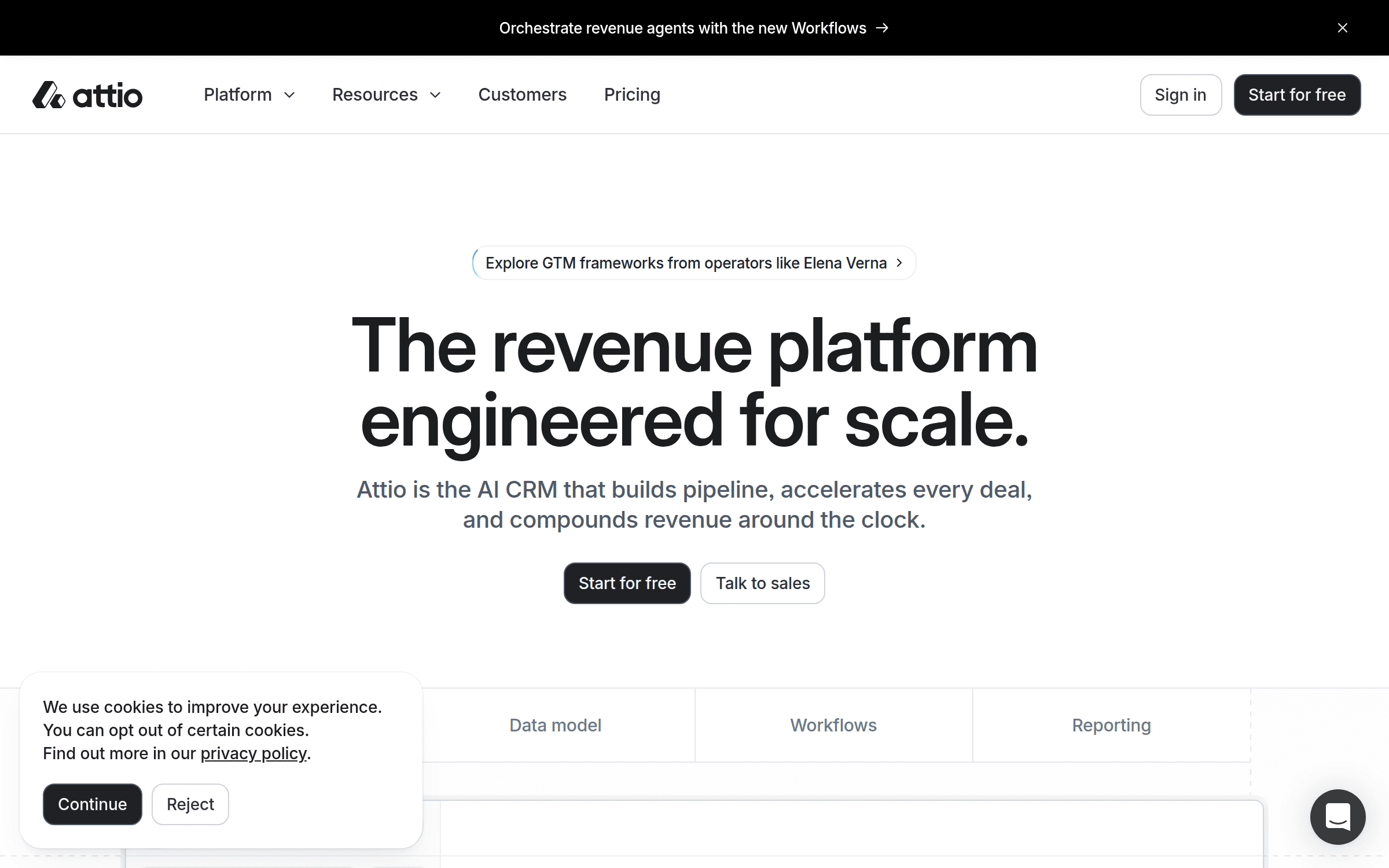
Attio is the CRM founders actually want to use — an AI-native system of record with a Notion/Airtable-flexible data model, real-time contact syncing, automatic enrichment, and a built-in AI research agent that investigates companies and people on the web from inside your workflows. Where legacy CRMs take six to eight weeks to implement, Attio's median go-live is around 12 days. It shipped native workflows, sequences, and call intelligence through 2025 and into 2026, backed by a $52M Series B led by Google Ventures.
Every AI GTM stack needs a system of record, and for founders the choice in 2026 is Attio or HubSpot. Attio wins for technical founders and small teams who want a CRM that bends to their data model instead of forcing them into a rigid pipeline object. The free plan (up to 3 seats) is a legitimate starting point, and the AI research agent means new records self-enrich rather than sitting empty. The honest limitation: feature depth thins out past 10-15 people — no unified inbox, lighter reporting, and several integrations still route through Zapier. If you are a five-person team that values speed and flexibility, this is the CRM. If you need marketing automation and a service desk in the same tool, look at HubSpot.
Key Features
- AI-native, Notion-flexible data model — build custom objects and relationships without a consultant
- Built-in AI research agent enriches records with ICP fit, decision-makers, and funding history
- ~12-day median implementation vs 6-8 weeks for legacy CRMs
- Native workflows, sequences, and call intelligence shipped through 2026
- Genuine free plan for up to 3 seats — no trial clock, no credit card
Pricing
Free ($0, up to 3 seats). Plus $29/user/mo annual ($36 monthly). Pro $66/user/mo annual ($86 monthly). Enterprise custom. Enrichment/AI actions are credit-metered.
Rating
4.5/5 — G2 (200+ reviews)
Best For
Technical founders and small teams who want a fast, flexible AI-native CRM they ...
Pros
- Fastest, most flexible CRM to stand up — live in days, not weeks
- AI research agent keeps records enriched automatically instead of leaving blank fields
- Free plan up to 3 seats is a real starting point for solo founders and tiny teams
- Data model bends to your business — no fighting a rigid legacy pipeline object
Cons
- Feature depth thins past 10-15 people — no unified inbox, lighter reporting, some integrations need Zapier
- Credit-metered enrichment means the $29-$66 sticker is not your true all-in cost at scale
Unify
Best Agentic Warm Outbound — The "System of Action" for Intent-Triggered Plays
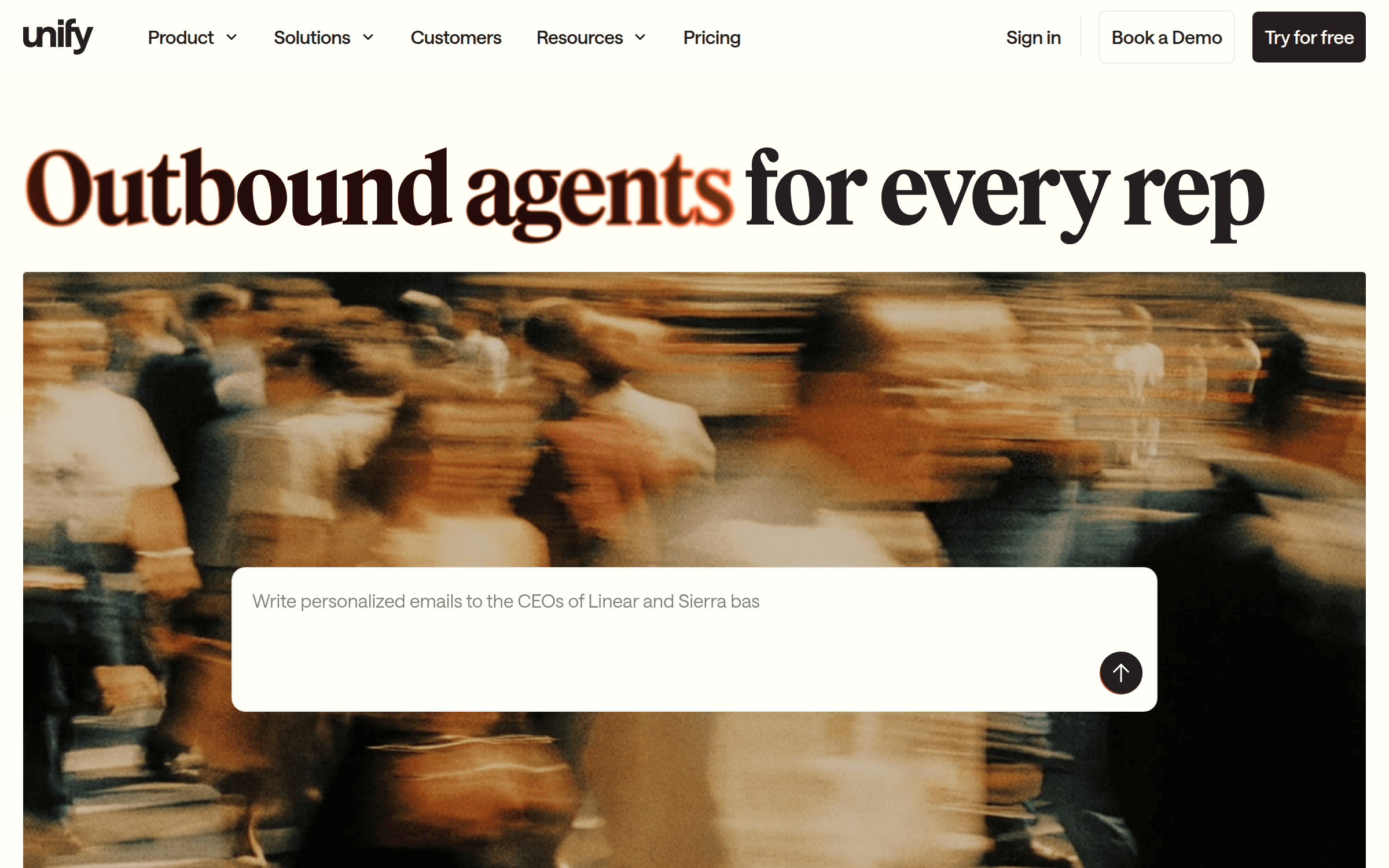
Unify calls itself the "system of action" for revenue — an agentic warm-outbound platform that watches for buying signals (website visits, intent surges, job changes, funding), then automatically runs AI-personalized multichannel plays against the accounts showing intent. It bundles person-level website de-anonymization, intent data, managed email deliverability (warmup, rotation, monitoring), and AI agents that draft and send outreach without a human staging every step. Backed by a $40M Series B led by Battery Ventures, it is one of the most-funded pure-play AI GTM startups still independent in 2026.
Unify is the clearest picture of where AI GTM is heading: you do not build lists and send cold email — you define an ICP and a signal, and the platform executes warm plays the moment intent appears. Users report the difference is real — around 80% open and 5% reply rates on intent-triggered outreach versus 30% and under 1% for cold. The catch is cost and complexity. Pricing is credit-based and quote-driven; teams running serious warm outbound routinely land at $1,000+/mo, and the most common complaint on G2 (4.7/5, but only ~43 reviews — this is still early-stage software) is that credit consumption makes monthly spend hard to predict. Prove the motion on free signal tools first, then graduate to Unify when the warm-play volume justifies it.
Key Features
- Signal-to-action automation — website, intent, hiring, and funding triggers fire AI-personalized plays automatically
- Person-level website de-anonymization built into the outbound engine
- Managed deliverability: email warmup, rotation, and monitoring handled for you
- AI agents draft and send multichannel outreach without staging every step by hand
- $40M Series B (Battery Ventures) — among the best-funded independent AI GTM platforms in 2026
Pricing
Free tier available. Paid plans are credit-based and quote-driven — teams at volume report $1,000+/mo; legacy Growth ran ~$1,740/mo annual. No transparent flat self-serve tier at scale.
Rating
4.7/5 — G2 (~43 reviews)
Best For
Funded teams running high-intent warm outbound at volume who want signal capture...
Pros
- Purpose-built for warm outbound — the highest-converting outbound motion in 2026
- Signal capture, de-anonymization, deliverability, and AI execution in a single platform
- Managed email deliverability removes the biggest operational headache in outbound
- Strong customer success on Pro/Enterprise (dedicated Slack channels) per G2 reviews
Cons
- Credit-based pricing makes monthly spend genuinely hard to forecast — the #1 user complaint
- Early-stage (~43 G2 reviews) with no native calling tool and no cheap self-serve entry at scale
Want More Tool Recommendations?
Subscribe for curated indie hacker tool picks every week. No sponsored content, no fluff.
Common Room
Best GTM Signal Aggregation — Unify Community, Product, and Web Intent Into One View
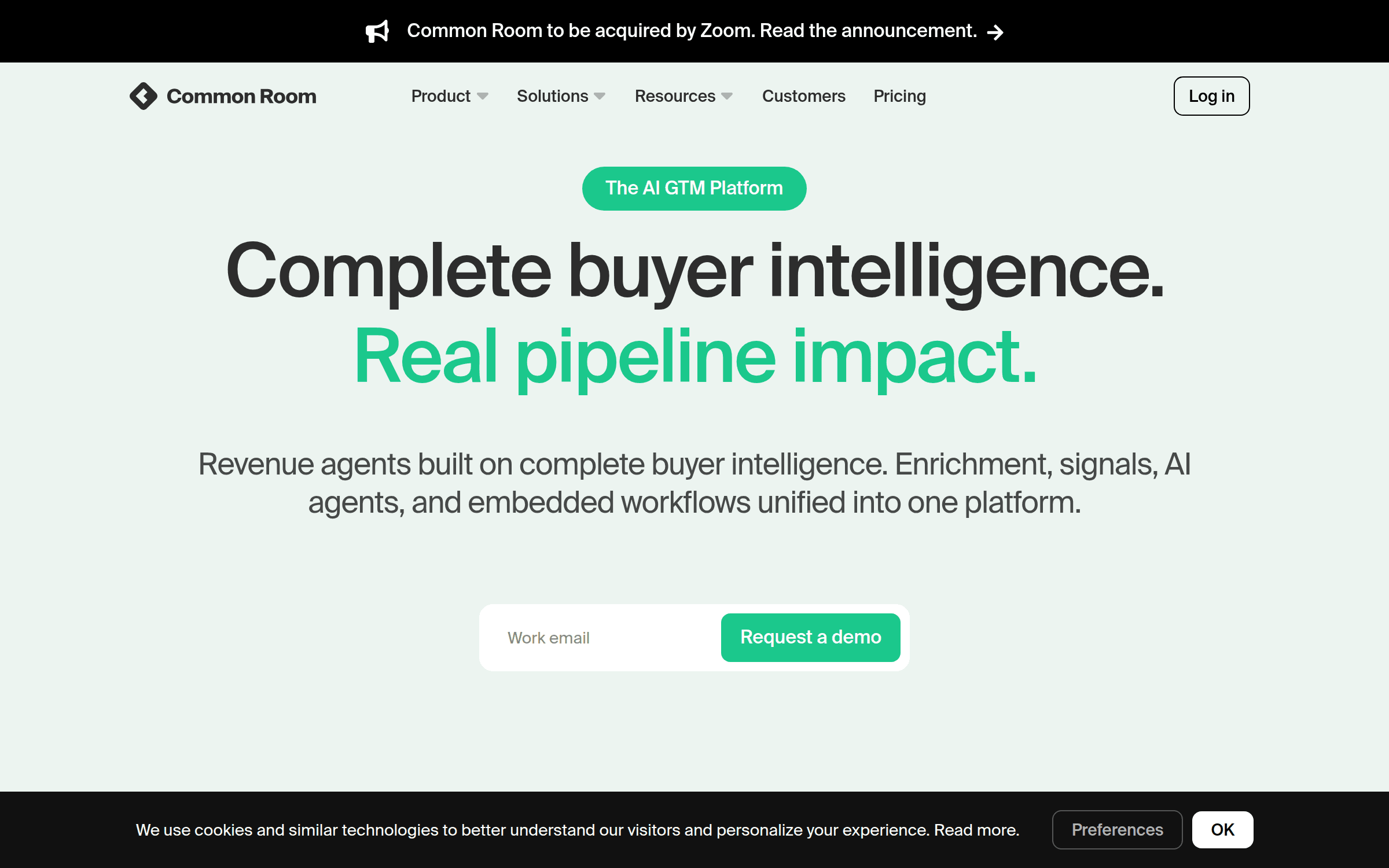
Common Room is the signal-aggregation layer for go-to-market. It ingests intent from everywhere your buyers actually show up — community (Slack, Discord, GitHub, forums), product usage, website visits, social, and third-party intent — resolves it to a person, and routes the hottest signals to the right rep with AI-suggested next steps (RoomieAI). For product-led and community-led motions, it is the tool that answers "who is showing intent right now, and what should we do about it?" It carries a 4.5/5 on G2 across ~106 reviews, with reviewers repeatedly calling out best-in-class signal capture and large time savings.
Common Room is the signal brain that makes the rest of your GTM stack fire at the right moment — and it is also a live case study in the 2026 consolidation wave. On July 2, 2026, Zoom announced it is acquiring Common Room, closing within weeks. That is a genuine consideration: the standalone product is excellent today, but its packaging and pricing may change once it sits inside Zoom. For now, if you run a PLG or community-led motion and need person-level signal aggregation, nothing independent matches its breadth. Just go in eyes-open on the acquisition, and keep your signal logic portable (Clay can replicate a chunk of it) rather than betting your entire routing layer on a tool mid-acquisition.
Key Features
- Aggregates signals across community, product, web, social, and third-party intent into one person-level view
- RoomieAI research credits surface context and suggested next steps per contact
- Prospector and website IP enrichment turn anonymous intent into workable contacts
- Best-in-class for product-led and community-led GTM motions
- G2 4.5/5 with 70% five-star reviews — reviewers cite 5x time savings on signal triage
Pricing
Essential from ~$2,100/mo billed annually (5 seats, 100k contacts). Advanced and Enterprise custom. Note: Zoom acquisition announced July 2, 2026 — packaging may change.
Rating
4.5/5 — G2 (106+ reviews)
Best For
PLG and community-led teams that need to unify scattered buying signals and rout...
Pros
- Broadest signal aggregation on the market — community + product + web + intent in one place
- Person-level resolution plus RoomieAI next-step suggestions cut signal-triage time dramatically
- The clear best fit for PLG and community-led GTM motions
- Strong sentiment (4.5/5, 70% five-star) from a real review base
Cons
- Zoom acquisition (July 2026) puts standalone packaging and pricing in question
- Essential starts at ~$2,100/mo billed annually — enterprise-shaped pricing, not indie-friendly
HubSpot Breeze
Best All-in-One GTM + CRM for Scaling Teams — Now With Outcome-Based AI Pricing
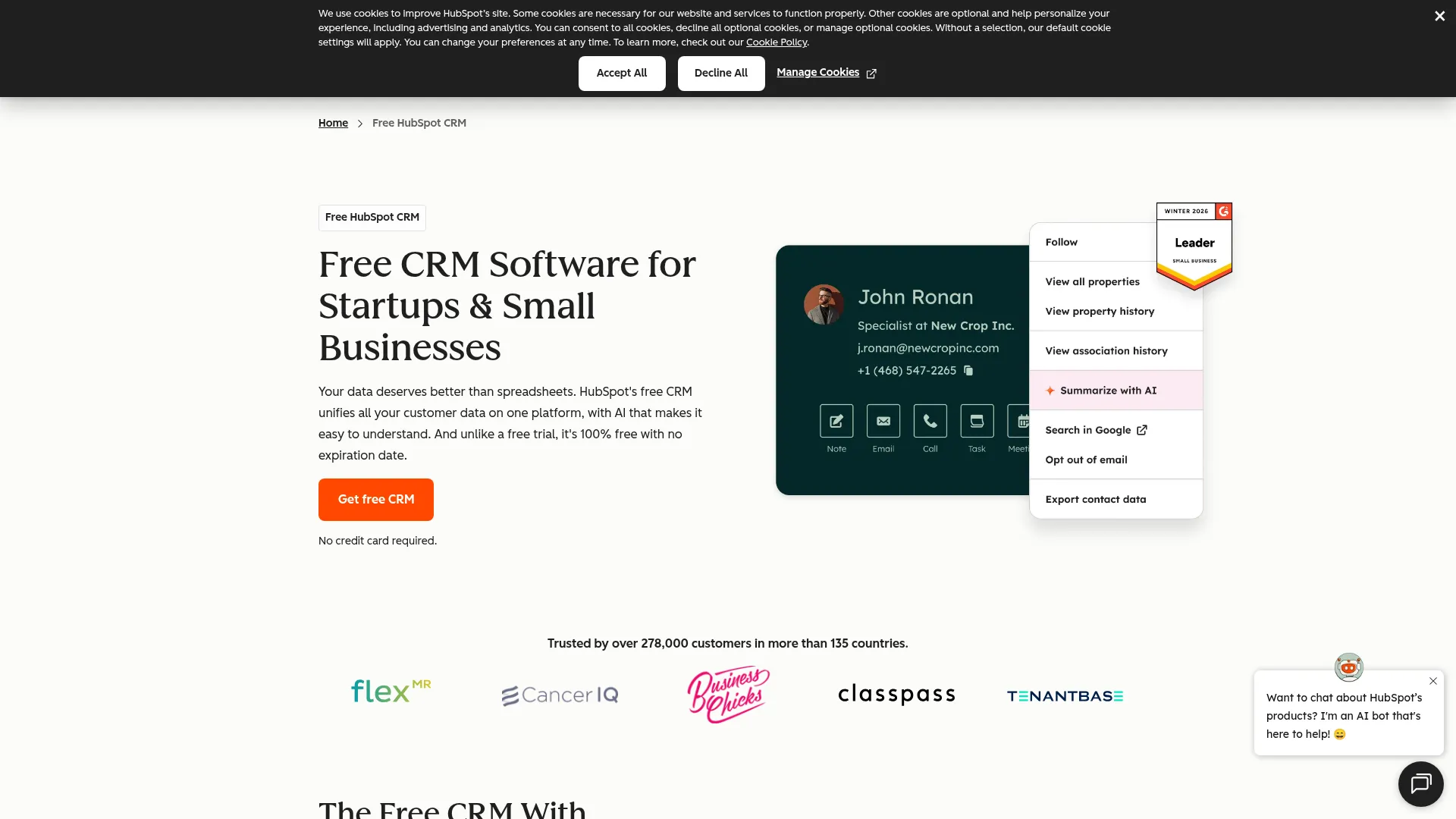
HubSpot is the all-in-one GTM platform that scaling teams graduate into — CRM, Sales Hub, Marketing Hub, and Service Hub on one data model, now wrapped in Breeze, its AI layer. In 2026 HubSpot did two things that matter for this list. First, it moved Breeze AI agents to outcome-based pricing (effective April 14, 2026): the Prospecting Agent costs $1 per qualified lead, the Customer Agent $0.50 per resolved conversation, and the Data Agent $0.10 per answer — you pay when the work lands, not for seats. Second, it acquired Warmly (June 30, 2026) to bring person-level buyer intent and AI sales agents in-house.
HubSpot is the safe, durable system of record for a team that has outgrown a lightweight CRM and wants marketing, sales, and service under one roof with AI stitched through all of it. The outcome-based Breeze pricing is genuinely founder-friendly in spirit — you are not paying for an AI agent that sits idle. And the Warmly acquisition tells you HubSpot is buying its way to the front of the AI GTM signal race rather than watching from the sidelines. The trade-offs are the classic HubSpot ones: Sales Hub Professional jumps to roughly $90-100/seat/mo with a one-time onboarding fee, the Breeze credit and per-outcome costs stack on top, and the platform rewards commitment — it is a system you settle into, not one you casually trial.
Key Features
- Full GTM suite — CRM, Sales, Marketing, and Service Hubs on one shared data model
- Breeze AI agents priced by outcome (April 2026): $1/qualified lead, $0.50/resolved conversation, $0.10/answer
- Acquired Warmly (June 2026) for person-level buyer intent and AI sales agents
- Free CRM tier remains one of the most generous entry points in the category
- Deepest integration ecosystem of any tool on this list
Pricing
Free CRM ($0). Sales Hub Starter ~$9-15/seat/mo. Professional ~$90-100/seat/mo (+ onboarding fee). Enterprise $150/seat/mo. Breeze AI billed per outcome/credits on top.
Rating
4.4/5 — G2 (12,000+ reviews)
Best For
Scaling teams that want marketing, sales, and service unified with AI — and are ...
Pros
- One platform for the full GTM motion — no stitching marketing, sales, and service tools together
- Outcome-based Breeze pricing means you pay for AI work delivered, not idle seats
- Warmly acquisition (2026) brings person-level intent natively into the CRM
- Free CRM tier plus the largest integration ecosystem in the category
Cons
- Professional tier plus onboarding fees plus Breeze per-outcome costs add up fast
- Rewards platform commitment — heavier and less flexible than Attio for small technical teams
Amplemarket
Best AI-Native Outbound Execution — Duo AI Agents Run the Full Multichannel Play
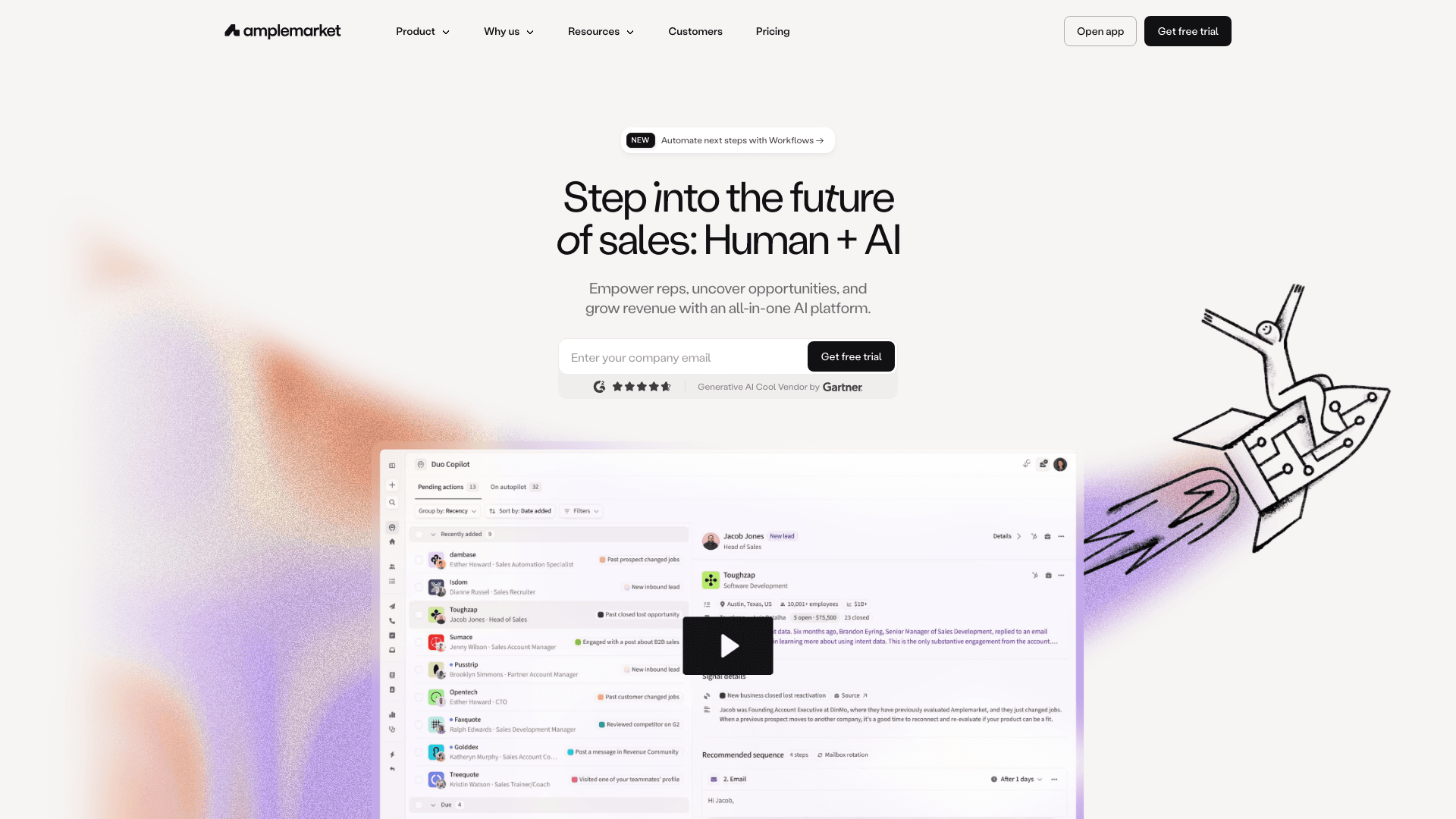
Amplemarket is the AI-first sales engagement platform that turns a defined ICP into executed multichannel outbound. Its Duo AI agents split the work — Signal monitors intent, Research builds a per-prospect dossier, and Sequence orchestrates email, LinkedIn, WhatsApp, and AI voice from one contact record — all on a single database with built-in deliverability protection (warmup, spam checks, sender rotation). Where Apollo is best-of-breed parts bolted together, Amplemarket is one unified AI model running the full outbound pipeline. It holds a 4.6/5 on G2 across ~598 reviews, with 76% five-star and zero one- or two-star ratings.
Once you have proven an outbound motion and would otherwise stitch Apollo + Clay + a sequencer + a manual signal-watcher together, Amplemarket consolidates the execution layer into one license. The unified-model approach produces better personalization than a stitched stack, and the sentiment scores are the strongest in this category. The catch: it starts at $600/mo on annual contracts only — no monthly billing, no self-serve — and real costs climb once you add Sales Navigator, extra seats, and credit overages. For solo or pre-revenue founders this is overkill; run Apollo with humans in the loop first, then graduate to Amplemarket when the volume and the ACV justify it.
Key Features
- Duo AI agents: Signal (intent), Research (per-prospect dossier), Sequence (multichannel orchestration)
- Executes email, LinkedIn, WhatsApp, and AI voice from one contact record
- Built-in deliverability: warmup, spam checks, and automatic sender rotation
- Single unified AI model across the pipeline — better personalization than a stitched stack
- Native CRM sync with Salesforce and HubSpot
Pricing
Startup $600/mo (annual only, 2 users, 30k contacts). Growth and Enterprise custom-quoted. Real cost climbs with Sales Navigator, seats, and overages.
Rating
4.6/5 — G2 (598+ reviews)
Best For
Revenue teams of 3-30 reps running serious multichannel outbound who want execut...
Pros
- 76% five-star G2 reviews with zero 1- or 2-star ratings — strongest sentiment in this category
- Single unified AI model beats stitched stacks on personalization quality
- Multichannel execution (email + LinkedIn + WhatsApp + AI voice) from one platform
- Built-in deliverability removes the biggest operational risk in outbound
Cons
- $600/mo entry on annual contracts only — no monthly billing, no self-serve trial
- Data and deliverability quality degrade outside US tech ICPs, like all enrichment platforms
11x
Most-Hyped Autonomous AI SDR — Powerful Pitch, Real Caveats (Enterprise Only)
11x builds Alice, an autonomous outbound AI SDR that handles prospect research, email and LinkedIn outreach, reply triage, and meeting booking, plus Julian, an inbound voice agent that qualifies leads in seconds. The pitch is seductive: replace an $80K/year SDR with a digital worker. Reality is more complicated. A March 2025 TechCrunch investigation reported that 11x had overstated its ARR, listed companies as customers that were not, and suffered churn in the 70-80% range. Pricing is enterprise-only and opaque — roughly $5,000/mo entry, with Vendr putting the median contract at $40,125/year on a 12-month commitment.
AI SDRs are the most-hyped category in go-to-market, and 11x is the most-funded name in it — which is exactly why founders need to go in clear-eyed. The most consistent complaint, even from customers, is that Alice's outreach reads like generic AI email despite extensive ICP and brand-voice setup, and the 2025 churn reporting suggests plenty of buyers reached the same conclusion. Include it on your shortlist so you understand the frontier, but do not buy an autonomous AI SDR before you have three-plus months of human data on what actually works in your motion — the AI cannot reproduce a playbook that does not exist yet. For almost every founder, "AI drafts, human approves, AI sends" via Apollo or Amplemarket beats a fully autonomous SDR on measured reply rates.
Key Features
- Alice: autonomous outbound SDR — research, email + LinkedIn outreach, reply triage, meeting booking
- Julian: inbound voice AI agent that qualifies leads within seconds and routes to humans
- Multichannel story (email + LinkedIn + voice) broader than most AI SDR competitors
- Strong onboarding and support — the most consistently praised aspect in reviews
- The most-funded, most-recognized brand in the AI SDR category
Pricing
Custom enterprise only, ~$5,000/mo entry. Vendr median contract $40,125/year on a 12-month commitment. No self-serve trial.
Rating
4.4/5 — G2 (32 reviews)
Best For
Enterprise teams with ops support and budget for a 60-90 day rollout who want to...
Pros
- The most mature and recognized AI SDR product — heavily funded with real enterprise deployments
- Julian (inbound voice AI) is a genuine differentiator — most AI SDRs are outbound-only
- Multichannel outreach story broader than Artisan or Regie.ai
- Onboarding and support are the most-praised aspects in third-party reviews
Cons
- March 2025 TechCrunch investigation reported inflated ARR, non-customer logos, and 70-80% churn
- Opaque enterprise-only pricing (~$5K/mo, 12-month lock-in) and outreach that reviewers call generic
Gong
Best Revenue Intelligence — Coach Reps and Forecast From Call Data
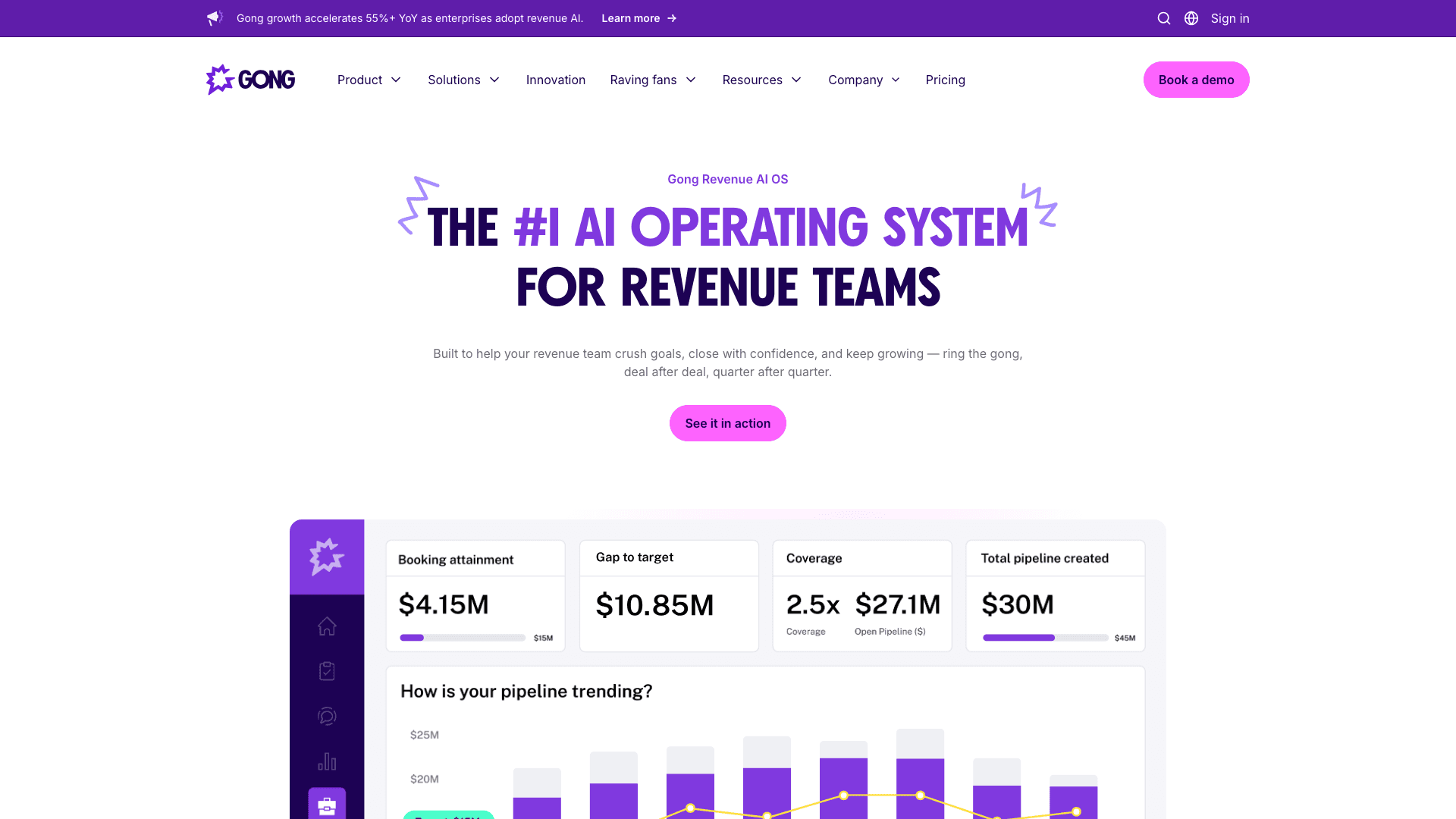
Gong is the revenue intelligence platform that defined the category. Every sales call is recorded, transcribed with speaker separation, and analyzed for objections, competitor mentions, talk-time ratios, and buying signals. Its "Ask Anything" AI search runs across your entire call library, deal boards flag stalled deals before reps do, and forecasting is grounded in actual pipeline health rather than rep optimism. It holds a 4.7/5 on G2 across 6,500+ reviews — the most-validated product on this list — and carries a $7.25B valuation.
Once your team has five-plus reps making 30+ calls a week, the leverage from revenue intelligence is enormous — Gong catches the deal where a competitor was mentioned three months ago, the call where the rep talked 70% of the time, and the pattern where deals close faster when a specific objection is handled early. This is the top of the GTM funnel meeting the bottom: signals in, coaching and forecasting out. The trade-off is price and packaging. Gong restructured pricing in 2025, unbundling forecasting and analytics into paid modules, and effective per-user cost now runs $200-250/mo on top of a $5,000-$50,000/year platform fee. For solo founders this is overkill; for revenue leaders running 10+ reps, the win-rate math usually pays back within six months.
Key Features
- Call recording and transcription with speaker separation across 70+ languages
- "Ask Anything" AI search across your entire call library — surface any competitor mention in seconds
- Deal boards and risk detection flag stalled deals weeks before reps do
- Forecasting grounded in actual call and pipeline data, not rep optimism
- 6,500+ G2 reviews at 4.7/5 — the most-validated tool in this category
Pricing
$5,000-$50,000/year platform fee + $1,298-$1,426/user/year (Core) up to ~$3,000/user/year bundled. Effective $200-250/user/mo. Multi-year contracts the norm.
Rating
4.7/5 — G2 (6,500+ reviews)
Best For
Revenue teams of 5+ reps where coaching, deal review, and forecast accuracy just...
Pros
- 6,500+ reviews at 4.7/5 — the most-validated product in the entire AI GTM category
- "Ask Anything" AI search across the call library is category-defining
- Deal risk detection catches stalled deals 2-4 weeks before reps flag them manually
- Forecasting from real call data materially improves quarterly accuracy
Cons
- Platform fee + per-user + onboarding stacks to $200-250/user/mo effective at 2026 contracts
- 2025 unbundling plus 5-15% annual auto-renewal uplifts mean you commit hard before proving ROI
Warmly
Best Website De-Anonymization — Turn Anonymous Traffic Into Warm Outreach
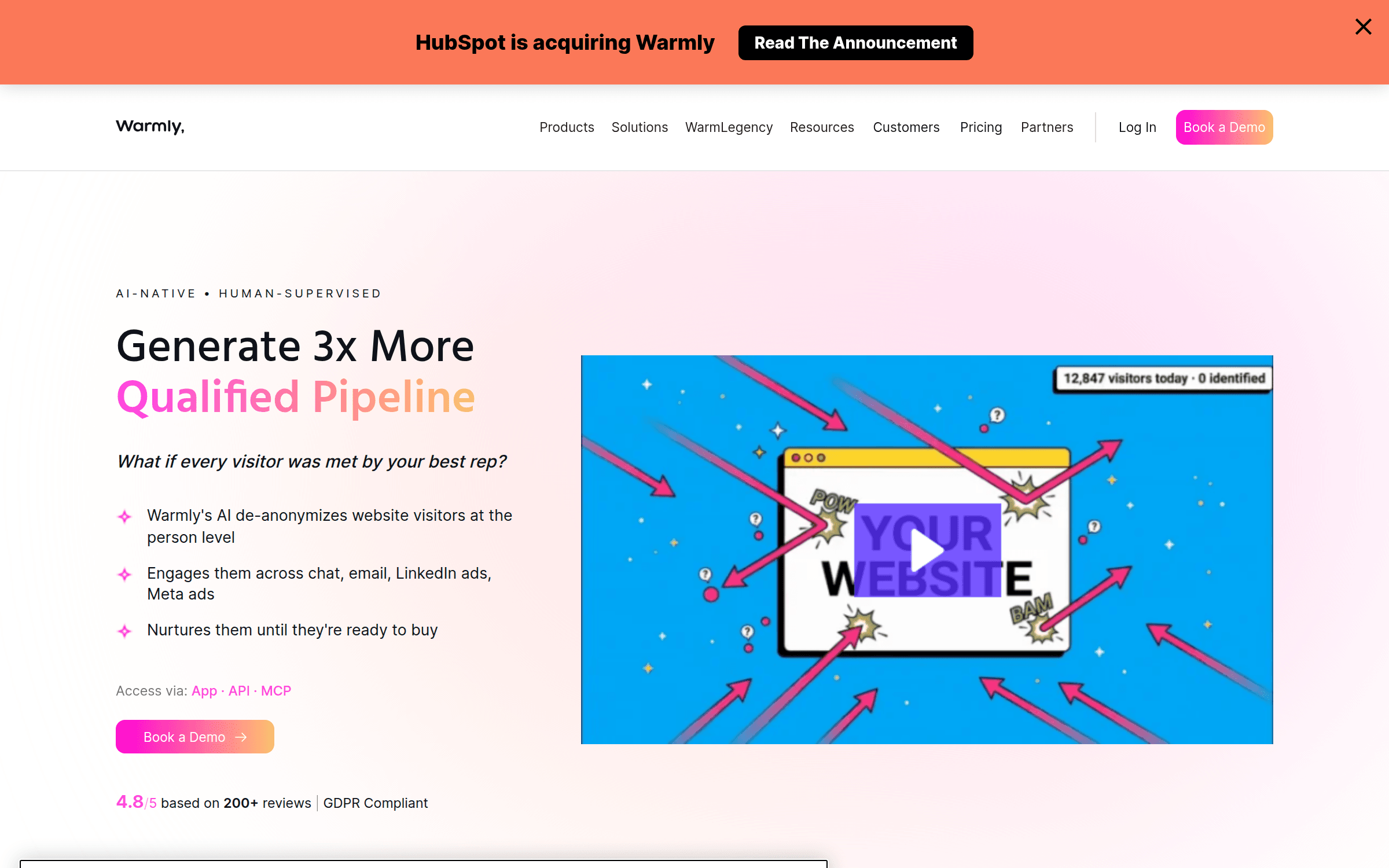
Warmly is the person-level website de-anonymization platform that turns anonymous traffic into warm outbound. It identifies the individuals visiting your site (not just the companies), enriches them with contact data, layers on intent signals, and fires real-time plays — Slack alerts, chat routing, AI-personalized email — the moment a target account shows up. It holds a 4.6/5 on G2 across ~203 reviews, with standout scores for ease of setup and support. The headline 2026 event: HubSpot announced it is acquiring Warmly on June 30, 2026.
Website de-anonymization is the highest-intent signal in go-to-market — someone on your pricing page is worth ten cold contacts — and Warmly does it at the person level better than almost anyone. But this entry comes with a two-part honesty flag. First, the HubSpot acquisition (June 2026) means Warmly's standalone roadmap is now uncertain; it will likely be folded into HubSpot's Breeze stack. Second, current paid pricing has moved upmarket to credit-based, annual-only tiers starting around $10,000/year. For founders who just want to prove the motion, the smarter play in 2026 is RB2B — a free, independent, person-level de-anonymization tool that pushes US visitor identities straight to Slack (paid plans from $79/mo). Use Warmly's free tier or RB2B to validate that de-anon converts for you before committing real budget to any tool in a category this consolidated.
Key Features
- Person-level de-anonymization — identifies individuals, not just companies, on a majority of traffic
- Real-time plays: Slack alerts, chat routing, and AI-personalized email when target accounts visit
- Intent and enrichment layered onto identified visitors automatically
- Free plan (up to 500 visitors/mo) to validate the motion before paying
- RB2B is the free, independent alternative — US person-level IDs pushed to Slack, paid from $79/mo
Pricing
Free plan (up to 500 visitors/mo). Paid tiers credit-based, annual-only, from ~$10,000/year. Note: HubSpot acquisition announced June 30, 2026.
Rating
4.6/5 — G2 (203+ reviews)
Best For
Teams with real inbound traffic who want to convert anonymous visitors into warm...
Pros
- Best-in-class person-level de-anonymization — the highest-intent signal you can capture
- Real-time Slack + chat + email plays fire the moment a target account visits
- Free plan (500 visitors/mo) lets you validate de-anon before paying
- Top G2 scores for ease of setup (9.6) and quality of support (9.6)
Cons
- HubSpot acquisition (June 2026) leaves the standalone roadmap uncertain
- Paid pricing moved upmarket — credit-based, annual-only, from ~$10,000/year (RB2B is the free hedge)
How We Chose These Tools
We evaluated 30+ AI go-to-market tools across the first half of 2026 and weighted them against five founder-specific criteria. Most competing listicles rank by feature count and enterprise deployment depth. We weighted the opposite — how fast a solo founder or small team can turn a buying signal into a booked meeting.
- Signal-to-meeting speed — how quickly the tool turns intent into a real conversation, not theoretical feature depth
- Free or low-cost entry — can a founder validate the tool before a real budget commitment?
- Honest all-in cost — including credits, overages, onboarding fees, and annual-only lock-ins hidden behind the sticker price
- Durability in a consolidating market — is it independent, or mid-acquisition and likely to change under new ownership?
- AI as architecture, not veneer — tools where AI runs the workflow, not a chatbot bolted onto a legacy product
How to Build Your AI GTM Stack
You will not run all ten. A real AI GTM stack is a system of record, a signal layer, an execution layer, and (later) intelligence. Pick by your stage:
Solo founder, $0/mo budget...
Attio free (CRM) + Apollo free (prospecting + sequencer) + RB2B free (person-level de-anon). A genuine $0/mo AI GTM stack that only costs money once it works.
Personalized / signal-based outbound...
Clay Launch ($185/mo) + Apollo Basic ($49/mo). Clay is the engine, Apollo supplies the database and sends. The core GTM-engineering stack.
Inbound-heavy, real website traffic...
Warmly free or RB2B (de-anon) + Common Room (signal aggregation). Convert anonymous visitors into warm outreach the moment they show intent.
Funded team, warm outbound at volume...
Unify or Amplemarket ($600/mo+) for AI-run multichannel plays, with Clay upstream feeding signals and enrichment.
Scaling team wanting one platform...
HubSpot Breeze — CRM, marketing, sales, and service with AI across all of it, plus outcome-based agent pricing. The graduate-into option.
5+ reps, coaching & forecasting matter...
Add Gong for revenue intelligence. Overkill for solo founders; pays back within six months once you have a real sales team making calls.
Stay Ahead of the Tool Curve
We research dozens of tools so you don't have to. Get our top picks and insider insights delivered weekly.
Frequently Asked Questions
What is the difference between AI sales tools and AI GTM tools?
AI sales tools focus on the outbound motion — finding contacts and sending sequences. AI GTM (go-to-market) tools cover the whole revenue engine: capturing buying signals, enriching and orchestrating data, the CRM system of record, executing multichannel outreach, and revenue intelligence. In 2026 the two categories are converging under "GTM engineering" — the discipline of wiring signals, data, and CRM into one automated pipeline. Clay is the tool that best embodies it, which is why it tops this list.
What is the cheapest way to build an AI GTM stack in 2026?
There is a genuinely free starting point. Attio (free CRM, up to 3 seats) for your system of record, Apollo (free plan, 10,000 email credits/mo) for prospecting and sequencing, and RB2B (free) for person-level website de-anonymization. That covers CRM, outbound, and inbound-intent capture at $0/mo. You only start paying once the motion works and you hit the free-tier limits — at which point Apollo Basic ($49/mo) and a paid de-anon tier are the first upgrades. The same stack from legacy vendors would run $1,000-$3,000/mo.
Is Clay worth the learning curve for a solo founder?
If you are running signal-based or personalized outbound, yes. Clay's value is turning "50,000 contacts in my ICP" into "200 accounts to work this week, each with a unique opener referencing a real public signal." That is worth the two-to-three-week ramp. If you are sending the same template to a large list, you do not need Clay yet — start with Apollo's sequencer and add Clay when personalization-per-account becomes the bottleneck. The March 2026 pricing reset (Launch at $185/mo, data costs down 50-90%) put it within reach of solo founders for the first time.
Why are so many AI GTM tools being acquired in 2026?
Because the signal and data layer is the new battleground, and the platforms want to own it. In mid-2026 alone: HubSpot acquired Warmly (June 30), Zoom acquired Common Room (July 2), and Apollo acquired Pocus (March 18) — following the Salesloft + Clari merger in December 2025. The lesson for founders: the best standalone signal tools are excellent today but may live inside a bigger platform within a year. Keep your GTM logic portable (Clay can replicate much of it), and do not bet your entire routing layer on a tool that is mid-acquisition.
Are autonomous AI SDRs like 11x worth it in 2026?
For most founders, not yet. AI SDR platforms start around $5,000/mo on 12-month contracts, and even customers report the outreach reads like generic AI email despite detailed setup. 11x specifically faced a March 2025 TechCrunch investigation over inflated ARR and reported 70-80% churn. The math only works at enterprise scale where you would otherwise hire 2-3 SDRs. For everyone else, "AI drafts, human approves, AI sends" through Apollo or Amplemarket still beats fully autonomous SDRs on measured reply rates. Do not buy one until you have 3+ months of human data on what works in your motion.
Attio vs HubSpot — which CRM should anchor my AI GTM stack?
Attio for technical founders and small teams; HubSpot for scaling teams that want everything under one roof. Attio is AI-native and flexible, lives free up to 3 seats, and goes live in about 12 days — but feature depth thins past 10-15 people. HubSpot unifies CRM, marketing, sales, and service with Breeze AI across all of it, plus its 2026 outcome-based AI pricing ($1/qualified lead) and the Warmly acquisition — but Professional runs ~$90-100/seat/mo plus onboarding, and it rewards commitment over casual trialing. Pick Attio if you value speed and flexibility, HubSpot if you need marketing automation and service in the same platform.
What does "warm outbound" mean and why does it convert better?
Warm outbound means reaching out only to accounts that have shown a buying signal — a website visit, an intent surge, a job change, a funding round — instead of cold-emailing a static list. Because the prospect is already in-market, response rates jump: Unify users report roughly 80% open and 5% reply rates on intent-triggered outreach versus 30% and under 1% for cold. The tradeoff is that you need a signal layer (Common Room, Warmly, RB2B, or Clay-driven signals) feeding an execution layer (Unify, Amplemarket, Apollo). That signal-to-action pipeline is what the whole AI GTM category is racing to own.
The Bottom Line
The AI GTM category in 2026 splits into two moves. The first is GTM engineering — using Clay, an AI-native CRM, and signal tools to build a pipeline that turns intent into meetings with minimal humans. That is where the leverage is, and where founders should spend their learning time. The second is the consolidation wave: the best standalone signal tools are getting acquired, so keep your logic portable and do not bet your whole routing layer on a tool that is mid-deal.
The wrong move is paying $5,000/mo for an autonomous AI SDR before you have proven your motion with humans. The right move is starting free — Attio for the CRM, Apollo for prospecting, RB2B for de-anonymization — then layering Clay on top the moment personalization-per-account becomes the bottleneck. Add Unify or Amplemarket when warm-outbound volume justifies it, graduate to HubSpot when you want everything on one platform, and add Gong once you have a real sales team to coach.
For most founders, the stack is: Attio or Apollo (free) as the foundation, Clay ($185/mo) as the engine, RB2B or Warmly's free tier for inbound intent, and Unify or Amplemarket when you are ready to automate warm outbound. Start free, measure signal-to-meeting speed weekly, and add tools only when the limit is your pipeline — not your tooling.
Related Reading
- 10 Best AI Sales Tools for 2026 — The outbound-execution deep dive: sequencers, cold email, and LinkedIn at scale
- Best Sales Intelligence Tools — The data layer that feeds your GTM engine: contacts, firmographics, and intent
- Best ABM Platforms — Account-based plays: the highest-intent motion the signal layer enables
- Best Marketing Automation Tools for Early-Stage Startups — Pair AI GTM with marketing automation for closed-loop demand gen
- Best Competitor Analysis Platforms — Find signal-rich accounts by tracking competitor and intent data
- Best Workflow Automation Tools for Non-Technical Teams — Wire Clay, Apollo, and your signal tools into one automated GTM pipeline
Sources
- Clay — Official Pricing (March 2026 reset)
- Clay Announces Second Employee Tender Offer at a $5B Valuation (Jan 2026)
- Apollo.io — Official Pricing
- Attio — Pricing & AI Research Agent
- Unify — Pricing (System of Action)
- Common Room — Pricing
- HubSpot — Breeze AI Outcome-Based Pricing (April 2026)
- Amplemarket — Pricing & Reviews
- 11x — Alice & Julian AI Workers
- Gong — Revenue Intelligence Platform
- Warmly — Website De-Anonymization Pricing
- RB2B — Free Person-Level Visitor Identification
Stay Ahead of the Tool Curve
We research dozens of tools so you don't have to. Get our top picks and insider insights delivered weekly.
Trusted by indie hackers and startup founders
Keep Reading
10 Best AI Sales Tools for 2026 (Ranked for Founders, Not Enterprise Buyers)
The 10 best AI sales tools for 2026 — Apollo, Clay, Amplemarket, Saleshandy, Smartlead, Instantly, Lemlist, HeyReach, 11x.ai, and Gong. Ranked by founders-first criteria: pricing transparency, time-to-first-meeting, and what works for teams under 20 reps.
10 Best ZoomInfo Alternatives in 2026 (Ranked by How You Buy, Not Just What You Get)
The 10 best ZoomInfo alternatives in 2026 — Apollo.io, Clay, Lusha, Lead411, RocketReach, Cognism, Amplemarket, Instantly, Saleshandy, and 6sense. Ranked by buying friction rather than database size, with ZoomInfo's real contract math and the 60-90 day auto-renewal window that catches people.
10 Best Sales Intelligence Tools for 2026 (Ranked for Founders, Not Enterprise Procurement)
The 10 best sales intelligence tools for 2026 — Apollo, Cognism, Clay, Lusha, Lead411, RocketReach, 6sense, Bombora, UserGems, and G2 Buyer Intent. Ranked by founders-first criteria: real pricing, data verification depth, and the path to coverage that does not start at $25K/yr.