
10 Best ABM Platforms for 2026 (Ranked by What Actually Drives Pipeline, Not Analyst Quadrant Position)
The 10 best ABM platforms for 2026 — 6sense, Demandbase, RollWorks, Terminus, Mutiny, Influ2, Userled, Factors.ai, HockeyStack, and Foundry ABM. Ranked by real all-in pricing, time-to-value, and the threshold at which the math actually works.
ABM platforms in 2026 split into six jobs. Most teams need 2-3, not all 6.
Account identification + intent (6sense, Demandbase), advertising activation (RollWorks, Terminus), website personalization (Mutiny), person-based marketing (Influ2), AI content personalization (Userled), and engagement analytics + attribution (Factors.ai, HockeyStack, Foundry). The 2026 consolidation favors AI-native newcomers that bundle 3-4 of these jobs at $400-$2K/mo over legacy stitched stacks at $200K-$400K/yr. Choose by your CRM (HubSpot or Salesforce), your ARR tier (under $50M, $50M-$250M, $250M+), and which 2-3 jobs are blocking pipeline this quarter.
Key Takeaways
- ABM platforms in 2026 split into six jobs: account identification + intent (6sense, Demandbase), advertising activation (RollWorks, Terminus), website personalization (Mutiny), person-based marketing (Influ2), content personalization (Userled), and engagement analytics + attribution (Factors.ai, HockeyStack, Foundry). Almost no one needs all six.
- The right entry point depends on your CRM and ARR. RollWorks is the cleanest fit for HubSpot teams under $50M ARR ($13K-$60K/yr). Demandbase is the Salesforce-native pick at $50M-$250M ARR ($40K-$250K/yr). 6sense is the enterprise default above $100M ARR with mature RevOps ($80K-$1M+/yr).
- Mid-market teams in 2026 run programs at $80K-$250K all-in that would have required $400K+ legacy stacks two years ago. The category consolidation favors AI-native newcomers (Userled, Factors.ai) over legacy multi-vendor stitching (Demandbase + Terminus + Mutiny + Influ2 + Bombora).
- Mutiny is overkill for most teams. Median $37,800/yr contract for website-personalization-only — no intent data, no ABM ads. Worth it only when you have 5,000+ named target accounts hitting your site monthly. Below that volume, the personalization signal does not move the needle.
- Influ2 is the only platform that targets named individuals (not just accounts). For ABM motions where the buying committee size is small (3-5 people) and you already know who they are, contact-level ad targeting + engagement tracking is materially more efficient than account-level ABM.
- Skip the analyst-quadrant trap. Forrester and Gartner rank by enterprise feature depth. Founders should rank by time-to-value (RollWorks: 4-6 weeks; 6sense: 60-90 days; Demandbase: 90-120 days) and breaking points (where signals go stale, where the math collapses below scale).
Most "best ABM platforms" lists are written for enterprise procurement teams comparing $100K-$1M/yr deployments. This one is written for marketing leaders who need to know which platform actually drives pipeline at sub-$60K/yr entry prices — with honest disclosure of where each platform breaks at scale and which CRM ecosystem each one fits.
The 2026 shape of this market is clear. The legacy multi-vendor ABM stack (6sense + Mutiny + Terminus + Bombora at $200K-$400K/yr) is being replaced by smaller, more integrated stacks. Mid-market teams now run programs at $80K-$250K all-in that would have required $400K+ stacks two years ago. AI-native newcomers (Userled, Factors.ai) are consolidating 3-4 legacy jobs into single platforms at $400-$2,000/mo. Person-based marketing (Influ2) is replacing account-level ABM for motions where the buying committee is small and known.
We picked 10 platforms across the full spectrum: enterprise account + intent (6sense, Demandbase), mid-market all-in-one (RollWorks, Terminus), specialty personalization (Mutiny, Influ2, Userled), and engagement analytics + attribution (Factors.ai, HockeyStack, Foundry ABM). Every entry ranks on three founders-first criteria: real all-in pricing (not headline entry pricing), time-to-value (4-6 weeks vs 90-120 days), and the threshold at which the math actually works.
Quick Comparison
| # | Tool | Best For | Starting Price | Rating |
|---|---|---|---|---|
| 1 | 6sense | Best Enterprise ABM | Custom enterprise pricing $80,000-$1,000,000+/yr depending on features and account volume | 4.4 |
| 2 | Demandbase | Best Salesforce-Native ABM | Custom pricing $40,000-$250,000/yr depending on account volume, ad spend, and modules | 4.3 |
| 3 | RollWorks (AdRoll ABM) | Best for HubSpot + Sub-$50M ARR | Custom pricing $13,000-$60,000/yr depending on account volume and ad spend | 4.4 |
| 4 | Terminus | Best Cross-Channel ABM Activation | Custom enterprise pricing $40,000-$120,000/yr depending on channels activated and account volume | 4.3 |
| 5 | Mutiny | Best 1:1 Website Personalization | No public pricing — sales-led | 4.6 |
| 6 | Influ2 | Best Person-Based Marketing | Custom pricing typically $30,000-$80,000/yr depending on contact volume and ad spend | 4.4 |
| 7 | Userled | Best AI-Native ABM Content Personalization | Plans range $400-$2,000/mo depending on accounts tracked and content volume | 4.5 |
| 8 | Factors.ai | Best ABM Engagement Analytics | Base $399/mo (limited integrations) | 4.4 |
| 9 | HockeyStack | Best ABM Revenue Attribution | Growth $1,399/mo | 4.5 |
| 10 | Foundry ABM | Best Multi-Channel ABM Playbook Orchestration | Custom enterprise pricing $50,000-$150,000/yr depending on channels activated and account volume | 4.2 |
6sense
Best Enterprise ABM — Forrester Wave Leader, Largest Intent Stack
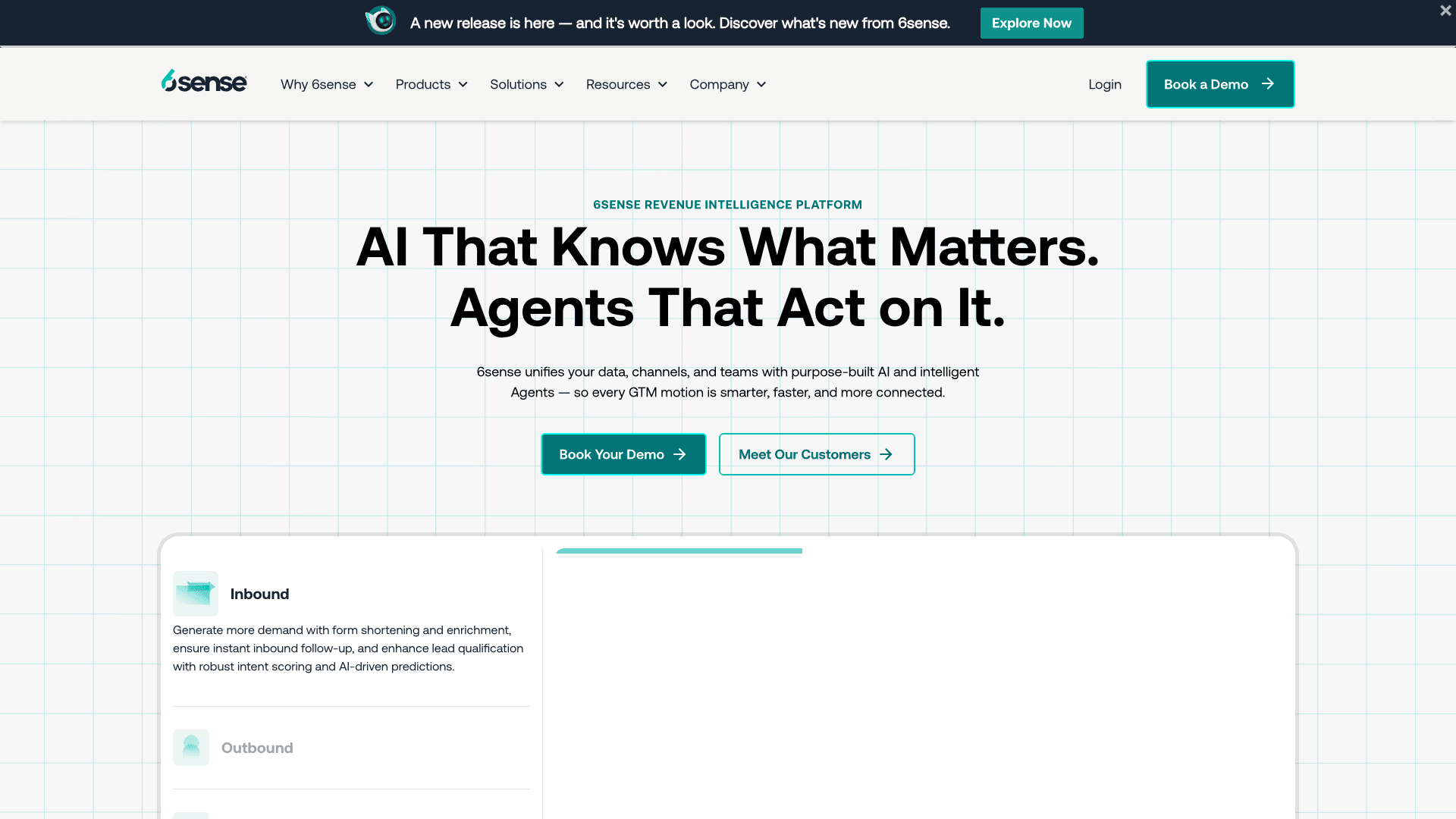
6sense is the enterprise ABM platform that earned Forrester Wave Q1 2026 Leader recognition for Revenue Marketing Platforms. It identifies 25M+ accounts using its own data plus the largest third-party intent signal stack in the category (Bombora + first-party + proprietary buying signals from millions of B2B web domains). The buying-stage prediction is the differentiator: 6sense maps accounts across Awareness, Consideration, Decision, and Purchase stages, then pushes prioritized lists into sales workflows via 6QA (6sense Qualified Account) framework. Custom enterprise pricing typically lands $80,000-$1,000,000+/yr depending on features and account volume.
6sense is the right buy for B2B SaaS at $100M+ ARR with mature RevOps teams and enterprise sales motions. The predictive intent scoring genuinely works — published case studies consistently show 30-50% improvement in opportunity-to-close rates when SDRs prioritize accounts by 6sense intent score. The catch is consumption: intent data is only valuable if your team can act on it within 24 hours, which requires 5+ SDRs plus dedicated sales ops. Below that threshold, the leaderboard of accounts with intent goes stale before anyone touches it, and the $80K+/yr buys nothing actionable. Either commit to the enterprise motion or pick RollWorks or Demandbase at the mid-market tier instead.
Key Features
- Largest third-party intent signal stack in the category (Bombora + first-party + proprietary)
- Buying-stage prediction across Awareness, Consideration, Decision, Purchase
- 6QA (6sense Qualified Account) framework — prioritized lists pushed into sales workflows
- Forrester Wave Q1 2026 Leader for Revenue Marketing Platforms
- Account orchestration: ABM advertising, dynamic personalization, sales handoff automation
Pricing
Custom enterprise pricing $80,000-$1,000,000+/yr depending on features and account volume. No self-serve or free trial. 60-90 day deployment.
Rating
4.4/5 — G2 (1,100+ reviews)
Best For
B2B SaaS at $100M+ ARR with mature RevOps teams, 5+ SDRs, and enterprise sales m...
Pros
- Predictive intent scoring is genuinely accurate — 30-50% lift in opportunity-to-close in published cases
- Largest intent dataset in the category — most platforms benchmark against 6sense
- Forrester Wave Q1 2026 Leader — analyst validation matters for enterprise procurement
- Account orchestration closes the loop from intent signal to rep outreach automatically
Cons
- Custom $80K-$1M/yr pricing makes it inaccessible to anyone below $100M ARR
- 60-90 day deployment with required ops capacity — wrong choice for early-stage teams
Demandbase
Best Salesforce-Native ABM — Advertising-First Architecture
Demandbase One is the comprehensive ABM platform combining account identification, intent data, B2B advertising, audience segmentation, and analytics into a single ecosystem. The platform was originally built as a B2B ad-targeting product, which means the audience-to-ad path is meaningfully smoother than 6sense or RollWorks — the same audience you identify via intent triggers a programmatic ad campaign without manual segment exports. Salesforce-native integration is the second differentiator: Demandbase ships the cleanest Salesforce sync in the category. Pricing $40,000-$250,000/yr depending on account volume, ad spend, and modules selected.
For B2B SaaS at $50M-$250M ARR running on Salesforce with multi-product complexity, Demandbase is the right pick. The advertising-native architecture eliminates the segment-export-then-campaign-build friction that costs marketing teams 5-10 hours per campaign on competing platforms. Salesforce-native sync means RevOps does not have to maintain custom integrations or middleware. The catch: Demandbase is overkill for sub-$50M teams (RollWorks covers 85-90% of the playbook at one-third the price), and the platform-fee structure means you pay base fees regardless of how much you actually use. Vendr benchmarking suggests 20-35% discount room on first quotes — never accept the first price.
Key Features
- Advertising-native architecture — audience-to-ad path smoother than any competitor
- Salesforce-native integration — cleanest sync in the category, no middleware required
- Account identification + intent + advertising + analytics in one platform
- Multi-product audience segmentation — handles complex enterprise SaaS portfolios
- Native Bombora intent data integration on upper tiers
Pricing
Custom pricing $40,000-$250,000/yr depending on account volume, ad spend, and modules. Platform fee structure. 90-120 day deployment.
Rating
4.3/5 — G2 (1,800+ reviews)
Best For
B2B SaaS at $50M-$250M ARR running on Salesforce with multi-product complexity, ...
Pros
- Advertising-native architecture eliminates 5-10 hours per campaign on segment-to-ad workflows
- Salesforce-native sync is the cleanest in the category — no middleware, no custom builds
- 1,800+ G2 reviews at 4.3/5 — most-validated mid-market ABM platform
- Multi-product audience segmentation handles complex enterprise SaaS portfolios
Cons
- Overkill for sub-$50M ARR teams — RollWorks covers 85-90% of the playbook at one-third the price
- 90-120 day deployment with required RevOps capacity — slowest time-to-value in this list
RollWorks (AdRoll ABM)
Best for HubSpot + Sub-$50M ARR — Cheapest Real ABM Platform
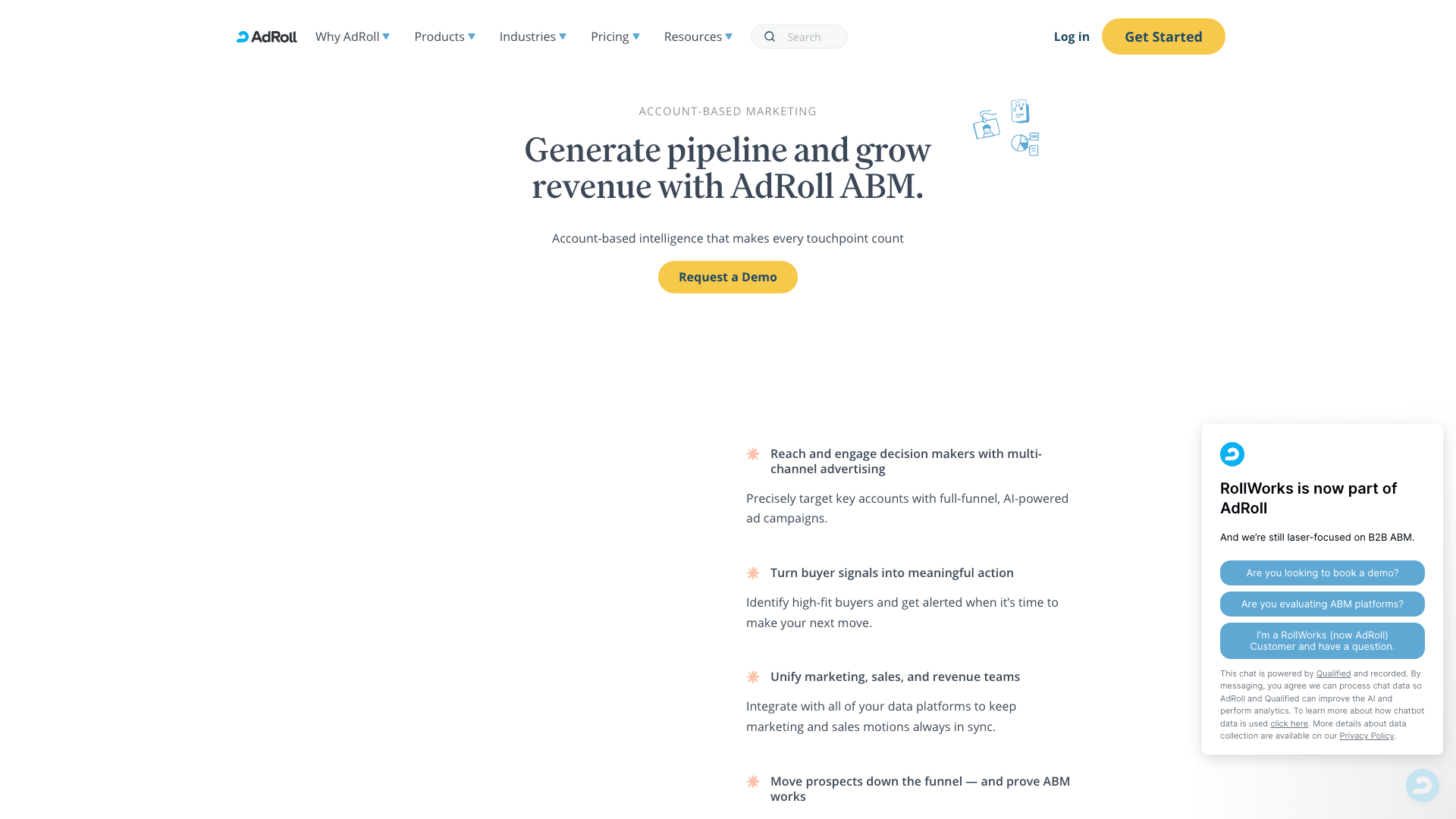
RollWorks (rebranded as AdRoll ABM in late 2025) is the ABM platform purpose-built for B2B teams running on HubSpot with under $50M ARR. The product covers the core ABM workflow — account identification, intent signals, account scoring, programmatic display + social ads, triggered emails — and ships the cleanest HubSpot integration in the category. Time-to-value is the major differentiator: most teams are operational in 4-6 weeks vs 60-120 days on 6sense or Demandbase. Pricing $13,000-$60,000/yr depending on account volume and ad spend — one-third to one-quarter the price of comparable Demandbase or 6sense deployments.
For most mid-market B2B teams in 2026 (50-500 target accounts, under $50M ARR, HubSpot stack), RollWorks is the right entry point into ABM. The HubSpot integration is meaningfully cleaner than competitors — most ABM platforms force Salesforce as a primary CRM, leaving HubSpot teams with manual sync workarounds. The 4-6 week deployment is the unsung win: teams running quarterly ABM pilots actually finish before the next quarter starts, which lets them iterate on what works. The trade-off: depth of AI and intent signals is less than 6sense (which has the largest third-party intent stack in the category), and the website personalization story is non-existent (pair with Mutiny if 1:1 personalization is critical).
Key Features
- Cleanest HubSpot integration in the ABM category — no middleware, no manual sync
- 4-6 week deployment — fastest time-to-value in this list
- Programmatic display + social ads + triggered email all in one platform
- Account scoring with AI-powered fit + intent signals
- $13K-$60K/yr — one-third to one-quarter the price of 6sense or Demandbase
Pricing
Custom pricing $13,000-$60,000/yr depending on account volume and ad spend. 4-6 week deployment. Account-based pricing model.
Rating
4.4/5 — G2 (550+ reviews)
Best For
B2B SaaS at $5M-$50M ARR running on HubSpot, running 1:many ABM (50-500 target a...
Pros
- 4-6 week deployment is meaningfully faster than 6sense (60-90 days) or Demandbase (90-120 days)
- Cleanest HubSpot integration in the category — no middleware required
- $13K-$60K/yr makes ABM accessible to mid-market without the enterprise platform fee
- Account scoring + ads + email orchestration in one platform — no stitched stack
Cons
- Depth of AI + intent signals is less than 6sense — wrong choice if intent breadth is critical
- No website personalization — pair with Mutiny if 1:1 personalization matters
Terminus
Best Cross-Channel ABM Activation — Display + Email + LinkedIn + Web
Terminus is the ABM platform purpose-built for cross-channel activation: orchestrate the same account list across display ads, email, LinkedIn, web personalization, and chat in a single campaign builder. The platform activates first-party data across channels through one engagement hub, with Bombora intent data + account scoring providing the targeting layer. Native LinkedIn integration is the standout feature — most ABM platforms ship LinkedIn as an afterthought, while Terminus treats it as a first-class channel with native campaign management. Custom enterprise pricing typically lands $40,000-$120,000/yr depending on channels and account volume.
Terminus is the right pick when your ABM motion is meaningfully multi-channel — you need the same target account to see your display ad, get a personalized email, see your LinkedIn campaign, and land on a personalized web experience without manually stitching audiences across 4 separate tools. The trade-off: depth in any single channel is less than purpose-built tools (Mutiny beats Terminus on website personalization, RollWorks beats Terminus on display + HubSpot integration), but the breadth of cross-channel orchestration is unmatched at this price tier. For ABM programs already running 3+ activation channels, Terminus often replaces $80K-$150K in stitched subscriptions with one $40K-$120K contract.
Key Features
- Cross-channel orchestration: display + email + LinkedIn + web + chat in one campaign builder
- Native LinkedIn integration — first-class channel, not a bolted-on integration
- Bombora intent data + account scoring bundled into engagement hub
- Personalized chat experiences for named accounts via integrated chatbot
- Account-based attribution tracking across all activated channels
Pricing
Custom enterprise pricing $40,000-$120,000/yr depending on channels activated and account volume. Bombora integration on upper tiers.
Rating
4.3/5 — G2 (550+ reviews)
Best For
B2B teams running ABM across 3+ activation channels (display + email + LinkedIn ...
Pros
- Cross-channel orchestration is unmatched at this price — replaces $80K-$150K stitched stacks
- Native LinkedIn integration treats it as a first-class channel, not an afterthought
- Bombora intent bundled into upper tiers — saves the $1K-$1,600/user/yr add-on
- Single attribution model across all channels — RevOps reporting is meaningfully cleaner
Cons
- Depth in any single channel is less than purpose-built tools (Mutiny, RollWorks)
- Mid-market positioning means underwhelming for $200M+ enterprises that need deeper customization
Want More Tool Recommendations?
Subscribe for curated indie hacker tool picks every week. No sponsored content, no fluff.
Mutiny
Best 1:1 Website Personalization — AI Agent for Named-Account Experiences
Mutiny is the AI-native website personalization platform built specifically for 1:1 account-based experiences. The product creates dynamic website experiences for named target accounts — when 6sense or Demandbase identifies an account, Mutiny renders a custom landing page experience (hero copy mentioning their company, social proof from their industry, case studies from their peers). In 2026 the product evolved into an AI agent that drafts entire personalized landing pages from a single prompt, dramatically collapsing the design-to-deployment cycle. Median contract is $37,800/yr; entry typically starts $60K+/yr for serious deployments.
Mutiny is the highest-impact ABM tool when used at the right scale, and dramatically overpriced when used below it. The math: personalization lifts conversion 30-50% in published case studies, but only when you have enough target-account traffic to make personalization signal meaningful. Below 5,000 named-account visits per month, personalized landing pages do not move the needle (sample size is too small to measure lift, and the engineering time spent maintaining variants exceeds the conversion gains). Above 5,000 visits, the ROI math compounds quickly — a 30% conversion lift on $100K-$500K target accounts pays back the $37,800 contract in 1-2 closed deals. The 2026 AI agent makes personalized page deployment faster than traditional Mutiny (drafts in minutes, not days), which lowers the threshold somewhat — but the volume requirement still applies.
Key Features
- AI agent (2026) drafts entire personalized landing pages from a single prompt
- 1:1 named-account website experiences — render custom hero/social proof per target account
- Native integration with 6sense, Demandbase, RollWorks for account identification triggers
- A/B testing infrastructure to measure personalization lift vs control
- Account-based engagement analytics tied to website behavior
Pricing
No public pricing — sales-led. Median contract $37,800/yr. Serious deployments typically start $60,000+/yr. Multi-year commits unlock first-year discounts.
Rating
4.6/5 — G2 (300+ reviews)
Best For
B2B teams with 5,000+ named-account visits/month, where website personalization ...
Pros
- 4.6/5 G2 across 300+ reviews — highest sentiment of any website personalization tool
- AI agent (2026) collapsed personalized page deployment from days to minutes
- 30-50% conversion lift in published case studies — when used at adequate scale
- Native integration with 6sense, Demandbase, RollWorks — automatic account-triggered experiences
Cons
- Overkill below 5,000 named-account visits/month — personalization signal is not measurable
- No public pricing — must talk to sales, $37,800/yr median contract is the realistic floor
Influ2
Best Person-Based Marketing — Target Individuals, Not Just Accounts
Influ2 is the only platform in this list that targets named individuals (not just accounts). The product uploads a list of specific named people from your CRM, serves ads directly to those individuals across LinkedIn, Meta, and display networks, and tracks engagement at the contact level — which specific person clicked which specific ad, on which platform, at what time. Unlike account-level ABM (where you target everyone at Company X), person-based marketing focuses ad spend on the 3-5 actual buying committee members who decide. The result: dramatically lower waste on irrelevant people at target accounts, and engagement signals that route to the right rep with name + role attached.
For ABM motions where the buying committee size is small (3-5 people) and you already know who they are (from CRM history, LinkedIn research, or sales intelligence tools), Influ2 is materially more efficient than account-level ABM. Account-level ads serve impressions to 50-200 employees at a target account; person-based ads serve only to the 3-5 who matter. The 10-50x targeting precision translates to lower CPM waste and clearer engagement signals for sales handoff. The trade-off: Influ2 does not solve account identification or intent scoring (you bring your own contact list), so it pairs with 6sense, Demandbase, or your sales intelligence stack rather than replacing them. Pricing is custom, typically $30K-$80K/yr.
Key Features
- Person-based ad targeting — serves ads to specific named individuals, not just accounts
- Cross-platform: LinkedIn, Meta, display networks all targetable by named contact
- Contact-level engagement tracking — which person clicked which ad on which platform
- Native CRM integration (Salesforce, HubSpot) — contact lists upload directly from existing records
- 10-50x targeting precision vs account-level ABM
Pricing
Custom pricing typically $30,000-$80,000/yr depending on contact volume and ad spend. No self-serve. Sales-led.
Rating
4.4/5 — G2 (180+ reviews)
Best For
B2B teams where buying committee size is small (3-5 people) and your CRM has acc...
Pros
- 10-50x targeting precision vs account-level ABM — dramatically lower CPM waste
- Contact-level engagement signals are the cleanest sales handoff data in the category
- Only platform that does true person-based marketing at scale
- Native LinkedIn + Meta integration — no manual contact list re-uploading
Cons
- Does not solve account identification or intent — pair with 6sense or sales intelligence stack
- Requires accurate CRM contact data — useless if your CRM is full of stale or wrong contacts
Userled
Best AI-Native ABM Content Personalization — Newcomer Worth Watching
Userled is the AI-native ABM platform that ships content personalization at agent-level cost. The product creates dynamic landing pages, email sequences, and microsites for named target accounts using AI agents that draft personalized content from a single prompt — like Mutiny but at $400-$2,000/mo instead of $37,800+/yr. The differentiator is the all-in-one shape: account identification + AI content personalization + LinkedIn campaign activation in one platform, designed for mid-market teams that cannot afford to stitch together 6sense + Mutiny + RollWorks. As of 2026 it is one of the fastest-growing AI-native ABM newcomers, with strong fit for $5M-$50M ARR B2B SaaS.
Userled represents the 2026 AI-native ABM consolidation trend. Legacy ABM stacks required 4-5 vendors (account ID + intent + ads + personalization + analytics); Userled bundles 3-4 of those jobs into one AI-driven product at $400-$2,000/mo. For founders running ABM as a paid-experiment marketing motion (not an enterprise commitment), this is the cleanest entry point. The trade-off: feature depth is less than purpose-built tools at any single layer — Mutiny does deeper personalization, 6sense has more intent signals, RollWorks has stronger ads infrastructure. Userled wins on integration speed and price, not feature depth. Best fit for early-stage ABM pilots where speed matters more than maturity.
Key Features
- AI agents draft personalized landing pages, emails, and microsites from a single prompt
- Account identification + content personalization + LinkedIn activation bundled
- $400-$2,000/mo entry — one-tenth the price of legacy ABM stacks
- Native integration with HubSpot, Salesforce, LinkedIn
- Mid-market positioning ($5M-$50M ARR B2B SaaS)
Pricing
Plans range $400-$2,000/mo depending on accounts tracked and content volume. Free trial available. Sales-led for upper tiers.
Rating
4.5/5 — Product Hunt + early G2 (newcomer, limited public reviews)
Best For
Mid-market B2B SaaS at $5M-$50M ARR running first ABM motions where speed-to-val...
Pros
- $400-$2,000/mo is one-tenth the price of legacy ABM stacks (6sense, Demandbase, Terminus)
- AI agents collapse personalized content deployment from days to minutes
- All-in-one shape eliminates the integration tax of stitching 4-5 vendors
- Free trial + sales-led upper tiers — clean validation path before committing budget
Cons
- Feature depth is less than purpose-built tools at any single layer (Mutiny, 6sense, RollWorks)
- Newcomer with limited G2 footprint — less third-party validation than established platforms
Factors.ai
Best ABM Engagement Analytics — Account-Level Journey Stitching
Factors.ai is the ABM engagement analytics platform that stitches together account-level journey data across every touchpoint — display ads, email opens, website visits, content downloads, sales meetings — into one unified account timeline. The core product is account-level engagement scoring + journey visualization: see exactly which target account engaged with which content piece, in what sequence, leading to which sales outcome. Factors starts at $399/mo on the base tier, but real-world deployments with LinkedIn integration and behavioral segmentation typically cost $2,149+/mo. Mid-market positioning fills the gap between RollWorks (ads-led) and HockeyStack (attribution-led).
Factors solves the question every ABM team eventually asks: "Which touchpoints actually moved this deal forward?" Without account-level engagement stitching, marketing teams default to attribution heuristics (first-touch, last-touch, U-shaped) that miss the multi-touch ABM reality. Factors gives RevOps the data to answer the question with real journey evidence. The trade-off: $399/mo base tier is too restrictive for real ABM use (limited integrations, no LinkedIn); the real entry is $2,149+/mo. Below that price, Factors is functionally a worse Google Analytics. Above it, Factors is one of the best ABM-specific analytics platforms in the category for mid-market teams.
Key Features
- Account-level journey stitching across ads, email, web, content, sales meetings
- AI-powered engagement scoring for target accounts
- LinkedIn integration on $2,149/mo tier — track LinkedIn engagement alongside other channels
- Behavioral segmentation for triggered campaign activation
- Native integrations with HubSpot, Salesforce, Marketo, and major ad platforms
Pricing
Base $399/mo (limited integrations). Real entry $2,149+/mo with LinkedIn + behavioral segmentation. Custom upper tiers.
Rating
4.4/5 — G2 (250+ reviews)
Best For
Mid-market ABM teams ($5M-$50M ARR) running 3+ activation channels who need acco...
Pros
- Best account-level engagement stitching in the mid-market price band
- Answers the "which touchpoints moved this deal?" question with real journey evidence
- LinkedIn integration is the right premium upgrade — most ABM tools skip this channel
- Native HubSpot + Salesforce + Marketo integrations — meets you where you are
Cons
- $399/mo base tier is too restrictive for real ABM use — real entry is $2,149+/mo
- Less analytics depth than HockeyStack at upper tiers — better for journey, not attribution
HockeyStack
Best ABM Revenue Attribution — Multi-Touch Math That Holds Up
HockeyStack is the attribution-led ABM analytics platform that solves the multi-touch attribution problem at the account level — not just at the lead level. The platform tracks every touchpoint (ad impression, email open, website visit, sales call, content engagement) across both anonymous and known journeys, then runs configurable attribution models (linear, time-decay, position-based, custom) to credit revenue back to specific marketing investments. Growth plan starts at $1,399/mo; Platform plan starts at $2,200/mo. Add-ons for ABM, sales intelligence, and data warehouse sync push real-world deployments to $3K-$8K/mo.
HockeyStack is the right pick when the question your team asks is "what is the actual ROI of our ABM spend?" The platform exists because legacy attribution tools (Adobe Analytics, Google Analytics 4) treat account-based marketing as if it were lead-based marketing, missing the multi-stakeholder reality where a single closed deal involves 5-10 touchpoints across 3-5 people over 6-18 months. HockeyStack tracks the full account journey and assigns revenue credit per touchpoint with configurable models, which means RevOps can defend ABM spend to the CFO with real numbers instead of "trust me, the ads worked." The catch: like all attribution platforms, the output is only as good as the data going in. Teams with messy CRM hygiene or inconsistent UTM tagging will get unreliable attribution regardless of platform.
Key Features
- Account-level multi-touch attribution with configurable models (linear, time-decay, position-based, custom)
- Tracks both anonymous and known journeys — captures full account history pre-conversion
- Native integrations with HubSpot, Salesforce, Marketo, LinkedIn, Google Ads, Bombora
- Data warehouse sync (Snowflake, BigQuery, Redshift) on enterprise tiers
- AI-powered insights flag underperforming and overperforming channels
Pricing
Growth $1,399/mo. Platform $2,200/mo. Add-ons (ABM, sales intelligence, data warehouse sync) push to $3K-$8K/mo. Usage-based pricing.
Rating
4.5/5 — G2 (200+ reviews)
Best For
Mid-market ABM teams ($10M-$100M ARR) where defending ABM spend to the CFO requi...
Pros
- Best multi-touch attribution math at the account level in this list
- Captures both anonymous and known journeys — full account history, not just post-conversion
- Configurable attribution models let RevOps defend specific revenue claims to the CFO
- Data warehouse sync on enterprise tiers — feeds your existing BI stack directly
Cons
- Real-world deployments are $3K-$8K/mo once add-ons are included — headline pricing misleading
- Output quality depends on CRM hygiene and UTM consistency — messy data in, messy attribution out
Foundry ABM
Best Multi-Channel ABM Playbook Orchestration — Pre-Built Account Plays
Foundry ABM (the renamed Triblio after the IDG Communications acquisition) is the ABM orchestration platform that ships pre-built account-based playbooks across web, display, email, direct mail, and sales touchpoints. The product specialty: orchestrate multi-channel campaigns from a single play definition — "high-intent account hits website → trigger personalized banner ad + sales alert + email sequence + direct mail send" — without manually configuring each channel separately. Native integration with IDG's first-party intent data (used to be one of the largest B2B intent datasets pre-merger). Custom enterprise pricing typically $50,000-$150,000/yr depending on channels and account volume.
Foundry ABM is the right pick for teams running mature multi-channel ABM motions where playbook orchestration matters more than feature depth in any single channel. The pre-built account plays library is the differentiator: instead of building each multi-channel campaign from scratch, you pick a play (e.g., "Re-engage stalled deal in late stage") and Foundry configures the touchpoint sequence across channels. The IDG intent data integration adds value if your ICP overlaps with IDG's editorial property audience (CIO, Computerworld, Network World — generally enterprise IT and B2B tech). The trade-off: post-acquisition, product velocity has been slower than 6sense, Demandbase, or RollWorks. Choose Foundry if playbook orchestration is the primary need; choose a more active platform if AI velocity matters.
Key Features
- Pre-built account-based playbooks across web, display, email, direct mail, sales
- Multi-channel campaign orchestration from single play definition
- IDG first-party intent data — strong fit for enterprise IT and B2B tech ICPs
- Account scoring + intent triggers route plays automatically into channels
- Native CRM integration (Salesforce, HubSpot, Marketo, Eloqua)
Pricing
Custom enterprise pricing $50,000-$150,000/yr depending on channels activated and account volume. Sales-led. No public pricing.
Rating
4.2/5 — G2 (180+ reviews)
Best For
Mid-market and enterprise B2B teams running mature multi-channel ABM motions whe...
Pros
- Pre-built account plays library is unique in this list — no manual multi-channel build per campaign
- IDG first-party intent data is differentiated for enterprise IT and B2B tech ICPs
- Native CRM integration across the major platforms (Salesforce, HubSpot, Marketo, Eloqua)
- Direct mail orchestration is the only platform in this list with native integration
Cons
- Post-IDG acquisition product velocity has been slower than 6sense, Demandbase, or RollWorks
- 4.2/5 G2 — lowest sentiment of major ABM platforms, signaling unmet user expectations
How We Chose These Tools
We evaluated 22+ ABM platforms across mid-2026 and weighted them against five founder-specific criteria. Most competing listicles weight analyst-quadrant position and enterprise feature depth. We weighted the opposite — time-to-value and breaking points.
- Real all-in pricing — platform fees + per-user + intent add-ons + ad spend minimums, not just headline entry pricing
- Time-to-value — 4-6 weeks (RollWorks, Userled) vs 90-120 days (Demandbase, Foundry); pick a platform that fits your pilot window
- CRM fit — HubSpot-native (RollWorks), Salesforce-native (Demandbase), or platform-agnostic
- Threshold for ROI — the scale at which the math works (5+ SDRs for 6sense, 5,000+ visits/mo for Mutiny, $100M ARR for enterprise tier)
- Honest disclosure of breaking points — where the platform fails (signals going stale, personalization sample size, attribution data quality)
How to Build Your ABM Stack
You will not run all ten of these platforms. A real ABM stack is 2-3 platforms that cover the jobs your motion actually needs. Pick by your stage and CRM:
Pre-Series A, $0-$2M ARR...
Skip the dedicated ABM platform. Run LinkedIn Sales Navigator ($99/user/mo) + Clay ($185/mo) + Apollo ($49-$99/user/mo) for 5-25 target accounts manually. Total: $400-$600/mo.
$2M-$10M ARR, HubSpot...
Userled ($400-$2,000/mo) + Factors.ai ($2,149/mo). AI-native content personalization + account-level analytics. Total: ~$50K/yr.
$10M-$50M ARR, HubSpot...
RollWorks ($13K-$30K/yr) + Factors.ai ($2,149/mo) + HockeyStack ($1,399/mo). Full mid-market ABM stack ~$55K-$80K/yr.
$50M-$250M ARR, Salesforce...
Demandbase ($40K-$100K/yr) + Mutiny ($37,800/yr median) when web visits hit 5K+/mo. Total: $80K-$150K/yr.
$100M+ ARR enterprise...
6sense ($80K-$300K/yr base) + Mutiny ($60K+/yr) + Influ2 ($30K-$80K/yr) for person-based motions. Total: $200K-$500K/yr.
Multi-channel orchestration priority...
Terminus ($40K-$120K/yr) for cross-channel campaign orchestration, or Foundry ABM ($50K-$150K/yr) for pre-built account play libraries.
Stay Ahead of the Tool Curve
We research dozens of tools so you don't have to. Get our top picks and insider insights delivered weekly.
Frequently Asked Questions
What is the best ABM platform for mid-market B2B teams?
For mid-market B2B SaaS at $5M-$50M ARR running on HubSpot, RollWorks (AdRoll ABM) at $13K-$60K/yr is the cleanest entry point — fastest time-to-value (4-6 weeks), cheapest real ABM platform, and HubSpot-native integration. For teams at $50M-$250M ARR running on Salesforce, Demandbase at $40K-$250K/yr is the right pick because of advertising-native architecture and Salesforce-native sync. For teams under $5M ARR running first ABM motions, Userled at $400-$2,000/mo or Factors.ai at $399-$2,149/mo is the right entry — both AI-native platforms that consolidate 3-4 legacy ABM tools into one product.
When is 6sense actually worth $80,000-$1,000,000/year?
Only for B2B SaaS at $100M+ ARR with mature RevOps teams, 5+ SDRs, and enterprise sales motions where intent data must be consumed within 24 hours. Below that threshold, the predictive intent signals go stale before anyone touches them, and the $80K+/yr buys nothing actionable. 6sense's genuine differentiators (largest third-party intent stack, Forrester Wave Leader, 30-50% lift in opportunity-to-close) only manifest when your sales team has the capacity to act on intent within hours, not days. For sub-$100M teams, Demandbase ($40K-$250K/yr) or RollWorks ($13K-$60K/yr) covers 85-90% of the playbook at meaningfully lower cost.
Is Mutiny worth $37,800/year for website personalization?
Only if you have 5,000+ named-account visits/month and your target accounts are $100K+ ACV. The math: Mutiny lifts conversion 30-50% in published case studies, but only with enough target-account traffic to make the signal meaningful. Below 5,000 visits/month, personalization does not move the needle (sample size is too small to measure, engineering time spent maintaining variants exceeds gains). Above 5,000 visits, a 30% conversion lift on $100K-$500K target accounts pays back the contract in 1-2 closed deals. The 2026 AI agent collapses deployment time from days to minutes, which lowers the threshold somewhat — but the volume requirement still applies.
What is the difference between account-based ABM and person-based marketing (Influ2)?
Account-based ABM targets entire companies (Company X is a target account → serve ads to everyone at Company X across LinkedIn, display, and other channels). Person-based marketing (Influ2) targets specific named individuals at target accounts (the 3-5 actual buying committee members → serve ads only to those specific people). The math: account-level ads serve impressions to 50-200 employees at a target account; person-based ads serve only to the 3-5 who matter. The 10-50x targeting precision translates to lower CPM waste and clearer engagement signals for sales handoff. Influ2 is the only platform in this list that does true person-based marketing at scale.
How long does it take to deploy an ABM platform end-to-end?
RollWorks: 4-6 weeks (fastest). Userled and Factors.ai: 2-4 weeks for the AI-native newcomers. Mutiny: 4-8 weeks for the first personalized experience. 6sense: 60-90 days for full deployment. Demandbase: 90-120 days. Terminus: 60-90 days. Foundry ABM: 90-120 days. The deployment time correlates strongly with platform complexity — enterprise platforms (6sense, Demandbase, Foundry) require RevOps ops capacity and Salesforce integration depth; mid-market platforms (RollWorks, Userled) ship pre-built integrations and faster onboarding. Most teams run a 30-60 day ABM pilot before committing to multi-year contracts — choose a platform whose deployment fits inside your pilot window.
Can I run effective ABM without a dedicated ABM platform?
Up to a point, yes. For 1:few ABM at small scale (5-25 named target accounts, $100K+ ACV), you can run a credible motion with LinkedIn Sales Navigator ($99/user/mo for account research) + Clay ($185/mo for signal-based personalization) + Apollo ($49-$99/user/mo for contact data) + your existing email and ads platforms. Total cost: $400-$600/mo for the stack. This works because 25 target accounts is a manageable manual workflow — you do not need orchestration software to coordinate 25 touchpoints. Above 50 target accounts, the orchestration tax (manually keeping lists in sync, tracking touchpoints across channels, attributing revenue) starts eating SDR + marketer time, and a dedicated ABM platform (RollWorks $13K/yr entry) becomes net-positive.
What is the cheapest ABM stack that actually works in 2026?
For sub-$5M ARR teams: Userled ($400-$2,000/mo, depending on accounts) for AI-native content personalization + account ID. For $5M-$25M ARR: RollWorks ($13K-$30K/yr) + Factors.ai ($2,149/mo with LinkedIn) — RollWorks handles account ID + ads + email; Factors handles engagement analytics. Total: $39K-$56K/yr for a real ABM motion. For $25M-$50M ARR: RollWorks + Mutiny ($37,800/yr median) + HockeyStack ($1,399/mo) — adds website personalization + attribution. Total: $70K-$120K/yr. Compare to the legacy stack of 6sense + Mutiny + Terminus + Bombora at $200K-$400K/yr — the 2026 mid-market stacks deliver 80-90% of the playbook at one-third the cost.
The Bottom Line
ABM in 2026 stopped being a single-vendor decision. The platforms split into six jobs — account ID + intent, advertising activation, website personalization, person-based marketing, AI content personalization, and engagement analytics + attribution — and the right stack depends entirely on your ARR, your CRM, and which jobs are blocking pipeline this quarter.
For most teams, the wrong move is committing to a $200K-$500K legacy stack (6sense + Mutiny + Terminus + Bombora) before validating that ABM is the right motion. The right move is starting with RollWorks ($13K-$30K/yr) or Userled ($400-$2,000/mo) for a 90-day pilot, measuring whether targeted accounts actually convert at higher rates than your inbound funnel, and only then graduating to Demandbase or 6sense once the unit economics justify the spend.
For most mid-market teams, the 2026 stack is: RollWorks ($13K-$30K/yr) for account ID + ads + email orchestration, Factors.ai ($2,149/mo) for engagement analytics, and HockeyStack ($1,399-$2,200/mo) for attribution. Total: $55K-$80K/yr for a complete mid-market ABM motion that delivers 80-90% of what a $400K legacy stack covers. Save 6sense, Demandbase, Mutiny, and Influ2 for when revenue and team capacity justify the spend.
Related Reading
- 10 Best ZoomInfo Alternatives — For teams leaving ZoomInfo, ranked by contract terms as much as coverage
- 10 Best Sales Intelligence Tools for 2026 — The data layer that feeds your ABM motion: Apollo, Cognism, Clay, and intent providers
- 10 Best AI Sales Tools for 2026 — The sales engagement counterpart: tools that execute outbound on ABM target accounts
- Best Marketing Automation Tools for Early-Stage Startups — The MA layer underneath ABM: HubSpot, Marketo, Customer.io
- Best Competitor Analysis Platforms — Identify target accounts by tracking competitor account engagement
Sources
- 6sense — Revenue AI Platform
- Demandbase One — Official Site
- RollWorks — AdRoll ABM
- Terminus — ABM Engagement Hub
- Mutiny — AI Personalization Platform
- Influ2 — Person-Based Marketing
- Userled — AI-Native ABM
- Factors.ai — Pricing & Plans
- HockeyStack — Pricing & Plans
- Foundry ABM — Multi-Channel Orchestration
- Gartner Peer Insights — ABM Platform Reviews
- Userled — Best ABM Tools 2026 (Category Framework)
Stay Ahead of the Tool Curve
We research dozens of tools so you don't have to. Get our top picks and insider insights delivered weekly.
Trusted by indie hackers and startup founders
Keep Reading
10 Best ZoomInfo Alternatives in 2026 (Ranked by How You Buy, Not Just What You Get)
The 10 best ZoomInfo alternatives in 2026 — Apollo.io, Clay, Lusha, Lead411, RocketReach, Cognism, Amplemarket, Instantly, Saleshandy, and 6sense. Ranked by buying friction rather than database size, with ZoomInfo's real contract math and the 60-90 day auto-renewal window that catches people.
10 Best Sales Intelligence Tools for 2026 (Ranked for Founders, Not Enterprise Procurement)
The 10 best sales intelligence tools for 2026 — Apollo, Cognism, Clay, Lusha, Lead411, RocketReach, 6sense, Bombora, UserGems, and G2 Buyer Intent. Ranked by founders-first criteria: real pricing, data verification depth, and the path to coverage that does not start at $25K/yr.
7 Best AI App Builders for Non-Technical Founders in 2026
The best AI app builders for non-technical founders, ranked by what you can actually launch: user accounts, data, payments, publishing, costs, and exit paths.