
The Founder's Guide to Agent Loops: Stop Prompting, Start Designing Systems
Agent loops are the shift from AI chatbots to AI systems. Here is how indie founders can use context, tools, skills, memory, and permissions to build useful AI workflows.

Key takeaways
- Most founders are still using AI like a chatbot. The next level is building loops that observe, think, act, check, and repeat.
- The model is only the engine. The real advantage comes from the harness: context, tools, memory, skills, permissions, and verification.
- Prompt engineering asks what words to type. Context engineering asks what system should run.
- Skills turn repeated founder workflows into reusable AI SOPs, which is where the compounding starts.
- Do not start with a company of agents. Start with one painful recurring workflow and make that loop reliable.
Most people are still using AI like a smarter search box.
They open ChatGPT or Claude, paste a prompt, get an answer, tweak the prompt, get another answer, then wonder why the output still feels shallow.
That is the chatbot mindset.
The next level is not better prompts. It is better loops.
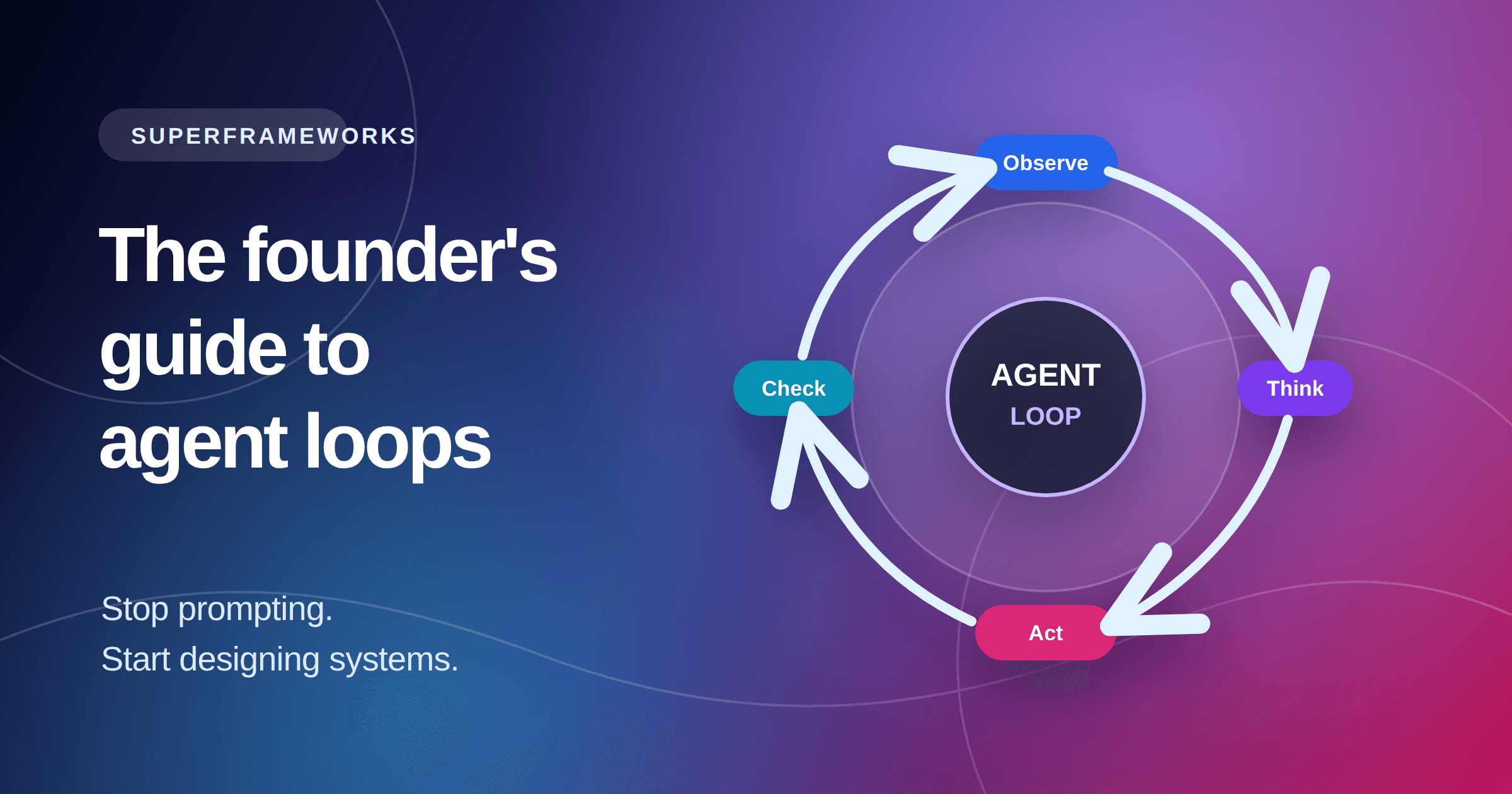
An agent loop is the basic pattern behind useful AI workers: observe, think, act, check, repeat. The model does not just answer. It reads context, decides what to do, uses tools, inspects the result, and continues until the job is done or it hits a boundary.
This sounds abstract until you apply it to a founder's actual work.
A simple chatbot can draft a cold email.
An agent loop can find the right leads, inspect their websites, draft personalized emails, save them to a CRM, flag uncertain cases for review, learn from your edits, and improve the workflow next time.
One gives you output. The other starts becoming infrastructure.
The mistake founders make with AI
The common mistake is thinking the model is the product.
It is not.
The model is the engine. The product is the harness around it.
The best AI operators are no longer obsessing over tiny prompt tricks. They are building systems around the model: context files, reusable skills, tool access, memory, permissions, evaluation steps, and scheduled workflows.
That shift matters because frontier models are already good enough for a lot of founder work. The bottleneck is usually not intelligence. It is structure.
The chatbot path
One-off prompts, no tools, no memory, no verification, and a human re-explaining the same task every week.
The systems path
Reusable workflows with clear goals, scoped context, real tools, approval gates, and lessons that persist.
What an agent loop actually does

Goal
A clear outcome the agent can work toward instead of a vague request.
Context
The background, examples, constraints, and taste that a real teammate would need.
Tools
Access to files, web pages, apps, databases, scripts, and APIs where the work actually happens.
Evaluation
Tests, checklists, scoring rules, or review gates that tell the agent whether the output is good.
Memory
Durable preferences and workflow lessons that reduce repeated correction over time.
Why prompt engineering is becoming less important
Prompting still matters. But it is no longer the highest-leverage layer.
Prompt engineering asks: what words should I type?
Context engineering asks a better set of questions:
- What does the agent need to know?
- What should it ignore?
- What tools should it have?
- What should it never do without approval?
- What examples define quality?
- What process should it follow every time?
- What should it remember after this run?
This is a much more founder-relevant skill. A founder does not win by writing clever prompts. A founder wins by designing repeatable systems that keep working when they are not personally in the loop.

Build systems, not prompt collections
Get one weekly email on AI workflows, growth systems, and founder frameworks that compound instead of adding another tab to your browser.
Skills are the underrated building block
One of the most useful patterns in agent systems is the skill.
A skill is basically a reusable SOP for an AI agent.
Instead of explaining the same workflow every time, you package the workflow into a markdown file or instruction set the agent can load when needed.
For example:
- how to write a Superframeworks article
- how to research competitor landing pages
- how to create a GitHub PR safely
- how to summarize a sales call
- how to find content ideas from customer conversations
This matters because founders repeat more work than they realize. Every repeated explanation is a tax. Every saved skill removes that tax.
The best way to create a skill is not to write a perfect SOP upfront. Run the workflow manually with the agent, correct it when it makes mistakes, get one successful result, then turn that successful process into a reusable skill.
The skill creation loop
The danger of bloated context
There is one trap here: dumping everything into memory or always-on instruction files.
Founders love the idea of a giant brain file that tells the agent everything about the business. The instinct is understandable. But too much always-loaded context can make agents worse.
Every irrelevant sentence competes for attention.
If the agent needs your brand voice for writing, load the brand voice. If it needs API rules for publishing, load the publishing workflow. If it is researching leads, it probably does not need your entire product roadmap.
Good AI systems use progressive disclosure. Give the agent enough context to choose the right next context.
The permission layer matters
Agent loops become more powerful when they can act. They also become more dangerous.
Founders should separate actions into three buckets.

Safe actions
- • read public pages
- • summarize documents
- • draft copy
- • score opportunities
- • create local files
Review required
- • send emails
- • publish articles
- • post on social
- • merge code
- • change customer-facing data
Forbidden actions
- • spend money
- • delete production data
- • modify legal records
- • impersonate you
- • contact customers unsupervised
The founder playbook: build one loop this week
Do not start by building a company of agents.
That is the beautiful diagram trap: agents talking to agents while nothing useful ships.
Start with one painful recurring workflow.
The agent loop template
Goal: What outcome should exist at the end?
Inputs: What files, links, tools, or data does the agent need?
Rules: What should it never do? What requires approval?
Process: What steps should it follow?
Quality bar: What makes the output good or bad?
Verification: How should it check the work?
Memory: What should be saved for next time?
A real example
Every Friday, review the latest customer calls, extract recurring pain points, turn the best three into content ideas, score each idea by founder relevance, and post the shortlist to Discord. Do not publish anything externally. Save recurring customer language that could improve future copy.
That is a real loop.
Small. Useful. Safe.
Then you improve it.
What this means for indie founders
Big companies will build heavy internal AI platforms. Indie founders do not need that.
You need a handful of sharp loops around your highest-friction work.
A solo founder with five strong AI workflows can look strangely overpowered:
- one loop finds opportunities
- one loop drafts content
- one loop monitors customers
- one loop improves the website
- one loop prepares weekly strategy notes
None of these need to be perfect. They just need to run consistently and improve. That is where the compounding lives.
Customer support is the most mature commercial version of this pattern — entire products now run that loop end-to-end, resolving 40-70% of tickets autonomously. Our breakdown of the best AI customer support tools is a useful study in what production-grade agent loops look like.
The founder who saves one hour once gets a productivity boost.
The founder who turns that hour into a reusable loop gets an asset.
The new founder skill
The next founder skill is not "knowing how to use AI." That phrase is already too vague.
The real skill is designing reliable work loops around unreliable intelligence.
That means knowing what context matters, giving tools safely, building feedback loops, capturing reusable skills, keeping humans in approval paths, and turning repeated work into systems.
The winners will not be the people with the longest prompts.
They will be the people who build the best loops.
Because at some point, the question stops being: "What can AI answer?" The better question is: "What can I make run without me?"
That is where the leverage begins.
Useful Superframeworks tools
Start smaller than your ambition
The red-pill path is not "replace the company with agents." It is more boring and more powerful: find one loop, make it reliable, save the workflow, and let the system get sharper every week.
Keep Reading
8 MCPs That Turn an AI Assistant Into an Indie Business Operating System
These eight MCPs connect an AI agent to the product, revenue, customer, SEO, sales, and team signals an indie business needs to act on.
I Vibe-Coded a $10/Month Social Listening Tool. Here’s the Stack and Why I Built a Dashboard.
I built a private social-listening tool with Claude Code, direct APIs, OpenAI, Next.js, Vercel, NeonDB and Voibe. Here is the stack and the workflow.
How to Build an Autonomous Competitor Monitoring System with Hermes Agent
A practical founder guide to building a Hermes Agent market radar: competitor registry, page snapshots, diffs, cron jobs, skills, memory, and quiet alerts when something important changes.