 ByAyush Chaturvedi· Independent Entrepreneur·Co-authored withMorpheus
How to Build an Autonomous Competitor Monitoring System with Hermes Agent
A practical founder guide to building a Hermes Agent market radar: competitor registry, page snapshots, diffs, cron jobs, skills, memory, and a quiet monitoring ping when something important changes.
Key takeaways
- Competitor monitoring is not a dashboard problem first. It is a recurring intelligence loop: watch, remember, detect, judge, and wake the founder only when signal appears.
- Hermes Agent is well-suited for this because it combines cron, script execution, local state, skills, memory, and messaging delivery in one autonomous operating layer.
- Start deterministic: a YAML competitor registry, normalized page snapshots, SQLite state, and text diffs. Add LLM synthesis only after the signal quality is proven.
- The daily job should stay quiet, sending a monitoring ping only when something meaningful changes. The weekly brief should translate changes into product, positioning, pricing, or content decisions.
- The real moat is not the scraper. It is the loop that keeps watching, learns your workflow, and pings back when the market moves.
Most founders do competitor research in bursts.
You hear about a new feature. You open five tabs. You skim pricing pages. You paste something into ChatGPT. Then you forget everything until the next small panic.
That is not market intelligence. That is founder anxiety with browser tabs.
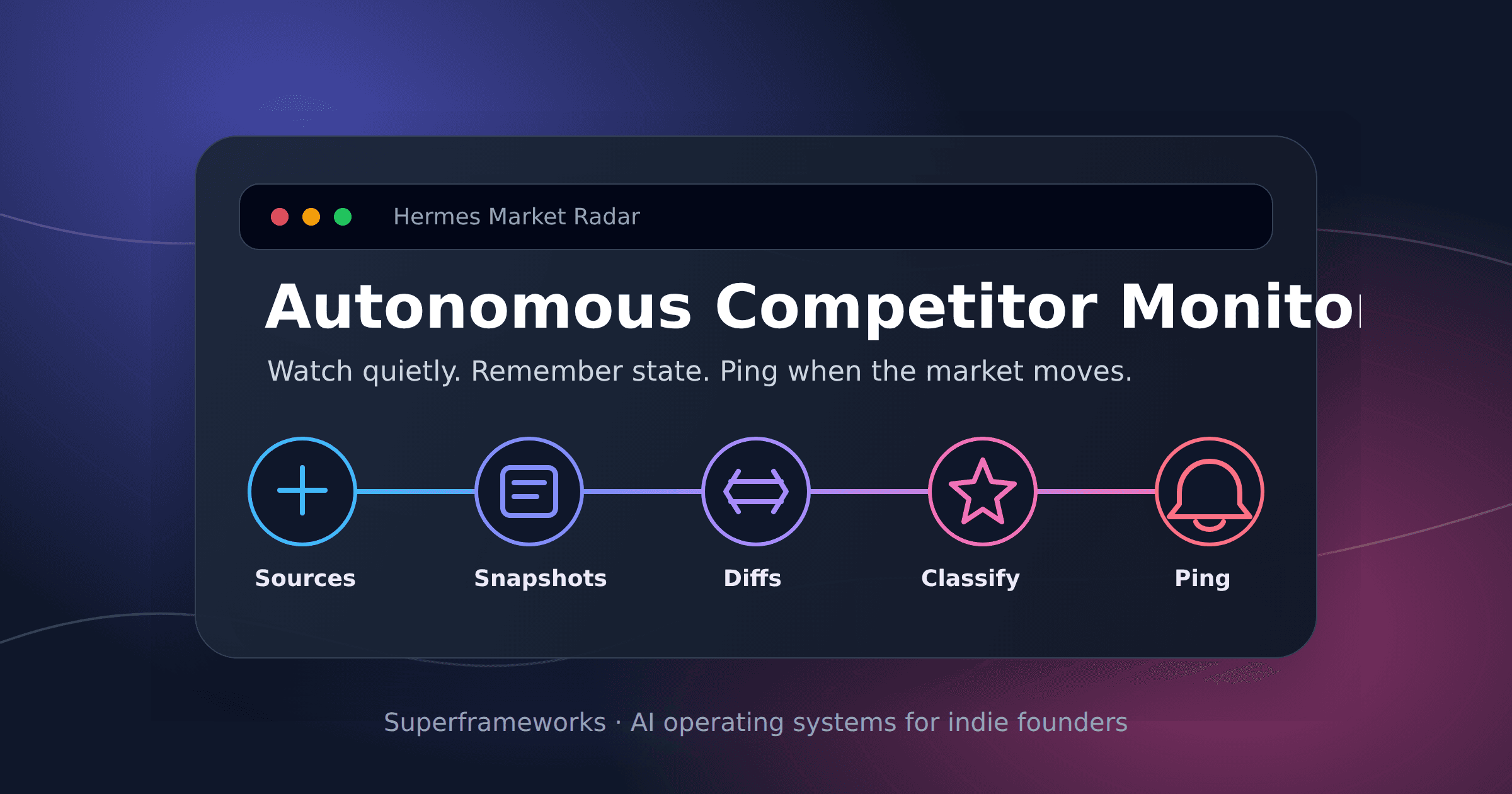
The better system is simple:
watch competitor sources
→ snapshot what changed
→ classify the signal
→ explain why it matters
→ ping the founder when attention is required
You do not need a full competitive intelligence SaaS dashboard to start. You need a loop.
This guide shows how to build that loop with Hermes Agent: a small internal market radar that watches competitor websites, pricing pages, changelogs, blogs, and launch pages, then pings you when something important changes.
The real job of competitor monitoring
The surface problem sounds like: "I want to know what my competitors are doing."
The system underneath is sharper: "I want to notice market movement early enough to update product, positioning, content, pricing, or distribution."
That means your system should not merely collect links. It should answer five questions:
- What changed?
- Who changed it?
- Is it meaningful or just website noise?
- Why does it matter for my product?
- What should I do next?
Most founders do not need a competitive intelligence platform first. They need a weekly decision feed.
The architecture
Competitor registry
A small YAML file lists products, competitors, source labels, and watched URLs.
Snapshots
A script fetches pages, strips layout noise, normalizes text, and stores content hashes.
Diffs
Each run compares the current page against the latest successful snapshot.
Classification
Pricing, launch, positioning, SEO, and strategic signals get priority labels.
Founder alert
Hermes stays silent on noise and pings your workflow when something matters.
competitors.yaml
→ Hermes cron job
→ Python scanner
→ normalized page snapshots
→ SQLite events
→ diff + priority classification
→ Discord / Slack / email alert
The stack is deliberately boring: YAML for the registry, Python for fetching and diffing, SQLite for durable state, Hermes cron for scheduling, Hermes skills for reusable procedure, and messaging delivery for alerts.
No dashboard. No vector database. No agent pretending to browse the internet every morning from scratch.
Start with deterministic monitoring. Add LLM synthesis only after the diffs are useful.
Why Hermes Agent is unusually well-suited for this
You can build a basic competitor monitor with cron, Python, and Slack.
Hermes is better suited because competitor monitoring is not a one-time task. It is an autonomous operating loop.
A good market radar needs to run on a schedule, remember prior state, stay quiet when nothing matters, detect meaningful change, summarize the delta, explain why it matters, ping you in your actual workflow, preserve the playbook, and improve as you correct it.
That is Hermes territory.
Autonomous cron
Hermes can run the scan daily and the brief weekly without you remembering to check anything.
Script-only jobs
Cheap deterministic jobs handle fetching, diffing, and rendering without spending LLM tokens.
Agent synthesis
When judgment is useful, Hermes can read the evidence and recommend product, content, or positioning moves.
Skills and memory
The workflow becomes reusable. Hermes can remember sources, reporting format, approval rules, and delivery destinations.
Messaging delivery
The radar comes to Discord, Slack, Telegram, email, or wherever you already operate.
Approval boundaries
Safe work can run autonomously. Publishing, outreach, and production changes still wait for human approval.
The correct division of labor:
Scripts handle evidence.
The agent handles interpretation.
The founder keeps approval over external action.
Step 1: Create your competitor registry
Start with a config file. Manual beats automatic at the beginning.
settings:
  user_agent: MyMarketRadar/0.1
  min_changed_ratio: 0.015
  max_diff_lines: 18
  high_priority_keywords:
    - pricing
    - price
    - launch
    - released
    - enterprise
    - teams
    - api
    - integration
    - changelog

products:
  myproduct:
    name: MyProduct
    domain: https://myproduct.com
    description: "Private AI writing assistant for consultants."
    competitors:
      - name: CompetitorOne
        domain: https://competitorone.com
        category: AI writing
        sources:
          - type: website
            label: homepage
            url: https://competitorone.com/
          - type: website
            label: pricing
            url: https://competitorone.com/pricing
          - type: website
            label: changelog
            url: https://competitorone.com/changelog
Include the pages that actually reveal strategic movement: homepage, pricing page, changelog, blog/product updates, comparison pages, docs, App Store pages, and Chrome Extension pages if relevant.
When you find yourself manually checking a competitor twice, add that page to the registry. Convert recurring anxiety into a monitored source.
Step 2: Fetch, normalize, and snapshot pages
Raw HTML is noisy. Modern pages include scripts, nav bars, cookie banners, tracking snippets, repeated footer links, and layout junk.
Your scanner should fetch the URL, strip the noise, convert the page into normalized text, dedupe repeated short lines, and store the content hash.
status, raw_html = fetch_url(url)
title = extract_title(raw_html)
normalized = normalize_html(raw_html)
content_hash = sha256(normalized)

save_snapshot(
    product=product,
    competitor=competitor,
    source_label="pricing",
    url=url,
    status=status,
    title=title,
    content_hash=content_hash,
    normalized_text=normalized,
)
You do not need the LLM here. This is plumbing. Keep it deterministic.
Step 3: Store snapshots and events in SQLite
SQLite is the right default for this. It gives you durable state, easy querying, local-first privacy, and enough scale for hundreds or thousands of watched URLs.
CREATE TABLE snapshots (
  id INTEGER PRIMARY KEY AUTOINCREMENT,
  created_at TEXT NOT NULL,
  product_key TEXT NOT NULL,
  competitor_name TEXT NOT NULL,
  source_label TEXT NOT NULL,
  url TEXT NOT NULL,
  status_code INTEGER,
  content_hash TEXT NOT NULL,
  title TEXT,
  normalized_text TEXT NOT NULL,
  error TEXT
);
Later, this ledger becomes useful history. You can ask which competitors changed pricing most often, which positioning themes keep spreading, and which category pages moved before a major launch.
Step 4: Diff before you ask AI to think
On every scan, compare the current normalized text against the latest successful snapshot. Ignore unchanged hashes. Ignore tiny changes below a threshold. Generate a compact diff excerpt.
-All-in-one growth tool for teams
-Whether you're starting out or scaling up...
+#1 workflow automation platform
+Get faster insights from your market
+Trusted by 10M+ operators worldwide
+Top rated by customers
This is the core of the system. You are not asking an LLM, "What happened in my market?" You are showing it, or yourself, the actual delta.
Step 5: Classify for action
Start with simple heuristics. Pricing keywords are pricing signals. Launch, released, changelog, and what's new language suggests product launches. Enterprise, teams, admin, and SSO suggest positioning. Funding, acquired, and partnership suggest strategic movement.
Then assign priority:
- High: pricing, packaging, major launches, acquisitions, enterprise moves
- Medium: positioning shifts, new comparison pages, notable content pushes
- Low: minor copy changes, layout noise, small updates
A useful event should include what changed, why it matters, suggested action, and a diff excerpt. Without the suggested action, your system creates homework instead of leverage.
Step 6: Add Hermes cron
Hermes turns the script into an operating loop. A good setup has two jobs.
Daily scan
Runs every day. Script-only. Quiet unless meaningful changes exist.
Weekly brief
Renders medium and high priority events into one decision-ready report.
# Daily scan wrapper
python market_radar.py scan --quiet

# Weekly brief wrapper
python market_radar.py brief --days 7 --min-priority medium --quiet-empty
In Hermes, make the deterministic jobs no_agent=True. That means the script produces the exact report text and Hermes delivers it only when there is output.
The daily job should stay quiet. If your monitor posts every day regardless of signal, you will start ignoring it.
How the Hermes monitoring ping works
The monitoring ping is the only part of this system you should ever see. Fetching, diffing, and classification all run silently in the background.
A ping fires when a change clears every filter: the content hash is different, the changed ratio is above your threshold, and the event earns a medium or high priority label. Pricing moves, launches, positioning shifts, and strategic signals qualify. Everything else stays silent. Unchanged pages send nothing. Tiny copy tweaks below the threshold send nothing. Low-priority noise gets archived in SQLite for the record, not pushed at you.
When a ping does fire, Hermes delivers it to Discord, Slack, Telegram, or email, wherever you already operate, with the priority label, what changed, why it matters, a suggested action, and a diff excerpt. That discipline is what makes the radar trustworthy. If it speaks, it is worth reading.
The Hermes skills used
hermes-agent
Configure Hermes cron, scripts, toolsets, gateway delivery, profiles, memory, and skills.
zapier-replacement-automations
Use the recurring automation pattern: deterministic script, durable state, dedupe, and report delivery.
growth-opportunity-scouting
Turn competitor signals into content gaps, comparison pages, backlink opportunities, and positioning moves.
blogwatcher
Extend the radar from static pages into RSS feeds, blogs, newsletters, and changelog streams.
A practical setup checklist
Create a market-radar folder inside your Hermes home directory.
Write a competitors.yaml file with product, competitor, category, and watched source URLs.
Build a scanner that fetches pages, normalizes text, stores snapshots, and writes events to SQLite.
Run an initial baseline scan and expect zero events. The first run is your reference point.
Run a local smoke test by changing a temporary HTML file and confirming the diff produces an event.
Create a daily script-only Hermes cron job that stays quiet unless new signals appear.
Create a weekly brief job that renders medium and high priority events into a short operator report.
Add an optional agent-powered synthesis layer after the deterministic signals are useful.
Pro tips and traps
Do not start with AI browsing
The fragile pattern is asking an agent to wander around competitor sites every morning and guess what changed. The better pattern is deterministic scanner first, LLM strategist second.
First run is only the baseline
On the first scan, you should expect zero alerts. That is not failure. That is the reference point future deltas compare against.
Watch specific pages, not entire websites
Monitor pricing, changelog, product updates, comparison pages, enterprise pages, docs, and launch pages. Precision beats volume.
Keep the daily job quiet
No change should mean no message. Small change should mean archive. Meaningful change should mean ping.
Use priority labels brutally
If everything is important, the radar becomes another inbox. Medium and high priority events should earn their place in the weekly brief.
Add LLM synthesis after signal quality is proven
Once the deterministic events are useful, add a weekly agent layer that clusters signals and recommends product, pricing, positioning, or content actions.
Build systems, not research rituals
Get one weekly email on AI workflows, founder operating systems, and practical frameworks for building leverage as a solo founder.
What this looked like in our internal system
Our internal Hermes Market Radar watches 32 configured sources across Voibe and OutlierKit's markets.
The public lesson is not which companies we track. Readers already know how to list obvious competitors. The important part is the operating pattern: pick the pages that reveal market movement, baseline them, and let Hermes watch for deltas.
The system has captured more than 180 snapshots and already detected a high-priority homepage positioning change around category language, customer proof, and buyer intent.
That single alert is enough to trigger useful questions: is the category language shifting, do we need sharper differentiation, and are there comparison or content opportunities worth acting on?
That is the point. A good radar does not tell you everything. It tells you what to think about next.
Why this is more than a scraper
A normal scraper collects data.
A Hermes-powered radar maintains an operating loop.
It knows what to watch. It remembers what changed. It stays quiet when nothing matters. It pings you when the market moves. It can draft the next action. And it can preserve the workflow as a reusable skill.
Most AI tools are waiting for a prompt. Hermes is different: it can keep watch.
For a solo founder, that changes the relationship with market intelligence. You are no longer relying on random bursts of competitor research. You have an autonomous radar running in the background, quietly watching the terrain and tapping you on the shoulder when the signal is real.
That is the founder advantage. Not more information. Better-timed attention.
Useful related reading
Keep Reading
8 MCPs That Turn an AI Assistant Into an Indie Business Operating System
These eight MCPs connect an AI agent to the product, revenue, customer, SEO, sales, and team signals an indie business needs to act on.
I Vibe-Coded a $10/Month Social Listening Tool. Here’s the Stack and Why I Built a Dashboard.
I built a private social-listening tool with Claude Code, direct APIs, OpenAI, Next.js, Vercel, NeonDB and Voibe. Here is the stack and the workflow.
The Founder's Guide to Agent Loops: Stop Prompting, Start Designing Systems
Agent loops are the shift from AI chatbots to AI systems. Here is how indie founders can use context, tools, skills, memory, and permissions to build useful AI workflows.