
I Vibe-Coded a $10/Month Social Listening Tool. Here’s the Stack and Why I Built a Dashboard.
I did not need another generic social-listening subscription. I needed a small system that fit the way I already decide what to respond to.
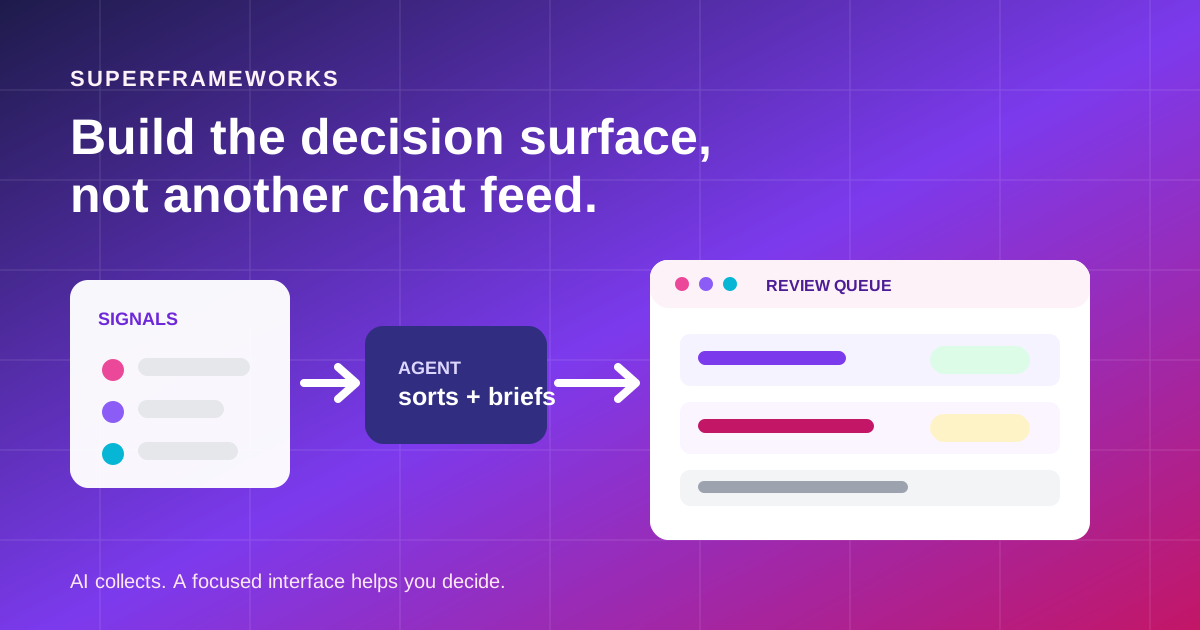
What I built
- I built this as an internal tool for my team, not a product. That keeps the scope small and the security burden honest.
- The stack is direct listening APIs, OpenAI APIs, Next.js on Vercel, NeonDB, Claude Code, and Voibe for dictation.
- The dashboard matters because social listening is a review workflow. I need a queue, source links, state, and one-click next actions.
- The tool costs around $10 per month to run. That does not mean SaaS is dead. It means basic workflow software is easier to tailor than it used to be.
The good social-listening tools cost around $100 a month. I did not want to pay that much, but I still wanted to track keyword mentions and competitor activity across the channels that matter to us. So I built a small version for my team instead.
It watches Reddit, X, LinkedIn, YouTube, forums and news. It filters noise, surfaces posts worth looking at, drafts a contextual reply, and keeps the original link close so I can open it and decide what to do. I built it with two prompts in Claude Code.
I am not selling this. I do not want to own the security and reliability burden of a multi-tenant social-listening product. For internal use, though, it is exactly what I need, and it costs around $10 a month to run.
How I used Voibe to build it faster
I used Voibe to dictate the prompts and changes into Claude Code. That was a more natural way to build this than stopping to type every little instruction. I could explain the workflow as I was thinking through it, then refine the result in the dashboard.
Voibe is a private dictation app for Mac and Windows. It works system-wide, so I can dictate into Claude Code, my editor, Slack, or a browser without changing my workflow. For this kind of build, the useful loop was simple: say what I want, inspect what Claude made, then say the next correction. If you want to see how this workflow compares across tools, I ranked the best dictation apps for vibe coding separately.
The stack I used
Raw listening
Direct APIs pull the raw mentions and competitor activity. That is the collection layer.
Synthesis and replies
OpenAI APIs summarize the signal, help filter it, and draft contextual replies for me to review.
App and database
Next.js runs the dashboard on Vercel. NeonDB holds the items, metadata, statuses, and decisions.
Build interface
Claude Code wrote the app. I dictated the instructions and refinements through Voibe.
Why I moved this out of Discord and into a dashboard
This workflow originally ran inside my Hermes setup. My agent would send the results into Discord each day. It worked, but after using it for a few weeks I realized Discord was the wrong place to do the actual review.
A chat feed is fine for alerts and exploration. It is bad at holding a queue. I needed to see what had already been handled, what was worth replying to, what was noise, and where the original post lived. That means lists, filters, buttons, links and states. A normal dashboard still wins for that job.
Want more build notes like this?
I write about the tools, systems, and experiments I am using to build with a small team.
How to build your own version
You can give this article and the stack above to Claude Code or Codex and have it build a version for your own workflow. I would start narrower than I did: one or two sources, one keyword list, and a tiny review queue. Do not begin by trying to recreate an entire social-listening company.
- 1Write down the decision you want the tool to help you make. Mine was simple: is this mention worth a thoughtful response, a save, or no action?
- 2Collect raw data with direct APIs. Store the source URL, author, date, matching keyword, raw text, and source platform before asking a model to summarize anything.
- 3Use the model for triage, not unsupervised outreach. Ask OpenAI to classify relevance, summarize context, and propose a reply. Keep the actual posting manual.
- 4Build a stateful review screen. In Next.js, show the source, a relevance score, the suggested reply, and clear states such as
new,saved,replied, andignored. NeonDB is enough for this first version. - 5Deploy it where you can keep iterating. I used Vercel because the app is Next.js. The important part is not the host. It is the habit of changing the tool whenever the real workflow reveals a missing action.
What I would not automate
I use this to make my review faster, not to spray auto-generated replies across the internet. The final decision and the final response stay with me. That keeps the system useful and stops it from becoming the kind of spam I am trying to filter out.
I also would not turn this exact project into a public SaaS without doing the real security work. Internal software can be rough around the edges because I know who is using it and what data is in it. The moment other people trust it with accounts and private data, the job changes.
If your version touches customer data, paid accounts, or automatic posting, treat security, permissions, retries, and audit logs as product work. They are not cleanup tasks for later.
The part I keep coming back to
This does not prove SaaS is dead. It proves that a lot of narrow internal workflow software is now buildable by the people who feel the pain.
If a product can be recreated with two prompts, it needs a stronger reason to exist: proprietary data, deep integrations, support, trust, or a customer who does not want to spend their Saturday building it. That is the moat test I am using now.
Related reading
How to Build an Autonomous Competitor Monitoring System with Hermes Agent covers the broader pattern: turning recurring intelligence work into a system you can trust and refine.
Original posts and links
Build the thing you keep paying for
I share the systems and experiments that help a small team move faster without adding more software subscriptions.
One practical build note at a time.
Keep Reading
8 MCPs That Turn an AI Assistant Into an Indie Business Operating System
These eight MCPs connect an AI agent to the product, revenue, customer, SEO, sales, and team signals an indie business needs to act on.
How to Build an Autonomous Competitor Monitoring System with Hermes Agent
A practical founder guide to building a Hermes Agent market radar: competitor registry, page snapshots, diffs, cron jobs, skills, memory, and quiet alerts when something important changes.
The Founder's Guide to Agent Loops: Stop Prompting, Start Designing Systems
Agent loops are the shift from AI chatbots to AI systems. Here is how indie founders can use context, tools, skills, memory, and permissions to build useful AI workflows.