
8 MCPs That Turn an AI Assistant Into an Indie Business Operating System
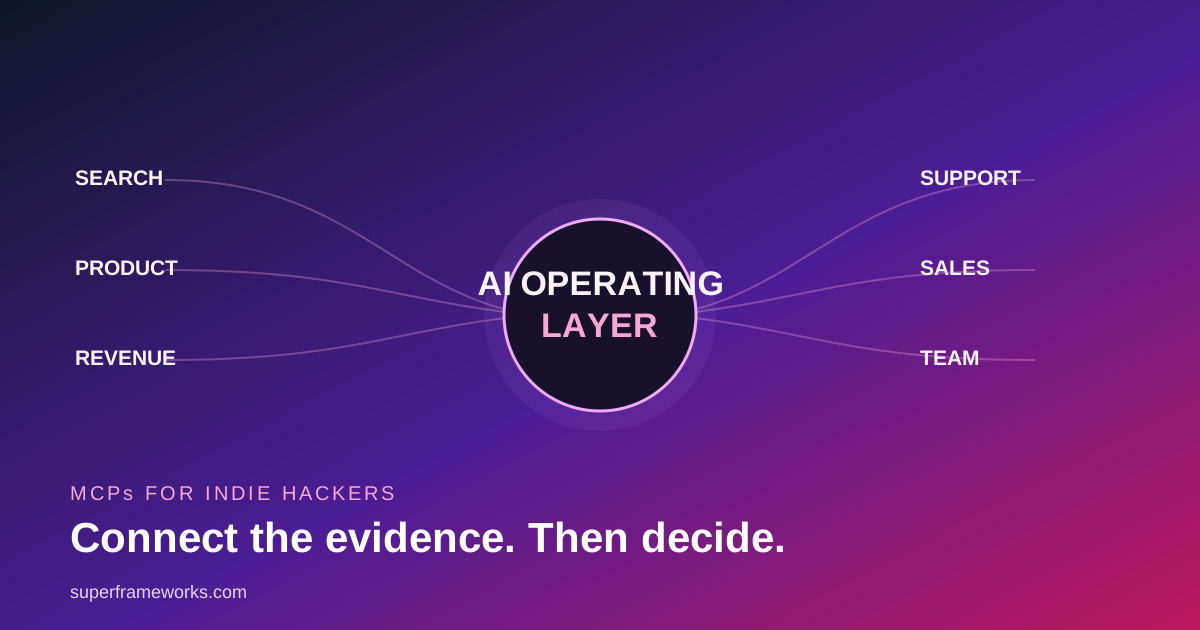
These eight MCPs connect an AI agent to the product, revenue, customer, SEO, sales, and team signals an indie business needs to act on.
The short version
- MCP is useful because it gives an AI agent access to current business data and actions, not because it creates an impressive integrations list.
- The useful starter stack covers product behavior, revenue, customer questions, market signals, sales context, and the team conversation around all of it.
- MissionControl can coordinate connected MCPs through a shared business brief and specialized agents, but it does not remove the need for access controls or founder review.
- Start with two read-heavy MCPs and one decision. Add write actions only after you can audit the workflow and trust its output.
Most founders do not need eight more dashboards. They need one place where an AI can ask a useful question across the business and return with evidence.
Bhanu Teja recently shared the stack behind his MissionControl workspace: eight MCP connections spanning search, product analytics, subscription revenue, support, SEO research, billing, sales, and Slack. The interesting part is not the list. It is the operating model.
MCP, short for Model Context Protocol, gives an AI client a standard way to use external tools and data. In founder terms: it is how an agent stops guessing about your business and starts looking at the systems where the facts live.
That does not mean you should give an agent every credential you own. It means you should connect the smallest set of signals that can answer one recurring business question.

The point is not to centralize every tool. It is to make recurring decisions with current evidence.
Bhanu Teja P
@pbteja1998 · Aug 11, 2026
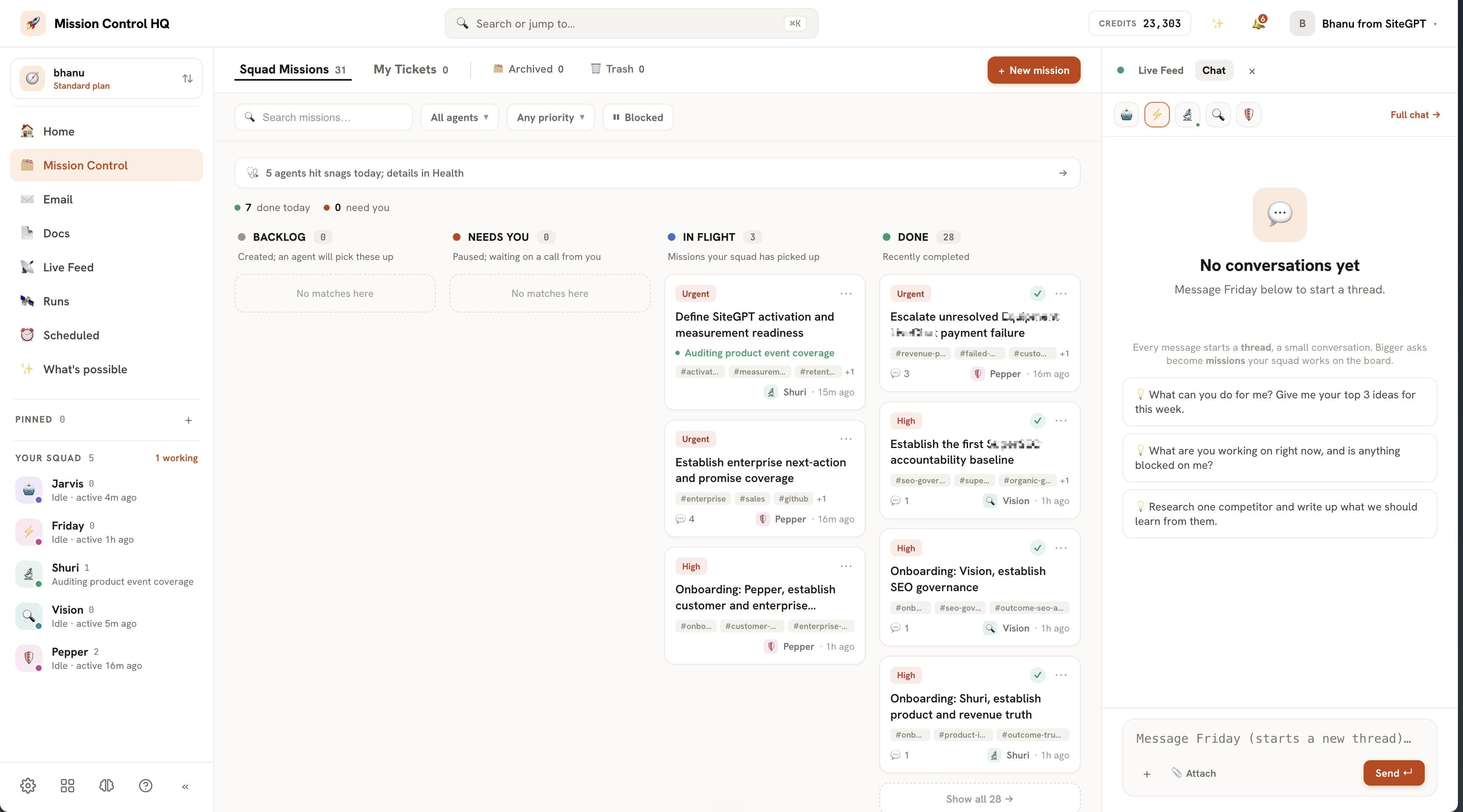
Someone asked how I use MissionControl. I connected my business data through MCP, gave the agents shared context, then let the system propose the AI squad and first tasks.
Open Bhanu's post on X
The 8 MCPs and the job each one does
DataFast MCP
Search performance and website intelligence
What it gives an agent: Use it to pull the search and site signals that tell you what people are discovering, where pages are leaking attention, and what deserves a closer look.
How it helps an indie business: A content or growth agent can turn a sudden drop, query pattern, or page opportunity into a short brief instead of a dashboard tab you forget to reopen.
PostHog MCP
Product analytics and experiments
What it gives an agent: PostHog MCP lets an agent query trends, funnels, retention, custom SQL, and saved insights in natural language.
How it helps an indie business: Ask why activation fell after a release, which step leaks trial users, or whether a feature flag changed behavior. The agent can investigate with product evidence, not vibes.
Official MCP informationChartMogul MCP
MRR, customers, and subscription health
What it gives an agent: ChartMogul describes its MCP server as natural-language access to subscription metrics and customer information, with tools that can retrieve and update account data.
How it helps an indie business: A finance or founder agent can explain revenue movement in plain English: new MRR, churn, expansion, and which customers caused the change.
Official MCP informationSiteGPT MCP
Customer questions and support knowledge
What it gives an agent: The support layer gives an agent access to the questions buyers and users keep asking, plus the knowledge used to answer them.
How it helps an indie business: That turns support into product research. Your agent can cluster recurring confusion, draft documentation gaps, and flag requests that should affect onboarding or roadmap decisions.
CrawlRaven MCP
SEO research and competitive intelligence
What it gives an agent: Use CrawlRaven when an agent needs structured website and search research rather than a generic web summary.
How it helps an indie business: A growth agent can watch competitors, inspect topic gaps, and bring back an evidence-backed content brief. The deliverable should be a decision, not a pile of URLs.
Paddle MCP
Billing, payments, and subscription operations
What it gives an agent: Paddle data gives an agent a commercial view of subscriptions, customers, and billing events.
How it helps an indie business: Combine it with product and revenue analytics to investigate a cancellation spike. Keep any refunds, plan changes, or customer-facing action behind a human approval gate.
Sybill MCP
Sales conversations and deal memory
What it gives an agent: Sybill says its MCP connector brings deal data, context, and reasoning into agent tools. It pulls from the calls and sales activity that explain why deals move or stall.
How it helps an indie business: A sales agent can prepare a follow-up, surface objections that repeat across calls, or connect a lost deal to a missing product capability without manually rereading transcripts.
Official MCP informationSlack MCP
Team context and the human handoff
What it gives an agent: Slack’s MCP server can search workspace content, retrieve and send messages, manage canvases, and work with users, subject to workspace permissions.
How it helps an indie business: This is where an agent asks for a decision, shares a concise finding, or retrieves the team context behind a metric. It should not become an excuse to spam every channel.
Official MCP informationHow MissionControl can turn MCPs into an operating layer
MissionControl is built around a different idea from a chat window: define a business mission, give a squad shared context, then delegate work to specialized agents. Its onboarding asks about the business and goals; in Bhanu's walkthrough, that context sits alongside the connected data sources before the system proposes agent roles.
That is a sensible pattern for a small business. A growth agent should know the offer and customer before it queries SEO data. A revenue agent should be able to compare ChartMogul movement with product behavior. A chief-of-staff agent should not have to reconstruct your priorities from scattered prompts every Monday.
MissionControl is an orchestration option, not a magic layer. Its value depends on the quality of the business brief, the boundaries around each agent, and whether the agent can raise a clear ticket when it cannot proceed. A long list of MCPs without those things becomes a sophisticated way to create noise.
Use an approval boundary
Read-only research, summaries, and draft recommendations are safe places to begin. Refunds, billing changes, outbound messages, deployments, and anything that changes customer data should require explicit approval. Powerful tools need a narrow blast radius.
Build the operating system, not a prompt collection
One weekly note on founder systems, AI workflows, and the small decisions that compound.
A sane way to start
- 1
Pick one decision
Examples: Why did trials fall last week? Which competitor pages deserve a response? Which deals need founder attention?
- 2
Connect two read-heavy MCPs
Start with the sources that answer the question. PostHog plus ChartMogul is a stronger first pair than connecting every service at once.
- 3
Write a short business brief
Give the agent the product, customer, metrics that matter, and what a good answer looks like.
- 4
Ask for a fixed deliverable
Request a weekly diagnosis with evidence, a recommendation, and a list of uncertainties. Do not ask it to “grow the business.”
- 5
Add actions slowly
Once the research is useful, let the agent draft a ticket or Slack message. Keep sending and modifying external systems behind review.
The founder test
If an MCP connection does not make a recurring decision faster, more accurate, or easier to audit, do not add it yet. The blue-pill path is a collection of integrations that looks impressive. The higher-leverage path is a small loop that notices something real, tells you what it means, and creates the next sensible action.
Start with one question your business asks every week. Connect the evidence. Then make the answer reliably useful before you expand the stack.
Sources
Keep Reading
I Vibe-Coded a $10/Month Social Listening Tool. Here’s the Stack and Why I Built a Dashboard.
I built a private social-listening tool with Claude Code, direct APIs, OpenAI, Next.js, Vercel, NeonDB and Voibe. Here is the stack and the workflow.
How to Build an Autonomous Competitor Monitoring System with Hermes Agent
A practical founder guide to building a Hermes Agent market radar: competitor registry, page snapshots, diffs, cron jobs, skills, memory, and quiet alerts when something important changes.
The Founder's Guide to Agent Loops: Stop Prompting, Start Designing Systems
Agent loops are the shift from AI chatbots to AI systems. Here is how indie founders can use context, tools, skills, memory, and permissions to build useful AI workflows.