 ByAyush Chaturvedi· Independent Entrepreneur·Co-authored with Morpheus
Claude Opus 5 vs GPT-5.6 Terra: Blind Judging Picked Opus 13–3 on Founder Work
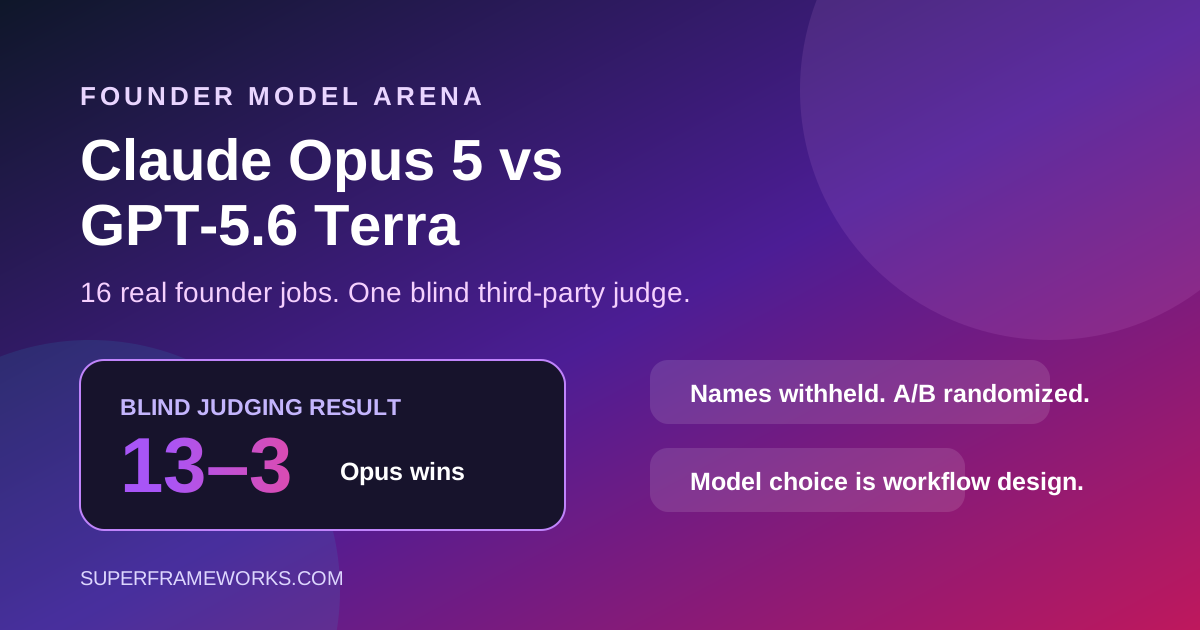
We tested Claude Opus 5 and GPT-5.6 Terra across 16 real founder jobs. Self-judging produced opposite conclusions. A blinded third judge gave Opus a 13–3 win.
Key takeaways
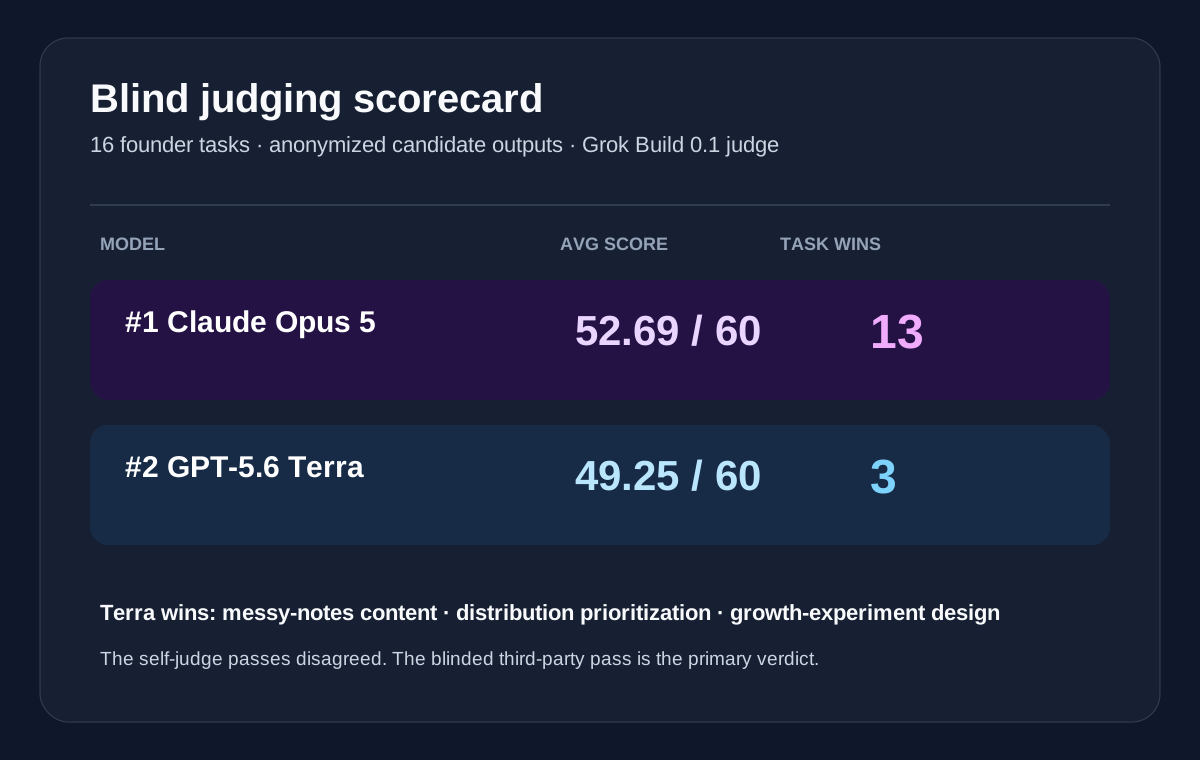
- Claude Opus 5 won 13 of 16 founder tasks in the blind third-party judging pass, with a 52.69 average score versus 49.25 for GPT-5.6 Terra.
- Letting competitors judge themselves was a trap: Opus picked Opus in all 16 tasks, while Terra picked Terra in 13.
- The right conclusion is not one-model loyalty. Use Opus as the decision-grade default, and use Terra where it creates a useful challenge pass.
- The strongest all-judge Opus signals were customer discovery, MVP scoping, and support/churn analysis.
- A model benchmark becomes useful only when it changes how work is routed next week.
The surface question was simple: which affordable flagship should a founder trust with real operating work?
We put Claude Opus 5 and GPT-5.6 Terra through 16 recurring founder jobs: product scope, pricing, customer discovery, churn analysis, positioning, landing pages, distribution, sales, SEO, and more. These are not exam questions. They are the jobs that decide what a small team builds, says, and ignores.
At first, the benchmark gave us a suspiciously neat answer. Claude judged all 16 tasks and picked Claude every time. Then Terra judged the same saved outputs and picked Terra in 13. That is not a winner. That is a warning.
So we ran a third pass: a blinded judge saw the task, rubric, and randomized candidate A/B outputs, but not the model names. The result was no longer symmetrical: Opus won 13 tasks to Terra's 3.
This is the latest Founder Model Arena test. Read it alongside our earlier five-model founder-task arena, non-frontier model benchmark, and Fable 5 vs GPT-5.6 Sol comparison. The series is not a leaderboard. It is an attempt to build a better routing table for founder work.
The setup: two flagships, 16 founder jobs
Both models answered the same local benchmark specs. The rubric scored strategic clarity, specificity and insight, editorial quality, founder usefulness, groundedness, and publishability. A Hermes agent orchestrated the runs, preserved raw outputs, created scorecards, and prepared the anonymized judge packets.
The blind judge was Grok Build 0.1. Candidate order was randomized and model labels were withheld. That does not make the result a clinical trial. It does remove the most obvious form of preference bias: allowing a model to grade its own work.
Claude Opus 5 and GPT-5.6 Terra
Real operating jobs, not synthetic puzzles
Opus wins in the third-party pass
Why blind judging changed the conclusion
The self-judging passes were useful, but only as diagnostics. Opus rewarded its own operating style on every task. Terra rewarded its own style on 13. If we had published either pass alone, we would have published a preference masquerading as evidence.
The blind pass changed the standard. It did not ask which model has the stronger brand or the prettier reasoning trace. It asked which anonymized answer helped a non-technical founder make the next useful decision with the least unsupported invention.
That distinction matters. A benchmark can be technically correct and still be operationally useless if the judge is allowed to recognize the contestant.
The blind scorecard
Where each model was strongest
Opus won in the blind pass
Activation, analytics diagnosis, competitor research, customer discovery, interview synthesis, both landing-page jobs, positioning, pricing, MVP scope, sales objections, SEO strategy, and churn analysis.
Terra won in the blind pass
Messy-notes content, distribution prioritization, and growth-experiment design.
The three strongest consensus signals
Customer discovery, product scope/MVP sequencing, and support/churn analysis. All three judging views selected Opus.
What the tasks looked like
Customer discovery plan
Turn scattered user feedback into a research plan that identifies the highest-risk assumption without pretending the evidence is stronger than it is.
Opus won across every judging pass by separating known signal from hypotheses, then pairing a narrow interview sequence with a decision threshold before recommending a build.
Product scope and MVP sequencing
Choose what a tiny team should ship, cut, and test next from a long list of user requests and a short runway.
Opus made the cleanest cuts and treated the first users as a learning system, not merely a feature backlog. It chose lower-build experiments before engineering completeness.
Growth experiment design
Design a concrete experiment from an early growth problem, including a hypothesis, decision rule, and guardrails.
Terra won the blind pass by turning the ambiguity into a sharper experiment sequence. This is exactly why the second model belongs in the workflow.
The routing playbook for founders
Default to Opus for decision memos
When the output changes your roadmap, pricing, customer research plan, or retention work, start with Opus. Its blind advantage was breadth and consistency, not one lucky task.
Use Terra as the challenger, not the loser
Have Terra attack an Opus answer on distribution, experiment design, and editorial transformation. Its three wins show that a challenger can improve the final decision even when it is not the primary model.
Blind the judge before you trust the leaderboard
Model names are expensive placebo. If the same model is a candidate and a judge, treat the result as a preference diagnostic, not a final verdict.
Keep your benchmark close to recurring work
Three to five jobs from your real operating week are more valuable than another generic score. Save the prompts, inspect mistakes, and update your routing when the models change.
The result is a workflow change, not a permanent crown
Opus won the blind third-party pass decisively enough to become the default final-answer model for this suite. That is useful. It is not a license to stop testing.
Models change, prompts change, and the work inside your company changes. The durable advantage is not knowing today's winner. It is having a small evaluation loop that tells you when your workflow should change.
For a founder, the practical move is simple: use Opus for high-consequence operating memos, use Terra to challenge the reasoning where it has shown distinct strength, and keep a blinded evaluator between your model preferences and your roadmap.
Want the detailed per-task scorecards?
The summary scorecard is above. We do not publish full raw benchmark folders because complete prompts and outputs are easy to misread without the surrounding test context. If you want a detailed per-task scorecard or relevant sample output, reach out.
Keep Reading
We Tested Claude Fable 5 vs GPT-5.6 Sol on Founder Work. Fable Won 4/4.
We ran Claude Fable 5 and GPT-5.6 Sol through four non-marketing founder tasks: product scope, customer synthesis, churn diagnosis, and pricing strategy. Fable swept the benchmark, but Sol still belongs in the workflow.
We Tested 5 Non-Frontier AI Models on Founder Work. Qwen Won Everything.
We ran Qwen3.7 Plus, GLM 5.2, DeepSeek V4 Flash, Kimi K2.6, and Mimo V2.5 Pro through three real founder tasks: positioning, pricing, and customer research synthesis.
We Tested 5 AI Models on Real Founder Work. GLM 5.2 Beat GPT-5.5.
We ran GPT-5.5, Grok 4.20, DeepSeek V4 Flash, GLM 5.2, and Claude Code through three messy founder tasks. The winner was not the model most people would guess.