
10 Best Business Bank Accounts for Startups in 2026 (Ranked by Who Actually Holds Your Money)
The 10 best business banking options for startups in 2026 — Mercury, Relay, Bluevine, Grasshopper, Rho, Meow, Novo, Found, Wise, and Chase. Ranked by the question the other listicles skip: which chartered bank actually holds your deposits, how far the FDIC sweep really goes, and what your idle cash should earn — with the Synapse collapse and Brex's 2022 small-customer purge as the cautionary anchors.
"FDIC insured" does not mean what most founders think it means.
FDIC insurance pays out when a bank fails. Most platforms on this list are fintechs, not banks — your deposits sit at partner banks behind the app. If the fintech (or its middleware) fails while the banks stay solvent, the FDIC does nothing. That's not hypothetical: when Synapse collapsed in 2024, roughly $265M belonging to 100,000+ people froze for months with no bank failure anywhere — and a $65-95M ledger shortfall was never fully recovered. The FDIC's own guidance says deposit insurance "does not protect against the insolvency or bankruptcy of a nonbank company." So every entry below answers the question the marketing pages skip: which chartered bank actually holds your money, and under what sweep structure. Prefer platforms that name their banks (all ten here do) — and keep a second account regardless.
Key Takeaways
- "FDIC insured" on a fintech's homepage is not the protection you think it is. FDIC insurance covers a bank failing — not the fintech in front of it. When middleware provider Synapse collapsed in 2024, roughly $265M belonging to 100,000+ end users froze for months with no bank failure anywhere, and a $65-95M shortfall was never fully recovered. Every pick below lists who actually holds the deposits.
- Mercury is the default pick for funded startups — Kruze Consulting's client data shows roughly 40% of new startups open there — and it received conditional OCC approval for its own national bank charter in April 2026, which would eventually remove the middleware question entirely.
- The two startup-banking leaders both got absorbed in the same month: Capital One closed its $5.15B Brex acquisition on April 7, 2026, and Mercury got its conditional charter approval on April 27. The category is consolidating — platform risk now includes "whose roadmap does my bank serve?"
- Brex is deliberately not ranked here. It remains a strong product for venture-backed companies at scale, but it offboarded tens of thousands of small businesses with ~60 days' notice in June 2022, still effectively gates accounts on professional funding or real revenue, and now answers to a top-10 US bank.
- Idle cash math, mid-2026: the Fed held at 3.50-3.75% in June and the 3-month T-bill yields ~3.7%, so a $500K seed sitting in a 0% checking account forfeits roughly $18K a year — a contractor's worth of runway. Realistic targets: 3.3-3.8% via treasury products, 1-2% on operating checking. Be skeptical of anything advertising more.
- The standard post-SVB playbook is two banks: a fintech platform for operations and a systemically-important bank as ballast. Chase went from ~15% of startups pre-SVB to 60%+ by end-2023 — not because founders love Chase, but because they stopped trusting any single point of failure.
Search for the best business banking for startups and you'll find two kinds of articles: affiliate roundups ranking by signup bonuses and branch counts, and vendor blogs where Rho ranks Rho first and Relay ranks Relay first. Almost none of them mention that in 2024, a hundred thousand fintech-app customers lost access to $265M for months — or explain the partner-bank plumbing that made it possible. This list is different: we don't sell banking, nobody paid to be here, and every pick is ranked by what actually protects and compounds a startup's cash.
The category changed shape this spring. Capital One closed its $5.15B acquisition of Brex on April 7, 2026; twenty days later Mercury received conditional OCC approval to become an actual bank. The two platforms that defined startup banking are now, respectively, a big-bank subsidiary and a bank-in-progress — while a real chartered challenger (Grasshopper) is itself being acquired. Meanwhile the Fed held rates at 3.50-3.75% in June, which means idle seed money has a real opportunity cost: roughly $18K a year on a $500K balance left at 0%.
Every entry below covers verified pricing and yields (as of early July 2026 — rates move), who legally holds the deposits and how far the FDIC sweep actually goes, eligibility for international founders, and the freeze-and-hold complaint patterns users report after the honeymoon. Where a number couldn't be independently verified, we say so.
Quick Comparison
| # | Platform | Best For | Who Holds Your Money | Rating |
|---|---|---|---|---|
| 1 | Mercury | Best Overall for Funded Startups | Choice Financial + Column N.A. — up to $5M swept | 4.1 |
| 2 | Relay | Best for Cash-Flow Control | Thread Bank — up to $3M swept | 4.3 |
| 3 | Bluevine | Best Interest Checking + Credit Line | Coastal Community Bank — up to $3M swept | 4.5 |
| 4 | Grasshopper Bank | Best Actual Bank for Startups | Grasshopper IS the bank — up to $125M via ICS | 4.1 |
| 5 | Rho | Best All-in-One Finance Stack | Webster Bank + ADM network — up to $75M (savings) | 4.8 |
| 6 | Meow | Best for Maximizing Yield | Cross River + Grasshopper — IntraFi sweep | 3.7 |
| 7 | Novo | Best Free Simple Checking | Middlesex Federal — $250K standard | 4 |
| 8 | Found | Best for Sole Proprietors | Lead Bank — $250K standard | 4.6 |
| 9 | Wise Business | Best for International Founders | Not a bank; JPMC program bank w/ interest opt-in ($250K) | 4.3 |
| 10 | Chase Business Complete Banking | Best Big-Bank Ballast | JPMorgan Chase itself — $250K standard | 1.3 |
Ratings are Trustpilot except Rho (G2); Chase's 1.3 is complaint-skewed (Chase doesn't solicit reviews). Sweep coverage figures are vendor-advertised maximums as of July 2026 — see each entry for the mechanics.
Mercury
Best Overall for Funded Startups — $5M FDIC Sweep, Free Everything, and a Bank Charter Incoming
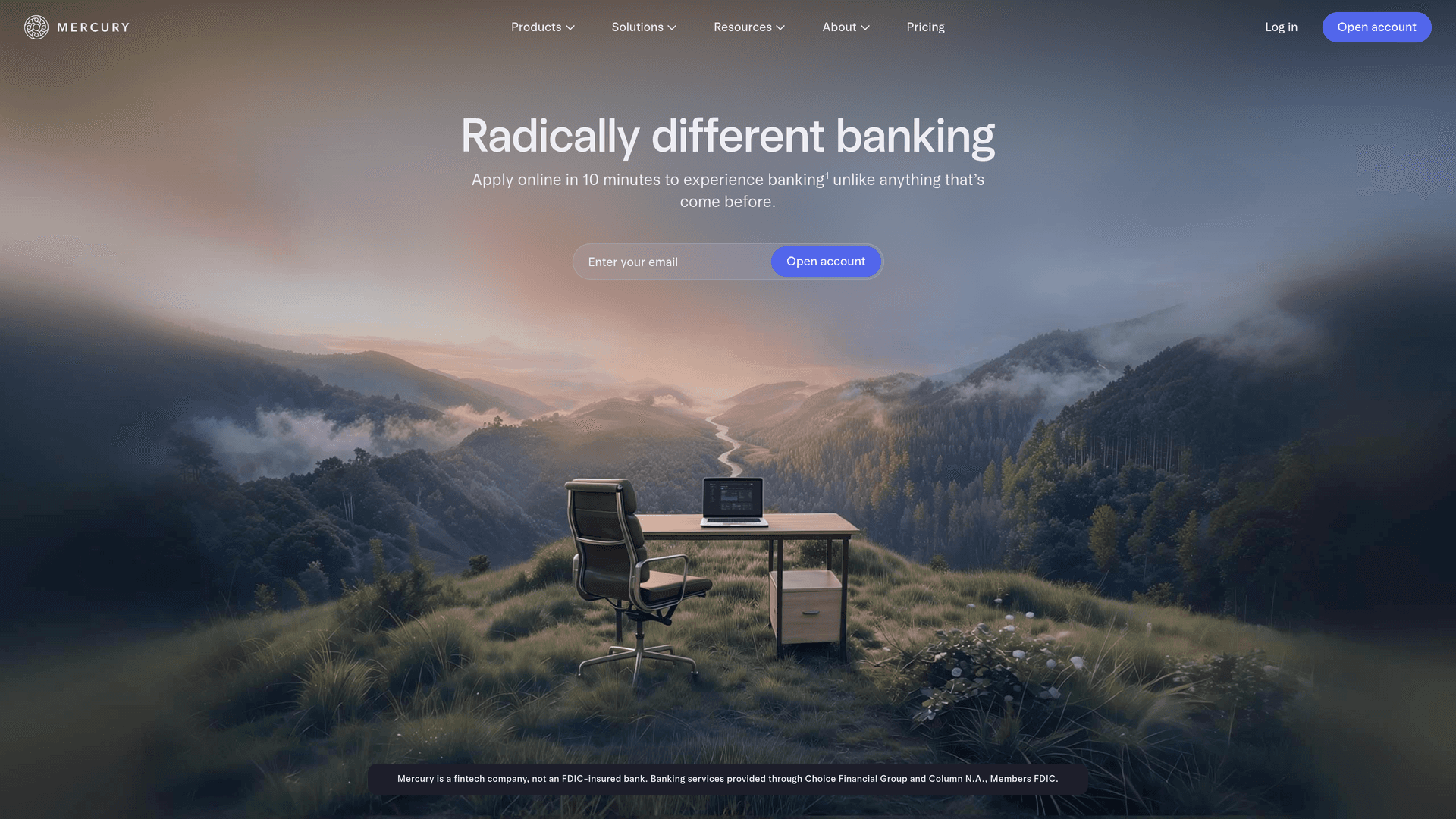
Mercury is the default startup bank account in 2026 — Kruze Consulting's client data shows roughly 40% of new startups open here, and the company crossed 300,000 customers, $650M in annualized revenue, and a $5.2B Series D valuation in May 2026. It is still a fintech, not a bank: deposits sit at Choice Financial Group and Column N.A., swept across program banks for up to $5M in FDIC coverage. That caveat has an expiry date, though — Mercury received conditional OCC approval for its own national bank charter (Mercury Bank, N.A.) in April 2026, with final approval possible in 2027. The core product is free: no monthly fee, free ACH, free domestic and USD international wires, sub-accounts, the IO corporate card (1.5% cashback, no personal guarantee), and treasury, invoicing, and bill pay in one dashboard.
Mercury wins on completeness-per-dollar: for $0/month a two-person Delaware C-corp gets banking that would have required a CFO stack five years ago, and non-US founders with a US entity can open remotely — something Chase and most fintechs still can't handle. The honest trade-offs: operating balances earn 0% (Mercury Treasury needs $250K+ across accounts to unlock ~3.0-3.6% net), support is email-first and strained in exactly the moments that matter (one Hacker News founder's $250K incoming wire went missing for a week in 2025 and was resolved only after tweeting at the CEO), and Mercury abruptly offboarded founders residing in ~37 countries in 2024 — including Ukraine and Nigeria — with a month's notice. It's the best default in the category; it is not a charity, and its compliance engine makes black-box calls. Keep a second account (see #10) from day one.
Key Features
- Up to $5M FDIC insurance via sweep networks across Choice Financial Group and Column N.A. — with a conditional OCC bank charter approved April 2026
- Free tier covers the whole operating stack: ACH, domestic + USD international wires, sub-accounts, bill pay, invoicing
- IO corporate credit card: 1.5% flat cashback, no personal guarantee, available from day one
- Mercury Treasury (at $250K+ balances): ~3.0-3.6% net yield via T-bill money market funds
- Remote onboarding for international founders with US entities — one of the few that does it well
Pricing
Free plan covers core banking. Plus $29.90/mo (recurring invoicing, more reimbursement users). Pro $299/mo (relationship manager, NetSuite sync). 1% FX on non-USD wires. Treasury requires $250K+ total balance; fees 0.15-0.6% annualized.
Rating
4.1/5 — Trustpilot (2,478+ reviews)
Best For
Funded startups and serious bootstrappers with a US LLC or C-corp who want the m...
Pros
- The most product per dollar in startup banking — free tier genuinely covers everything an early company needs
- $5M sweep insurance + a path to its own charter directly answers the "who holds my money" question
- IO card with no personal guarantee and treasury yield without leaving the dashboard
Cons
- 0% on operating cash until you clear the $250K Treasury gate — idle seed money earns nothing by default
- Email-first support and black-box compliance freezes; the 2024 offboarding of founders in ~37 countries still stings internationally
Relay
Best for Cash-Flow Control — Up to 50 Accounts, Profit First Built In
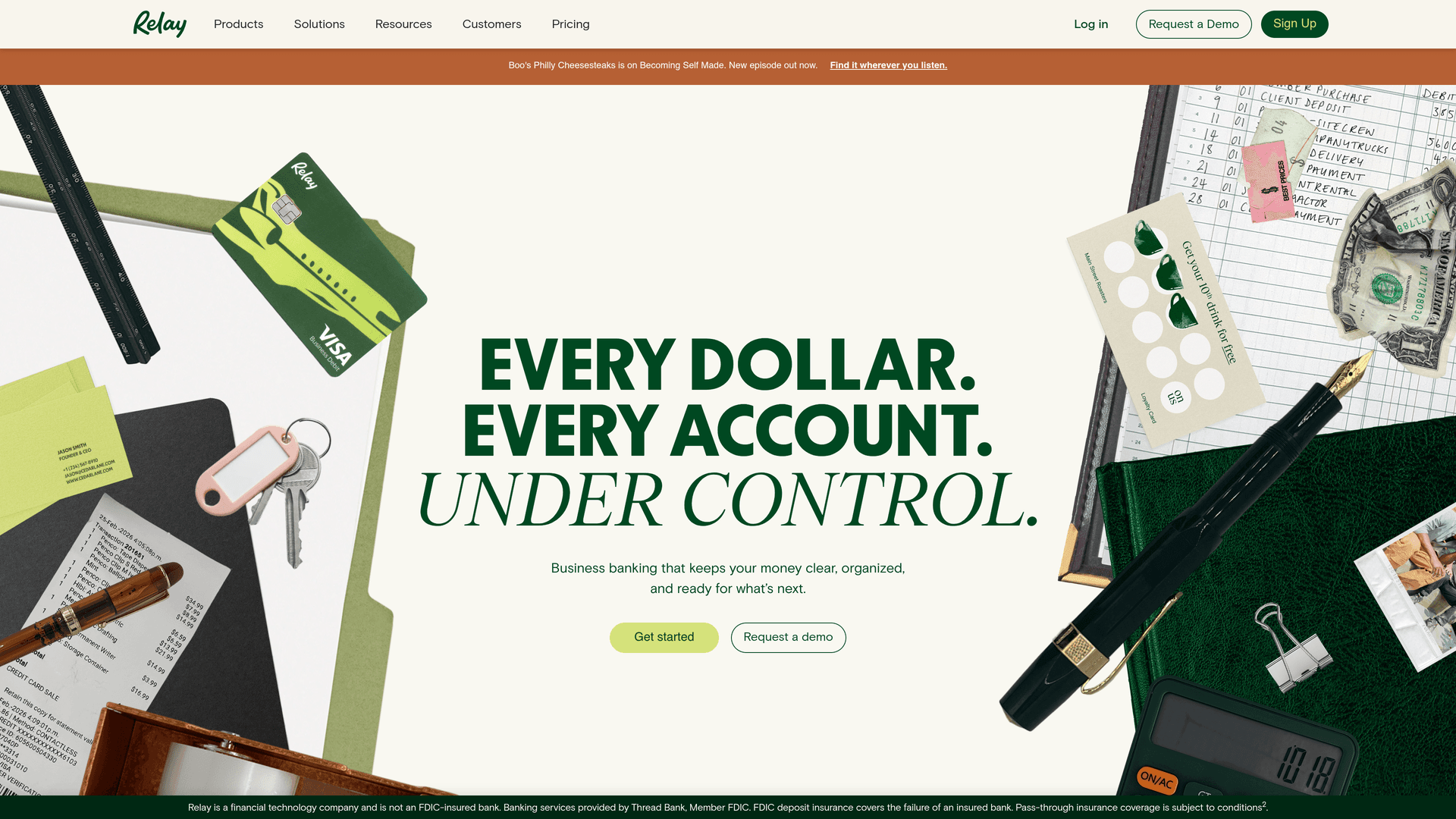
Relay is the operating account for founders who manage money by moving it: up to 20 checking accounts on the free Starter plan (50 on Scale), each with its own account number, plus two savings accounts, 50 debit cards, and percentage-based auto-transfer rules. It's the official banking platform of the Profit First method, and it grew from 100,000 to roughly 200,000 small-business customers through 2025, adding a $50M General Catalyst investment in May 2026. Deposits are held at Thread Bank (Member FDIC) with sweep coverage up to $3M. Worth knowing the history: Thread operated under an FDIC consent order over its fintech-partner oversight from May 2024 until regulators terminated it in December 2025 — the system working as intended, but a reminder that the partner bank is part of what you're buying.
If Mercury is built for the startup that raised, Relay is built for the business that collects and spends — agencies, e-commerce operators, service businesses, and bootstrappers who want taxes, payroll, and profit physically separated into different accounts the day revenue lands. Nothing else on this list does envelope-style money management this well, and the AP workflow on Grow ($30/mo) adds multi-step bill approvals most banks reserve for enterprise tiers. The trade-offs are unglamorous: wires cost money ($5-8 domestic, up to $25 SWIFT), savings tops out at 3.00% APY only on the $90/mo Scale plan (1.11% on Starter), and Trustpilot carries a pattern of accounts restricted for weeks during Thread Bank fraud reviews with little communication. For US-based operators with real cash flow, it's the strongest Mercury alternative; international founders need an SSN or ITIN plus a physical US address, which rules many out.
Key Features
- Up to 20 checking accounts free (50 on Scale), each with unique account numbers — real envelope budgeting, not virtual buckets
- Official Profit First support with percentage-based auto-transfer rules between accounts
- Built-in accounts payable: bill capture, approval chains (Grow), batch vendor payments
- Up to $3M FDIC via Thread Bank's sweep program; Visa debit + cashback credit card
- QuickBooks Online, Xero, and Gusto sync with per-account transaction feeds
Pricing
Starter free (20 accounts, 1.11% savings APY). Grow $30/mo (approval rules, 1.75% APY, 1.25% card cashback). Scale $90/mo promo (50 accounts, 3.00% APY, 10 free same-day ACH). Domestic wires $5-8; SWIFT $20-25; standard ACH free.
Rating
4.3/5 — Trustpilot (3,400+ reviews)
Best For
Agencies, e-commerce operators, and bootstrapped teams that manage cash by alloc...
Pros
- The best multi-account architecture in business banking — allocation-style money management with real account numbers
- Free tier is a complete operating stack for an SMB, and the AP features punch above the price
- Thread Bank's consent order was terminated in Dec 2025 — the partner-bank story improved rather than degraded
Cons
- Wires are never free, and top savings yield requires the $90/mo plan
- Recurring reports of multi-week account restrictions during fraud reviews, with support going quiet mid-freeze
Bluevine
Best Interest Checking + Credit Line — Up to 3.0% APY and $250K Revolving Credit
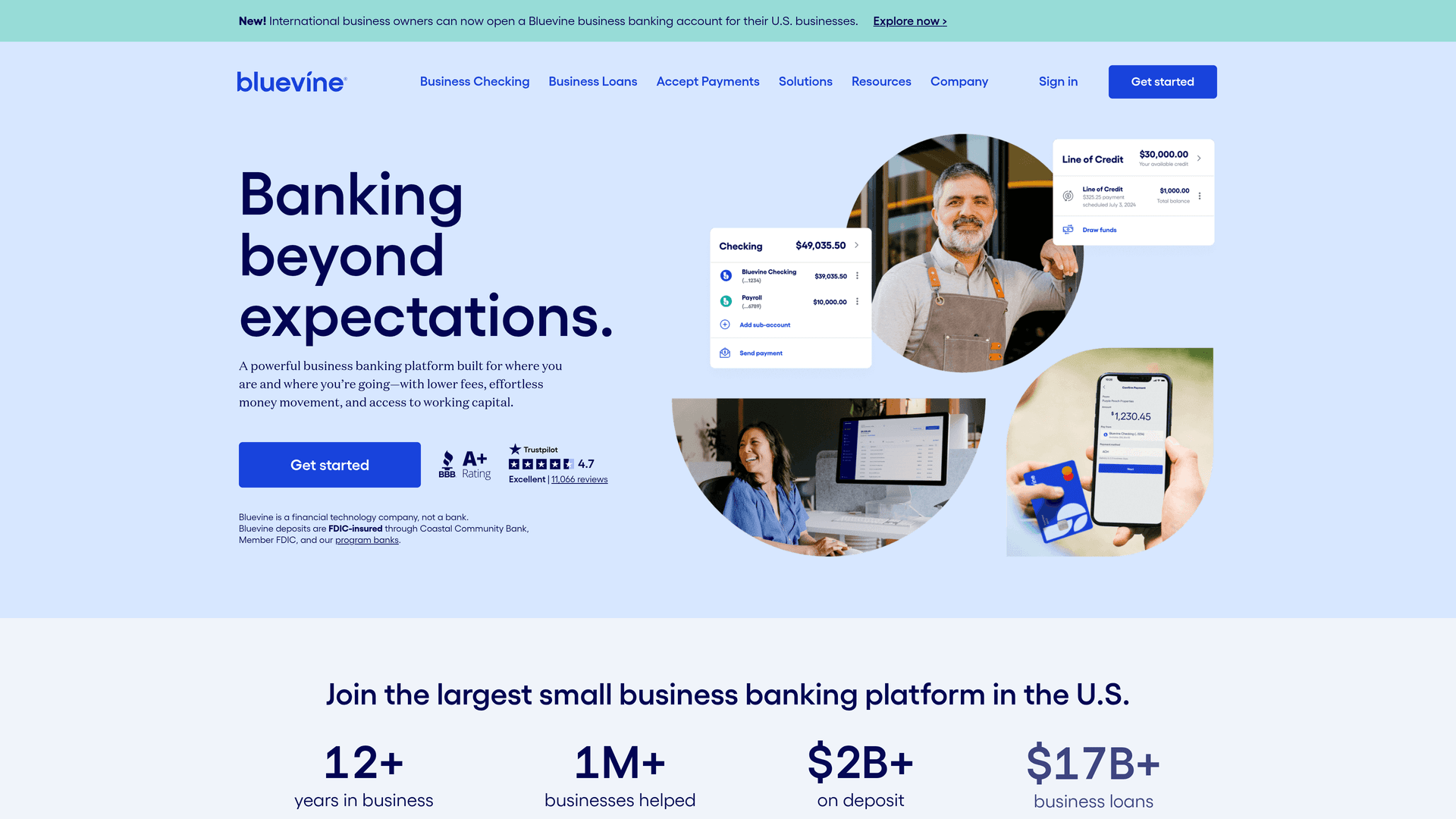
Bluevine is the yield-and-credit pick: business checking that actually pays on operating balances, attached to one of the most accessible small-business credit lines in the market. The standard free plan earns 1.3% APY on balances up to $250K (in months you spend $500 on the card or collect $2,500 in payments); Premier ($95/mo, waivable) pays 3.0% on all balances with no cap. The credit line goes to $250K revolving — 625+ FICO, 12+ months in business, ~$120K annual revenue — with decisions in minutes. It's a fintech: deposits sit at Coastal Community Bank with program-bank sweeps to $3M FDIC. Scale is real: 1M+ lifetime businesses served, $2B+ in deposits, $17B+ in financing originated, and Bluevine paid customers nearly $24M in interest in 2025.
For a bootstrapped or revenue-funded business, Bluevine solves the two problems that actually matter: idle cash earning something without a $250K treasury gate, and access to working capital before you're big enough for a real credit facility — the combination Mercury and Relay don't offer. The 3.0% uncapped Premier APY is the highest unconditional checking yield on this list. Go in clear-eyed: the Standard plan's APY has activity conditions (skip a month, earn nothing), sub-account counts are tier-gated, cash deposits cost $4.95 at Green Dot retailers, and the freeze pattern here is as documented as anywhere — funds locked "for a week or more while verification requests go in circles," with no weekend support to escalate. And note the restricted list: cannabis, money services, and crypto-heavy businesses are out. Historically it required US residency, though as of mid-2026 Bluevine's own site advertises accounts for international owners of US businesses — check current requirements if that's you, or default to #1, #6, or #9.
Key Features
- Interest on checking: 1.3% APY free tier (with activity), 1.75% on Plus, 3.0% uncapped on Premier
- Revolving line of credit up to $250K — 625+ FICO, decisions in minutes, funds as fast as 24 hours
- Up to $3M FDIC via Coastal Community Bank + program-bank sweeps
- Built-in AP with approval workflows, plus invoicing with Stripe-powered payment links (2025)
- Sub-accounts with unique account numbers: 5 free, up to 20 on Premier
Pricing
Standard free (1.3% APY w/ activity conditions). Plus $30/mo, waived at $20K balance + $2K card spend (1.75% APY). Premier $95/mo, waived at $100K + $5K spend (3.0% APY, no cap). Domestic wires $7.50-15; same-day ACH $5-10; cash deposits $4.95 via Green Dot.
Rating
4.5/5 — Trustpilot (10,000+ reviews)
Best For
Bootstrapped and revenue-funded businesses that want operating cash earning real...
Pros
- The best checking yield in the category — and the only top pick pairing deposits with an accessible $250K credit line
- Huge verified track record: 1M+ businesses served and ~10,000 Trustpilot reviews at 4.5
- Fee waivers are achievable for real businesses (balance + card spend), unlike most bank fee mazes
Cons
- Free-tier APY is conditional on monthly activity — miss the threshold, earn zero that month
- Documented freeze/hold pattern with weekday-only support; restricted industries list is long (no cannabis, MSBs, bulk crypto)
Grasshopper Bank
Best Actual Bank for Startups — No Middleware, 1.35% APY + 1% Cashback, $125M ICS Sweep
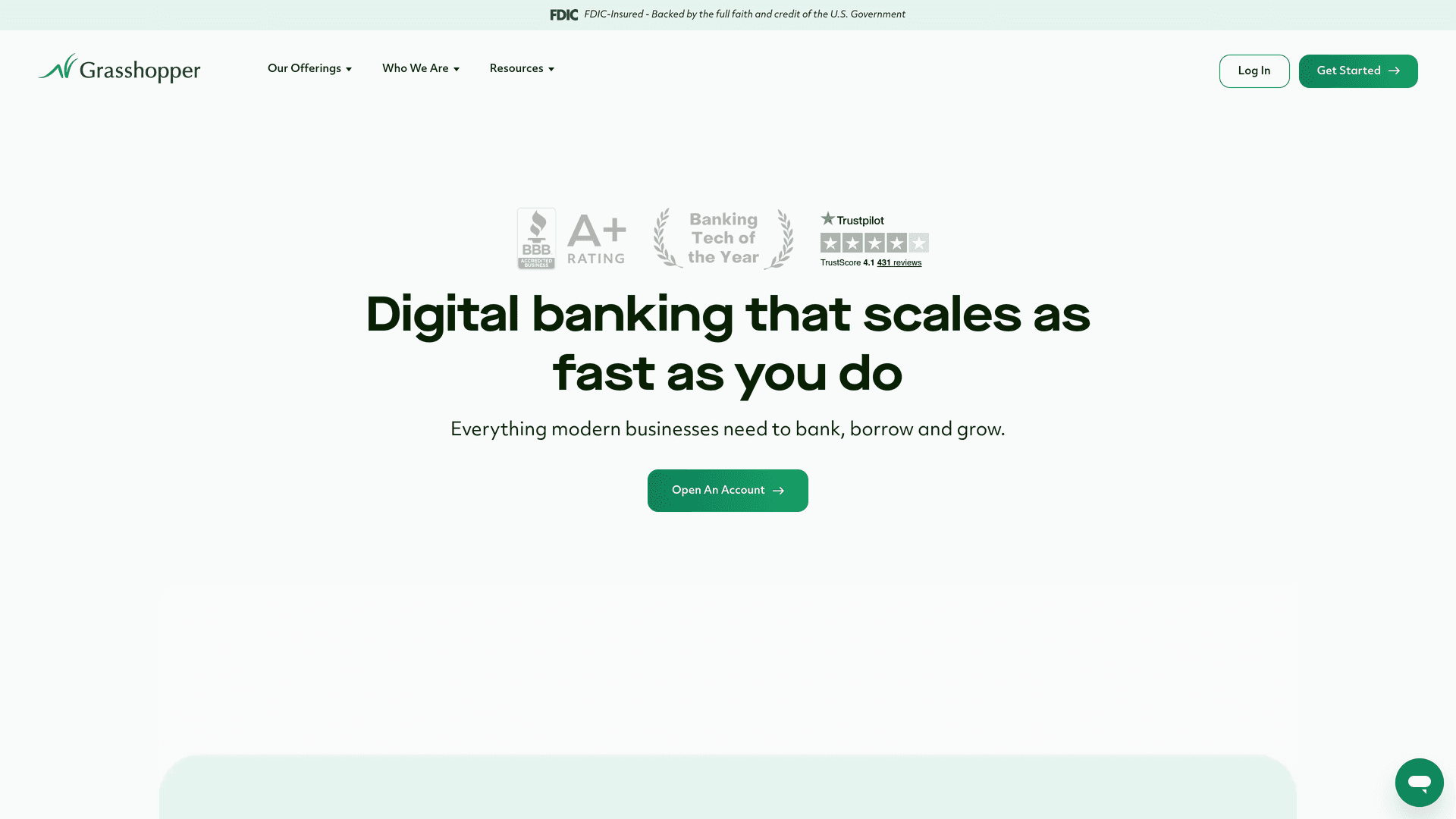
Grasshopper is the answer to this article's central question with no asterisk: it IS the chartered bank (OCC national charter, founded 2019, $1.4B+ in assets), so there's no fintech middleware between you and your deposits. The startup-facing Accelerator/Innovator checking pays 1.00-1.35% APY (the top rate on $25K-$250K) plus unlimited 1% cashback on signature debit purchases — a combination no fintech on this list matches on operating cash. Coverage extends to $125M through the IntraFi/ICS sweep network, there's a dedicated VC/PE fund-banking division, SBA 7(a) lending up to $5M, real banking APIs, and — since June 2026 — an MCP connector so AI agents can talk to your bank. One big development to watch: Enova International agreed in December 2025 to acquire Grasshopper Bancorp for ~$369M, expected to close in H2 2026.
After Synapse, "the app and the charter are the same company" is worth real money: if Grasshopper has a problem, FDIC insurance applies directly — there is no reconciliation-of-the-middleware scenario, because there is no middleware. Earning 1.35% plus 1% cashback on the operating account while fintechs pay 0% is the practical bonus, and the SBA lending desk gives bootstrappers a growth path fintechs can't offer. The counterweights: the pending Enova acquisition (a publicly-traded subprime consumer lender) is a genuine culture question even if the BaaS and startup business continues under current leadership; support is weekday-only; there are Trustpilot reports of deposit holds and abrupt closures; and eligibility is US citizens and permanent residents only — international founders are excluded outright. Cash deposits don't exist and there's no Zelle. If you want a real bank with startup DNA and you're US-based, this is the one; revisit after the Enova close.
Key Features
- An actual OCC-chartered national bank — deposits held by the institution you signed up with, FDIC direct
- 1.00-1.35% APY on checking PLUS unlimited 1% cashback on signature debit purchases
- Up to $125M coverage via IntraFi/ICS sweep; 3.00% APY money market at $25K+
- Startup ecosystem: Accelerator checking, VC/PE fund banking, SBA 7(a) to $5M, term loans to $200K in a day
- Real banking APIs plus an MCP-based AI connector (June 2026)
Pricing
$0/month, no minimum balance, $100 opening deposit. Free ACH and incoming wires; domestic wires $5 (free on startup suite with $25K+ balance). Treasury product targets higher yields at $250K+ with a 0.1% fee. No cash deposits.
Rating
4.1/5 — Trustpilot (429 reviews)
Best For
US-based founders who internalized the Synapse lesson and want a chartered bank ...
Pros
- The only pick where "who holds your money" has a one-word answer — no partner-bank layer at all
- APY + cashback on operating cash beats every fintech's 0% default
- Real lending (SBA, term loans) and fund banking under the same roof
Cons
- Pending acquisition by Enova (subprime lender) expected to close H2 2026 — strategy could shift
- US citizens/permanent residents only, weekday-only support, no cash deposits or Zelle
Want More Recommendations Like These?
Subscribe for curated founder tool picks every week. No sponsored content, no fluff.
Rho
Best All-in-One Finance Stack — $0 Fees, Free Global Wires, $75M Sweep, Human Support
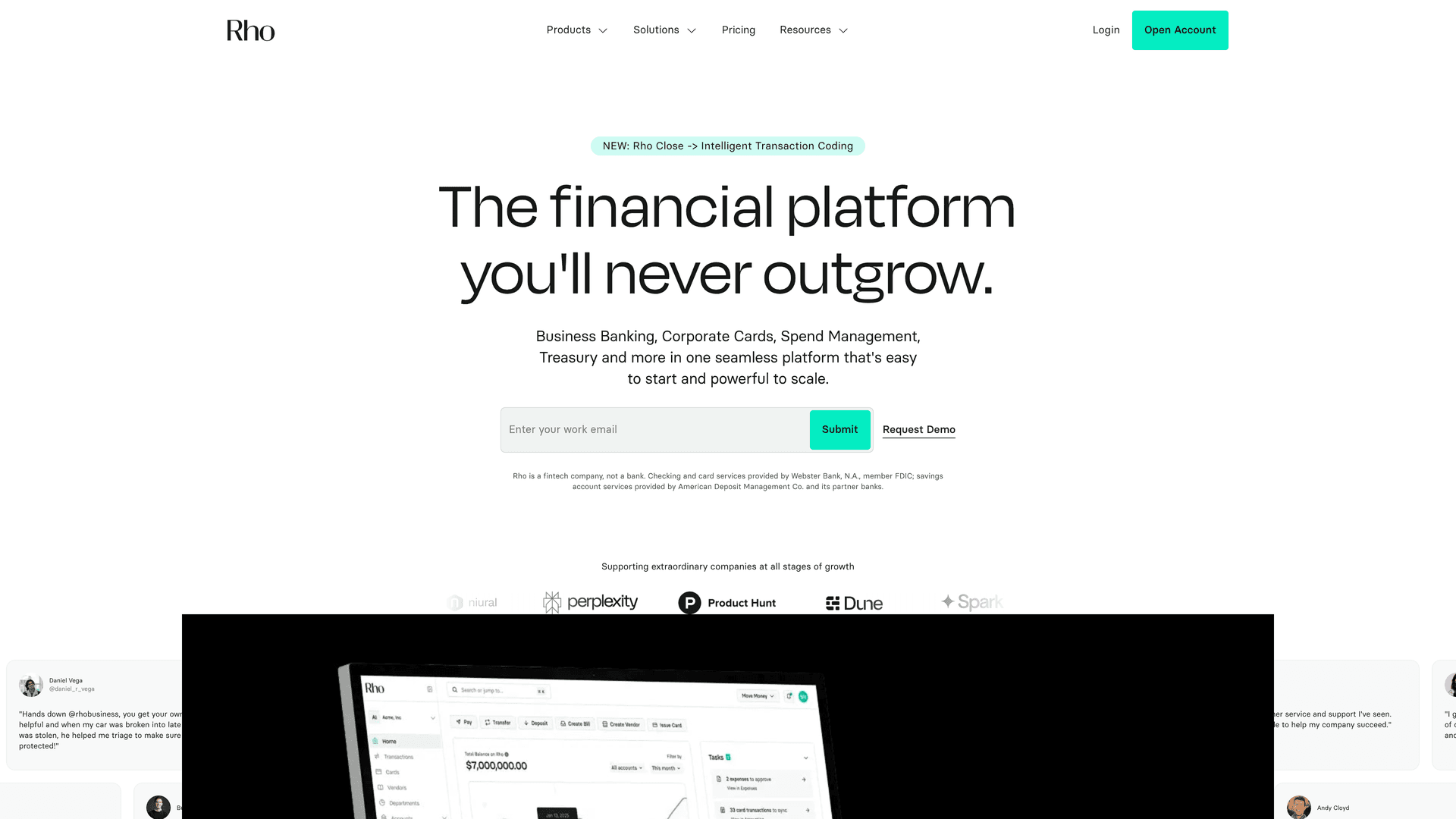
Rho bundles what Brex and Ramp sell — corporate cards, AP automation, expense management — with actual business checking, at a flat price of zero: no subscription, no per-user fees, free domestic AND international wires, free same-day ACH. Checking sits at Webster Bank, N.A.; savings sweep through the American Deposit Management network across 400+ banks for up to $75M in FDIC coverage — the deepest insurance on this list short of Grasshopper's ICS. Rho Treasury (at $100K minimum) advertised up to 4.43% net as of early July 2026 — notably above peers quoting the same T-bill benchmark, so treat that as Rho's number, not ours. The January 2026 Stripe Atlas partnership means new C-corps can have a Rho account before their EIN paperwork lands. Customers include Perplexity and Product Hunt.
For a funded startup with an ops-minded founder, Rho is the strongest "one login for all money" pitch: cards with 1.5% cashback, bill pay with PO matching, expense policies, and banking that syncs to QuickBooks, Xero, NetSuite, or Sage in real time — free, where the standalone spend platforms charge or upsell. The support model is the differentiator users rave about: dedicated account executives ("I literally have my account executive on a texting basis"), a 9.7/10 G2 support score. Balance that against the other tail: Trustpilot sits at 3.8 with reports including a company's $300K held for weeks of daily "24 more hours" promises — the familiar fintech pattern where everything is white-glove until compliance flags you. Eligibility is stricter than Mercury's: you need a US operating address or at least one US-based owner with an SSN, which rules out fully-offshore founding teams. No cash deposits, and checking itself earns 0%.
Key Features
- Genuinely $0: no subscription, no per-user fees, free domestic + international wires, free same-day ACH
- Corporate charge cards (1.5% cashback) + AP automation + expense management included — the Brex/Ramp feature set, with banking
- Up to $75M FDIC on savings via ADM's 400+ bank sweep network
- Rho Treasury at $100K+: advertised up to 4.43% net (verify current rate), T-bills in your company's name
- Stripe Atlas partnership: account opening before the EIN arrives, with incorporation bonuses
Pricing
Everything $0: no monthly fee, no wire fees (1% FX + optional $15 SWIFT on foreign currency), free same-day ACH. Treasury fees 0.15-0.6% annualized, $100K minimum. No cash deposits.
Rating
4.8/5 — G2 (120+ reviews)
Best For
Funded startups that want cards, AP, expenses, and banking consolidated into one...
Pros
- The most complete free finance stack on this list — replaces a spend-management subscription outright
- Deepest savings insurance here ($75M) and the highest advertised treasury yield (verify at signup)
- Named account executives and 9.7/10 G2 support — rare at $0
Cons
- Strictest eligibility of the fintechs: US address or US owner with SSN required; no fully-offshore teams
- Trustpilot (3.8) documents multi-week compliance holds — the white-glove experience has a compliance-flag failure mode
Meow
Best for Maximizing Yield — Direct T-Bills at 1bp/Month, Offshore Entities Welcome

Meow is the yield specialist: direct US T-bill purchases with auto-laddering at one basis point per month, money-market and commercial-paper accounts netting ~3.8-4.0% (at $100K minimums), even UK Gilts and German Bunds — wrapped around free checking with zero-fee wires, unlimited cards, and 2.5% cashback on eligible AI spend. Banking runs through Cross River Bank and Grasshopper Bank with IntraFi sweep coverage; securities custody at BNY Pershing. Founded 2021, it pivoted from crypto yield to treasuries, crossed $1B in platform assets within weeks of the SVB collapse, and runs famously lean (~15-20 people). In April 2026 it shipped the first "agentic banking" platform — AI agents via Claude, ChatGPT, or Cursor can open accounts, issue cards, and draft payments under initiator-approver controls. Uniquely on this list, Meow onboards offshore entities, including Cayman structures.
If your startup is sitting on a raise, Meow's pitch is arithmetic: T-bill yield minus 1bp/month beats every packaged treasury product's 15-60bp fee stack on this list, and the $100K gates are lower than Mercury's $250K. The offshore-entity support fills a real gap — LatAm, MENA, and APAC founders with Cayman or BVI structures have almost nowhere else to go on this list. The honest counterweights are structural: this is a ~20-person company you'd be trusting with your treasury (mitigated by the fact that securities sit at BNY Pershing in your name and deposits at chartered banks — but Synapse taught us to ask), its partner-bank roster has churned (FirstBank and Third Coast before Cross River and Grasshopper), Grasshopper itself is mid-acquisition by Enova, and the review base is tiny (15 Trustpilot reviews; no real G2 presence). Documented onboarding friction and rejection complaints round it out. Use it as the treasury layer next to a primary operating account, not as your only bank.
Key Features
- Direct T-bills with auto-roll and laddering at 1bp/month — the cheapest treasury execution on this list
- Commercial paper and money-market accounts netting ~3.8-4.0% at $100K+ (mid-2026)
- Zero-fee banking: free domestic and international wires, ACH, unlimited cards; 2.5% cashback on eligible AI spend
- Offshore entities accepted (incl. Cayman) — the international-structure option nothing else here offers
- Agentic banking (April 2026): AI agents operate accounts under initiator-approver controls and 2FA
Pricing
$0/month, no tiers. Free wires (domestic + international), free ACH, free cards. T-bills at 1bp/month annualized; commercial paper quoted net of fees. Money-market and CP accounts gated at $100K+.
Rating
3.7/5 — Trustpilot (15 reviews)
Best For
Startups holding $100K+ of raise who want maximum yield with minimum fee drag — ...
Pros
- Best raw yield economics here: T-bill rate minus 12bps a year, custodied in your name at BNY Pershing
- Only pick that welcomes offshore entities; strong pick for non-US founding structures
- Genuinely zero-fee banking layer, and the agentic-banking API is ahead of the market
Cons
- Tiny company (~15-20 people), tiny review base (15 Trustpilot reviews), and a history of partner-bank churn
- Onboarding friction is the top documented complaint — compliance rejections with little explanation
Novo
Best Free Simple Checking — Invoicing, Faster Stripe Payouts, Zero Learning Curve
Novo is the simplest real option on this list: one free checking account at Middlesex Federal Savings ($250K standard FDIC — no sweep network), a debit card with up to 2% cashback on eligible purchases, unlimited free invoicing, and up to 10 "Reserves" — virtual envelopes with percentage-based auto-allocation for taxes and payroll. Its quiet killer feature for online businesses is Novo Boost, which lands Stripe payouts 2-4 days early for free, plus native integrations with Square, PayPal, Shopify, Wise, and Xero. It serves 250,000+ small businesses and has processed $30B+ in transactions. The catch on costs: same-day Express ACH runs 1.5% of the amount (capped at $20), outgoing wires are limited to select customers, international payments route through the Wise integration, and cash deposits aren't supported at all.
For a freelancer-turned-LLC or a service business that invoices, collects by card or Stripe, and pays a handful of bills, Novo covers 100% of the actual workflow for exactly $0 — and the Reserves system is a lightweight Profit First without Relay's multi-account ceremony. That's the whole pitch, and for its lane it's the right answer. Know the boundaries: yield is 0% with no savings product (park surplus elsewhere), FDIC stops at the standard $250K, there's no lending beyond the invite-only credit card and working-capital offers, and the complaint pattern mirrors the category's worst habit — holds and reviews "without telling you anything," in one Trustpilot reviewer's words, with email-only support stretching to 5+ days. US SSN and address are required, so it's a no for international founders. Novo is a superb first business account; it's not the account you scale a funded startup on.
Key Features
- Genuinely free: no monthly fee, no minimums, free standard ACH, refunds up to $7/mo in ATM fees
- Novo Boost: free 2-4 day faster Stripe payouts — real cash-flow value for online businesses
- Up to 10 Reserves with percentage auto-allocation — DIY tax and profit set-asides
- Unlimited free invoicing plus Stripe, Square, PayPal, Shopify, Wise, and Xero integrations
- Up to 2% cashback on eligible debit purchases (with $5K+ balance)
Pricing
Free — single plan. Express same-day ACH 1.5% (min $0.50, max $20). Incoming wires free; outgoing wires limited to select customers. International via Wise integration (Wise fees). No cash deposits (money-order workaround).
Rating
4/5 — Trustpilot (4,650+ reviews)
Best For
Freelancers, solopreneurs, and small service businesses that invoice and collect...
Pros
- Zero-fee simplicity with the best payments-ecosystem integrations in the free tier
- Boost + Express ACH solve the "waiting on Stripe" problem cheaply
- Reserves give solo operators real budgeting discipline without a paid plan
Cons
- 0% yield, $250K standard FDIC only, and no real lending — outgrown quickly once balances build
- Hold/review complaints with slow email-only support; SSN + US address required
Found
Best for Sole Proprietors — Banking with Self-Employment Taxes on Autopilot
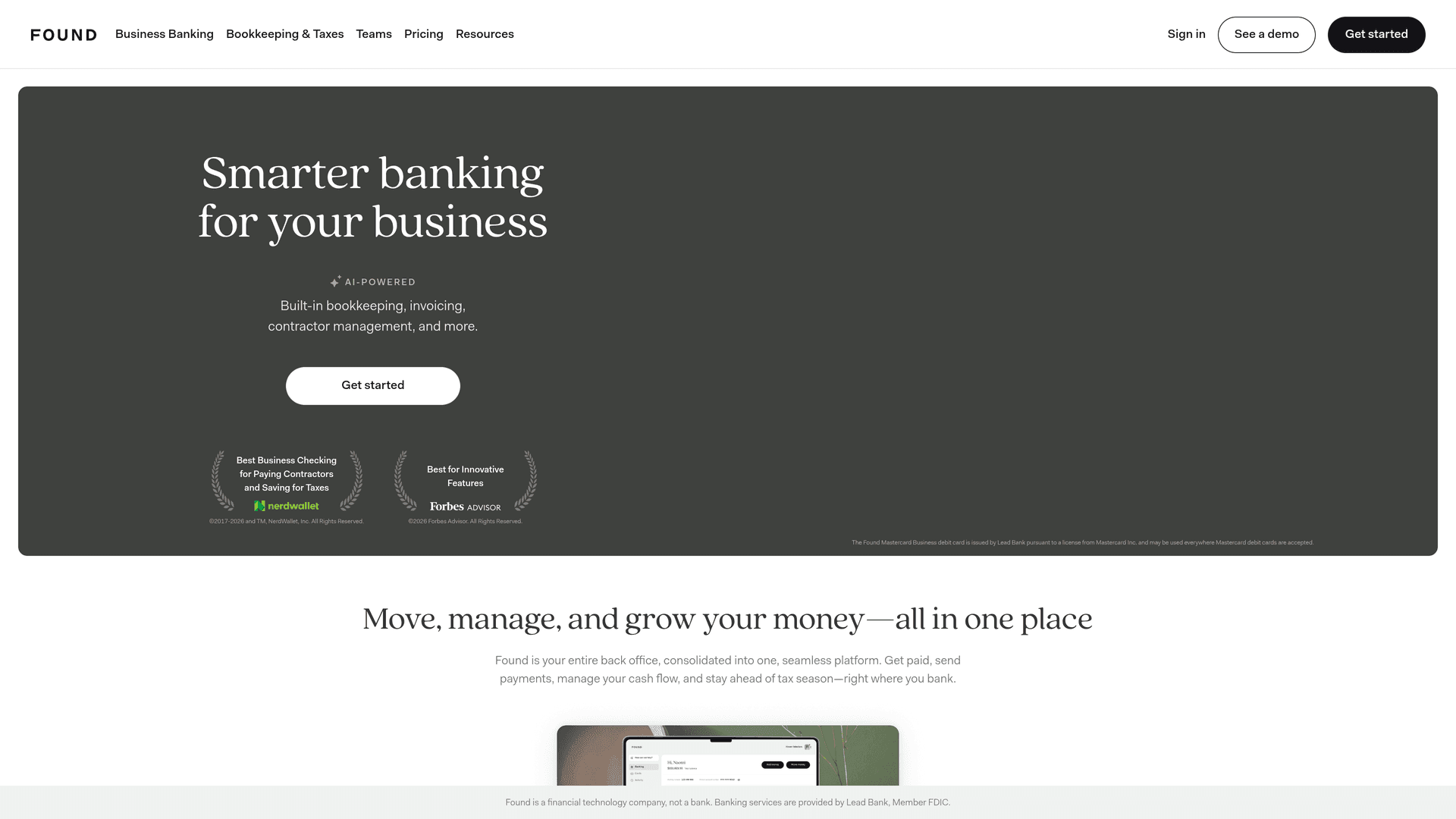
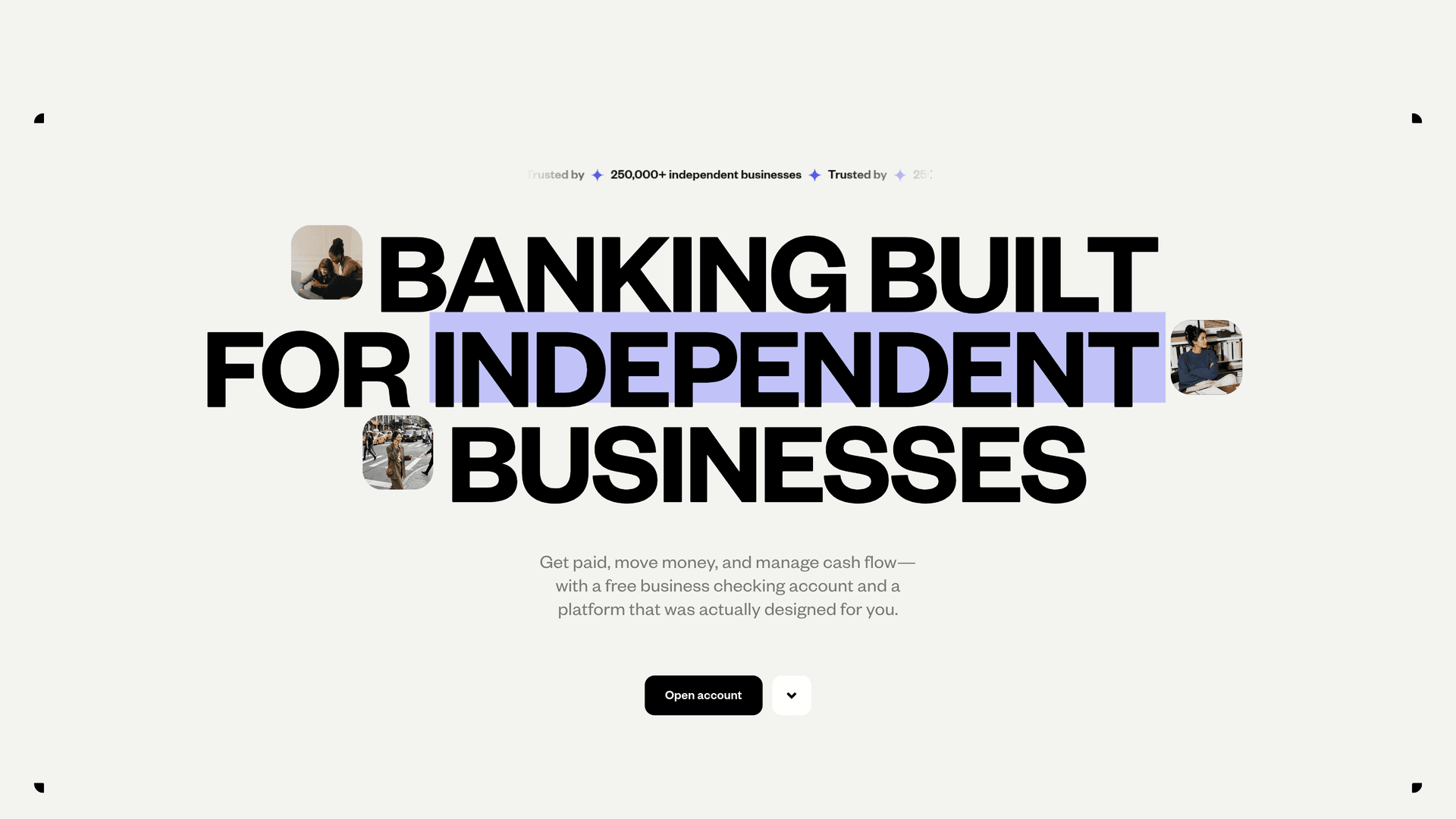
Found is banking for the Schedule C economy: checking (via Lead Bank — it switched from Piermont in October 2025), a debit card, and a bookkeeping-and-tax engine that estimates your self-employment taxes in real time, auto-sets money aside, detects write-offs, and generates your Schedule C. The free tier includes unlimited invoicing, contractor management with 1099-NEC e-filing, receipt capture, and 10 "Pockets" for envelope budgeting. Found Plus ($35/mo) adds 1.5% APY (to $20K), in-app quarterly federal tax payments, and human support; Pro ($80/mo) adds 2.5% APY on all balances and 1% cashback. Backed by a $50M Sequoia-led Series C, it serves 750,000+ self-employed owners. Note one 2026 change: full in-app business tax return filing was discontinued in March 2026 — the tax tooling now stops at form generation and quarterly payments.
For a sole proprietor, the tax layer is worth more than any APY: Found answers "how much of this invoice is actually mine?" continuously, which is the single question that sinks first-year freelancers. Nothing else on this list does it — Novo's Reserves are manual percentages; Found computes the percentage. The fit boundaries are sharp, though: the account opens on your SSN (EIN optional later), FDIC is the standard $250K with no sweep, cash deposits cost $2 with a $4K/month cap, there are no international wires at all, and the tax brain is built for Schedule C — an S-corp with payroll has outgrown it. The paid tiers price like SaaS, not banking ($420-960/yr), so do the math against a free account plus a bookkeeper. And the March 2026 removal of full tax filing shaved off the headline feature — what remains is still the best tax-aware bank account for solo operators, but the gap to a generic account plus QuickBooks Self-Employed narrowed.
Key Features
- Real-time self-employment tax estimates with automatic set-asides — the core differentiator
- Built-in bookkeeping: auto-categorization, write-off detection, receipt capture, Schedule C generation (Plus)
- Unlimited free invoicing + contractor 1099-NEC e-filing on the free tier
- Up to 2.5% APY on Pro (2.0% APY spend-bonus path on free tier with $5K/mo card spend)
- 10 Pockets for envelope budgeting; team cards with spend controls
Pricing
Free tier covers banking + invoicing + basic tax estimates. Plus $35/mo or $315/yr (1.5% APY to $20K, quarterly tax payments in-app, Schedule C). Pro $80/mo or $720/yr (2.5% APY uncapped, 1% cashback, $10 wires). Domestic wires only; cash deposits $2 each, capped.
Rating
4.6/5 — Trustpilot (1,200+ reviews)
Best For
Sole proprietors, freelancers, and one-person LLCs who want taxes handled contin...
Pros
- The only account here where taxes are a product, not a spreadsheet you owe yourself
- Free tier is genuinely useful (invoicing, 1099s, categorization) — 4.8/5 across 32K App Store ratings
- Pro's 2.5% uncapped APY is a top-three yield on this list
Cons
- Solo-shaped: SSN-based onboarding, $250K FDIC, no international wires, S-corps outgrow the tax engine
- Full in-app tax filing was removed in March 2026, and paid tiers cost SaaS money
Wise Business
Best for International Founders — 40+ Currencies, Local Details in 9, Mid-Market FX
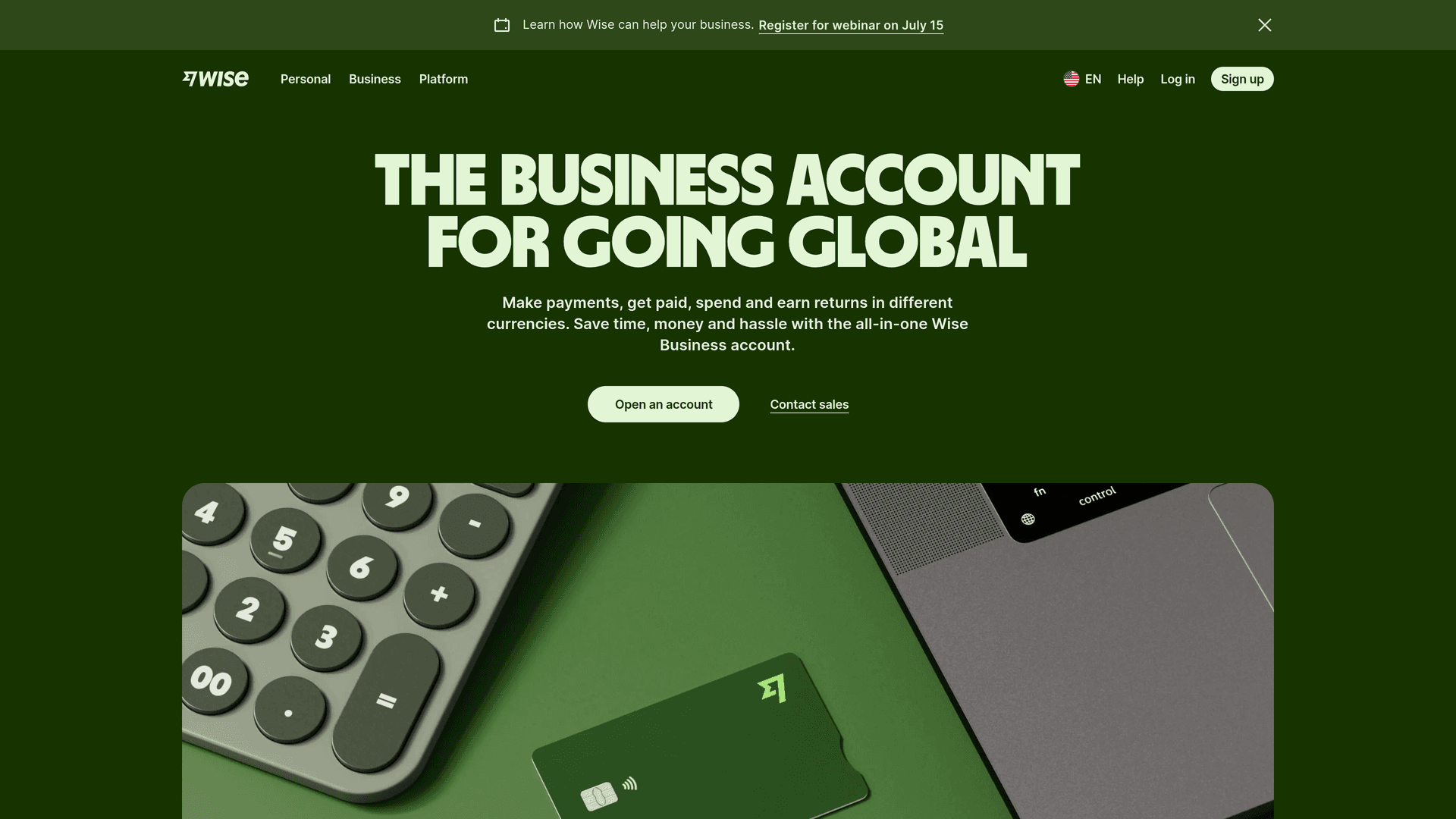
Wise Business is the international layer: hold 40+ currencies, get real local account details in ~9 of them (US ACH + wire, EUR IBAN, GBP sort code, AUD, CAD, SGD and more), and convert at the mid-market rate with fees from 0.57% on USD — against the 2-7% spread traditional banks bury in FX. The business account costs $31 once, then $0/month, with a real API for batch payouts (up to 1,000 transfers per call) and QuickBooks/Xero sync. Wise plc moved its primary listing to Nasdaq in May 2026 and has a US national trust bank charter application pending. Now the part that matters for this article: Wise is NOT a bank and NOT FDIC-insured by default — balances are safeguarded (segregated at program banks), which protects against Wise's insolvency but is not deposit insurance. Opt in to the interest feature (3.14% APY on USD, mid-2026) and your USD balance moves to JPMorgan Chase as program bank with $250K pass-through FDIC coverage.
If you're a non-US founder — or a US founder billing clients in three currencies — Wise solves problems the rest of this list can't touch: sole traders and companies registered in most of the world can open remotely with no SSN, invoice like a local in the US, UK, and eurozone, and keep FX costs visible instead of hidden in the rate. That earns it a permanent slot in the stack. Its boundaries are equally clear: no cash deposits, no checks, no credit, incoming USD SWIFT wires cost $6.11, and the safeguarding-vs-FDIC distinction means an uninvested balance is regulatorily protected but not insured — exactly the nuance this article exists to flag (turn on the interest feature; it fixes the insurance AND pays 3.14%). The complaint pattern is the category's: account deactivations "without any prior warning" (Wise explicitly doesn't share closure reasons) and security-check holds mid-transfer, amplified by a 2024-25 EU KYC remediation wave. Pair it with a primary US account rather than making it the treasury.
Key Features
- Hold 40+ currencies; local receiving details in ~9 (USD, EUR, GBP, AUD, CAD, SGD, NZD, HUF + more)
- Mid-market FX with fees from 0.57% on USD — no hidden spread, ever
- Open API with webhooks and batch payments (1,000 transfers per action) on the $0/mo account
- Non-US-resident founders are first-class: most countries supported, no SSN required
- Interest opt-in: 3.14% APY on USD + $250K pass-through FDIC via JPMorgan Chase as program bank
Pricing
$31 one-time setup, then $0/month. Conversions from 0.57% (USD). Local-rail receiving free in 9 currencies; incoming USD SWIFT $6.11. First debit card free, extras $5. ATM free to $250/mo withdrawn.
Rating
4.3/5 — Trustpilot (294,000+ reviews)
Best For
International founders, and any business invoicing or paying across currencies —...
Pros
- Unmatched multi-currency operations and the most transparent FX pricing in banking
- The genuinely global option: most nationalities and entity types can open remotely
- 294K+ Trustpilot reviews at 4.3 — the largest verified track record on this list by two orders of magnitude
Cons
- Not FDIC-insured unless you opt into the interest feature (and even then, $250K via the program bank)
- Deactivation/hold complaints with unexplained closures; no cash handling, checks, or credit
Chase Business Complete Banking
Best Big-Bank Ballast — Branches, Cash Deposits, and the Second Account You Should Have Anyway
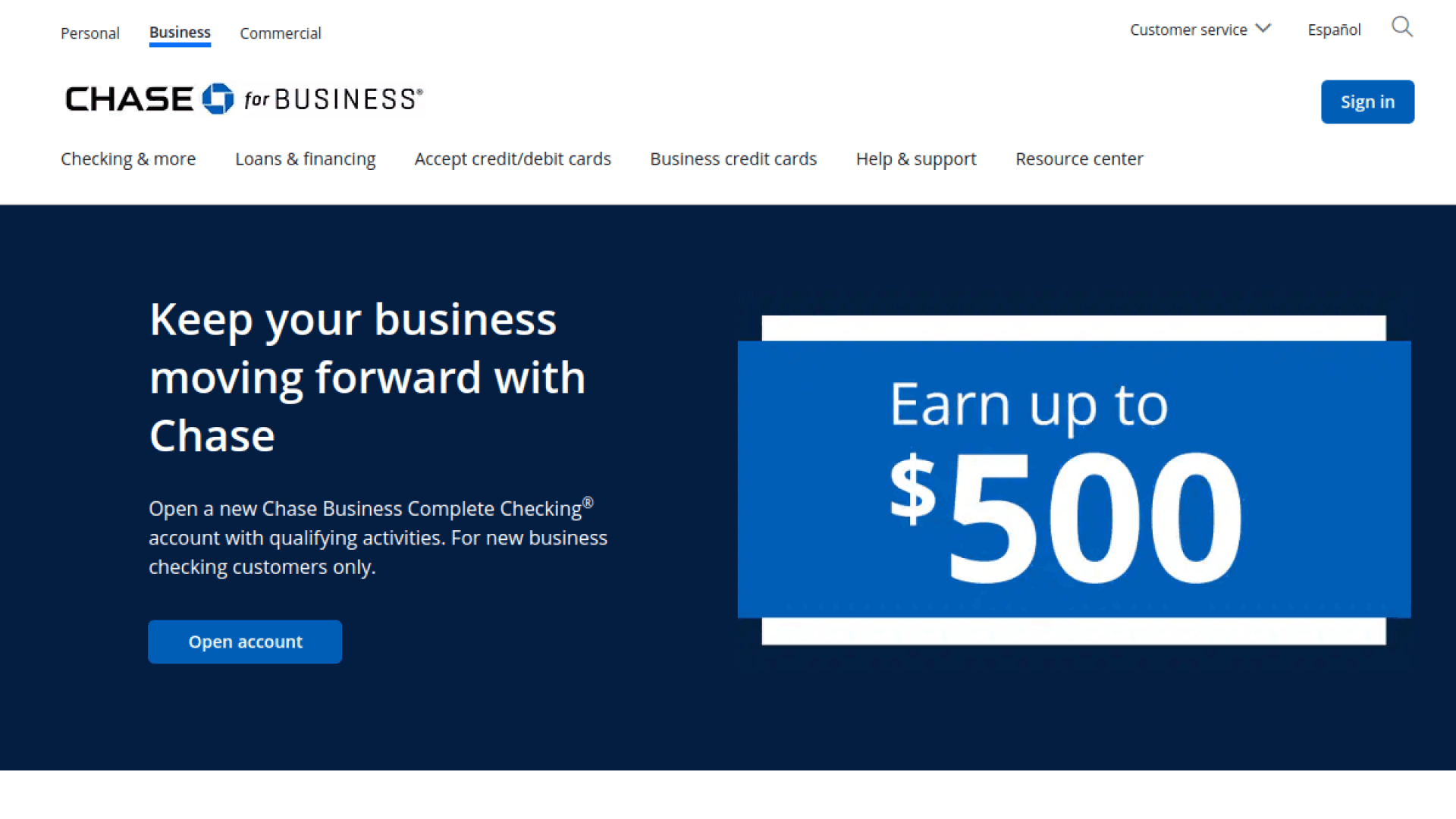
Chase Business Complete Banking is on this list for one strategic reason: after SVB, the standard startup playbook became a fintech platform for operations plus a systemically-important bank as ballast — and Chase's share of startups jumped from ~15% pre-SVB to over 60% by end-2023 (Kruze client data). For $15/month — waived with a $2,000 minimum daily balance, $2,000 in Ink card spend, or $2,000 in QuickAccept deposits — you get ~5,000 branches, $5,000/month in free cash deposits, built-in card acceptance with free same-day settlement, Zelle, and the Ink business credit card ecosystem. It is exactly what the fintechs aren't: a $4.9 trillion chartered bank where your money sits under plain-vanilla FDIC coverage ($250K, no sweep on this account) and a human at a branch can unstick a problem.
Treat Chase as infrastructure, not as your daily driver. The account pays 0.00% APY across every tier, wires are paper-era expensive ($25-35 domestic out, $40-50 international USD), the $2,000 waiver checks your balance every single day, and its risk models — built for Main Street — greet a Delaware C-corp's first $500K SAFE wire with holds and reviews (Trustpilot is 1.3/5, though Chase doesn't solicit reviews there, so it skews complaint-heavy). But as the second account holding a month of payroll, taking the occasional cash deposit, and anchoring an Ink card line, it does the one thing no fintech can: exist for 200 years with branches. QuickAccept's 2.6% + $0.10 processing with free same-day settlement is a legitimate bonus for anyone selling in person. Open it, park ballast, meet the waiver, and run your operations on #1-#6.
Key Features
- The two-bank strategy's ballast leg: a systemically-important chartered bank as your backstop
- ~5,000 branches + $5,000/month free cash deposits — the only real cash-handling option here
- QuickAccept card processing (2.6% + $0.10) with free same-day settlement built into the account
- Ink business credit cards — top-tier startup cards whose spend also waives the checking fee
- Unlimited free electronic deposits/ACH; Zelle for business
Pricing
$15/mo, waived via $2,000 min daily balance OR $2,000 Ink card spend OR $2,000 QuickAccept deposits. Wires: $15 in / $25-35 out domestic / $40-50 out international USD ($0 FX wires $5K+, with a 2-7% rate markup). Welcome bonus up to $500 (through July 17, 2026).
Rating
1.3/5 — Trustpilot (2,700+ reviews)
Best For
Every startup — as the second account. Primary only for cash-heavy or in-person ...
Pros
- Branches, cash deposits, Zelle, and 200 years of not disappearing — the exact inverse of fintech risk
- QuickAccept + Ink ecosystem genuinely earns its keep for in-person and card-spend-heavy businesses
- Fee waiver is achievable, and the current signup bonus (to $500) is free money for ballast you should hold anyway
Cons
- 0.00% APY everywhere, $250K plain FDIC, and wire fees from another decade
- Main Street risk models: new tech companies report holds, frozen funds, and 180-day closure limbo (1.3/5 Trustpilot, complaint-skewed)
What We Cut — And Why
The cuts say as much about the category as the picks. Each of these is a real product someone will tell you to use; here's why they didn't make the ten:
- Brex — the deliberate exclusion. It's a genuinely strong platform for venture-backed companies at scale (up to $6M FDIC via its Vault sweep, ~3.7% treasury yield), but it fails this list's audience three ways: eligibility still effectively requires professional funding or serious revenue (plus a $50K minimum balance for the startup tier); in June 2022 it offboarded tens of thousands of small businesses with ~60 days' notice, later admitting it "did a poor job explaining" the decision; and as of April 7, 2026 it's a Capital One unit — fine for stability, but the roadmap now answers to a top-10 bank's priorities, not yours. If you're post-Series-A with a finance team, evaluate it; if you're anyone else, it doesn't want you yet.
- Silicon Valley Bank (First Citizens) — still a legitimate relationship bank for later-stage venture companies, but First Citizens announced in April 2026 that the SVB name is being retired (rebranding to "First Citizens Innovation Banking" in Q4 2026). We don't recommend a brand that won't exist by year-end, layered on residual 2023 trust damage.
- Arc — pivoted from startup banking to an AI-powered private credit marketplace; the deposit product (a Stripe Treasury implementation) now exists to feed the capital-markets business. Buy your operating account from a company whose roadmap is your operating account.
- Slash — hit unicorn status in April 2026, but its growth engine is stablecoin infrastructure (its USDSL passed $1B in annualized volume) and vertical accounts for affiliate marketers and e-commerce operators. Impressive company, different lane.
- American Express Business Checking — 1.30% APY on the first $500K and no monthly fee is a fine parking spot, but there's no startup tooling, no cash deposits, no API, and treasury competitors pay 3-4%. A nice rate is not a platform.
- North One, Lili, Axos — solid Main Street neobanks, wrong audience: North One charges $20 domestic wires on the free tier and has no startup DNA; Lili paywalls its useful tax features at $15-55/mo for a freelancer product Found does better; Axos is a generic online bank with, per NerdWallet's 2026 review, "spotty support and a subpar mobile app."
- Highbeam — deliberately niche: banking plus credit lines for DTC/e-commerce brands doing $3M-$50M. If that's you, look at it; it's not a general startup pick.
- Ramp Treasury — out of scope by design: it's a cash-management layer inside Ramp's spend platform (deposits via First Internet Bank, ~2% yield) built to fund card statements and bill pay, not to be your primary operating bank. We cover spend management separately.
How We Chose These Platforms
We evaluated 19 banking platforms in July 2026 against five startup-specific criteria. Most competing lists rank by signup bonus or rank themselves; we weighted what the marketing pages leave out.
- Custody & insurance mechanics — which chartered bank holds deposits, sweep-network structure and advertised caps, and what actually happens in a fintech-failure scenario (the Synapse test)
- Real cost & yield at founder balances — fees on the flows startups actually run (ACH, wires, FX) and what $50K-$500K of idle cash earns, benchmarked against the ~3.7% T-bill rate
- Eligibility honesty — who can actually open the account: entity types, international founders, SSN/ITIN requirements, restricted industries — checked against official requirements pages, not marketing
- Freeze-and-hold patterns — the complaint every platform accumulates: how often accounts lock, how opaque the process is, and whether support escalates or goes silent (Trustpilot/BBB/Reddit, weighted by review volume)
- Platform risk — acquisitions in flight (Brex→Capital One, Grasshopper→Enova), charter progress (Mercury), partner-bank churn, funding runway, and 2022-style customer purge history
How to Choose by Situation
Pick by your structure and cash position, not by brand. The same account can be perfect at $5K MRR and wrong the week your seed round lands.
Funded startup, US entity...
Mercury as the platform, Chase as ballast. Add Rho instead if you want cards + AP + expenses consolidated free.
Bootstrapped with real cash flow...
Relay for allocation-style control (Profit First), or Bluevine if yield on checking + a credit line matter more.
Solo operator or freelancer...
Found if self-employment taxes are your main pain; Novo if you just want clean free checking with invoicing and fast Stripe payouts.
Sitting on a raise ($100K+ idle)...
Meow for direct T-bills at 1bp/mo, Rho Treasury or Mercury Treasury to keep it inside your operating platform. Target 3.3-3.8% net.
Non-US founder or offshore entity...
US entity, foreign founder: Mercury. Offshore entity: Meow. Multi-currency operations or neither works: Wise Business.
Burned by the Synapse story...
Grasshopper (the app IS the chartered bank) or Chase. No middleware, no pass-through conditions — at the cost of fintech polish.
Stay Ahead of the Tool Curve
We research dozens of tools so you don't have to. Get our top picks and insider insights delivered weekly.
Frequently Asked Questions
What is the best business bank account for startups in 2026?
For most funded startups: Mercury — the free tier covers ACH, wires, sub-accounts, bill pay, and corporate cards, deposits are swept across partner banks for up to $5M in FDIC coverage, and its conditional OCC charter approval (April 2026) means the fintech-middleware caveat is on its way out. Bootstrappers who manage cash by allocation should look at Relay; revenue-funded businesses that want yield plus a credit line should look at Bluevine; founders who want an actual chartered bank should look at Grasshopper. Whatever you pick, the post-SVB standard is two accounts — add a big-bank ballast account (Chase or similar) alongside your fintech platform.
Are Mercury, Relay, and Novo actually banks?
No — they are fintechs. Your deposits legally sit at chartered partner banks: Choice Financial Group and Column N.A. for Mercury, Thread Bank for Relay, Middlesex Federal Savings for Novo, Coastal Community Bank for Bluevine, Webster Bank for Rho, Lead Bank for Found, Cross River and Grasshopper for Meow. That layer is why this article ranks by "who holds your money": FDIC insurance protects you if the BANK fails, not if the fintech between you and the bank fails. The exceptions on this list: Grasshopper IS a chartered bank, Chase IS a chartered bank, and Wise is neither a bank nor FDIC-insured by default (it safeguards funds, which is a different protection). Mercury holds conditional approval to become Mercury Bank, N.A. — final approval possibly in 2027.
Why isn't Brex on this list?
Three reasons. First, eligibility: Brex still effectively requires professional funding (any equity investment plus a $50K minimum balance) or serious revenue — most bootstrappers and solo founders can't open an account at all. Second, history: in June 2022 Brex offboarded tens of thousands of small-business customers with roughly 60 days to move their money, admitting afterward it "did a poor job explaining" the decision. It was within its rights; it was also a live demonstration of what happens when you're not the customer a platform wants. Third, ownership: Capital One closed its $5.15B acquisition of Brex on April 7, 2026 — the product continues under its own brand, but the roadmap now serves a top-10 US bank's priorities. If you're venture-backed at scale, Brex remains genuinely good (up to $6M FDIC via its Vault sweep). For everyone else, the platforms above want your business unconditionally.
How much FDIC insurance do I actually get — and what happened with Synapse?
Standard FDIC coverage is $250K per depositor, per bank. The multi-million figures fintechs advertise ($3M at Relay/Bluevine, $5M at Mercury, $75M at Rho, $125M at Grasshopper) come from sweep networks that split your balance into sub-$250K slices across many program banks — legitimate, but conditional on accurate records of who owns what. The Synapse collapse (April 2024) is the cautionary tale: the middleware company between several fintech apps and their banks went bankrupt with ~$265M of customer money frozen and a $65-95M gap between its ledgers and what the banks actually held. No bank failed, so FDIC insurance never triggered; the bankruptcy was dismissed in November 2025 with a $46M CFPB fund covering only part of the shortfall. Lessons: prefer platforms that name their banks and publish their sweep mechanics (everything ranked here does), and don't keep 100% of your runway behind any single app.
What's the best business bank account for non-US founders?
Depends on your structure. If you have a US LLC or C-corp but live abroad: Mercury is the strongest full-featured option — it onboards non-US residents remotely, though founders residing in its prohibited-country list (expanded in 2024 to include Ukraine, Nigeria, Pakistan, and others) are excluded. If your entity itself is offshore (Cayman, BVI): Meow is nearly alone in accepting non-US structures. For multi-currency operations or if you can't get a US account at all: Wise Business opens for businesses registered in most countries with no SSN, and gives you real US ACH details. Relay, Novo, Found, Grasshopper, and Chase all effectively require US residency, an SSN/ITIN, or both; Bluevine historically did too, though in 2026 it began advertising accounts for international owners of US businesses — verify its current requirements directly.
Should my startup use two bank accounts?
Yes — this is the clearest post-SVB consensus in startup finance. The pattern: a fintech platform (Mercury, Relay, Rho) as the operating layer for its tooling, plus a systemically-important bank (Chase went from ~15% to 60%+ of startups after SVB) holding a reserve — commonly 1-3 months of payroll. The reasoning covers both failure modes this article documents: a bank failure (SVB) is survivable if you can run payroll from the second account while insurance resolves, and a fintech freeze (the Synapse pattern, or an ordinary compliance hold — documented at every platform on this list) is survivable if your reserve sits behind a different front door. Sweep insurance solves the insurance problem; it does not solve the access problem. Two accounts solve both.
What should my startup's idle cash earn in 2026?
Benchmark against the risk-free rate: the Fed held at 3.50-3.75% in June 2026 and the 3-month T-bill yields about 3.7%. Realistic tiers: treasury products (Mercury Treasury at $250K+, Rho Treasury and Meow at $100K+) net roughly 3.0-4.4% after fees; interest-bearing checking pays 1-3% (Bluevine up to 3.0% on Premier, Grasshopper 1.35% plus 1% cashback, Found Pro 2.5%); and the default at Mercury, Rho, Novo, and Chase is 0%. The math founders skip: $500K idle at 0% instead of 3.7% forfeits ~$18,500 a year. One warning sign: the June 2026 Fed dot plot leaned toward holds or even a hike, not cuts — so treat any account advertising well above T-bill yield as a prompt to read the conditions, not a bargain.
The Bottom Line
Startup banking in 2026 is a custody decision wearing a features comparison as a disguise. The apps look identical in screenshots; what differs is who legally holds the money (a partner bank, a sweep network, or the platform's own charter), what your idle cash earns against a 3.7% T-bill benchmark, and what happens on the bad day — a compliance freeze, a middleware failure, or an incumbent deciding you're no longer its customer, as Brex's small businesses learned in 2022.
The playbook for most founders: open Mercury (or Relay if you run Profit First, Bluevine if you want yield plus credit) as the operating layer, add Chase as the ballast account with a month or three of payroll, and put anything beyond that into T-bill-backed treasury — Meow, Rho, or your platform's own product — the week the wire lands, not next quarter. Solo operators: Found or Novo and get back to work. International founders: Mercury, Meow, or Wise depending on your structure.
Whatever you pick: know your partner bank's name, turn on every yield feature you qualify for, keep two accounts, and re-read the fine print before wiring the round in. The platforms aren't hiding who holds your money — they're just not leading with it.
Related Reading
- 10 Best Corporate Travel Management Software in 2026 — The other half of your money stack, ranked by what 10 trips a month actually cost
- $300B in One Quarter: The Two-Tier Startup Economy Is Here — What the funding environment means before that wire lands
- Stripe's Agentic Commerce Play: An Indie Hacker Playbook — The payments layer that sits on top of whichever account you pick
- The Solopreneur AI Stack Costs Under $200/Month in 2026 — The rest of the stack for the Found/Novo crowd
- 10 Best Website Builders in 2026 (Ranked by Real Cost and Lock-In) — The same no-affiliate-bias treatment, applied to your website
Sources
- Mercury — Official Pricing
- Relay — Official Pricing
- Bluevine — Plans and Pricing
- Grasshopper Bank — Startup Banking
- Rho — Official Pricing
- Meow — Official Site & Treasury
- Novo — Official Site
- Found — Official Pricing
- Wise Business — US Pricing
- Chase — Business Complete Banking
- CFPB — Synapse Financial Technologies Enforcement Action
- FDIC — Banking With Third-Party Apps (consumer guidance)
- FDIC — Proposed Recordkeeping Rule for Custodial Deposit Accounts (Sept 2024)
- Fintech Business Weekly — The Synapse-Evolve Disaster, One Year On
- Banking Dive — Synapse Bankruptcy Dismissed (Nov 2025)
- CNBC — Mercury Raises $200M Series D at $5.2B; Bank Charter (May 2026)
- Banking Dive — Mercury Nabs Conditional OCC Charter (April 2026)
- Capital One — Completes Acquisition of Brex (April 7, 2026)
- CNBC — Brex Drops Small-Business Customers (June 2022)
- Enova — Definitive Agreement to Acquire Grasshopper Bank (Dec 2025)
- Kruze Consulting — Startup Banking Market One Year After SVB (client data)
- Federal Reserve — FOMC Statement, June 17, 2026
- Bluevine — 1 Million Businesses Served Milestone (June 2026)
- American Banker — First Citizens to Drop SVB Name (April 2026)
Stay Ahead of the Tool Curve
We research dozens of tools so you don't have to. Get our top picks and insider insights delivered weekly.
Trusted by indie hackers and startup founders
Keep Reading
7 Best AI App Builders for Non-Technical Founders in 2026
The best AI app builders for non-technical founders, ranked by what you can actually launch: user accounts, data, payments, publishing, costs, and exit paths.
7 Best AI Search Visibility Tools for Agencies in 2026
Seven AI search visibility tools ranked for agencies by client workspaces, reporting, prompt economics, and the real cost of managing multiple brands.
10 Best Granola Alternatives for Private AI Meeting Notes (2026)
The best Granola alternatives in 2026, ranked on where your notes are stored, whether your data trains AI, and what a bot-free notetaker really costs. Verified pricing.