
10 Best Corporate Travel Management Software in 2026 (Ranked by What 10 Trips a Month Actually Cost)
The 10 best corporate travel management software for startups and small teams in 2026 — Perk, Engine, Itilite, Brex Travel, Ramp Travel, Corporate Traveler, Otto, BizAway, Spotnana, and Booking.com for Business. Ranked by the number the demos skip: what 10 trips a month actually cost under each fee meter — percentage booking fees, flat per-trip fees, subscriptions, or "free" funded by supplier commissions — and who actually answers when your 7 a.m. flight cancels. With newly public Navan's S-1-disclosed ~7% take rate as the cautionary anchor.
Nobody sells you flights at cost. The only question is which meter you're on.
Every platform on this list moves the same inventory — the same GDS, NDC, and hotel feeds. What differs is how you pay: a percentage of every booking (Perk: 3-5%), a flat fee per trip (Itilite $10, BizAway €5), a per-transaction agency schedule ($5-35 per booking, $25-45 per agent touch, per GBTA benchmarks), or "free" — funded by hotel commissions of 10-25%, GDS incentives of a few dollars per flight segment, and card interchange. That last meter is the one founders misread: Navan's own IPO filing disclosed a usage yield of roughly 7% of gross bookings. You don't get an invoice; the economics ride inside your fares — and a platform paid by commission has weak incentive to surface the cheapest non-commissionable rate. So every entry below leads with its meter, and the one universal rule is: get percentage-fee caps and per-touch fees in writing before you sign.
Key Takeaways
- Perk (formerly TravelPerk — it rebranded in November 2025) is the best overall pick for startups: the only category leader with published self-serve pricing ($0/month + 5% per booking, or $99/month + 3%), real US inventory including Southwest, and an 80%-back cancel-anything guarantee. The crossover math: Premium beats Starter once you book more than ~$4,950/month of travel.
- The fee model, not the feature list, is the actual decision. On identical travel — 10 trips a month, about $91K/year booked — your platform cost ranges from roughly $840/year (Itilite with a pre-funded wallet) to $8,400/year (agent-heavy classic TMC). A 10x spread for the same flights and hotel rooms.
- "Free" is not a discount; it's a different counterparty. Navan's IPO filing disclosed a usage yield of roughly 7% of gross bookings — collected as booking fees, supplier commissions, and card interchange. A platform paid by commission has weak incentive to surface the cheapest non-commissionable rate, which is why "prices higher than booking direct" is the category's #1 complaint.
- Navan is deliberately not ranked here. It IPO'd in October 2025 at $25, dropped 68% to $8.11 by March, lost its CFO ten weeks after listing, and is now visibly chasing Fortune 500 logos (up 61% year over year, ~$61K average revenue per customer). It remains a genuinely strong product — G2 4.7 across ~9,100 reviews — but a public company optimizing for $61K accounts is not optimizing for your 8-person startup.
- Support quality is the real product. 2025 was the worst US on-time year since 2014 — 76.3% on-time, roughly 1 in 4 flights delayed, canceled, or diverted. At 10 trips a month, expect 2-3 disrupted legs every month. Check who answers (own agents vs. outsourced vs. an OTA queue) and what an agent touch costs: included at Perk, Itilite, and Engine; $25-45 per touch in classic TMC fee schedules.
- Below roughly five trips a month you may not need any of this. A corporate card, Google Flights, and a shared sheet is a legitimate stack until policy enforcement, guest travel, or duty of care forces the upgrade — GBTA says classic TMCs generally don't want you below $250K in annual travel spend anyway.
Search for the best corporate travel management software and count who's doing the ranking: Ramp ranks Ramp first, Brex ranks Brex first, BILL ranks BILL first, Navan ranks Navan first — of the dozen listicles competing for this page, at least eight are written by a vendor that put itself at #1, and only one of them works out what any of it costs at real volumes. We don't sell travel software, nobody paid to be here, and every pick below leads with the number the demos skip: the fee meter, and what it produces at ten trips a month.
The category had its loudest year since the pandemic. Navan — the biggest brand in startup travel — went public in October 2025 at $25, fell 68% to $8.11 by March, lost its CFO ten weeks after listing, then clawed back to its IPO price on two strong quarters while pivoting hard toward Fortune 500 logos. TravelPerk rebranded to Perk, swallowed a US TMC (AmTrav) and an expense platform (Yokoy), and raised $300M more. Coupa retired its travel product entirely in January 2026; Amex GBT finished absorbing CWT; American Express bought Center; Routespring pivoted to airline crews. Meanwhile 2025 set the wrong kind of record in the air: the worst US on-time performance since 2014, with roughly one in four flights delayed, canceled, or diverted — which is exactly why "who answers at 2 a.m., and what does that call cost" matters more than any feature grid.
Every entry below covers verified pricing from official pages (as of mid-July 2026 — fees move), the fee meter and its hidden layers, who actually fulfills and services the trip, review scores with their real base sizes, and the complaint patterns that show up after the honeymoon. Where a number couldn't be independently verified, we say so.
Quick Comparison
| # | Platform | Best For | The Meter | Rating |
|---|---|---|---|---|
| 1 | Perk (formerly TravelPerk) | Best Overall for Startups | $0 + 5%/booking, or $99/mo + 3% | 4.6 |
| 2 | Engine | Best Genuinely Free Platform | Free — disclosed hotel commissions | 4.6 |
| 3 | Itilite | Best Flat-Fee Predictability | $10/trip flat ($7 pre-funded) | 4.5 |
| 4 | Brex Travel | Best Travel Inside a Spend Platform | Free with Brex; Premium $12/user/mo | 4.8 |
| 5 | Ramp Travel | Best Free Add-On for Ramp Customers | Free with Ramp; Plus $15/user/mo | 4.8 |
| 6 | Corporate Traveler (Melon) | Best Human Agency for SMBs | Per-transaction, quote-only (TMC) | 4.7 |
| 7 | Otto | Best AI-Native Pick for Solo Founders | $10/mo flat — free year one | Too new — no base |
| 8 | BizAway | Best for EU-Heavy Teams | €5 per booking, no subscription | 4.7 |
| 9 | Spotnana | The Infrastructure Inside Half This List | Flat per-trip, via partner platforms | 4.6 |
| 10 | Booking.com for Business | Best Free Zero-Commitment Option | Free — OTA commissions | 4 |
Ratings are G2 except BizAway (Capterra); Brex and Ramp scores are platform-wide, not travel-specific; Otto has no public review base yet (GA December 2025). Fee figures are official-page numbers as of July 2026 — see each entry for the fine print.
What 10 Trips a Month Actually Cost
The scenario: a team taking 10 trips a month, each averaging one domestic flight at $400 (the 2025 BTS average itinerary fare was $387, and Q1 2026 rose 4.7%) plus two hotel nights at $180 (US ADR has been running $166-169). That is $760 per trip, 20 bookings and $7,600 booked per month — $91,200 a year. Same flights, same rooms, ten different bills:
| Meter | The math | Annual cost | % of travel spend |
|---|---|---|---|
| Itilite, pre-funded wallet | $7 × 10 trips | $840 | 0.9% |
| Itilite, standard | $10 × 10 trips | $1,200 | 1.3% |
| BizAway Advanced | €5 × 20 bookings ≈ €100/mo | ~€1,200 | ~1.4% |
| Classic TMC, online bookings | 20 transactions × $10-20 | $2,400-4,800 | 2.6-5.3% |
| Perk Premium | $99/mo + 3% of $7,600 | $3,924 | 4.3% |
| Perk Starter | 5% of $7,600/mo | $4,560 | 5.0% |
| Classic TMC, agent-booked | 20 transactions × $25-35 | $6,000-8,400 | 6.6-9.2% |
| "Free" (Navan, Engine, Ramp/Brex, Booking.com) | $0 invoiced — commissions + interchange ride inside fares (Navan S-1: ~7% blended take) | $0 invoiced | 0% billed; economics embedded |
Three things fall out of the table. The spread is 10x between the cheapest metered option and an agent-heavy TMC, for identical travel. Percentage fees are a tax on airfare inflation — when fares rose 4.7% in Q1 2026, every 5%-model customer's fee rose with them, for zero extra work. And the crossovers are computable: Perk Premium beats Starter above $4,950/month of bookings ($99 ÷ 2% spread), so most teams at this scenario's volume should skip Starter entirely. Add the two costs no meter shows: unused tickets (5-10% of corporate air spend leaks into credits nobody reclaims — $2,400-4,800/year in this scenario) and disruption handling, which at 2025's rates (roughly 1 in 4 flights) hits this team 2-3 times a month — either included (Perk, Itilite, Engine, Spotnana-serviced platforms) or billed at $25-45 a touch (classic TMC schedules).
Perk (formerly TravelPerk)
Best Overall for Startups — Published Pricing, Southwest Inventory, Cancel-Anything Guarantee
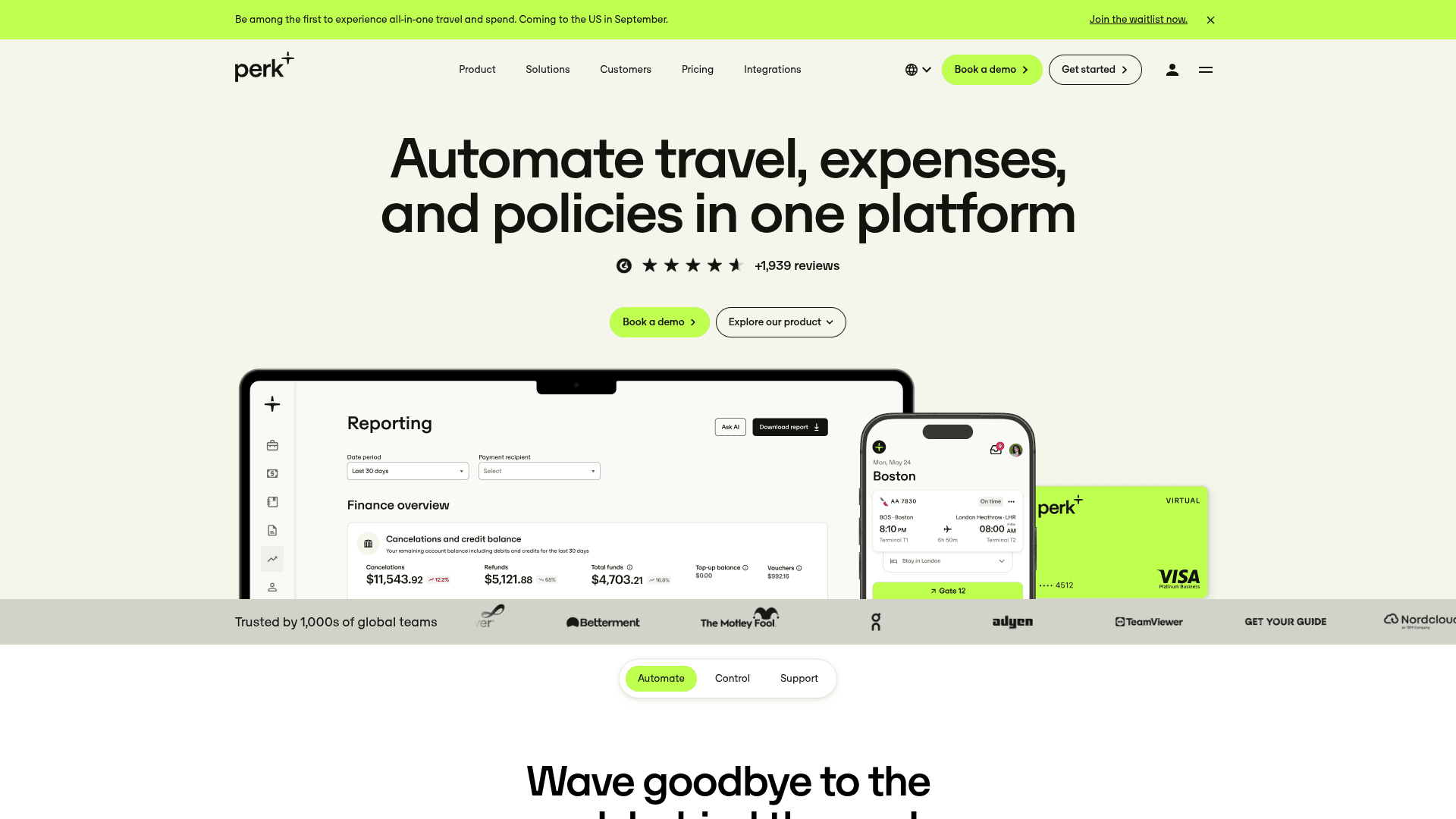
Perk is the category leader that still publishes its prices — rare in a market where everything else says "book a demo." TravelPerk rebranded to Perk in November 2025 after a year of consolidation: a $200M Series E at a $2.7B valuation, the acquisition of Swiss expense platform Yokoy, US TMC AmTrav folded in (doubling US revenue), and a $300M credit facility in June 2026 to fund the AI push. The pricing is a clean hybrid: Starter is $0/month plus 5% per booking; Premium is $99/month plus 3%; Pro is $299/month plus 3%. Inventory is genuinely US-competitive — all four major US carriers including Southwest, plus NDC connections to ~20 airlines. FlexiTravel, the standout feature, lets you cancel any trip up to shortly before departure and recover 80% of the money. On July 13, 2026 it shipped Perk MCP, making it the first travel platform your AI tools can book through natively.
For a 10-50 person team, Perk hits the sweet spot: self-serve signup today, policies and approvals that work without an admin hire, and fee math you can actually compute before you commit. Do the crossover arithmetic — 5% vs. $99 + 3% breaks even at $4,950/month of bookings, so a team past ~$60K/year of travel should start on Premium, not Starter. Go in clear-eyed about two things. First, the booking fees carry "min/max thresholds" that Perk does not publish (third-party trackers report ~$2 min, ~$30 max) — get the caps in writing from sales before you sign. Second, the support gap: Perk markets 24/7 human support with a 15-second response target, but Trustpilot's recurring complaint is multi-hour waits and agent handoffs during real disruptions, plus fares that sometimes exceed booking direct — the standard tax of any platform that also earns supplier commissions. It's still the most complete, most transparent option for a US startup, which is why it's #1.
Key Features
- Published self-serve pricing: $0/mo + 5% per booking (Starter), $99/mo + 3% (Premium), $299/mo + 3% (Pro) — the only major player with numbers on the page
- US inventory that actually competes: Southwest included, NDC content across ~20 carriers, plus AmTrav's US TMC operation absorbed in 2024
- FlexiTravel: cancel any trip and get 80% back, no questions — the strongest flexibility guarantee in the category
- Perk Spend (ex-Yokoy) folds expense, invoices, and cards into the same platform; US travel+spend bundle launching September 2026
- Perk MCP (July 2026): book and query travel from Claude, ChatGPT, and other AI tools — first mover on agentic booking
Pricing
Starter $0/mo + 5% per booking. Premium $99/mo + 3%. Pro $299/mo + 3%. Booking fees have unpublished min/max caps (~$2/$30 per third-party trackers — confirm in writing). 24/7 support and FX included; FlexiTravel add-on priced per trip. EU travel+spend bundles from ~$11/user/mo.
Rating
4.6/5 — G2 (1,780+ reviews)
Best For
Startups and SMBs booking $5K-$50K/month of travel that want published pricing, ...
Pros
- Transparent hybrid pricing with computable crossover math — no demo required to know your costs
- Best-in-class flexibility (FlexiTravel 80% back) and genuinely deep US + EU inventory
- Momentum: Yokoy expense integration, AmTrav US muscle, $300M facility, first-to-MCP
Cons
- Booking-fee min/max caps are not published — a 5% fee on a $1,500 international fare is $75 unless the cap says otherwise
- Support target (15 seconds) vs. Trustpilot reality (hours, during disruptions) is the recurring gripe, along with occasional fares above direct prices
Engine
Best Genuinely Free Platform — Hotel-First, Direct Bill, No Card Required
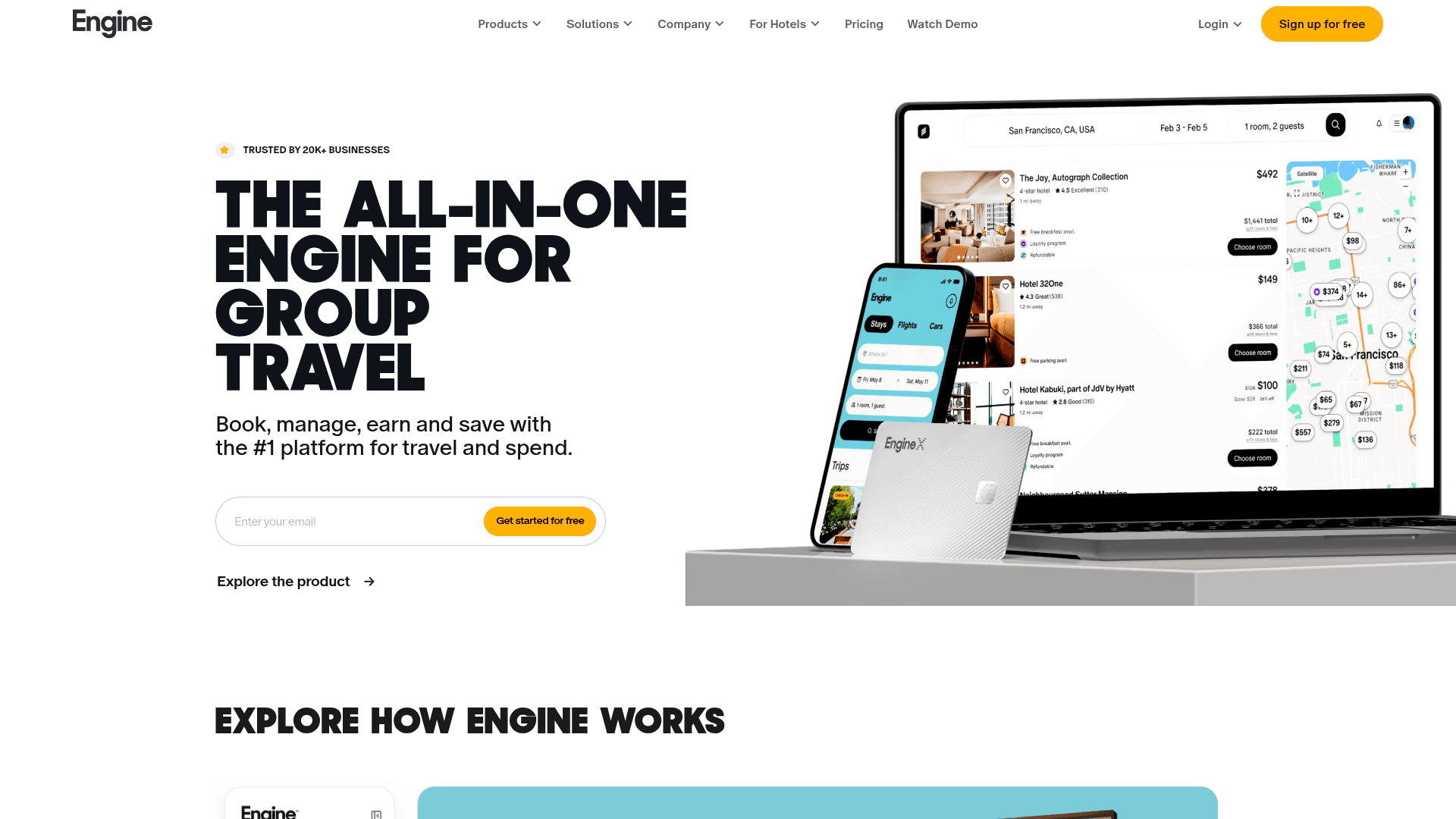
Engine (Hotel Engine until its October 2024 rebrand) is the anti-SaaS answer: actually free — no membership fees, no contracts, no minimum spend, no agent-assist fees — and unusually honest about why: "Hotels pay us a commission for bringing them business." Built on a decade of workforce-lodging DNA, it covers 1M+ properties in 185+ countries with unusually deep coverage of the roadside and extended-stay hotels field teams actually use, and added flights and rental cars in late 2024. Two features matter most for small operators: Direct Bill, which consolidates every booking onto one monthly invoice so crews don't need corporate cards, and FlexPro ($200/month or $2,000/year flat, company-wide), which makes every hotel booking cancellable until noon on check-in day. It's profitable, grew ~70% year over year into a $2.1B valuation (Permira-led Series C, September 2024), and launched Engine Spaces — free meeting-space booking across 40,000+ US venues — in February 2026.
If your travel is mostly hotel nights — field services, construction, on-site sales, implementation teams — Engine is the honest version of the "free platform" trade: commission funds the product, and Engine says so on its pricing page instead of burying it. The claimed average 26% hotel savings is a vendor number, but the structural pitch holds: it negotiates rates in exactly the hotel tier big TMCs ignore. Know the boundaries. Flights and cars are new and thinner than the hotel core (Southwest specifically is unconfirmed — check in-app before you commit), there's no rail, and the worst failure mode is documented and painful: virtual-card or Direct Bill payments occasionally failing at the front desk, stranding a traveler at 11 p.m. while support untangles it. Trustpilot runs polarized (3.0 across a small base) against a much larger, happier G2 base of 1,900+ reviews. Use it as the lodging layer — possibly alongside a flight-first platform — and it's the best $0 you'll spend.
Key Features
- Actually free: no membership, contract, minimum spend, or agent-assist fees — funded by disclosed hotel commissions
- 1M+ properties with real depth in workforce, roadside, and extended-stay hotels big platforms skip
- Direct Bill: one consolidated monthly invoice, no corporate cards needed — built for crews and contractors
- FlexPro ($200/mo or $2,000/yr flat): every hotel booking cancellable until noon on check-in day
- Engine Spaces (Feb 2026): free booking across 40,000+ US meeting and work spaces; groups desk for 9+ rooms
Pricing
Free — no fees on bookings, support, or changes; monetized via hotel commissions (disclosed). FlexPro flexibility add-on $200/mo or $2,000/yr company-wide. Expense add-on ~$15/user/mo after 5 free users. Direct Bill subject to credit approval.
Rating
4.6/5 — G2 (1,900+ reviews)
Best For
Hotel-heavy US teams — field services, construction, sales, support crews — that...
Pros
- The most honest "free" in the category — the commission model is on the pricing page, not hidden
- Direct Bill + workforce-hotel depth solve problems no subscription platform touches
- Profitable and growing (~70% YoY at its $2.1B raise) — low vendor risk for a startup to build on
Cons
- Hotel-first DNA: flights/cars are new, rail doesn't exist, and Southwest coverage is unconfirmed
- Documented payment failures at hotel check-in (virtual card/Direct Bill not honored) are rare but brutal when they hit
Itilite
Best Flat-Fee Predictability — $10 a Trip, Support and Changes Included
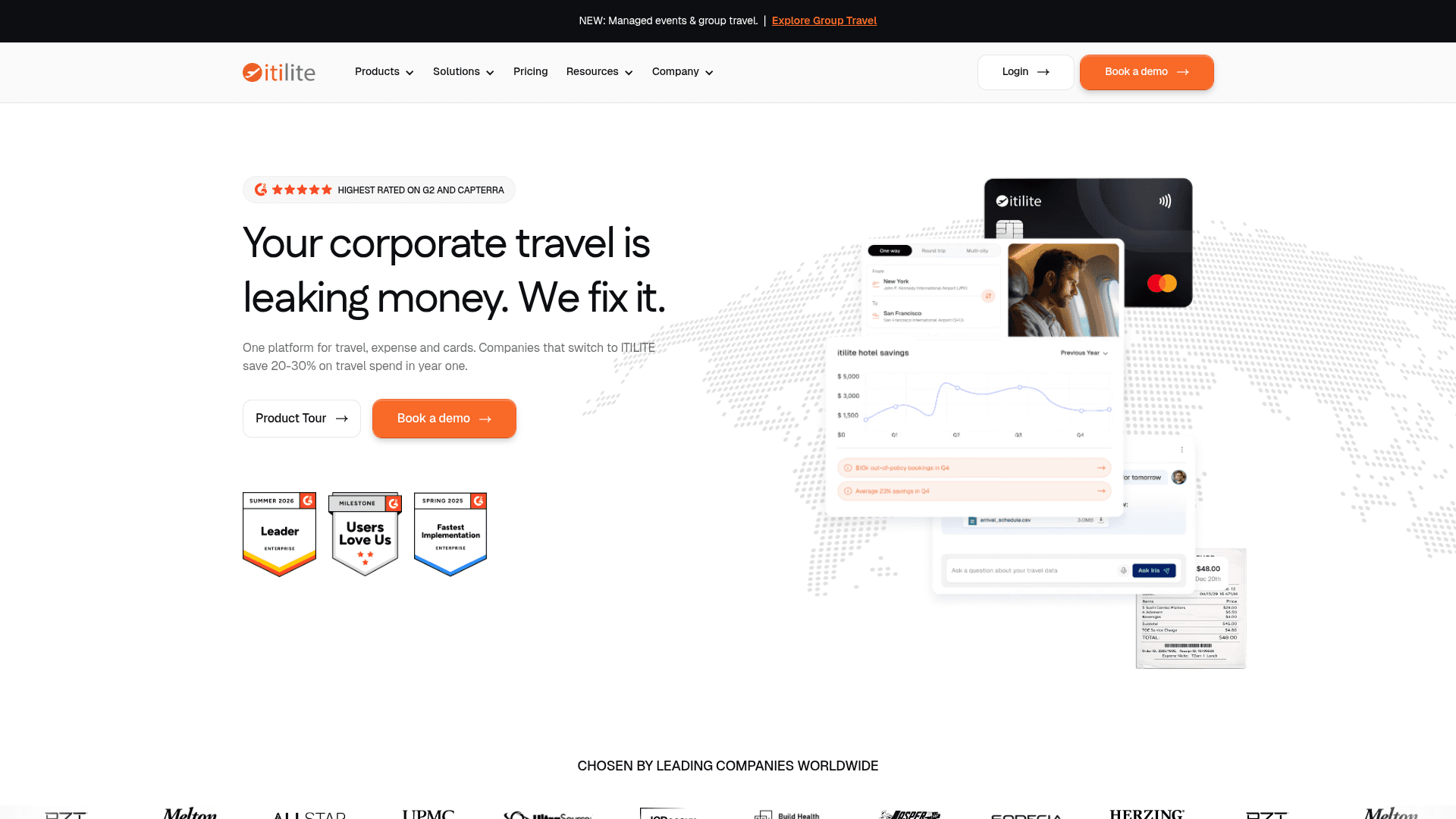
Itilite is the cleanest meter in the category: a flat $10 per trip — $7 if you pre-fund a wallet — where a "trip" covers every flight, hotel, and rental booked in one session. No platform fee, no per-seat fee, no implementation fee, and its pricing page makes the category's sharpest promise: "No platform, support, or after-hour fees." That last clause is the differentiator — 24/7 human support (with a claimed 30-second response) and itinerary changes are included in the trip fee, where classic TMCs bill $25-45 per agent touch and after-hours surcharges. The expense module runs $6 per active user per month (only users who actually submit reports get billed), and its corporate cards are free with up to 2.5% cashback. Founded in 2017 with Tiger Global backing and a Delaware HQ, it serves 500K+ users across 300+ companies in the US and India, holds a 4.5 on G2, and shipped Iris, an AI travel analyst, in late 2025.
At founder volumes, Itilite's math embarrasses percentage models: 10 trips a month costs $100 — $70 pre-funded — against $327-380 on Perk's tiers for identical travel, and the fee doesn't inflate when airfares do. A flat fee also removes the commission conflict: Itilite claims no markup tied to hotel prices, so it has no structural reason to hide the cheapest fare. The honest caveats: Itilite's own positioning targets 200-10,000-employee companies, so a five-person team should confirm onboarding appetite before planning around it; it's a small vendor (roughly $6.6M ARR by third-party estimate, no new funding since 2022) in a category where the giants raise billions; and its complaint file mirrors the category — occasionally uncompetitive displayed fares, rescheduling that works as cancel-and-rebook, and uneven agent skill despite fast response. Spot-check three real itineraries against direct prices during the trial. If the rates hold up, this is the best pure price-performance on the list.
Key Features
- Flat $10 per trip ($7 pre-funded wallet) covering all bookings in a session — no platform, seat, or implementation fees
- 24/7 human support and itinerary changes included in the trip fee; claimed 30-second live response
- Expense at $6/active user/month — only people who file reports get billed; free cards with up to 2.5% cashback
- Claims no commission markup tied to hotel prices — the flat fee is the whole revenue model on travel
- Iris AI travel analyst (Oct 2025) for spend and program questions; 20-30% first-year savings claimed for switchers
Pricing
$10 per trip flat, or $7 per trip with a pre-funded wallet. Expense $6/active user/mo (annual) or $9 (monthly). Cards free with up to 2.5% cashback. Support, changes, and after-hours help included. Custom integrations may carry setup fees.
Rating
4.5/5 — G2 (350+ reviews)
Best For
Teams that want a predictable, auditable travel line item — and anyone allergic ...
Pros
- The best price-performance math on this list: ~$840-1,200/year at 10 trips/month, support included
- Flat fee removes the commission conflict — no structural incentive to show pricier inventory
- Fastest-implementation reputation (G2 badge) and taxes-included expense bundling at honest per-active-user pricing
Cons
- Self-positions for 200+ employee companies — tiny teams should confirm fit; small vendor by category standards
- Recurring review themes: some fares above consumer OTAs, and rescheduling = cancel-and-rebook friction
Brex Travel
Best Travel Inside a Spend Platform — Spotnana Rails, Real Human Servicing
Brex Travel is what you get when a card platform buys the best plumbing instead of building a booking toy: it runs on Spotnana's infrastructure (see #9), which means enterprise-grade content — direct NDC to American, United, and Lufthansa Group, a direct Southwest API, Amtrak rail — and, crucially, 24/7 human travel agents on Spotnana's own servicing desk, reachable by chat, phone, or email. It's included on Brex's free Essentials plan; Premium at $12/user/month adds customizable travel policies and live budgets, and Enterprise layers on group bookings and a concierge. Policy enforcement happens at booking (not in an expense report three weeks later), and every booking auto-reconciles against the Brex card and expense system. For the venture-backed startups Brex targets, it turns travel from a separate procurement decision into a checkbox you flip on.
If you're already on Brex — and this site's banking article explains why funded startups often are, and why bootstrappers often can't be — turning on Brex Travel before buying anything else is simply correct: $0 incremental software cost, better inventory than most standalone SMB platforms, and the strongest included servicing story of the card-platform trio thanks to Spotnana's agents. The two honest limits: you must be a Brex customer, which still effectively requires professional funding or real revenue (the same gate that kept Brex off our banking list for bootstrappers), and the free tier is single-policy — multi-policy control costs $12/user/month, which at 25 employees is $3,600/year and suddenly comparable to a standalone platform. Watch one small fee: booking travel with Brex points carries a $10 nonrefundable service fee per trip. If you're on Brex, start here; if you're not, don't adopt Brex for the travel tool alone.
Key Features
- Spotnana infrastructure: direct NDC (American, United, Lufthansa Group), direct Southwest API, Amtrak rail, unused-ticket tracking
- 24/7 human agents via Spotnana's servicing desk — chat, phone, email — included, no per-touch fees
- Included on the free Brex Essentials plan; Premium ($12/user/mo) adds multi-policy control and live budgets
- Policy enforcement at booking time, auto-reconciled to Brex cards and expense — no report-chasing
- Group bookings and travel concierge on Enterprise; guest travel supported
Pricing
Included with Brex Essentials (free plan). Brex Premium $12/user/mo adds travel policies and budgets; Enterprise custom. No booking fees on cash bookings; $10 nonrefundable service fee per trip when booking with Brex points. Requires being a Brex customer.
Rating
4.8/5 — G2 (1,500+ reviews, Brex platform)
Best For
Startups already running on Brex cards and expense — the travel module is a free...
Pros
- Best included servicing of the card-platform options — Spotnana's own 24/7 agents, not an OTA queue
- Enterprise-grade content (Southwest direct, NDC, Amtrak) at $0 incremental cost on Essentials
- Booking-time policy enforcement plus automatic card/expense reconciliation kills the report-chasing loop
Cons
- Gated behind Brex eligibility — funding-gated underwriting excludes most bootstrappers, per our banking coverage
- Multi-policy control needs Premium ($12/user/mo), and the G2 rating is for the Brex platform, not travel specifically
Want More Recommendations Like These?
Subscribe for curated founder tool picks every week. No sponsored content, no fluff.
Ramp Travel
Best Free Add-On for Ramp Customers — Priceline Inventory, Zero Booking Fees
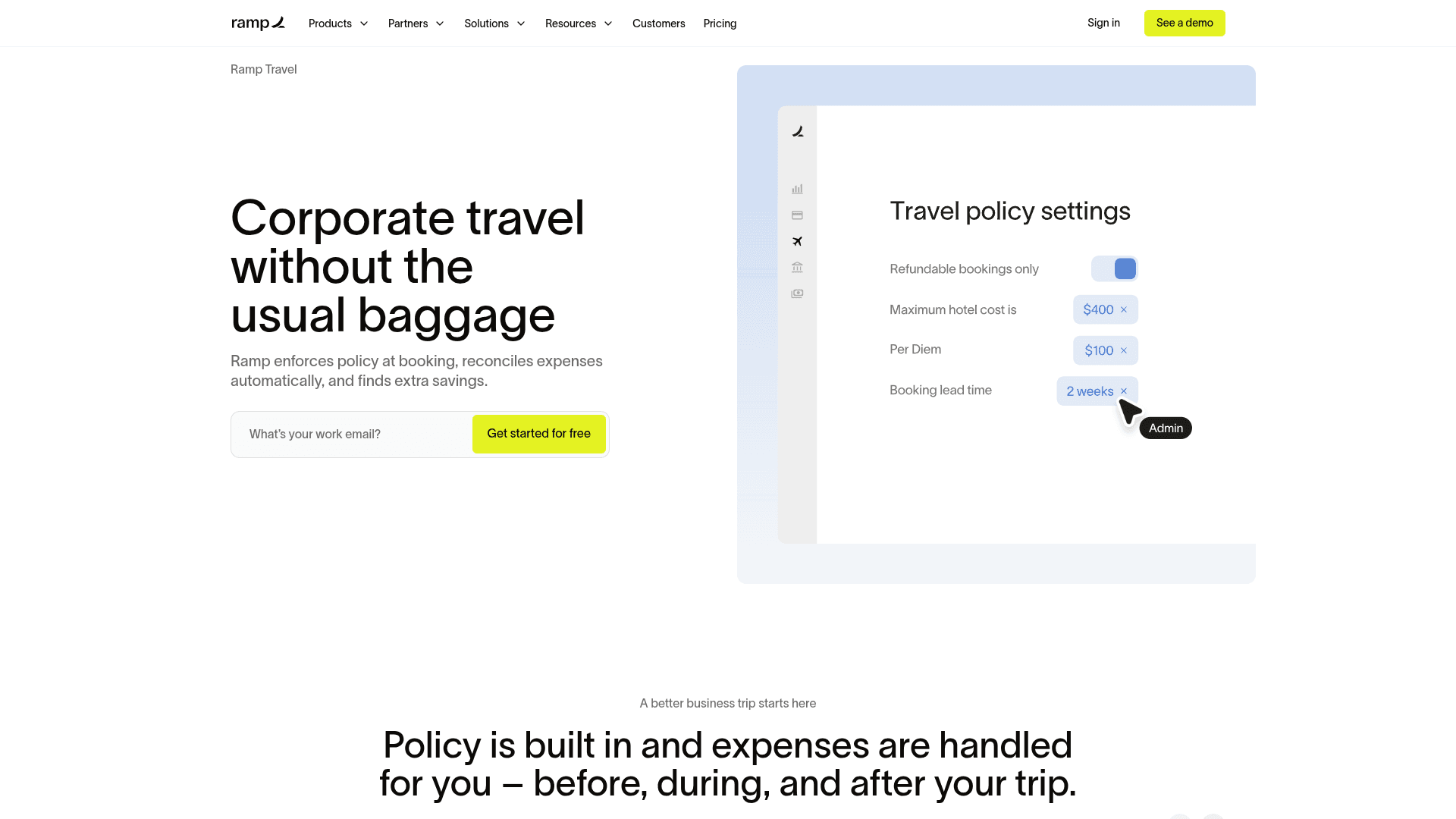
Ramp Travel (launched June 2024) is Ramp's answer to the same question Brex answered — why should travel be a separate purchase? — with a different supplier: inventory and servicing come from Priceline rather than Spotnana. It's available on every Ramp plan, including the free base platform, with $0 booking and platform fees; Ramp Plus at $15/user/month unlocks multiple travel policies. Bookings enforce policy at checkout, receipts and expense coding happen automatically, and Ramp's scale is its own argument: 50,000+ customers, $1B+ annualized revenue, a $32B valuation as of November 2025, and the March 2026 acquisition of Juno — a guest-travel startup founded by Pana's founders — to cover booking travel for candidates, contractors, and advisors who aren't employees. The catch is structural: employees must pay with a Ramp card, and disruption support routes through Priceline's consumer-grade desk.
The pitch is identical to Brex Travel's — if you already run Ramp, flipping on travel costs nothing and closes the expense loop — and Ramp is the more accessible platform for non-venture-backed companies, which matters for this audience. The difference to price in is servicing: Priceline's 24/7 support is an OTA help desk, competent for straightforward rebookings, but it is not Spotnana's agent bench, and at 2025-26 disruption rates (roughly 1 in 4 flights) that difference stops being theoretical. The Juno acquisition signals real investment — guest travel is the feature small teams discover they need the first time they fly in a candidate — but treat Ramp Travel as what it is today: an excellent free perimeter around Ramp's spend platform, not a TMC. If your team flies weekly into weather-prone hubs, pair it with Engine for hotels or budget for the day you graduate to #1, #3, or #6.
Key Features
- Free on all Ramp plans: $0 booking fees, $0 platform fees; Priceline-powered flights, hotels, and cars
- Policy enforcement at checkout with automatic receipt matching and expense coding on Ramp cards
- Juno acquisition (March 2026) adds guest travel — candidates, contractors, advisors — to the roadmap
- Ramp Plus ($15/user/mo) unlocks multiple travel policies for teams with tiered rules
- Backed by Ramp's scale: 50K+ customers, $1B+ annualized revenue, $32B valuation (Nov 2025)
Pricing
Included free on all Ramp plans; Ramp Plus $15/user/mo for multiple travel policies. $0 booking/platform fees — Ramp earns interchange and supplier economics. Bookings must be paid on Ramp cards; 24/7 support via Priceline.
Rating
4.8/5 — G2 (2,000+ reviews, Ramp platform)
Best For
Teams already on Ramp (or choosing it for spend management anyway) whose travel ...
Pros
- Zero-fee travel booking inside the spend platform many startups already use — accessible to non-VC companies, unlike Brex
- Policy-at-checkout plus auto-reconciliation; guest travel incoming via Juno
- Ramp's scale and pace of shipping make abandonment risk low
Cons
- Priceline servicing is an OTA desk, not a TMC agent bench — the gap shows during real disruptions
- Requires paying with Ramp cards (one-time cards for non-cardholders still rolling out); G2 rating is platform-wide, not travel-specific
Corporate Traveler (Melon)
Best Human Agency for SMBs — Dedicated Travel Managers Plus the Melon Platform
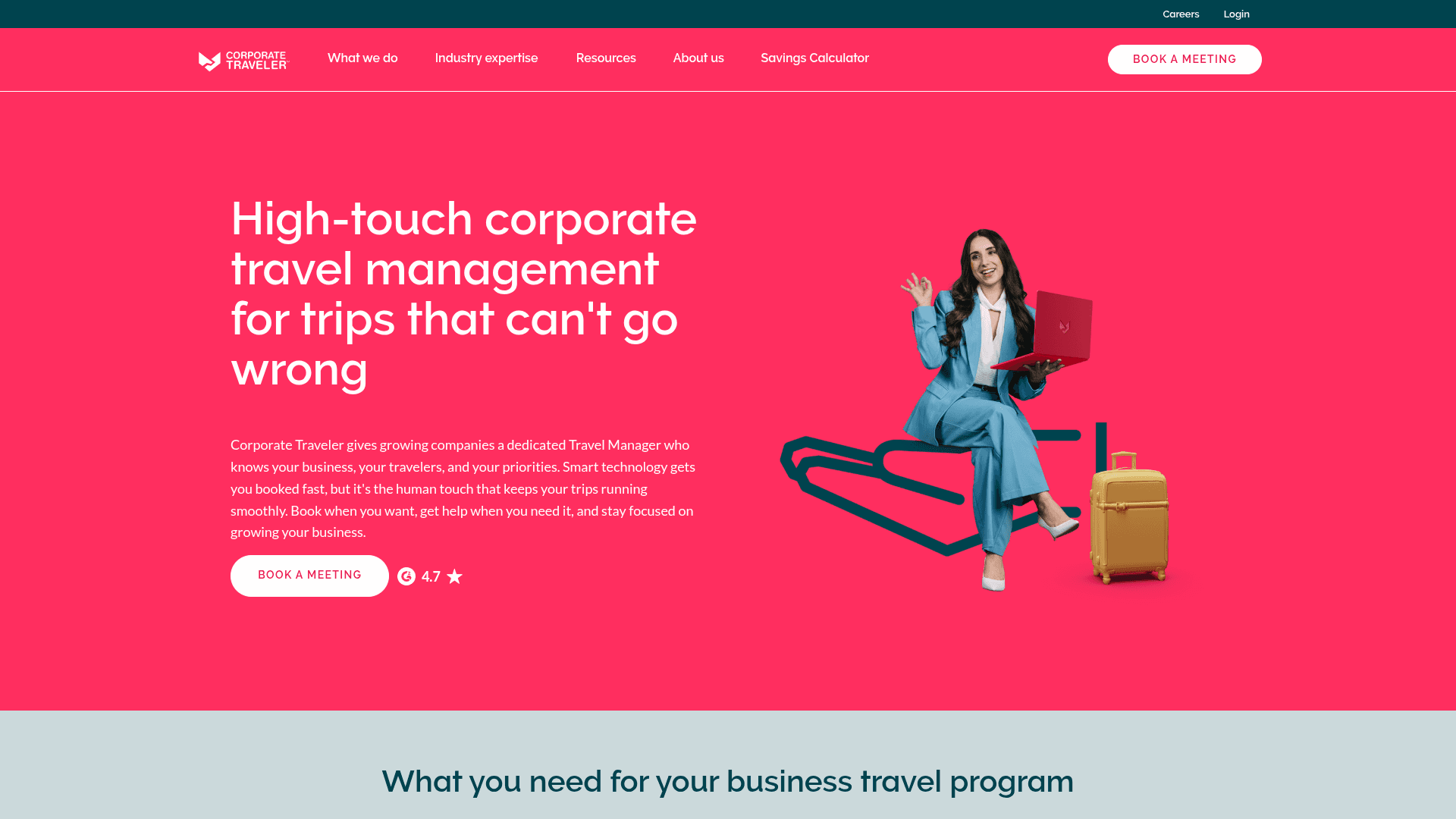
Corporate Traveler is the one true travel agency on this list that's actually built for small and mid-sized companies: it's Flight Centre Travel Group's dedicated SMB brand (16,000+ clients), pairing its proprietary Melon booking platform with the thing software can't fake — a dedicated Travel Manager who knows your company, backed by 24/7/365 in-house consultants who claim to answer in 3-5 rings. Competing listicles routinely list "Melon" as a separate product (and misattribute it to CTM, an unrelated Australian TMC) — it's the same offering: Melon is the software, Corporate Traveler is the humans. The model is classic TMC per-transaction pricing — pay-as-you-go per booking with no subscription — but the fee schedule itself is quote-only, and its own terms reserve the right to charge for changes, cancellations, exchanges, and after-hours help. An April 2026 Emburse partnership tightened the expense-receipt loop.
There's a moment — usually the first multi-leg international trip, the first visa question, the first CEO-stuck-in-Frankfurt incident — when founders stop wanting software and start wanting a person whose job is fixing it. Corporate Traveler is the smallest-company-friendly way to buy that person without signing an enterprise TMC contract or clearing GBTA's informal $250K-spend bar. The trade-offs are exactly what you'd guess: quote-only pricing (benchmark against GBTA's canonical $5-35 per-transaction TMC range, and get change/after-hours fees in writing), per-touch fee culture inherited from the agency world, and a strikingly thin public review base for a 30-year-old firm — G2 sits at 4.7 across only ~47 reviews, so the marquee support claims rest more on reputation than on review volume. If your trips are high-stakes rather than high-volume, this is the slot to spend on; if they're simple and domestic, the software above is cheaper.
Key Features
- Dedicated Travel Manager who knows your account, not a rotating queue — the core product
- 24/7/365 in-house consultants (3-5 rings answer claim) for disruptions, visas, and complex international routings
- Melon platform included: self-serve booking, policies, approvals, trip proposals, risk alerts
- Pay-as-you-go per-booking pricing with no subscription or minimum-spend contract
- Emburse partnership (April 2026) for integrated receipts and expense flow; Flight Centre group buying power
Pricing
Quote-only, per-transaction: pay per booking, no subscription. Benchmark against standard TMC fees ($5-35 per transaction per GBTA; $25-45 for agent/after-hours touches) and get the change/cancellation/after-hours schedule in writing before signing.
Rating
4.7/5 — G2 (47 reviews)
Best For
Teams whose travel is complex or high-stakes — international, multi-leg, exec-he...
Pros
- A real dedicated human plus 24/7 in-house consultants — the strongest disruption story on this list
- Melon gives you self-serve software so you're not phoning an agent for routine bookings
- No subscription or spend minimum — rare for genuine agency service at SMB scale
Cons
- Quote-only fees with per-touch agency DNA — the meter is opaque until you ask, so ask for everything in writing
- Tiny public review base (~47 G2 reviews) for the size of the claims; pricing-discrepancy complaints appear in what exists
Otto
Best AI-Native Pick for Solo Founders — $10/Month, Free for Year One
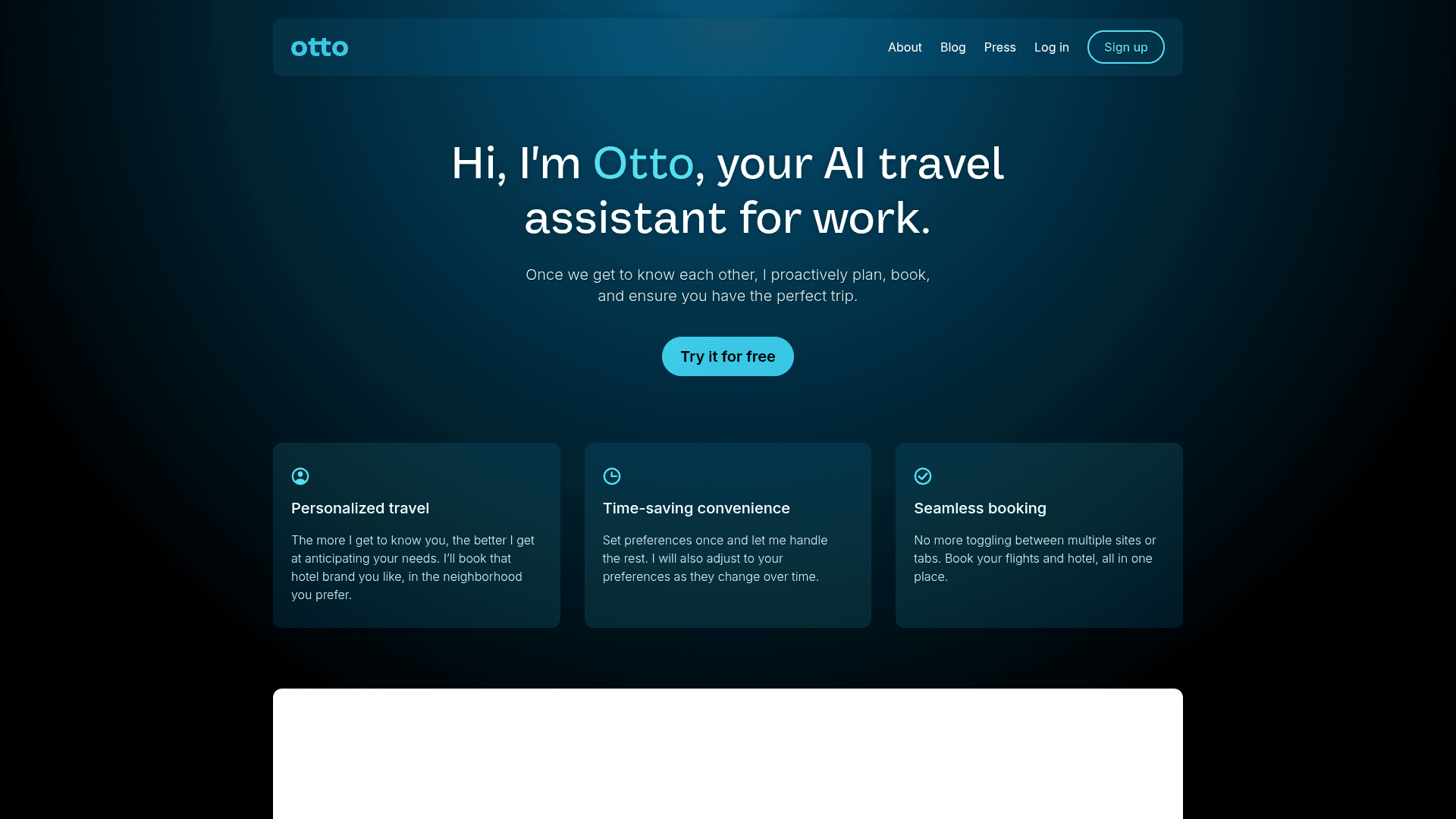
Otto is what this category looks like rebuilt from zero in the AI era: a conversational travel agent that learns your preferences, watches your calendar, proactively proposes trips, and books flights and hotels end-to-end — GA since December 4, 2025 after nine months of beta. The pedigree is unusually credible for a seed-stage product: founded by Michael Gulmann (ex-Expedia SVP of Consumer Product, ex-Egencia CPO), incubated at Madrona, with Concur co-founder Steve Singh as executive chairman — and it runs on Spotnana's booking infrastructure with Booking.com inventory, with human-agent handoff serviced by Direct Travel when the AI hits its limits. Pricing is the simplest on this list: $10/month flat, currently free for the first year, "no contracts, no agent-assist fees, no minimum spend." Otto for Teams and a Slack integration are rolling out; revenue comes from booking commissions on top of the subscription.
For a solo founder or three-person team, the honest question isn't "which TMC" — it's "why am I spending Sunday night on Google Flights?" Otto answers that specific question better than anything else here: it remembers you take aisle seats, book the same three hotels, and land the night before morning meetings, and it does the tab-juggling for you at effectively zero cost this year. Now the equally honest limits: this is a ~$6M-seed-stage company with no G2 or Capterra review base at all, the product is single-traveler-first (team policy, approvals, and admin tooling are early), and it books from Booking.com inventory — fine for hotels, thinner for complex multi-carrier flights. The Spotnana rails and Direct Travel human backstop de-risk the scary part (your booking exists in real TMC infrastructure, not a chatbot's imagination), but treat Otto as the AI EA for individuals it is today, not the company travel program it wants to become. At free-for-a-year, the trial costs you nothing but curiosity.
Key Features
- Conversational AI agent that plans, proposes, and books proactively off your calendar and learned preferences
- $10/month flat, free for the first year — no contracts, agent-assist fees, or minimum spend
- Built on Spotnana booking infrastructure with Booking.com inventory; human handoff via Direct Travel agents
- Founded by ex-Expedia/Egencia product leadership with Concur co-founder Steve Singh as executive chairman
- Otto for Teams + Slack integration rolling out; corporate pilots running through Direct Travel
Pricing
$10/month flat, free for the first year (no credit card). No agent-assist fees, contracts, or minimums; Otto earns booking commissions. Otto for Teams pricing TBD.
Rating
No public review base yet (GA Dec 2025)
Best For
Solo founders and 2-5 person teams who want the booking chore to disappear — and...
Pros
- Genuinely novel: proactive AI booking with learned preferences, at a price rounding to zero this year
- Serious rails for a seed-stage product — Spotnana infrastructure plus Direct Travel human backstop
- Founding team that built Expedia, Egencia, and Concur knows exactly which problem they're attacking
Cons
- Seed-stage vendor risk ($6M raised) with zero G2/Capterra review history — you are the early adopter
- Single-traveler-first: team policies, approvals, and admin controls are early; inventory leans on Booking.com
BizAway
Best for EU-Heavy Teams — €5 a Booking Flat, Real Rail, VAT Recovery
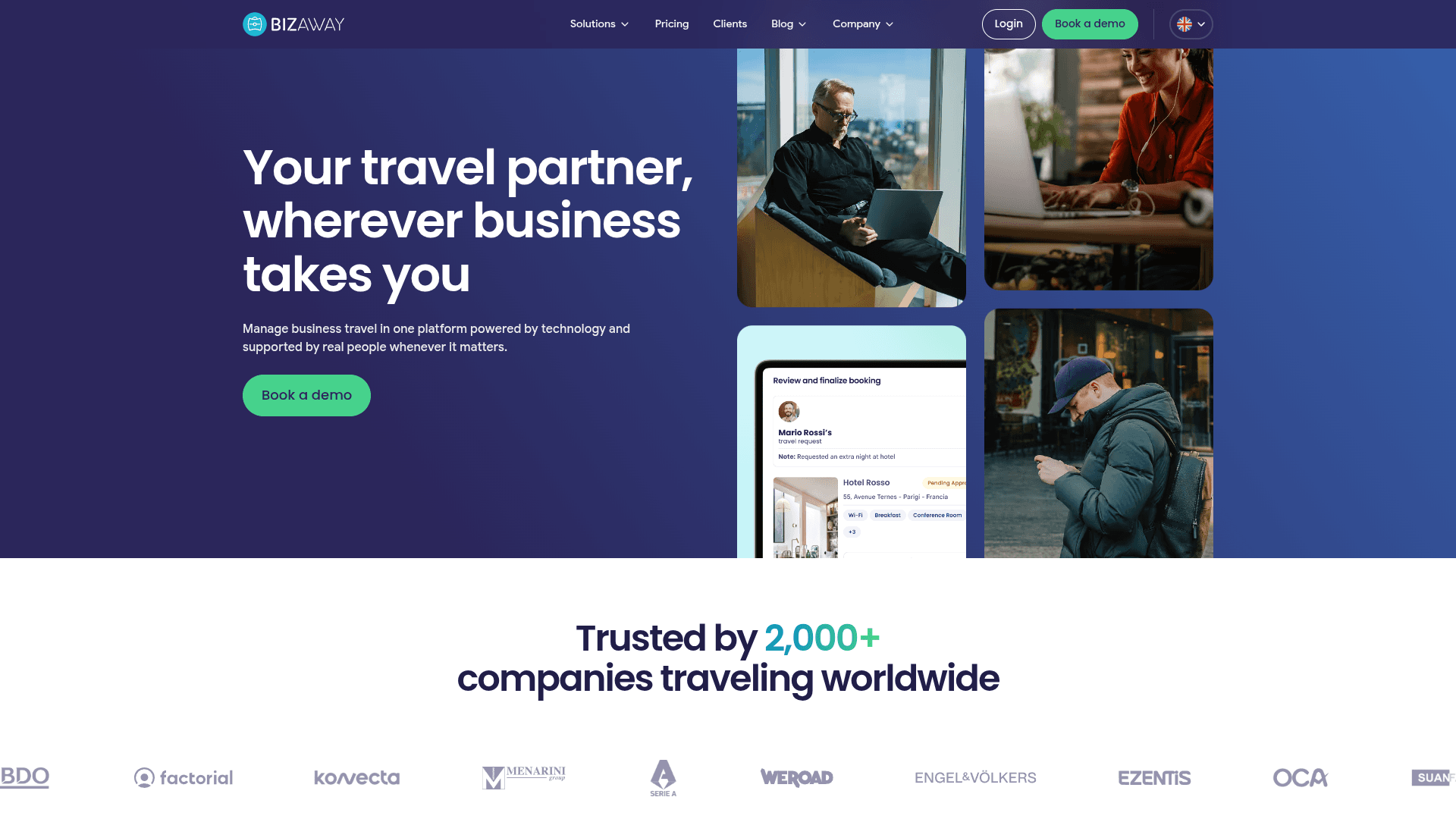
BizAway is the European answer to Itilite's flat-fee math: €5 per booking on the Advanced plan, no subscription, no hidden fees, with 24/7 multilingual support that's explicitly in-house rather than outsourced. The Italian B-Corp (founded 2015, 2,000+ companies including BDO and Engel & Völkers, FT-ranked fastest-growing European travel scale-up) covers what US-first platforms treat as an afterthought: 25+ rail carriers (Trenitalia, Italo, Renfe-class coverage), 1.4M accommodations, 500+ airlines — plus the finance plumbing European entities actually need: consolidated multi-entity, multi-currency invoicing auto-sorted by cost center, and VAT recovery tooling that turns travel receipts back into cash. It bought AI specialist Aervio in April 2025 to build out its Bizzy assistant, and raised €35M from Mayfair in late 2024.
If your startup has a European entity, EU-heavy travel, or a team that takes trains as often as planes, the US-centric picks above quietly fail you — no meaningful rail, no VAT tooling, dollar-denominated everything. BizAway fixes exactly that lane with the cheapest honest meter in the category: 20 bookings a month costs ~€100, support and changes included, and reviewers describe disruption help resolved "within 3-4 minutes." The boundaries are the mirror image of its strengths: pricing and invoicing are euro-denominated, there's no US office, no Southwest story, and no meaningful US review presence (Capterra 4.7 across ~51 reviews is the best signal available) — so a purely US team should stay with #1-#5. Note also the fine print: implementation fees exist on Advanced/Enterprise, and the flexible-cancellation add-on (BizzyFlex) is paid. For the EU-heavy minority of our readers, though, this is the pick the US listicles don't know exists.
Key Features
- €5 per booking flat (Advanced), no subscription — "only pay when you travel," changes and support included
- Real European rail: 25+ carriers alongside 500+ airlines, 1.4M stays, 300+ car agencies
- VAT recovery + consolidated multi-entity, multi-currency invoicing auto-sorted by cost center
- 24/7 multilingual in-house support (not outsourced); ~3-4 minute resolution claims from customer reviews
- Bizzy AI assistant (boosted by the April 2025 Aervio acquisition); B-Corp certified, €35M Mayfair-backed
Pricing
Advanced: €5 per booking, no subscription. Enterprise: custom (multi-entity, ERP/HR integrations, dedicated support). One-time implementation fees on paid tiers; BizzyFlex flexible-cancellation add-on priced per booking. Euro-denominated billing.
Rating
4.7/5 — Capterra (51 reviews)
Best For
Startups with EU entities or Europe-heavy travel patterns — especially teams tha...
Pros
- Cheapest transparent meter in the category for EU travel — ~€100/month at our 10-trip scenario
- Rail + VAT recovery + multi-entity invoicing: the European necessities US platforms skip
- In-house multilingual 24/7 support with unusually clean complaint file for the category
Cons
- Euro-first everything: no US office, dollar billing, or Southwest-class US inventory story
- Small review footprint (~51 Capterra reviews) and implementation fees that dilute the no-subscription pitch
Spotnana
The Infrastructure Inside Half This List — Buy It Through Brex, Expensify, or a Partner TMC
Spotnana is the entry that explains the others: a "travel-as-a-service" infrastructure company (founded 2020, ~$116M raised from ICONIQ, Madrona, Durable, Lufthansa, and Amex Ventures, with Concur co-founder Steve Singh deeply involved) whose single cloud stack powers Brex Travel (#4), Expensify Travel, Otto (#7), and a growing bench of next-gen TMCs like Solutions Travel and Direct Travel's Avenir. Its edge is plumbing nobody else has assembled: the industry's deepest direct NDC integrations (American, United, Lufthansa Group), a direct Southwest API with content the GDS doesn't carry, Amtrak and Trainline rail, a Booking.com hotel feed added in December 2025 — and a servicing model where 24/7 in-house agents work the same platform you book on, with no fees for contacting them. The pricing philosophy matches: a flat per-trip fee, with no deployment, subscription, change, or agent fees — though the dollar amount is negotiated, not published.
You can't sign up for Spotnana on its website — the corporations page routes you to partner TMCs, and its named direct customers are enterprises. So why rank it? Because for a startup, "get Spotnana" is an actionable strategy with three concrete doors: turn on Brex Travel if you're on Brex, turn on Expensify Travel if you're on Expensify, or engage a Spotnana-powered TMC (Solutions Travel, Avenir, Cadence) when you're ready for managed service — and because knowing what's under the hood tells you what you're actually buying. The same logic this site applies to banking (know your partner bank) applies here: the app on top determines your policies and expense flow, but Spotnana determines your inventory, your unused-ticket recovery, and who picks up at 2 a.m. One deliberate framing note: G2's 4.6 across ~111 reviews reflects mostly enterprise deployments, and a minority report content gaps on specific routes. If your growth plan ends in a real managed travel program, starting on Spotnana rails today means never migrating.
Key Features
- One platform powering Brex Travel, Expensify Travel, Otto, and next-gen TMCs — book and service on the same stack
- Deepest direct-connect content in the category: NDC to American/United/Lufthansa Group, direct Southwest API, Amtrak + Trainline rail
- Flat per-trip fee philosophy: no deployment, subscription, change, or agent-contact fees (amount negotiated via partners)
- 24/7 in-house agents on the same platform — no per-touch billing, ~1-minute response claims
- Unused-ticket management and Booking.com hotel content (Dec 2025); Travelodge direct connect (May 2026)
Pricing
Flat per-trip fee, negotiated by volume and channel — no published rate card, and no deployment, subscription, change, or agent fees by policy. Realistic SMB access: included economics inside Brex/Expensify, or quotes via partner TMCs (Solutions Travel, Avenir, Cadence).
Rating
4.6/5 — G2 (111 reviews)
Best For
Startups choosing rails, not just apps: adopt via Brex/Expensify today, graduate...
Pros
- The best content plumbing in the industry — Southwest direct, deep NDC, rail — under whichever app you prefer
- Fee philosophy startups should demand everywhere: flat per-trip, zero punitive touch fees
- Adopting via Brex/Expensify today gives a no-migration path to a full TMC later
Cons
- Not directly buyable by small companies — you reach it through partner platforms, so your app layer choice still matters
- Per-trip fee amounts are negotiated and unpublished; enterprise-skewed review base (~111 on G2)
Booking.com for Business
Best Free Zero-Commitment Option — For 2-10 Person Teams Not Ready for a Platform
Booking.com for Business is the free, sign-up-today floor of this category: flights across 500+ airlines, Booking.com's 3M+ property inventory, basic policies and approvals, a spend dashboard, and Genius loyalty discounts up to 20% — at genuinely zero cost, with "no subscription, booking or pricing plan fees." It claims 1.5M+ companies, and since 2024 the corporate product has been rebuilt on Serko's Zeno platform (Booking Holdings' corporate-travel partner), which quietly upgraded it from a leisure site with a business checkbox into a real, if basic, managed-travel tool. Its economics are the OTA model: Booking.com already earns 15-25% commissions from properties, so the business layer costs it nothing to give away.
For a 2-10 person team doing a few trips a month, this is the honest alternative to buying software: better-than-consumer rates via Genius, one place where receipts and itineraries land, and approvals that stop the intern booking a suite — for free, forever, with no sales call. The equally honest warning is the support model: when a flight cancels at 11 p.m., you're in an OTA service queue, not talking to a travel agent with rebooking authority, and the G2 signal is both thin and lukewarm (4.0 across just 34 reviews — strikingly small for a claimed 1.5M companies, and the lowest score on this list). Policy controls are shallow next to Perk or even Ramp. Use it as the starter kit: it costs nothing to adopt, nothing to leave, and by the time it hurts — usually the first serious disruption or the tenth monthly trip — you'll know exactly which of #1-#6 you're graduating to.
Key Features
- Completely free: no subscription, booking, or plan fees — funded by the commissions Booking.com already earns
- Genius business discounts up to 20% on top of 3M+ properties and 500+ airlines
- Basic policies, approvals, central billing view, and spend dashboard — rebuilt on Serko's Zeno platform
- Self-serve signup in minutes; no sales call, contract, or minimum volume
- Zero switching cost in either direction — the definitionally safe first step out of unmanaged travel
Pricing
Free — no subscription, booking, or pricing-plan fees. Monetized via standard OTA supplier commissions. Genius discounts unlock with usage.
Rating
4/5 — G2 (34 reviews)
Best For
Very small teams (2-10 people) taking their first step out of card-plus-Google-F...
Pros
- Actually free with no commitment in either direction — the cheapest possible exit from unmanaged travel
- Genius discounts and huge accommodation inventory beat consumer booking for zero effort
- Serko Zeno rebuild made policies/approvals real instead of cosmetic
Cons
- OTA-grade support: a service queue without rebooking authority is the failure mode during disruptions
- Lowest rating on this list (G2 4.0) on a tiny 34-review base; policy controls stay shallow as you grow
What We Cut — And Why
The cuts say as much about this category as the picks — 2025-26 was a consolidation wave, and several names still ranking on competitor lists are effectively gone:
- Navan — the deliberate exclusion, covered in the FAQ below. The short version: a genuinely strong product (G2 4.7, ~9,100 reviews) whose incentives moved away from this audience — public-market scrutiny since October 2025, Fortune 500 logos up 61% year over year, ~$61K average revenue per customer, a commission-funded free tier its own S-1 prices at roughly 7% of bookings, and a Trustpilot slide to 3.5 on prices-above-direct and support-escalation complaints. If a 300-person company is what you're becoming, evaluate it then.
- SAP Concur — the enterprise standard, not a startup tool. The advertised ~$7-11 per expense report hides that Concur Travel is quote-only (Premium tier), implementations run $20K-75K over 3-6 months for small deployments, live travel servicing requires a TMC billed per touch on top, and it carries the category's worst UX scores — G2 4.0 ("not intuitive" is the top dislike theme) and a 1.9 on Trustpilot. You migrate to Concur at 500+ employees; you don't start there.
- Egencia (Amex GBT) — a real TMC with excellent 24/7 in-house agents, wrong-sized for this list: reported SMB economics run $15-25 per booking plus $500-1,500/month platform fees plus $5K-25K implementation (Vendr contract data), agent assists bill $10-20+, and it's mid-replatform — Amex GBT closed its $540M CWT acquisition in September 2025 and is launching a "next-gen Egencia" through 2026. Graduate to it at $250K+ annual travel spend; don't onboard a 10-person team into an integration year.
- TravelBank — no longer buyable standalone: its own announcement says the platform is "exclusively available to existing customers," with new customers routed into U.S. Bank commercial-card programs aimed at $10M-150M-revenue firms (and its travel-plan rebates require $250K in-app spend). Great app, closed door.
- AmTrav — not cut so much as merged: acquired by TravelPerk in June 2024, it now markets as "AmTrav, powered by Perk" and its pricing page redirects to perk.com. Its US inventory and advisor bench are part of why Perk is #1; recommending it separately in 2026 would just route you to the same company mid-absorption.
- Routespring — pivoted. The pay-per-use SMB platform that earned a 4.9 G2 seller rating now leads with "AI Powered Travel Management for Airlines" — crew lodging and IROPS recovery for carriers like Breeze — and its self-serve SMB tiers are gone from the pricing page. Buying the secondary product of a company selling to airlines is not a startup play.
- Kayak for Business — overlaps its Booking Holdings sibling (#10) with thinner management features, a Biz+ tier whose once-published $20/trip price has drifted behind "contact sales," and effectively no G2/Capterra review base. One free Booking Holdings option on a list is enough.
- TruTrip — honest publishable pricing (from $4/month plus a 1.7-2.8% platform commission), but it's a Singapore-first product with APAC inventory DNA, a ~23-person team, and near-zero US review presence. The right answer for a Southeast Asian startup; not for this list's US-centric audience.
- Expensify Travel — an honorable mention rather than a cut: it's Spotnana-powered travel rolled out to all Expensify members in 2025, with central billing added that August. If Expensify is already your expense stack, you have a Spotnana door open — see #9 — before shopping this list.
- The dead pool — still appearing on stale competitor lists: Coupa Travel (the former Pana) was fully retired on January 31, 2026; Center was acquired by American Express in April 2025; CWT was absorbed into Amex GBT in September 2025; Lola and Upside shut down back in 2021; Deem now lives inside Travelport as a TMC-channel product. Any listicle recommending these is telling you when it was actually written.
How We Chose These Platforms
We evaluated 24 travel platforms, TMCs, and card-platform travel modules in July 2026 against five startup-specific criteria. Most competing lists are vendors ranking themselves; we weighted what the demos leave out.
- The meter, computed — verified official-page pricing run through the same 10-trips-a-month scenario, plus the hidden layers: supplier commissions, GDS/NDC incentives, interchange, unpublished fee caps, and change/after-hours charges
- Who fulfills, and what a bad day costs — own agents vs. outsourced vs. OTA queue, per-touch fees, and claim-vs-reality gaps in review data, weighted against 2025's 1-in-4 disruption rate
- Self-serve honesty — can a 5-person company sign up today with published pricing, or is it demo-gated, quote-only, eligibility-gated (Brex), or not directly buyable at all (Spotnana — ranked with that caveat stated, not hidden)
- Platform risk — IPO-driven upmarket drift (Navan), acquisitions in flight (AmTrav→Perk, TravelBank→U.S. Bank, CWT→Amex GBT), pivots (Routespring), sunsets (Coupa Travel), and seed-stage fragility (Otto — ranked, flagged)
- Review-base reality — G2/Capterra/Trustpilot scores cited with their actual counts; platform-wide ratings (Brex, Ramp) labeled as such; tiny bases (Corporate Traveler's 47, Booking.com for Business's 34) and empty ones (Otto) flagged instead of laundered
How to Choose by Situation
Pick by your trip volume and travel shape, not by brand. The right answer at two trips a month is usually "nothing yet" — and the right answer at twenty is a different meter than at five.
Already on Brex or Ramp...
Turn on Brex Travel or Ramp Travel before buying anything. $0 incremental cost; Brex's Spotnana servicing is the stronger disruption story.
10+ trips a month, want one platform...
Perk Premium (you're past the $4,950/mo crossover — skip Starter), or Itilite if you want the fee flat and the support included.
Hotel-heavy field or sales teams...
Engine — free, workforce-hotel depth, and Direct Bill means crews never touch a corporate card. Add FlexPro if plans change weekly.
Solo founder or 2-5 people...
Otto (free year one) to kill the booking chore, or Booking.com for Business for free basics. Card + Google Flights is legitimate below ~5 trips/month.
EU entity or Europe-heavy travel...
BizAway — €5/booking flat with real rail and VAT recovery. Perk's EU travel+spend bundles are the subscription alternative.
Complex, high-stakes, international trips...
Corporate Traveler for a named human on the account now; graduate to Egencia/Amex GBT when annual spend clears ~$250K.
Stay Ahead of the Tool Curve
We research dozens of tools so you don't have to. Get our top picks and insider insights delivered weekly.
Frequently Asked Questions
What is the best corporate travel management software in 2026?
For most startups and small teams: Perk (formerly TravelPerk) — it's the only category leader with published self-serve pricing ($0/month + 5% per booking, or $99/month + 3%), US inventory that includes Southwest, an 80%-back cancel-anything guarantee, and integrated expense via Yokoy. Hotel-heavy field teams should look at Engine (genuinely free, Direct Bill invoicing); teams that want a predictable flat fee should look at Itilite ($10/trip with support included); and if you already run Brex or Ramp for spend management, turn on their built-in travel modules before buying anything standalone. Below roughly five trips a month, a corporate card plus Booking.com for Business is a legitimate answer.
Why isn't Navan on this list?
Three reasons, none of them "it's a bad product" — Navan's G2 score (4.7 across ~9,100 reviews) is excellent. First, the incentive shift: Navan went public in October 2025 (NASDAQ: NAVN), dropped 68% by March 2026 before recovering, lost its CFO ten weeks after listing, and is now visibly chasing enterprise logos — Fortune 500 customers up 61% year over year, average revenue per customer around $61K. A public company optimizing for $61K accounts is not optimizing for your 8-person startup. Second, the meter: Navan's free tier (up to 300 employees) is, in its own words, "powered by travel providers' commission fees," and its S-1 disclosed a usage yield of roughly 7% of gross bookings — you don't get an invoice, but the economics ride inside your fares, and third-party trackers report extra fees like $25 personal bookings and charges for live-agent bookings. Third, the complaint pattern: prices above direct booking and support escalation dead-ends during disruptions are the top themes on Trustpilot, where Navan's score has slid to 3.5. If you're a 300-person company wanted by its sales team, evaluate it; below ~50 employees you're not who it's building for.
How do "free" corporate travel platforms actually make money?
Four channels, all riding inside the booking rather than on an invoice. (1) Hotel commissions: properties pay 10-25% to OTA-style channels (Booking.com's standard range is 15-18%), which funds Engine, Booking.com for Business, and much of Navan's free tier. (2) GDS incentives: global distribution systems charge airlines roughly $4-6 per booked segment and rebate part of it to the booking platform. (3) Airline NDC incentives — American, for example, has paid a $2.00-per-segment incentive on NDC bookings. (4) Card interchange, when the platform issues the card (Navan, Brex, Ramp). None of this is illegitimate — but a platform paid by suppliers per booked dollar has a weak incentive to show you the cheapest non-commissionable rate, which is why "fares higher than booking direct" is the category's most persistent complaint. During any trial, spot-check three real itineraries against direct prices before you commit.
What's the difference between travel management software and a TMC — and do I need either?
Travel management software (Perk, Itilite, Ramp/Brex Travel) is self-serve SaaS: you sign up, set policies, and employees book themselves, with support desks for disruptions. A TMC — travel management company — is an agency (Egencia, CWT, Corporate Traveler, AmTrav): humans book and service travel, billed per transaction, historically $5-35 per booking and $25-45 per agent or after-hours touch. The lines blurred in 2026 — Corporate Traveler bundles real software (Melon), and Spotnana-powered platforms include TMC-grade servicing — but the buying rule holds: classic TMCs generally want $250K+ in annual travel spend (GBTA's benchmark) and charge per touch, so a 10-person startup is usually better served by software with included support. And below roughly five trips a month, you likely need neither: a corporate card with clear limits, Google Flights, and a shared tracking sheet is a legitimate program until approvals, guest travel, or duty-of-care obligations force the upgrade.
What does corporate travel management software actually cost?
Depends entirely on the meter. Take a concrete team: 10 trips a month, each averaging one $400 domestic flight plus two hotel nights (~$360) — about $91,200 a year of travel across 20 bookings a month. Percentage fees: Perk Starter (5%) runs ~$4,560/year; Perk Premium ($99/month + 3%) runs ~$3,924. Flat per-trip: Itilite costs $1,200 ($840 pre-funded); BizAway about €1,200. Classic TMC per-transaction: $2,400-4,800 if bookings stay online, up to $8,400 with agent-heavy service. "Free" platforms (Navan, Engine, Booking.com, Ramp/Brex Travel): $0 invoiced, with economics riding inside fares and interchange — Navan's S-1 put its blended take at ~7% of booked dollars. Same flights, same hotels: anywhere from ~$840 to ~$8,400 a year. Two rules: compute the crossover before picking a tier (Perk Premium beats Starter above $4,950/month of bookings), and get percentage-fee caps in writing.
How does Brex Travel compare with Perk for corporate travel management?
Brex Travel and Perk answer different questions, and which one wins depends entirely on whether you are already a Brex customer. Brex Travel is included at $0 incremental software cost on the free Brex Essentials plan and runs on Spotnana's infrastructure — direct NDC content from American, United and Lufthansa Group, a direct Southwest API, Amtrak rail, and 24/7 human agents on Spotnana's own servicing desk — which is better inventory and stronger servicing than most standalone SMB platforms charge for. Perk charges $0/month plus 5% per booking on Starter, $99/month plus 3% on Premium and $299/month plus 3% on Pro, with all four major US carriers including Southwest and FlexiTravel returning 80% on any cancelled trip. The decision rule is simple: if you are already on Brex, turn on Brex Travel before buying anything, because it costs nothing and its rails are excellent. If you are not on Brex, do not adopt Brex for the travel tool — its underwriting effectively requires professional funding or real revenue, which excludes most bootstrapped companies, and Perk is self-serve today with published pricing you can compute before committing. Two caveats that change the maths: Brex's free tier is single-policy, and multi-policy control needs Premium at $12/user/month, which at 25 employees is $3,600/year and becomes comparable to a standalone platform; and Perk's crossover between Starter and Premium lands at $4,950/month of bookings, so a team past roughly $60K/year of travel should start on Premium.
When does a startup actually need travel management software?
Watch for five triggers rather than a headcount: (1) trip volume passes roughly five per month, where booking chores and receipt-chasing start eating real hours; (2) you book travel for non-employees — candidates, contractors, advisors — and personal cards stop working (this is why Ramp bought Juno in March 2026); (3) you need policy enforcement before booking rather than expense-report arguments after; (4) duty of care becomes real — you need to know where people are during an incident; (5) unused-ticket credits start leaking, which industry data pegs at 5-10% of corporate air spend. If none of those bite yet, don't buy software — a card plus Booking.com for Business covers you. When they do bite, the free tiers here (Engine, Brex/Ramp Travel, Booking.com) mean upgrading costs nothing but an afternoon.
Can AI agents book business travel yet?
Yes — 2026 is the year it became real, with two different shapes. Otto (#7) is the AI-native approach: a conversational agent with Spotnana rails and a Direct Travel human backstop that learns preferences and books proactively — genuinely useful for individuals today, still early on team policy controls. The incumbents ship the other shape: Navan's Ava has handled a large share of support interactions since 2023 and its "Navan Anywhere" embeds booking agents in Gemini Enterprise; Perk shipped an MCP connector in July 2026 so Claude and ChatGPT can query and book travel; Navan followed with its own MCP for T&E data. Practical guidance: let AI handle the booking chore (Otto, or your platform's assistant), but keep a human escalation path you've actually tested — 2025's disruption rates (worst on-time performance since 2014) are exactly the scenario where "the AI is sorry" doesn't rebook the flight.
The Bottom Line
Corporate travel software in 2026 is a fee-model decision wearing a booking-app costume. The platforms sell the same seats and the same rooms; what differs is the meter — a percentage that inflates with airfares, a flat fee that doesn't, an agency schedule that bills by the touch, or a "free" product whose economics ride inside your fares at a rate Navan's own S-1 pegs around 7% — and what happens on the bad day, which 2025's worst-since-2014 disruption rates guarantee you two or three of every month.
The playbook for most teams: if you're on Brex or Ramp, flip on their travel module today and revisit when volume grows. Choosing a standalone platform, start with Perk — Premium, not Starter, once you book past ~$5K/month — or Itilite if you want the line item flat and the 2 a.m. call included. Hotel-heavy teams: Engine. EU-heavy teams: BizAway. Solo founders: Otto costs nothing this year and gives you your Sunday nights back. And whichever door you pick, spot-check three real itineraries against direct prices during the trial, get the fee caps in writing, and test the support line once before you need it at an airport.
The platforms aren't hiding how they charge you — they're just not leading with it. Now you can ask the right question in the demo.
Related Reading
- 10 Best Business Bank Accounts for Startups (Ranked by Who Actually Holds Your Money) — The same follow-the-money treatment, applied to where your runway sits
- Best Automation Tools & Zapier Alternatives (The Billing Unit Is the Product) — The original fee-meter framework this article applies to travel
- 10 Best Stripe Alternatives for SaaS (Ranked by Who Owns Your Tax Liability) — Same method, payments edition: the fine print is the product
- Best Customer Service Software (Ranked by Real All-In Cost) — Pricing-model-first buying for the other tool your team lives in
Sources
- Perk — Official Pricing
- Perk — TravelPerk Rebrands to Perk (Nov 2025)
- GlobeNewswire — TravelPerk Raises $200M, Acquires Yokoy (Jan 2025)
- Perk — Perk MCP Launch (July 2026)
- Engine — Pricing (free platform + FlexPro)
- Engine — Company Overview & FAQs (commission model)
- Crunchbase News — Engine $140M Series C at $2.1B (Sept 2024)
- Itilite — Official Pricing ($10/trip)
- Brex — Travel Product
- Spotnana — Powering Brex Travel (case study)
- Ramp — Travel
- PR Newswire — Ramp Acquires Juno for Guest Travel (Mar 2026)
- Corporate Traveler — TMC Fee Structures Explained
- Business Wire — Otto Launches to the Public (Dec 2025)
- BizAway — Official Pricing (€5/booking)
- Spotnana — Company Facts (partners, content, servicing)
- Booking.com for Business — Official Site
- Navan — Official Pricing (free tier, commission-funded)
- SEC EDGAR — Navan S-1 (usage yield, revenue model)
- CNBC — Navan IPO Debut (Oct 30, 2025)
- Mostly Metrics — Navan S-1 Breakdown (~7% usage yield)
- SaaStr — Navan at $700M ARR (upmarket mix, $61K ARPC)
- GBTA — Top 5 TMC Questions (fee ranges, $250K threshold)
- Engine — Calculating True TMC Costs (fee benchmarks)
- GBTA — Business Travel Spend to Reach $1.57T in 2025
- BTS — 2025 Average Domestic Air Fare
- US PIRG — Plane Truth 2026 (worst on-time year since 2014)
- Cornerstone — Unused Airline Tickets (5-10% of air spend)
- Deloitte — 2025 Corporate Travel Study (2026 budget outlook)
- BTN — Coupa to Sunset Travel Offering (retired Jan 31, 2026)
- Business Wire — Amex GBT Completes CWT Acquisition (Sept 2025)
Stay Ahead of the Tool Curve
We research dozens of tools so you don't have to. Get our top picks and insider insights delivered weekly.
Trusted by indie hackers and startup founders
Keep Reading
7 Best AI App Builders for Non-Technical Founders in 2026
The best AI app builders for non-technical founders, ranked by what you can actually launch: user accounts, data, payments, publishing, costs, and exit paths.
7 Best AI Search Visibility Tools for Agencies in 2026
Seven AI search visibility tools ranked for agencies by client workspaces, reporting, prompt economics, and the real cost of managing multiple brands.
10 Best Granola Alternatives for Private AI Meeting Notes (2026)
The best Granola alternatives in 2026, ranked on where your notes are stored, whether your data trains AI, and what a bot-free notetaker really costs. Verified pricing.