
10 Best Stripe Alternatives for SaaS in 2026 (Merchant of Record, Ranked by Who Owns Your Tax Liability)
The 10 best Stripe alternatives and payment processors for SaaS founders in 2026 — Kelviq, Paddle, Polar, Lemon Squeezy, Creem, FastSpring, 2Checkout, Chargebee, Fungies, and Braintree. Ranked by the one thing pricing pages hide: whether the platform is a Merchant of Record that takes your global sales-tax and VAT liability, or a payment processor that leaves it with you. Verified fees, payout timing, and the surcharges vendors keep off the headline rate.
You're not choosing a payment button. You're choosing who owns your tax liability.
There are two kinds of tool on this list. A payment processor (Stripe, Braintree) charges the card — but you stay the legal seller, so you register for, collect, file, and remit sales tax and VAT in every jurisdiction yourself. A Merchant of Record (Kelviq, Paddle, Polar, Lemon Squeezy, Creem, FastSpring, 2Checkout, Fungies) becomes the reseller of record and takes that entire liability off your books. That's what the fee gap buys: a processor runs ~2.9% + 30¢, an MoR ~3.5%-6%. Stripe Tax (~0.5%) only calculates — you still file. Even Stripe now sells its own MoR tier (Managed Payments, ~6.4%), which tells you the "just use Stripe" era is over for global sellers. Decide the tax question first; compare percentages second.
Key Takeaways
- The real decision isn't "which payment button" — it's Merchant of Record (MoR) vs. payment processor. With a processor like Stripe or Braintree you are the legal seller, so you register for, collect, file, and remit sales tax and VAT in every jurisdiction yourself. An MoR (Kelviq, Paddle, Polar, Lemon Squeezy, Creem, FastSpring, 2Checkout, Fungies) becomes the reseller of record and takes that liability off your books entirely.
- That liability transfer is what the ~2-point fee gap buys. Stripe is 2.9% + 30¢; MoR platforms run ~3.5%-6%. But raw Stripe leaves you owning VAT registration in the EU, economic-nexus tracking across 45+ US states, and the filings — Stripe Tax (~0.5%) only calculates and collects; you still register and remit. Even Stripe now sells its own MoR tier (Managed Payments, ~6.4% + 30¢), which is the clearest signal that "just use Stripe" stopped being the default answer for global sellers.
- Every competing "best Stripe alternatives" list is written by a payment company that ranks itself #1. We don't process payments, no platform paid to be here, and each pick is ranked by who it actually fits — starting with what a real founder owes at the end of the tax year.
- Editor's pick for AI & usage-based SaaS: Kelviq. It carries the lowest headline rate of any full MoR (3.5% + 40¢, 2.9% on your first $5K, no monthly fee) and bills natively on tokens, credits, and metered usage — built by the ParityDeals team. The honest caveat is that it launched in May 2026, so it has a thin track record, not a decade of receipts.
- The fixed per-transaction fee is the silent killer for low-ticket products. A flat 40-50¢ barely registers on a $99 plan but is a 10%+ tax on a $5 microtransaction — which is why per-unit AI pricing and cheap digital goods change the ranking. Model your average order value before you compare percentages.
- The headline rate is not the whole bill. Payout timing (Kelviq T+7, Creem twice a month), dispute fees ($15 on Polar, $15-45 on 2Checkout), the near-universal +1.5% international-card surcharge, and account-freeze/holdback risk cost more than a 0.5% rate difference for most founders. Read the surcharge table, not the hero number.
Search for the best Stripe alternatives and every top result is a payment company ranking itself #1 — with a comparison table engineered to make its own fee look inevitable. This list is different: we don't process payments, no platform paid to be here, and every pick is ranked by who it actually fits, starting with the one question the pricing pages bury — does this tool take your global tax liability, or leave it with you?
That's the real fork. Stripe is a superb payment processor, but with it you are the merchant of record: you own VAT registration in the EU, economic nexus across US states, and every filing. The tools below split cleanly. Eight are Merchant of Record platforms that make that liability disappear — Kelviq, Paddle, Polar, Lemon Squeezy, Creem, FastSpring, 2Checkout, and Fungies. One (Chargebee) is a billing platform with MoR only as an add-on. And one (Braintree) is a pure processor we included on purpose, to show what "leave Stripe but keep the tax problem" actually looks like.
Every entry covers verified pricing — including the surcharges and payout mechanics vendors keep off the headline rate — plus who each tool is genuinely for and the trade-offs users report after the honeymoon. Where a number couldn't be independently verified, or a platform is too new to have a track record, we say so.
Quick Comparison
| # | Tool | Best For | Type | Headline Fee | Rating |
|---|---|---|---|---|---|
| 1 | Kelviq | Editor's Pick for AI & Usage-Based SaaS | MoR | 3.5% + 40¢ (MoR) | New / n/a |
| 2 | Paddle | Best for Established B2B SaaS at Scale | MoR | 5% + 50¢ (MoR) | 4.1 |
| 3 | Polar | Best for Developers & Open Source | MoR | 4%–5% + fees (MoR) | New / n/a |
| 4 | Lemon Squeezy | Best for Solo Digital-Product Sellers | MoR | 5% + 50¢ (MoR) | New / n/a |
| 5 | Creem | Best Budget MoR for Bootstrappers | MoR | 3.9% + 40¢ (MoR) | New / n/a |
| 6 | FastSpring | Best for Enterprise & Global Veterans | MoR | ~5.9% + 95¢ (MoR, negotiated) | 4.5 |
| 7 | 2Checkout (Verifone) | Best for Broad Local Payment Methods | MoR | 3.5%–6% + fees (tiered MoR) | 2.1 |
| 8 | Chargebee | Best for Complex Subscription Billing | Processor | From $0; MoR via add-on | 4.4 |
| 9 | Fungies | Best for Games & Digital Goods | MoR | ~4.9%–5% + fees (MoR) | New / n/a |
| 10 | Braintree (PayPal) | Best Processor If You'll Own Your Own Tax | Processor | 2.9% + 30¢ (processor) | 1.6 |
Ratings are drawn from the most robust verifiable source per tool (Trustpilot, G2, Sitejabber) and reflect different sample sizes — a low score on a support-heavy consumer site isn't directly comparable to a developer-review G2 score. Newer platforms with no meaningful review corpus are marked "New / n/a" rather than assigned a number we can't stand behind.
Kelviq
Editor's Pick for AI & Usage-Based SaaS — the Lowest Full-MoR Rate With Native Token & Credit Billing
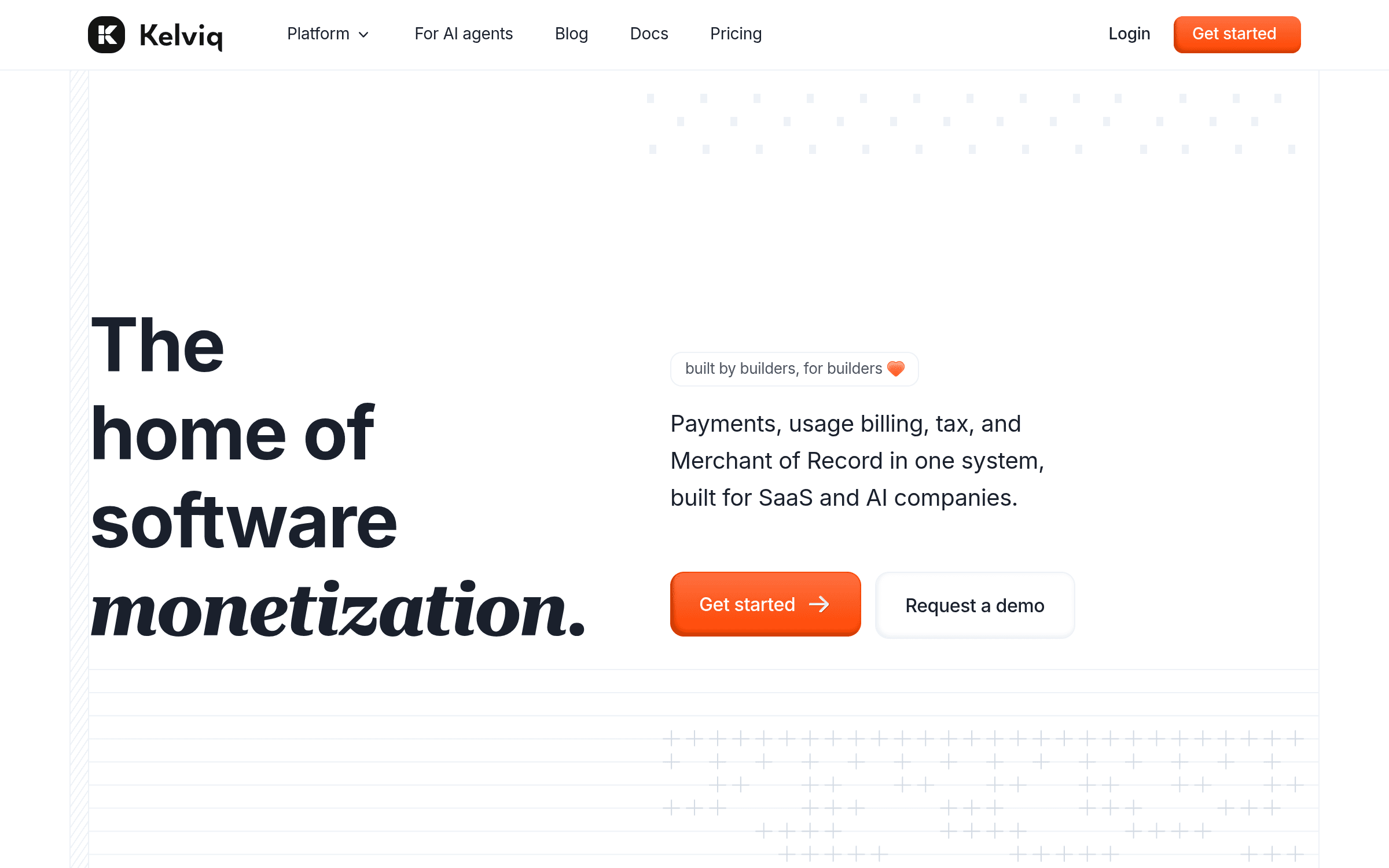
Kelviq is a Merchant of Record built specifically for SaaS and AI companies, bundling global payments, tax/VAT compliance, subscriptions, and usage-based billing — including AI-token, credit, and per-agent metering — into one layer. It's built by the team behind ParityDeals (the purchasing-power pricing tool from Sachin Choolur, creator of the open-source lightGallery library, with Rohan Chaubey and Alok Vats), and launched in May 2026 to a #1 Product of the Day on Product Hunt. The pitch is simple: the compliance and tax coverage of an incumbent MoR, at the lowest headline rate in the category, with billing primitives the older platforms bolt on as afterthoughts.
If you're selling an AI product where usage is the unit — tokens, API calls, compute, credits — most MoRs make you jury-rig metering on top of a subscription engine. Kelviq bills that natively (real-time metering with unlimited API calls, a credits ledger, entitlements/feature-gating) while still taking full VAT/sales-tax liability across 135+ countries. And it does it at 3.5% + 40¢ with no monthly fee — 2.9% + 40¢ on your first $5,000 of volume — which undercuts Paddle and Lemon Squeezy's 5% outright and beats Polar's free-tier rate. The honest caveat, and it's a real one: this is a launch-stage product. There is no G2 corpus, no five-year uptime record, one public review. For a business where every dollar routes through this pipe, "new" is a risk you price in — start with a non-critical product line, confirm payout reliability (T+7 rolling), and scale once it's earned your trust. But for AI-native founders who want usage billing and a sub-4% MoR from proven builders, nothing else on this list matches the combination.
Key Features
- Native usage-based billing — meter tokens, API calls, compute, and credits in real time with a ledger and entitlements
- Full MoR: VAT/GST/sales-tax calculated, collected, and remitted across 135+ countries and currencies
- Every pricing model in one place — flat, per-seat, tiered usage, credits, one-time, and hybrid
- No monthly fee, unlimited team seats, unlimited API calls, fraud/chargeback protection included
- Built by the ParityDeals team; ParityDeals users are grandfathered onto the rate
Pricing
No monthly fee. Standard 3.5% + 40¢ per transaction; reduced 2.9% + 40¢ on your first $5,000 of volume. Surcharges: +1.5% international (non-US) cards, +0.5% on recurring charges. Payouts T+7 rolling (T+3 or custom for enterprise). Fee includes MoR liability, tax compliance, usage metering, feature gating, and chargeback protection.
Rating
Product Hunt — #1 Product of the Day (launched May 2026)
Best For
AI-native and usage-based SaaS founders who want token/credit metering plus a fu...
Pros
- Lowest headline rate of any full MoR here (3.5% + 40¢), with no monthly fee
- Best-in-class usage/AI billing — tokens, credits, and metering are native, not bolted on
- Built by proven founders (ParityDeals / lightGallery) with founder-led, responsive support
Cons
- Launch-stage (May 2026): thin track record, one public review, no G2/Capterra history yet
- International-card (+1.5%) and recurring (+0.5%) surcharges apply on top of the base rate
Paddle
Best for Established B2B SaaS at Scale — the Proven, Decade-Old Merchant of Record
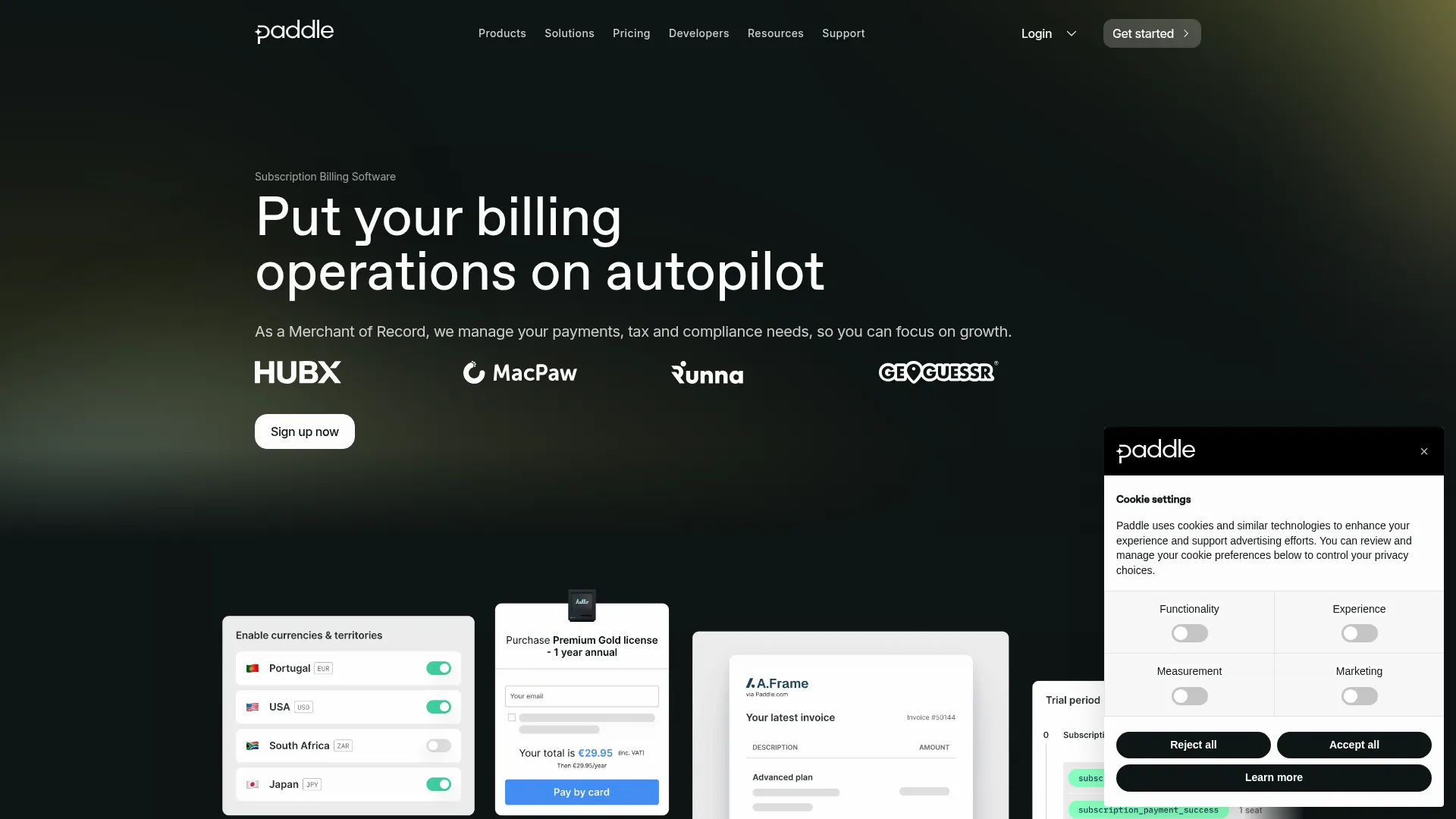
Paddle is the veteran full-service Merchant of Record: founded in London in 2012, it resells your software as the legal seller and handles payments, subscriptions, renewals, dunning, and global sales-tax/VAT compliance end to end. It's the platform established SaaS companies graduate to when tax compliance across dozens of jurisdictions becomes a real liability rather than a hypothetical one, and its Trustpilot record — 4.1/5 across more than 10,000 reviews — is the deepest verified track record in this roundup.
For a scaling SaaS doing real volume into the EU and internationally, Paddle's value is that global tax simply becomes someone else's problem — registration, collection, filing, and remittance all handled, with buyer-facing payment support included. That reliability is why it's the default for companies past roughly $1M ARR. The costs are equally clear: 5% + 50¢ is the highest flat rate of the modern MoRs, the fixed 50¢ makes low-ticket sales brutal (a $5 sale runs 15%+ effective), onboarding is heavier and more enterprise-flavored than the indie tools, and support on complex account issues draws mixed reviews. One more thing to weigh honestly: in June 2025 the FTC settled with Paddle for $5 million over claims it processed payments for deceptive tech-support operations — it doesn't affect legitimate SaaS sellers day to day, but it's a governance data point worth knowing. Buy Paddle for proven, hands-off compliance at scale; look elsewhere if you're pre-revenue or selling cheap.
Key Features
- True MoR — global VAT/sales tax registered, collected, and remitted on your behalf
- Deep subscription management: renewals, proration, dunning, and revenue reporting
- Broad international payment-method and currency coverage with localized checkout
- Buyer-facing payment support handled by Paddle, not your inbox
- Migration assistance and a decade of billing-infrastructure maturity
Pricing
No monthly fee. 5% + 50¢ per transaction, all-inclusive (MoR + tax + subscriptions). Currency-conversion margins (~2-3% over mid-market) apply on non-USD. Custom/enterprise pricing at volume.
Rating
4.1/5 — Trustpilot (10,143 reviews)
Best For
Established, scaling SaaS businesses — especially EU/international-heavy ones — ...
Pros
- The most proven MoR here — a decade of operation and 10,000+ Trustpilot reviews
- Genuinely hands-off global tax compliance, the core reason to pick an MoR at all
- Full subscription, dunning, and revenue tooling built in for scaling teams
Cons
- Highest flat rate (5% + 50¢); the fixed 50¢ punishes low-ticket and microtransaction pricing
- Enterprise-flavored onboarding and mixed support reviews; June 2025 FTC $5M settlement on record
Polar
Best for Developers & Open Source — Code-First MoR With the Best DX in the Category
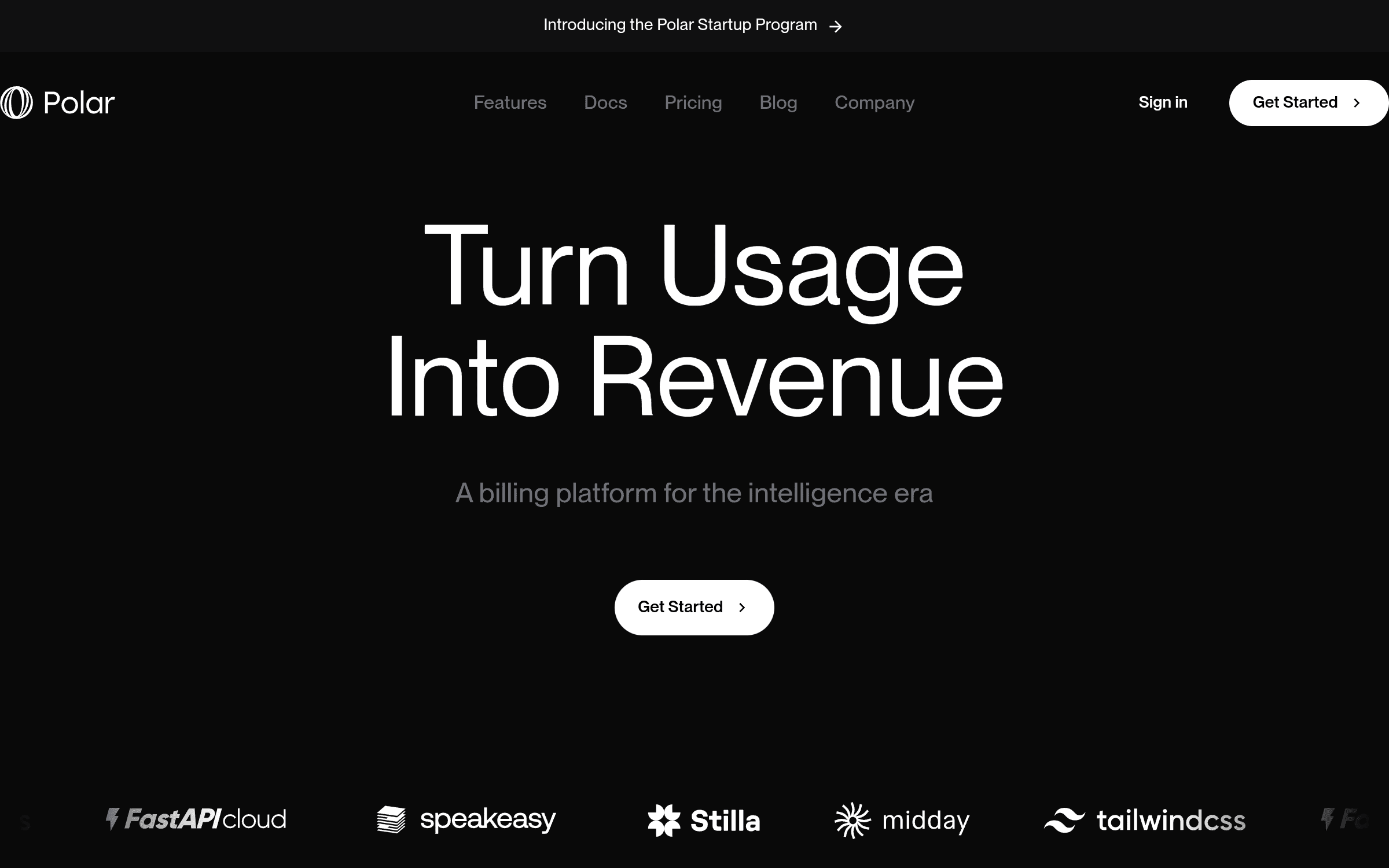
Polar is the open-source, developer-first Merchant of Record: founded in 2022 by Birk Jernström (who previously built Tictail, acquired by Shopify) and backed by a $10M seed led by Accel in 2025. Built on Stripe underneath, it handles subscriptions, one-time sales, and usage-based/AI billing with global tax compliance — but its real differentiator is developer experience. You can go from zero to a working checkout in about six lines of code, with SDK adapters for Next.js, Laravel, and BetterAuth, and the entire codebase is inspectable on GitHub (it crossed 10,000 registered developers in early 2026).
For technical founders — especially AI and dev-tool builders — Polar is the MoR that respects that you'd rather write code than click through a dashboard. It's transparent where competitors are black boxes, and its usage-based billing is pitched squarely at "the intelligence era" (metered AI consumption). The pricing shifted in May 2026 to tiered plans: a free Starter tier at 5% + 50¢, then Pro ($20/mo) at 3.8% + 40¢, Growth ($100/mo) at 3.6% + 35¢, and Scale ($400/mo) at 3.4% + 30¢. Organizations created before May 27, 2026 keep a legacy 4% + 40¢ rate — but lose it permanently if they move to a paid plan, so do the math before upgrading. The trade-offs are the flip side of "developer-first": checkout needs code (not for non-technical sellers), country coverage (~60) is narrower than Paddle's, enterprise features and support are thinner, and every plan adds +1.5% on international cards plus a $15-per-dispute fee. For a developer who values open source and code-level control, though, nothing here comes close on DX.
Key Features
- Open-source and self-inspectable — no black-box billing
- Best developer experience in the category: ~6 lines to a checkout, framework SDK adapters
- Usage-based/AI billing built for metered consumption
- Full MoR global tax compliance (built on Stripe, ~60 countries)
- GitHub-native workflows; 10,000+ registered developers
Pricing
Tiered (from May 27, 2026): Starter free at 5% + 50¢; Pro $20/mo at 3.8% + 40¢; Growth $100/mo at 3.6% + 35¢; Scale $400/mo at 3.4% + 30¢. Legacy Early Member rate 4% + 40¢ for pre-May-2026 orgs (lost on upgrade). +1.5% international cards; $15 per dispute; Stripe payout fees pass through.
Rating
10,000+ developers (no formal G2 aggregate yet)
Best For
Developers and technical indie founders — especially AI/dev-tool startups — who ...
Pros
- Unmatched developer experience and genuine open-source transparency
- Native usage/AI billing and a clear, tiered path to sub-3.5% rates at volume
- Accel-backed with fast momentum (10K+ developers in under a year of traction)
Cons
- Checkout requires code — wrong choice for non-technical sellers
- Narrower country coverage (~60), thinner enterprise support, and the May 2026 repricing raised the entry rate for new orgs
Lemon Squeezy
Best for Solo Digital-Product Sellers — the Simplest MoR, Now a Stripe Company
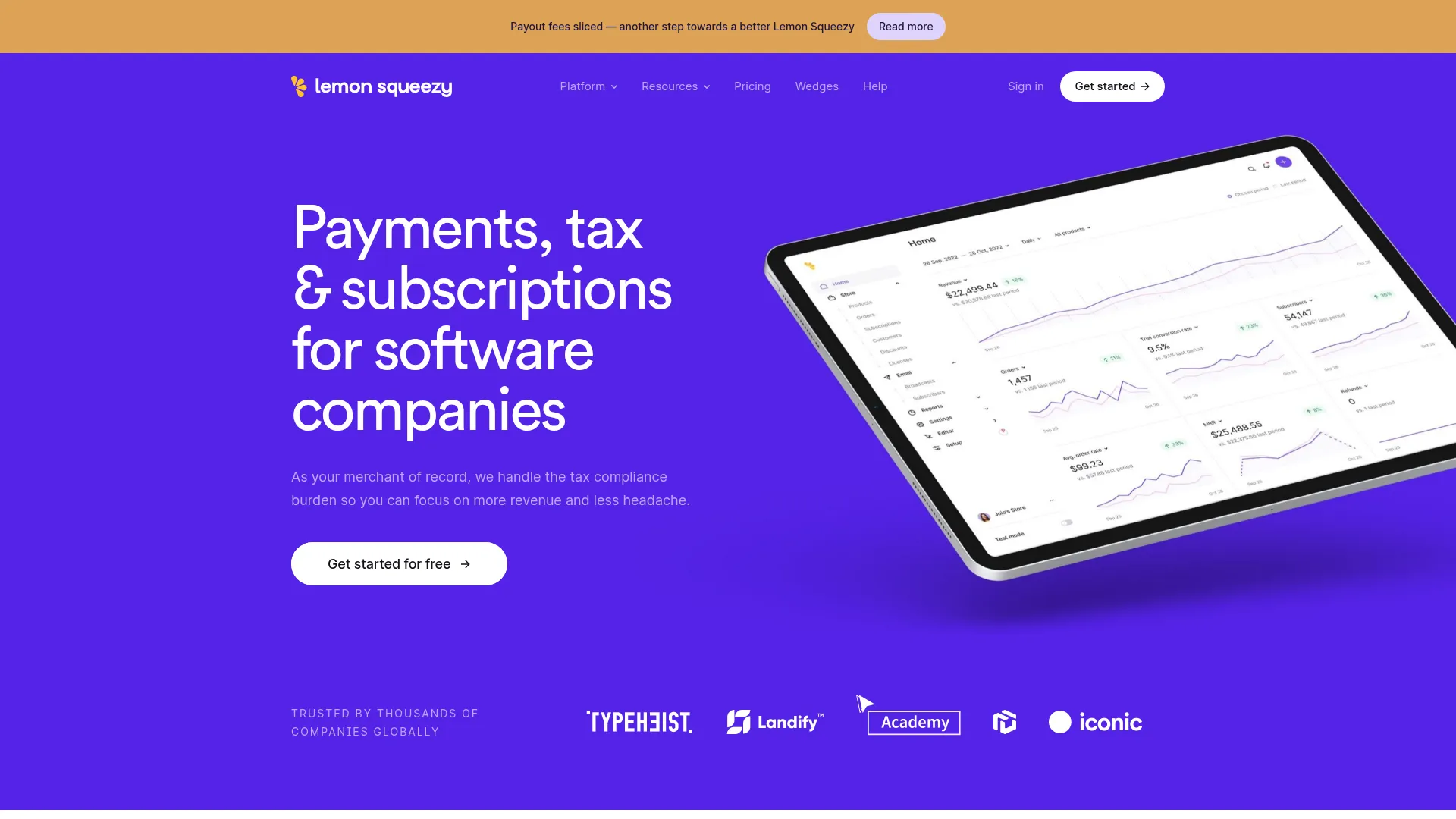
Lemon Squeezy is the indie-friendly Merchant of Record that made selling digital products genuinely easy: founded in Salt Lake City in 2020 and acquired by Stripe in 2024, it handles tax compliance, checkout, subscriptions, software license keys, and affiliate payouts in one clean, no-code package. For a solo founder shipping a digital download, a template, or a small SaaS, it's long been the shortest path from "I built a thing" to "I'm getting paid, and someone else owns the VAT."
Lemon Squeezy's reputation among indie creators is built on two things: a genuinely intuitive setup and transparent pay-as-you-go pricing with no monthly fee. Built-in license-key generation and affiliate tooling make it especially strong for people selling licensed software or running referral programs. At 5% + 50¢ it's priced like Paddle, with a stack of surcharges to watch (+1.5% international cards, +1.5% PayPal, +0.5% subscriptions, +5% on recovered carts, +3% on affiliate referrals). The two honest concerns: account-verification friction is a recurring complaint — some sellers report document requests and rejected or frozen accounts — and there's genuine strategic uncertainty about direction now that it's a Stripe property, especially after Stripe launched its own competing MoR (Managed Payments) in 2026. It remains an excellent, simple MoR for small digital-product businesses; just go in knowing who owns it and where the surcharges hide.
Key Features
- Full MoR with global VAT/sales-tax remittance and no monthly fee
- Built-in software license-key generation and management
- Subscriptions plus one-time digital products in one no-code checkout
- Native affiliate tooling with automated payouts
- Polished, genuinely beginner-friendly storefront and dashboard
Pricing
No monthly fee. 5% + 50¢ per transaction. Surcharges: +1.5% international cards, +1.5% PayPal, +0.5% subscriptions, +5% recovered carts, +3% affiliate referrals.
Rating
G2 page exists (no reliable aggregate at time of research)
Best For
Solo founders and small digital-product or SaaS businesses that want the simples...
Pros
- Easiest setup here — a solo seller can be live in an afternoon
- License keys plus affiliates built in, ideal for digital-product businesses
- Transparent pay-as-you-go pricing, no monthly fee
Cons
- Account-verification friction: reports of document requests, rejected or frozen accounts
- Strategic uncertainty as a Stripe property now competing with Stripe's own MoR; surcharges stack quickly
Want More Tool Recommendations?
Subscribe for curated indie hacker tool picks every week. No sponsored content, no fluff.
Creem
Best Budget MoR for Bootstrappers — the Lowest-Fee Indie Play, With Caveats
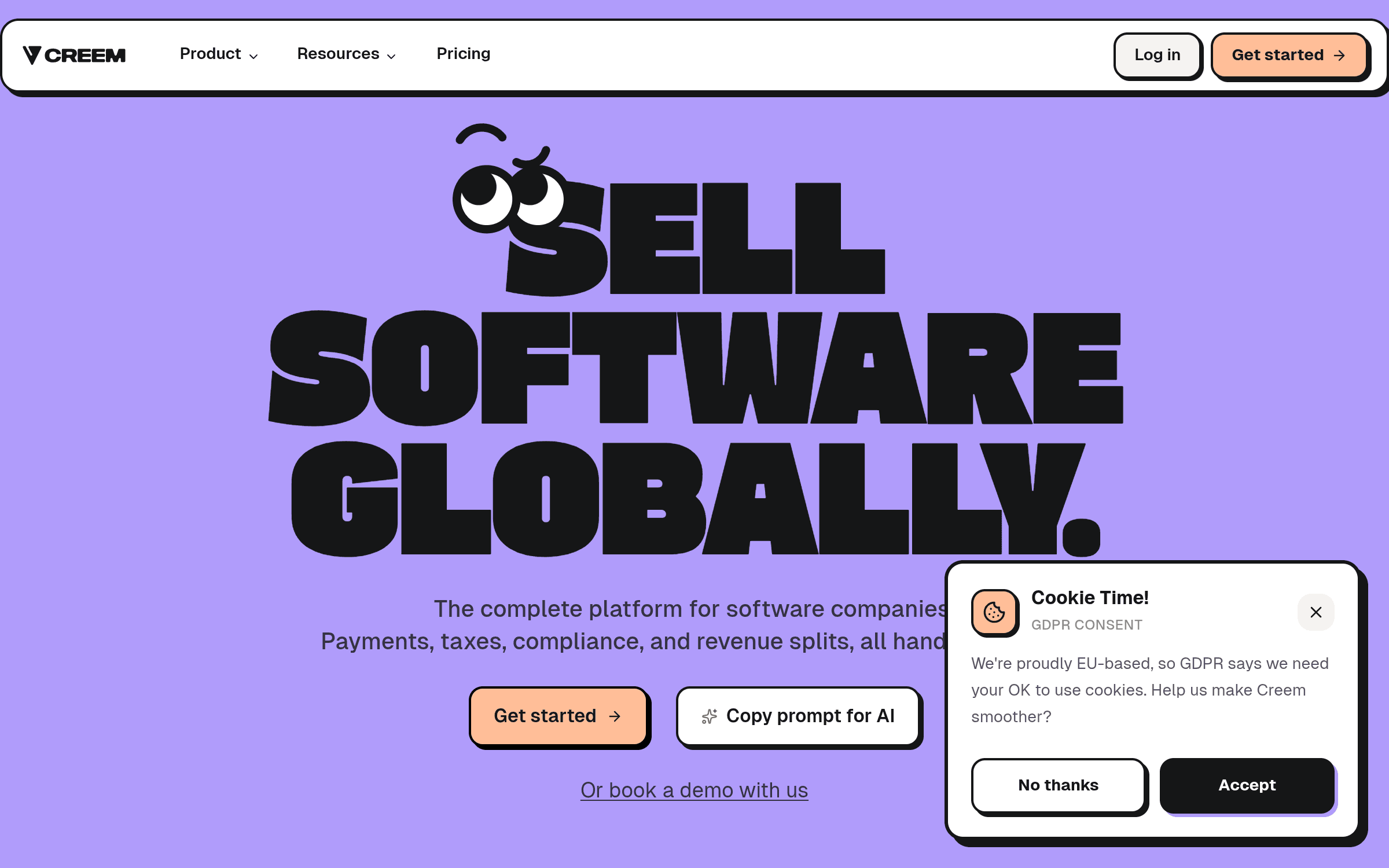
Creem is a low-cost Merchant of Record pitched explicitly as the anti-Paddle: no sales calls, no volume minimums, and a headline rate — 3.9% + 40¢ — aimed at bootstrapped indie hackers and early-stage AI builders. Founded around 2024, it handles VAT/GST/sales-tax remittance, offers a no-code drag-and-drop checkout, and adds founder-friendly extras like revenue splits for co-founders and contractors, plus crypto payouts.
For a side project or an early SaaS where every point of fee matters and a sales process is a non-starter, Creem's economics are attractive: one of the lowest headline rates of any MoR, no monthly minimum, no international-card surcharge on the base rate, and payouts twice a month (1st and 15th, bank or crypto). Revenue splits are a genuinely useful touch for founders paying out to partners. But this is where honesty matters most: Creem's Trustpilot presence is small and polarized, with some reviews alleging unauthorized charges, and users report technical bugs (duplicate product creation, an awkward usage-billing API). Its country coverage is also ambiguous — the pricing page says "50+ countries" while its marketing claims "130+." Treat Creem as the high-value, higher-risk budget pick: excellent for low-revenue projects where the fee savings are real and the stakes are low, but not where you'd bet a primary revenue line on an unproven platform.
Key Features
- One of the lowest MoR rates (3.9% + 40¢), no monthly fee, no volume minimum
- VAT/GST/sales-tax collection and remittance handled as MoR
- No-code drag-and-drop branded checkout and payment pages
- Revenue splits for co-founders, affiliates, and contractors
- Payouts twice monthly to bank or crypto wallet
Pricing
No setup or monthly fees. 3.9% + 40¢ per transaction, no international-card surcharge on base. Optional: +2% revenue splits, +2% affiliate, +5% abandoned-cart recovery. Payouts 1st and 15th; international payout fee $7/€7 or 1%, whichever is higher.
Rating
Trustpilot (small, polarized sample)
Best For
Bootstrapped indie hackers and early-stage SaaS/AI builders who want the lowest ...
Pros
- Lowest headline rate of the indie MoRs, with no monthly minimum or base international surcharge
- Revenue splits and crypto payouts are genuinely founder-friendly extras
- Fast-moving, responsive team with an actively improving product
Cons
- Polarized Trustpilot with some unauthorized-charge complaints; reported bugs (duplicate products, awkward usage API)
- Ambiguous country coverage (pricing page "50+" vs. marketing "130+") and a young, unproven track record
FastSpring
Best for Enterprise & Global Veterans — Negotiated Rates and Deep Compliance

FastSpring is the other veteran full-service Merchant of Record: founded in 2005, it resells your software/SaaS/digital goods as the legal seller across 200+ regions, handling payments, subscriptions, fraud, and sales-tax/VAT collection and remittance. It bootstrapped to roughly $110M in revenue before taking outside investment (Accel-KKR, and a May 2026 strategic investment from LLR Partners), and it's built for mid-to-large software companies with complex, global sales rather than solo makers.
FastSpring's strength is battle-tested, enterprise-grade infrastructure: deep tax compliance across 200+ regions, strong fraud tooling and card-approval optimization, localized checkout in 20+ languages, and a G2 record (4.5/5 across ~200 reviews) reflecting years of reliability. Because pricing is a negotiated flat revenue-share rather than a published rate, high-volume sellers can land better economics than a fixed 5% — third-party sources peg the baseline around 5.9% + 95¢, scaling toward ~3.9% at volume. The trade-offs point squarely away from indie use: effective fees run high for small sellers (often 20-60% more than the lean alternatives), the dashboard feels dated, FX markups (~3.5-5.5%) apply on non-USD, and there's no self-serve transparency — you talk to sales. It's the right MoR for a serious software company with global complexity and volume to negotiate with; it's the wrong one for a $9/mo side project.
Key Features
- MoR tax/VAT compliance and remittance across 200+ regions
- Subscription and recurring-billing management with dunning
- Localized checkout in 20+ languages, multi-currency
- Enterprise fraud monitoring and card-approval optimization
- Negotiated flat revenue-share — better economics at real volume
Pricing
No monthly fee or minimums; negotiated flat revenue-share (not published). Third-party-reported baseline ~5.9% + 95¢, scaling toward ~3.9% at higher volume. FX markups ~3.5-5.5% on non-USD. Exact rate requires a sales conversation.
Rating
4.5/5 — G2 (204 reviews)
Best For
Mid-to-large software, SaaS, and AI companies with global sales and complex pric...
Pros
- Two decades of proven, enterprise-grade MoR reliability and compliance depth
- Negotiated rates reward volume; strong fraud and card-approval tooling
- Broad regional and language coverage for genuinely global selling
Cons
- High effective fees for small sellers; no self-serve pricing (sales-led only)
- Dated dashboard and FX markups on non-USD transactions
2Checkout (Verifone)
Best for Broad Local Payment Methods — a Veteran MoR With Post-Acquisition Baggage

now Verifone-owned, 2Checkout is a veteran Merchant of Record (founded 2000, acquired by Verifone in 2020) that sells your digital goods and SaaS as reseller of record across 200+ markets with 45+ payment methods. Its differentiator is breadth of local payment coverage and a tiered model that lets you pay only for the layer you need — from basic payment processing up to full tax-compliant MoR.
If reaching buyers through local payment methods in far-flung markets is the priority, 2Checkout's coverage is genuinely global, and its tiered pricing is unusually honest about what you're buying: 2Sell (3.5% + 30¢) is payments and fraud only; 2Subscribe (4.5% + 40¢) adds subscription and churn tools; 2Monetize (6% + 50¢) is the full MoR suite with tax compliance — meaning the true "tax liability transfer" only kicks in at the top tier. That's the catch to understand before comparing its low tier to a full MoR. The bigger caution is reputational: consumer-review sentiment is weak (Sitejabber ~2.0-2.3/5), and a consistent theme is that support and service quality declined after the Verifone acquisition, alongside billing and payout complaints. It's a capable, established platform for global local-payment reach — but weigh the full-MoR tier's 6% rate and the post-acquisition support reports carefully.
Key Features
- MoR global tax/VAT compliance at the 2Monetize tier
- 45+ payment methods and localized checkout across 200+ markets
- Tiered pricing — pay only for payments, subscriptions, or full MoR
- Recurring billing with churn and dunning management
- Affiliate/partner and dynamic-pricing tooling
Pricing
No setup/monthly fees. Tiered: 2Sell 3.5% + 30¢ (payments/fraud); 2Subscribe 4.5% + 40¢ (adds subscriptions); 2Monetize 6% + 50¢ (full MoR + tax). Cross-border fee up to ~2%; chargeback fees ~$15-45. Full tax liability transfer requires 2Monetize.
Rating
2.1/5 — Sitejabber (155 reviews)
Best For
Software/SaaS vendors selling globally who need the widest local-payment-method ...
Pros
- Widest local-payment-method and market coverage of any MoR here
- Honest tiered pricing — buy only the layer you need
- Two-decade track record selling software globally
Cons
- Full tax-liability MoR only at the 6% 2Monetize tier — pricier than it first looks
- Weak consumer-review sentiment and reports of degraded support after the Verifone acquisition
Chargebee
Best for Complex Subscription Billing — a Billing Platform, With MoR as an Add-On

Chargebee is not a native Merchant of Record — it's the most powerful subscription-billing and revenue-management platform in this roundup, and it offers MoR only as an add-on layer through its "Reach" integration (currently private beta). Founded in 2011 and a Leader in the 2025 Gartner Magic Quadrant for Recurring Billing, it's what growth-stage and enterprise SaaS teams use when their billing logic — plans, proration, metered usage, dunning, revenue recognition — has outgrown what a checkout tool can handle.
Include Chargebee on your shortlist only if billing complexity, not tax liability, is your real problem. Its recurring-billing engine is genuinely deep: sophisticated proration, usage-based billing, churn/revenue recovery, RevRec, and 100+ payment-gateway integrations (you bring your own processor, often Stripe). Pricing is generous at the bottom — free up to $250K in cumulative billing, then Performance from $599/mo, with ~0.75% overage above thresholds. The critical distinction for this list: because Chargebee sits on top of your own processor, you remain the merchant of record and own your tax obligations — unless you add the Reach MoR layer, which is in private beta with no published pricing. So it's the pick when you need billing horsepower and will handle tax separately (via Stripe Tax or Reach), and the wrong pick if you wanted a single tool to make VAT disappear out of the box.
Key Features
- Deepest recurring-billing engine here: proration, metered usage, dunning, RevRec
- 100+ payment-gateway integrations (bring your own processor)
- Churn and revenue-recovery tooling with SaaS analytics
- Free up to $250K cumulative billing before paid tiers
- Optional MoR via the Reach add-on (private beta)
Pricing
Starter/Launch free up to $250K cumulative billing; Performance from $599/mo; Enterprise custom. ~0.75% overage above plan thresholds. Reach MoR add-on: private beta, pricing on request. You supply your own payment processor.
Rating
4.4/5 — G2 (1,033 reviews)
Best For
Growth-stage and enterprise SaaS teams that need sophisticated subscription bill...
Pros
- Unmatched subscription-billing depth for complex or usage-based pricing
- Strong free tier ($250K cumulative billing) and a huge integration ecosystem
- Gartner-recognized, enterprise-proven with 1,000+ G2 reviews
Cons
- Not a native MoR — you keep your own tax liability unless you add Reach (private beta)
- Cost and complexity scale up fast; overkill for simple checkout needs
Fungies
Best for Games & Digital Goods — a Modern No-Code MoR for Self-Publishers

Fungies is a newer, AI/no-code Merchant of Record (founded 2022) built for digital goods, SaaS, and especially game developers. It takes full legal seller responsibility — payments, sales tax/VAT, compliance — across 150+ countries, and spins up hosted storefronts and checkout in minutes, with game-specific tooling like in-game purchases and virtual currency alongside standard SaaS subscriptions.
For an indie game studio or a digital-goods seller who wants to self-publish without building billing infrastructure, Fungies is purpose-fit in a way the generalist MoRs aren't: game-commerce primitives (virtual currency, in-game purchases, engine integrations) sit next to subscriptions, all under a no-code storefront you can launch fast. Reviewers praise the quick implementation and responsive support. The honest limits are those of a young company: the review corpus is thin, feature depth is less mature than the incumbents, the dashboard can be slow, and reported rates vary across sources (roughly 4.9% + 30¢ to 5% + 50¢, with volume discounts above $50K/month) since the official pricing page isn't cleanly published. It's a strong, modern fit for games and digital goods specifically — just size the track-record risk for anything mission-critical.
Key Features
- MoR tax/VAT compliance across 150+ countries
- No-code hosted storefronts and checkout, live in minutes
- Game-commerce tooling: in-game purchases, virtual currency, engine integrations
- SaaS subscriptions alongside digital-goods sales
- AI-assisted setup and configuration
Pricing
No monthly fee or setup cost; tax and FX included. Reported ~4.9% + 30¢ to 5% + 50¢ per transaction (sources vary; official page not cleanly published), with volume discounts above ~$50K/month. Verify a live quote before committing.
Rating
Limited reviews (2022 startup)
Best For
Indie game studios and early-stage digital-goods or SaaS founders who want a mod...
Pros
- Purpose-built game-commerce tooling no generalist MoR matches
- Fast, no-code storefront setup and responsive support
- Modern MoR with tax and FX bundled, no monthly fee
Cons
- Young company: thin review history and less mature feature depth
- Inconsistent published rates and a dashboard reported as occasionally slow
Braintree (PayPal)
Best Processor If You'll Own Your Own Tax — the Stripe-Style Alternative That Isn't an MoR
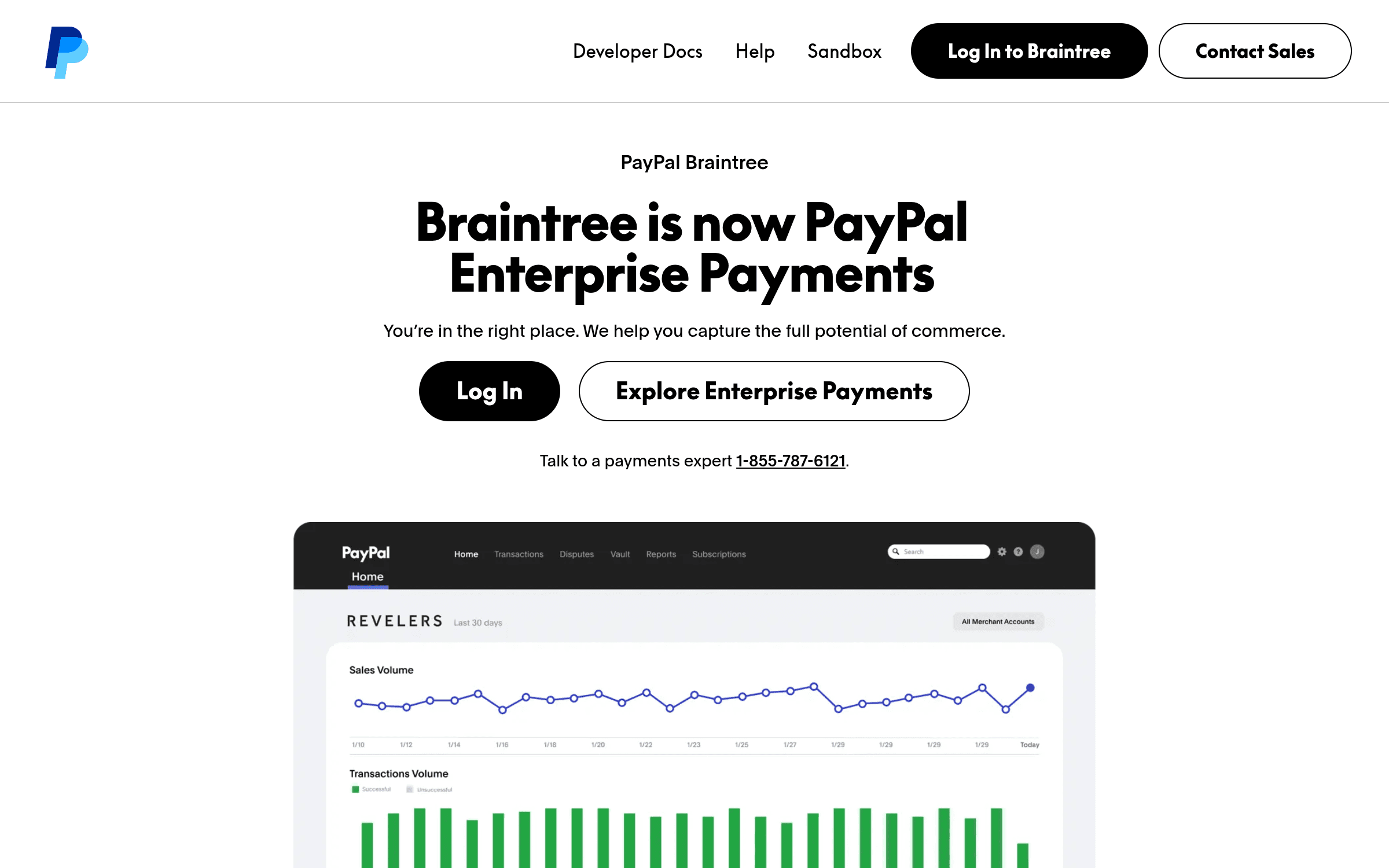
Braintree is the honest "not an MoR" entry, included precisely to sharpen the distinction this list is built on. It's a developer-focused payment processor (founded 2007, acquired by PayPal for $800M in 2013), not a Merchant of Record — you remain the legal seller and own your global sales-tax and VAT obligations, exactly as you would with raw Stripe. What it offers is strong APIs and native acceptance of cards, PayPal, and Venmo in one integration.
If your reason for leaving Stripe is anything other than tax compliance — you want PayPal and Venmo natively, or you're standing up a marketplace and want granular control of your own payments stack — Braintree is the closest like-for-like processor, at Stripe-identical 2.9% + 30¢ for standard cards (PayPal 3.49% + 49¢, Venmo 3.5% + 49¢). But be clear-eyed about two things. First, it does nothing for the tax problem: choosing Braintree over an MoR means you're signing up to register, collect, file, and remit tax yourself in every jurisdiction. Second, its consumer-review reputation is poor — Trustpilot sits around 1.6/5 across ~280 reviews, dominated by support complaints: no phone support, slow email, and reports of account freezes and fund-access delays (the classic PayPal-ecosystem risk). Pick Braintree if you specifically want PayPal/Venmo acceptance and will own your compliance; if you wanted the tax headache gone, every MoR above is the actual answer.
Key Features
- Native card, PayPal, Venmo, and wallet acceptance in one integration
- High-quality developer APIs, SDKs, and drop-in UI
- Recurring billing, vaulting, and advanced fraud tools (Kount)
- Global multi-currency acceptance across 40+ countries
- Backed by PayPal's enterprise payments infrastructure
Pricing
No monthly fee (standard). 2.9% + 30¢ per card transaction; PayPal 3.49% + 49¢; Venmo 3.5% + 49¢. Custom interchange-plus at volume. Not an MoR — you remain responsible for your own sales tax/VAT.
Rating
1.6/5 — Trustpilot (280 reviews)
Best For
Developer-heavy businesses, platforms, and marketplaces that want PayPal/Venmo a...
Pros
- Native PayPal and Venmo acceptance no MoR here offers
- Excellent developer APIs and documentation at Stripe-identical rates
- PayPal-grade payment infrastructure and fraud tooling
Cons
- Not a Merchant of Record — you own all global tax registration, filing, and remittance
- Poor support reputation (Trustpilot ~1.6/5): no phone support, account-freeze and fund-hold reports
What We Cut — And Why
Several credible names didn't make the ten, and the reasons are themselves useful buying signals:
- Stripe — deliberately excluded as the incumbent this whole list is measured against. It's the best payment processor there is, but standard Stripe leaves you as the merchant of record owning your own global tax. It's the baseline, not an alternative to itself.
- Stripe Managed Payments — Stripe's own 2026 MoR tier (~6.4% + 30¢). Genuinely an MoR, but it's Stripe wearing an MoR hat at a premium rate; if you're already leaving Stripe, the independents below undercut it.
- Gumroad — a fine creator-first MoR for one-off digital products, but its flat 10% (post-2023 changes) is punishing for SaaS, and it's built for creators selling ebooks and courses, not software subscriptions.
- Payhip / Sellfy — simple digital-storefront MoRs for creators; capable for a first ebook or template, but too thin on subscription and usage-billing depth for a real SaaS.
- DodoPayments — a promising newer MoR in the same indie lane as Creem and Kelviq, but too early and thinly reviewed to rank with confidence yet. Worth watching.
How We Chose These Tools
We evaluated 15 payment platforms in July 2026 against five founder-specific criteria. Most competing listicles are written by the payment companies themselves; we weighted what they don't put on the pricing page.
- Tax liability transfer — is it a true Merchant of Record that owns your VAT/sales-tax compliance, or a processor that leaves it with you? This is the primary axis.
- True effective cost — headline rate plus the fixed per-transaction fee, international-card surcharges, FX markups, and payout fees that determine what you actually net
- Billing model fit — subscriptions, one-time, and especially usage/credit/AI-token billing, which most incumbents handle poorly
- Verified track record — G2/Trustpilot ratings and review counts cross-checked against complaint themes (account freezes, support decay); thin samples flagged, not hidden
- Platform risk — ownership, funding, acquisitions (Lemon Squeezy → Stripe, 2Checkout → Verifone), regulatory events (Paddle's FTC settlement), and payout/holdback reliability
How to Choose by Your Situation
Pick by what you're selling and who you are, not by the lowest headline number. The right answer changes completely depending on your average order value, your stack, and whether tax compliance is the thing you're trying to escape.
AI product billed on tokens or usage...
Kelviq (native metering + lowest full-MoR rate) or Polar if you want it open-source and code-first.
Established SaaS at scale, EU-heavy...
Paddle for the proven track record, or FastSpring if you have volume to negotiate rates.
Solo maker selling digital products...
Lemon Squeezy (license keys + affiliates, simplest setup) or Creem if fees are your top concern.
Developer who'd rather write code...
Polar — six lines to checkout, open source, framework SDKs, and a tiered path to sub-3.5% at volume.
Games or digital goods...
Fungies for game-commerce primitives (virtual currency, in-game purchases) under a no-code MoR storefront.
You want control and will own your tax...
Braintree (PayPal/Venmo native) or stay on Stripe — but budget for your own VAT/sales-tax compliance, or add Chargebee for billing depth.
Stay Ahead of the Tool Curve
We research dozens of tools so you don't have to. Get our top picks and insider insights delivered weekly.
Frequently Asked Questions
What is the difference between a payment processor and a merchant of record?
A payment processor (Stripe, Braintree) moves money — it charges the card and deposits funds — but you remain the legal seller of record, which means you are responsible for registering for, collecting, filing, and remitting sales tax and VAT in every jurisdiction where you have customers. A Merchant of Record (Kelviq, Paddle, Polar, Lemon Squeezy, Creem, FastSpring, 2Checkout, Fungies) becomes the reseller of record on paper: the platform is legally the seller, so it takes on that entire tax-compliance liability for you. You pay a higher fee (~3.5%-6% vs. a processor's ~2.9%) in exchange for never having to register in the EU, track economic nexus across US states, or file returns. The fee gap is the price of offloading compliance.
Is Stripe a merchant of record?
Standard Stripe is not a merchant of record — with it, you are the seller of record and you own your global sales-tax and VAT obligations. Stripe Tax is a paid add-on (~0.5% per transaction) that calculates and collects the right tax, but you still register and file/remit yourself, so it does not transfer liability. As of 2026, Stripe also offers Managed Payments — its own MoR-style service where Stripe becomes the seller of record — at roughly +3.5% over base (~6.4% + 30¢). The fact that Stripe now sells an MoR tier is the clearest sign that "just use Stripe" is no longer the automatic answer for founders selling globally.
What is the best Stripe alternative for SaaS in 2026?
It depends on what you're actually replacing. If you want to offload tax compliance (the main reason to leave Stripe), you want a Merchant of Record: Kelviq is our pick for AI and usage-based SaaS thanks to native token/credit billing at the lowest full-MoR rate (3.5% + 40¢), Paddle is the proven choice for established SaaS at scale, and Polar is best for developers who want open source and code-first setup. If your reason for leaving is not about tax — you want PayPal/Venmo acceptance or marketplace control — Braintree is the closest like-for-like processor, but you'll keep your own tax liability. Match the tool to the problem: tax → MoR; features/control → processor.
What is the cheapest merchant of record?
Among full MoRs with published rates, Kelviq (3.5% + 40¢, and 2.9% on your first $5,000) and Creem (3.9% + 40¢) carry the lowest headline fees, both with no monthly minimum. Polar reaches 3.4% + 30¢ but only on its $400/mo Scale tier; its free tier is 5% + 50¢. Watch two things beyond the headline: the fixed per-transaction fee (40-50¢) dominates the effective rate on low-ticket sales, and near-universal surcharges (+1.5% on international cards, +0.5% on subscriptions) apply on top. For a low-revenue project the cheapest option is usually Kelviq or Creem — but weigh Creem's thinner, more polarized track record before routing primary revenue through it.
Do I actually need a merchant of record, or can I just use Stripe plus Stripe Tax?
You can stay on Stripe + Stripe Tax — but understand what you're keeping. Stripe Tax (~0.5%) calculates and collects the correct tax, but you remain responsible for registering in each jurisdiction and filing/remitting the returns yourself. That's manageable if you sell mostly domestically or into a couple of regions; it becomes a real, recurring compliance burden once you're selling into the EU (VAT registration) and across US states (economic nexus thresholds). The rough math: Stripe + Stripe Tax lands around 3.4% + 30¢ and you own the paperwork; a Merchant of Record runs ~3.5%-5% and the paperwork disappears. If your time is worth more than the ~1-2% delta, or global filings scare you, an MoR pays for itself.
Is Lemon Squeezy still a good choice after the Stripe acquisition?
It's still a genuinely easy, capable MoR for solo digital-product sellers — license keys, affiliates, and a clean no-code checkout remain strong. But two caveats matter in 2026. First, some sellers report account-verification friction, including document requests and frozen or rejected accounts. Second, there's strategic uncertainty now that Stripe owns it and has launched its own competing MoR (Managed Payments), which raises fair questions about long-term investment in Lemon Squeezy as a standalone product. If simplicity for a small digital business is your priority, it's still a solid pick; if you want a platform whose roadmap independence is clearer, Kelviq, Polar, or Creem are worth comparing.
What happened with Paddle and the FTC?
In June 2025, the FTC settled with Paddle for $5 million over allegations that it processed payments for deceptive tech-support operations. It's a governance and compliance data point worth knowing, but it does not affect legitimate SaaS sellers in day-to-day operation — Paddle remains a fully functioning, widely used Merchant of Record with the deepest verified track record on this list (4.1/5 across 10,000+ Trustpilot reviews). We flag it because an honest ranking shows the receipts, good and bad; weigh it as one input, not a disqualifier.
The Bottom Line
Choosing a Stripe alternative in 2026 is a tax-liability decision wearing a fee comparison as a disguise. The moment you sell across borders, the question stops being "which processor is cheapest" and becomes "do I want to be the merchant of record, or pay someone ~2 points to be it for me?" For most founders selling globally, the answer is the second one — the time and risk of VAT registrations and multi-state filings dwarfs the fee difference.
If you're building an AI or usage-based product, Kelviq is our pick: native token and credit billing at the lowest full-MoR rate, from founders with a real track record — just start on a non-critical line while it earns trust. Scaling SaaS with real volume: Paddle or FastSpring. Developers: Polar. Solo digital sellers: Lemon Squeezy, or Creem if fees rule. And if your reason for leaving Stripe was never about tax, Braintree or staying put is honest — just don't forget the compliance bill you're keeping.
Whatever you pick: decide the merchant-of-record question first, model your true effective rate at your actual average order value (that fixed 40-50¢ matters more than you think), read the surcharge and payout-timing fine print, and — for the newer platforms — route a secondary revenue line through it before you bet the business on it.
Related Reading
- Best Business Banking for Startups — Once payments land, where should the money actually sit?
- The End of Per-Seat Pricing: SaaS Outcome & Usage Models — Why usage billing is reshaping how founders charge — and bill
- Best AI Landing Page Builders for SaaS Founders — The page that turns traffic into the checkout you just set up
- Best Automation Tools & Zapier Alternatives — Wire your new billing events into the rest of your stack
Sources
- Kelviq — Official Pricing
- Kelviq — Merchant of Record
- ParityDeals — Introducing Kelviq
- Kelviq — Product Hunt Launch
- Paddle — Official Pricing
- Paddle — Trustpilot Reviews
- Polar — Pricing & Plans
- Polar — Merchant of Record Fees
- Lemon Squeezy — Official Pricing
- Lemon Squeezy — 2026 Update (Stripe Managed Payments)
- Creem — Official Pricing
- FastSpring — Merchant of Record
- FastSpring — G2 Reviews
- 2Checkout (Verifone) — Pricing
- Chargebee — Official Pricing
- Chargebee — Reach (MoR) Docs
- Fungies — Pricing
- PayPal Braintree — Fees
- Stripe — Official Pricing
- Stripe — Understanding Stripe Tax Pricing
Stay Ahead of the Tool Curve
We research dozens of tools so you don't have to. Get our top picks and insider insights delivered weekly.
Trusted by indie hackers and startup founders
Keep Reading
7 Best AI App Builders for Non-Technical Founders in 2026
The best AI app builders for non-technical founders, ranked by what you can actually launch: user accounts, data, payments, publishing, costs, and exit paths.
7 Best AI Search Visibility Tools for Agencies in 2026
Seven AI search visibility tools ranked for agencies by client workspaces, reporting, prompt economics, and the real cost of managing multiple brands.
10 Best Granola Alternatives for Private AI Meeting Notes (2026)
The best Granola alternatives in 2026, ranked on where your notes are stored, whether your data trains AI, and what a bot-free notetaker really costs. Verified pricing.