
10 Best Automation Tools & Zapier Alternatives in 2026 (Ranked by What 10,000 Runs Actually Cost)
The 10 best automation tools and Zapier alternatives for 2026 — n8n, Make, Activepieces, Pabbly Connect, Relay.app, Gumloop, Latenode, Lindy, Integrately, and Power Automate. Ranked by billing unit and real cost at founder volumes: per-execution vs. per-credit vs. per-task pricing, what 10,000 monthly runs cost on each, and the overage mechanics vendors keep off the pricing page.
In 2026, you are choosing a billing unit before you are choosing a builder.
Six units compete: per-task (Pabbly, Integrately — every action counts), per-credit (Make, Gumloop, Lindy — AI steps cost more), per-execution (n8n — unlimited steps inside each run), per-active-flow (Activepieces — unlimited runs), per-CPU-second (Latenode — only runtime matters), and per-step with free triggers (Relay.app). The cautionary anchor: Zapier bills every executed action step from a shared task pool that now also covers AI steps, code, and MCP calls (2 tasks each) — which is how 10,000 tasks a month lands near $300 while the same volume costs $0-$40 on most of this list. Sketch your three biggest workflows and count what each platform would bill first — then compare features.
Key Takeaways
- In 2026 you are choosing a billing unit before you are choosing a builder. Six units compete: per-task (Zapier, Pabbly, Integrately), per-credit (Make, Gumloop, Lindy), per-execution with unlimited steps (n8n), per-active-flow with unlimited runs (Activepieces), per-CPU-second (Latenode), and per-step with free triggers (Relay.app). The unit determines your bill more than the feature list does.
- The 10,000-runs-a-month math is brutal for the incumbent: roughly $300/mo on Zapier (per eesel's worked pricing table) vs. ~$12 on Make, ~€20 on n8n cloud, ~$16 on Pabbly Connect, effectively $0 on Activepieces cloud (up to 10 active flows), and $0 on self-hosted n8n or Latenode's free CPU-second allowance.
- Every top-ranking "best Zapier alternatives" listicle is written by a vendor that ranks itself #1 — Vellum's list crowns Vellum, Gumloop's crowns Gumloop. We don't sell automation software, and no tool on this list paid to be here.
- n8n is the best overall pick for technical founders: per-execution billing means a 20-step AI workflow costs the same as a 2-step one, and the self-hosted Community Edition removes volume pricing entirely. It raised $180M at a $2.5B valuation in October 2025 — the platform risk is low.
- The AI tax is the new gotcha. AI steps bill differently everywhere: Make meters AI modules by model and tokens, Gumloop's AI nodes bill by token usage, Lindy stopped publishing credit allowances altogether, and Zapier now routes AI steps, code, and MCP calls (2 tasks each) through the same task pool. Model your AI-heavy workflows before committing anywhere.
- Gartner expects 40% of enterprise apps to ship task-specific AI agents by end of 2026 — and predicts over 40% of agentic AI projects will be canceled by end of 2027. Buy automation for the workflows you run today, not the agent future vendors are selling.
Search for the best Zapier alternatives and every top result is a vendor ranking itself #1 — Vellum's list crowns Vellum, Gumloop's crowns Gumloop, and most never quote Zapier's actual prices. This list is different: we don't sell automation software, no tool paid to be here, and every pick is ranked by what automation actually costs a founder at real volumes — starting with the billing unit, because in 2026 that decides your bill more than any feature comparison.
The market split cleanly this year. Workflow platforms fight on unit economics: n8n bills per execution with unlimited steps, Activepieces stopped metering volume entirely, Latenode bills raw CPU seconds, and Make, Pabbly, and Integrately compete on cheap per-credit and per-task tiers. Meanwhile the AI-agent wave — Lindy's AI employees, Gumloop's agent canvas, Relay.app's approval-gated agents — charges a premium for judgment, not pipes. Zapier itself is deliberately absent from the ranking: it's the incumbent every tool here is measured against, and its per-task economics are the cautionary tale in the callout above.
Every entry covers verified pricing (including the AI fees and overage mechanics vendors keep off comparison pages), G2 sentiment, who the tool is actually for, and the billing gotchas users report after six months. Where a number couldn't be independently verified, we say so.
Quick Comparison
| # | Tool | Best For | Billing Unit | Rating |
|---|---|---|---|---|
| 1 | n8n | Best Overall for Technical Founders | Per execution (unlimited steps) | 4.7 |
| 2 | Make | Best Visual Builder | Per credit (1 = standard module) | 4.6 |
| 3 | Activepieces | Best Fixed-Cost Pricing | Per active flow (unlimited runs) | 4.8 |
| 4 | Pabbly Connect | Best Budget Pick | Per task (actions only) | 4.4 |
| 5 | Relay.app | Easiest to Learn | Per step (free triggers) | 4.9 |
| 6 | Gumloop | Best for AI-Heavy Workflows | Per credit (AI by tokens) | 4.8 |
| 7 | Latenode | Cheapest at Scale | Per CPU second | 4.7 |
| 8 | Lindy | Best AI Employee | Credits (unpublished) | 4.9 |
| 9 | Integrately | Best for 1-Click Setup | Per task (incl. conditions) | 4.7 |
| 10 | Microsoft Power Automate | Best If You Live in Microsoft 365 | Per user / per bot | 4.4 |
n8n
Best Overall for Technical Founders — Unlimited Steps per Execution + a Self-Host Escape Hatch
n8n is the source-available automation platform that repositioned itself as the AI workflow orchestration layer — node-based visual editor, JavaScript and Python escape hatches everywhere, native AI Agent nodes built on LangChain, RAG pipelines, and MCP support in both directions (n8n can act as MCP server and client). Its structural advantage is the billing unit: one workflow execution is one execution, whether it has 2 steps or 200. Backed by a $180M Series C at a $2.5B valuation (October 2025, led by Accel), with roughly 195,000 GitHub stars, it is the alternative Zapier power users graduate to.
Zapier bills every action step, so a 10-step workflow costs 10x a 1-step one. n8n bills the execution — 2,500 of them for €20/mo on Starter, 10,000 for €50 on Pro — which is why AI-agent workflows with a dozen tool calls per run are dramatically cheaper here. And when even that grows, the Community Edition self-hosts free on a $5-10 VPS with unlimited executions. The honest trade-offs: there is no free cloud tier (only a trial), the learning curve is real for non-coders, and cloud plans halt workflows at the cap — a polling workflow checking every 10 minutes burns 4,320 executions a month before doing any work. If you can run Docker, nothing else on this list matches the price-to-power ratio.
Key Features
- Per-execution billing with unlimited steps — multi-step AI workflows don't multiply cost
- Self-hosted Community Edition: free, unlimited executions, your infrastructure
- AI Agent nodes (LangChain-based), RAG pipelines, and MCP server + client support
- Code nodes in JavaScript/Python when the visual builder isn't enough
- ~195,000 GitHub stars and a $2.5B-valuation company behind it — low platform risk
Pricing
No free cloud tier (free trial only). Starter €20/mo annual (2,500 executions, 5 concurrent). Pro €50/mo annual (10,000 executions, 20 concurrent). Business €667/mo (40,000 executions, self-host deployment). Community Edition free self-hosted, unlimited executions.
Rating
4.7/5 — G2 (283+ reviews)
Best For
Technical solo founders and indie hackers running high-step-count or AI-agent wo...
Pros
- Unlimited steps per execution — the cheapest unit for complex and AI-heavy workflows
- Self-hosting removes volume pricing entirely; the fair-code license keeps it viable
- The deepest AI tooling of any general automation platform (agents, RAG, MCP)
Cons
- Steepest learning curve here — non-coders will struggle past basic workflows
- Cloud plans halt workflows at the execution cap, and frequent polling burns the allowance fast
Make
Best Visual Builder — $12/mo for 10,000 Credits, If You Watch the Credit Meter
Make (ex-Integromat, owned by Celonis) still has the most polished drag-and-drop canvas in automation: scenarios with routers, iterators, and error handling you can actually see, across 3,000+ apps. In 2025-26 it shipped AI Agents inside the scenario builder, the Maia assistant, and Make Grid — a visual map of your whole automation estate. The big change to understand: in August 2025 billing switched from "operations" to "credits." A standard module run is still 1 credit, but code modules bill 2 credits per second and AI modules meter by model and tokens — which quietly repriced AI-heavy scenarios.
At $12/mo for 10,000 credits, Make's Core plan is the cheapest paid cloud entry among the big-name alternatives — roughly 4% of what the same volume costs on Zapier's task tiers (per eesel's worked table). The visual builder is also the one non-technical founders actually finish workflows in. The warnings: per-module billing punishes long scenarios the same way Zapier's per-task model does, the credits migration was described by users as a stealth price increase for AI and code-heavy workflows, and since November 2025 extra credits carry a 25% surcharge over plan credits. Keep scenarios short and standard-module-heavy and Make is the best value in mainstream automation; load them with AI steps and the meter spins.
Key Features
- The most polished visual scenario builder in the category — routers, iterators, error handlers
- 3,000+ app integrations plus HTTP/webhook modules for everything else
- AI Agents in the scenario builder, Maia AI assistant, and Make Grid estate mapping
- Free plan: 1,000 credits/mo — enough to validate real workflows before paying
- Credit bundles and auto-purchase for overage (at +25% since Nov 2025 — set alerts)
Pricing
Free 1,000 credits/mo. Core $12/mo (10,000 credits). Pro $21/mo (10,000 credits + priority execution, full-text logs). Teams $38/mo. Enterprise custom. 1 standard module run = 1 credit; code = 2 credits/sec; AI modules metered by model/tokens. Extra credits +25% over plan rate.
Rating
4.6/5 — G2 (300+ reviews)
Best For
Non-technical founders and marketers who want the best visual builder and the ch...
Pros
- Cheapest mainstream paid entry: $12/mo for 10,000 credits
- Visual debugging that beginners can actually follow — watch data move through the scenario
- AI Agents and Grid shipped to all customers, not gated to enterprise tiers
Cons
- Per-module billing multiplies cost on long scenarios, like Zapier's per-task model
- The 2025 credits migration repriced AI/code-heavy scenarios upward, and overage credits carry a 25% surcharge
Activepieces
Best Fixed-Cost Pricing — Unlimited Runs, Pay per Active Flow
Activepieces is the MIT-licensed, YC-backed open-source alternative with the most founder-aligned pricing experiment in the category: cloud plans no longer meter tasks at all. You get unlimited runs and pay per active flow — free for up to 10 active flows, then $5 per flow per month. AI agents, unlimited MCP servers, and tables are included even on the free tier, and roughly 60% of its integration "pieces" are community-contributed TypeScript. If you want the open-source model without n8n's learning curve, this is the approachable one.
Every other cloud platform on this list eventually charges you for volume. Activepieces doesn't: a flow that runs 50 times a month and a flow that runs 50,000 times cost the same. For a founder with a handful of high-volume workflows — webhook glue, lead routing, content pipelines — 10 free active flows with unlimited runs is a genuinely unmatched deal, and the MIT-licensed Community Edition self-hosts free besides. The honest caveats: the integration catalog is thinner and shallower than Zapier's or Make's (some pieces have actions but no triggers, pushing you to webhooks), and youth bugs are documented — silent loop failures on empty arrays, OAuth token-expiry hiccups. Deep, mature integrations with obscure SaaS are not the strong suit yet. Volume economics are.
Key Features
- Unlimited runs on every cloud plan — pricing is per active flow, not per task
- Free tier: 10 active flows, unlimited runs, AI agents, unlimited MCP servers included
- MIT-licensed Community Edition for free self-hosting
- Pieces written in TypeScript; ~60% community-contributed and growing
- AI agents, human-in-the-loop steps, and tables built in
Pricing
Standard: free for 10 active flows (unlimited runs), then $5 per active flow/mo. Ultimate: custom, annual (RBAC, SSO, audit logs). Community Edition: free, MIT-licensed, self-hosted.
Rating
4.8/5 — G2 (142+ reviews)
Best For
Bootstrapped founders with a few high-volume workflows who want fixed, predictab...
Pros
- Unlimited runs make it the only cloud platform here where volume never raises the bill
- 10 free active flows is a real production tier, not a demo
- MIT license is the cleanest open-source story in the category (n8n is fair-code, not OSI)
Cons
- Integration catalog is thinner and shallower — some pieces lack triggers, forcing webhook workarounds
- Youth bugs documented by users: silent loop failures, OAuth expiry handling, slow execution history
Pabbly Connect
Best Budget Pick — Action-Only Task Counting + Lifetime Deals That Kill the Subscription
Pabbly Connect is the value play: ~2,000 app integrations, unlimited workflows and team members on every paid plan, and the friendliest task math in per-task automation — only successfully executed actions count. Triggers, filters, routers, formatters, and delays are free on paid plans, where Zapier bills many of the equivalent steps. Standard runs about $16/mo annual for a five-figure monthly task allowance, and Pabbly sells permanent lifetime deals directly (not AppSumo promos), historically from around $349 one-time — the only mainstream option where automation can become a one-off cost.
For price-sensitive founders with high-volume but structurally simple workflows, Pabbly's economics are hard to argue with: at roughly $16 per 10,000 tasks — where internal steps don't even count as tasks — it undercuts Zapier by an order of magnitude, and an LTD removes the recurring bill entirely. The trade-offs are exactly what you'd expect at this price: support is email-only and slow (no live chat; users report replies that miss the point), reliability complaints include silent workflow failures, the UI is dated, and complex branching is weaker than Make's. Buy it for linear, high-volume automation with a calculator in hand; don't buy it to orchestrate AI agents.
Key Features
- Action-only task counting: triggers, filters, routers, formatters, and delays are free on paid plans
- Unlimited workflows and unlimited team members on every paid tier
- Direct lifetime deals (30-day money-back) — a one-time price for automation
- ~2,000 app integrations including the long tail of Indian and budget SaaS
- Free tier: 100 tasks/mo with full feature access to evaluate
Pricing
Free 100 tasks/mo. Standard ~$16/mo annual (~10,000-12,000 tasks — slider-based, verify current volumes). Pro ~$33/mo. Ultimate from ~$59/mo scaling to ~300,000 tasks. Lifetime deals sold directly, historically $349-$1,298 by tier (promos fluctuate — check the pricing page).
Rating
4.4/5 — G2 (20+ reviews)
Best For
Bootstrappers with high-volume, linear workflows who want the lowest cost per ta...
Pros
- Cheapest per-task pricing in mainstream automation — and internal steps are free
- Lifetime deals are permanent and sold directly, not expiring AppSumo promos
- Unlimited workflows and team members at every paid tier
Cons
- Email-only support with slow, sometimes off-target replies — no live chat
- Reliability and polish lag: silent failure reports, dated UI, weaker branching than Make
Want More Tool Recommendations?
Subscribe for curated indie hacker tool picks every week. No sponsored content, no fluff.
Relay.app
Easiest to Learn — Human-in-the-Loop Automation with Free Triggers
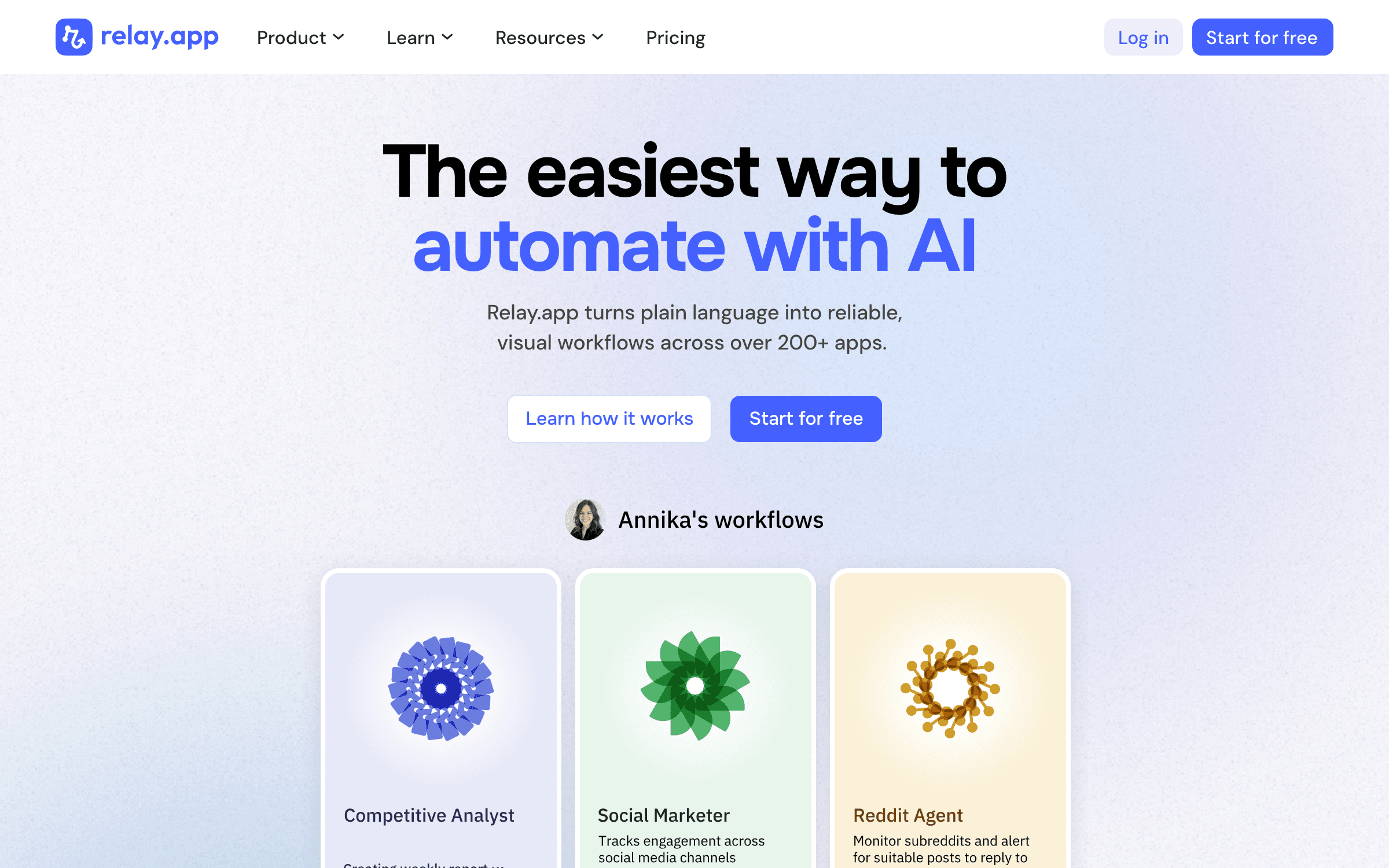
Relay.app is the automation tool built around a simple insight: most founders don't want fully autonomous workflows — they want automation that pauses for a human sign-off at the moments that matter. Founded by Jacob Bank (ex-Director of PM for Gmail and Google Calendar), it combines a genuinely beginner-friendly builder with human-in-the-loop checkpoints, AI steps on every plan, MCP support (July 2025), and a February 2026 relaunch around teams of AI agents. Billing is a flat subscription with included steps, and — like Pabbly — triggers, data transforms, and path/loop evaluations don't consume steps.
If Zapier's editor still feels like work and n8n looks like an IDE, Relay.app is the tool you'll actually finish setting up — its G2 ease-of-use score (9.4) tops both Zapier and Make, and its 4.9/5 rating is the highest on this list. The approval-step pattern is the killer feature for founder workflows with real stakes: outbound emails, refunds, CRM writes — the AI drafts, you approve. Budget honestly, though: included volumes are small (750 steps on the $19 Professional plan), top-up pricing isn't published, third-party reviews report workflows pausing at hard caps mid-month, and the integration catalog (~100+ apps) is a fraction of Zapier's. Perfect for low-volume, high-judgment automation; wrong for 10,000 webhook fires a month.
Key Features
- Human-in-the-loop approvals: pause any workflow for review before the consequential step
- Triggers, data transforms, and path/loop evaluations are free — only real actions consume steps
- AI agents (Feb 2026) with the same approval controls, plus MCP servers and tools
- The lowest learning curve in the category — G2 ease-of-use 9.4/10
- Free plan: 200 steps + 500 AI credits/mo across 2 active workflows
Pricing
Free: 200 steps, 500 AI credits/mo, 2 active workflows. Professional $19/mo annual (750 steps, 2,000 AI credits, unlimited workflows). Team $59/mo (10 users, 1,500 steps). Enterprise custom. Step/credit top-ups exist but prices aren't published.
Rating
4.9/5 — G2 (70+ reviews)
Best For
Solo operators and small teams automating consequential workflows (outreach, bil...
Pros
- Highest-rated tool on this list (4.9/5) with the signature approval-step feature
- Free triggers and transforms make the small step allowances go further than they look
- Founder-grade support and polish; MCP + agents shipped fast through 2025-26
Cons
- Small included volumes and unpublished top-up pricing — expensive if you scale past ~1,500 steps/mo
- ~100+ integrations is a fraction of Zapier's catalog; niche tools need workarounds
Gumloop
Best for AI-Heavy Workflows — Scraping, Enrichment, and Agents on One Canvas
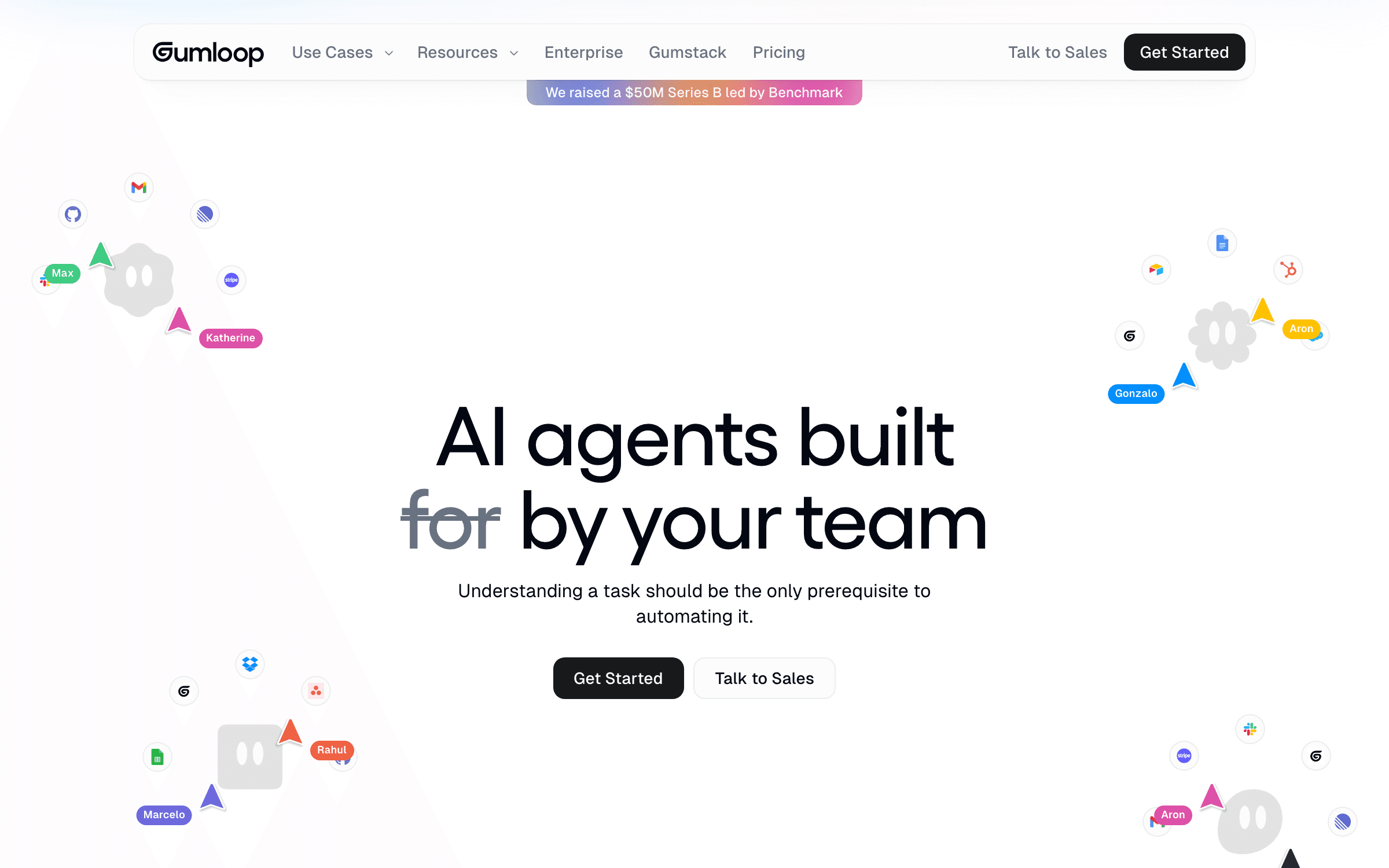
Gumloop is the AI-native workflow platform that grew up fast: founded 2023, $17M Series A (January 2025), then a $50M Series B led by Benchmark in March 2026, with Shopify, Ramp, Gusto, and Instacart as customers. The canvas is built for AI work specifically — LLM nodes for any major model (bring your own key for 50% off credits), built-in web scraping and crawling, Apollo-style contact and company enrichment, agents with memory, and browser automation via its Autopilot cloud computers. Standard integrations like Sheets, Slack, and Gmail cost zero credits; you pay for the AI and data-heavy nodes.
If your automation backlog is really an AI backlog — summarize inbound leads, scrape competitors, enrich contacts, draft responses — Gumloop replaces a stack of point tools (scraper + enrichment API + LLM glue code) with one canvas at $37/mo for 20k+ credits with unlimited seats. That's the pitch, and post-Series-B the platform risk is low. The caution flags are real, though: credit consumption is the top user complaint (a small workflow edit can silently multiply per-run cost — one documented forum case jumped from ~2 to 70 credits per run), enrichment nodes are expensive (60 credits each), the G2 sample is tiny (4.8 from single-digit reviews), and Gumloop itself admitted "Gumloop was too expensive" when restructuring pricing in 2025. Model your credit burn on a real workflow during the free 5,000-credit month before committing.
Key Features
- AI nodes for every major model with BYOK at 50% credit discount
- Built-in scraping, crawling, and contact/company enrichment — no third-party scraper stack
- Agents with memory and human-in-the-loop approvals; Autopilot cloud computers for browser automation
- Standard integrations (Sheets, Slack, Gmail, Salesforce) cost 0 credits
- Unlimited seats on Pro — the whole team builds on one $37/mo plan
Pricing
Free: 5,000 credits/mo, 1 active trigger. Pro $37/mo (20k+ credits via slider, unlimited seats, 1 hosted MCP server; 20% off annual). Enterprise custom. Credits: 1/run base, 0 for standard integrations, AI billed by tokens (BYOK -50%), scraping/enrichment nodes 1-60 credits.
Rating
4.8/5 — G2 (6+ reviews)
Best For
Marketing, sales, and ops-minded founders running AI-heavy pipelines — scraping,...
Pros
- The most complete AI-workflow toolkit here: models, scraping, enrichment, agents, browser automation
- Unlimited seats at $37/mo undercuts per-seat AI tools for teams
- Benchmark-led $50M Series B and enterprise logos de-risk the platform
Cons
- Opaque credit burn is the top complaint — per-run costs can jump after small edits, and enrichment nodes are pricey
- Tiny verified review base (single-digit G2 sample) and admittedly rough onboarding/docs
Latenode
Cheapest at Scale — CPU-Second Billing Makes 10,000 Simple Runs Free
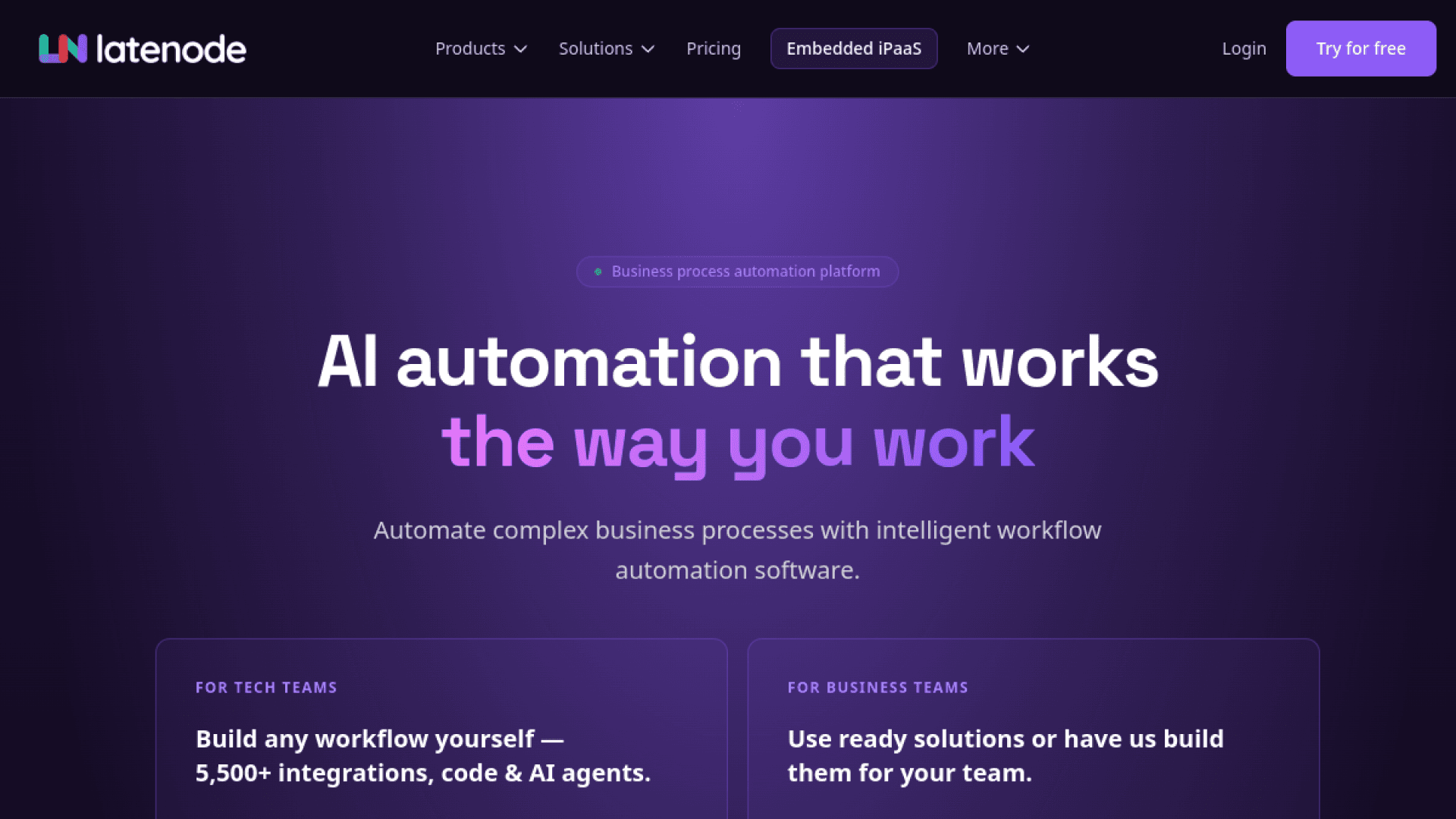
Latenode bills a unit nobody else uses: CPU seconds. Not tasks, not steps, not credits — the actual processing time your workflow consumes. A 20-step workflow costs the same as a 2-step one if it runs in the same time, and the free allowance is 10,000 CPU seconds a month (about 10,000 runs of a typical 1-second scenario). Past that, pay-as-you-go rates start at $0.00012 per CPU second with no base subscription, and you can set a monthly spending cap so usage pauses before surprise charges. A headless browser for scraping, an AI Copilot, an AI agent node, and RAG storage are included on every plan — including free.
For high-volume, compute-light automation — webhook glue, scrapers, AI pipelines that fire thousands of times a month — Latenode's math embarrasses per-task pricing: 10,000 short runs cost $0, and ~50,000 CPU seconds of medium workflows run under $5/mo at published rates. The built-in headless browser alone replaces a paid scraping tool. The honest counterweights: the native integration catalog and documentation trail the big platforms (JavaScript nodes fill gaps, which assumes some code comfort), user reviews note rigid expression handling, there's at least one reported billing dispute on Trustpilot, and the company is young with no disclosed funding. Treat it as the high-upside value pick: put your volume workloads here, keep anything mission-critical on a more established platform until it earns trust.
Key Features
- CPU-second billing: step count doesn't matter, only runtime — with a user-set spending cap
- Free tier: 10,000 CPU seconds/mo (~10,000 simple runs), no credit card
- Headless browser for scraping/automation included on all plans, even free
- AI Copilot builds workflows from natural language; AI agent node + RAG storage built in
- JavaScript code nodes with NPM package support for anything the catalog misses
Pricing
Free: 10,000 CPU seconds/mo, 5 active scenarios. Pay-as-you-go: $0 base, first 10,000 CPU-sec free, then $0.00012/CPU-sec declining to $0.00005 at volume; add-ons for extra workers ($10/mo), longer executions, and RAG storage. Monthly spending cap settable.
Rating
4.7/5 — G2 (45+ reviews)
Best For
Technical and semi-technical builders with high-volume, compute-light workloads ...
Pros
- The cheapest published unit economics in automation — 10k simple runs/mo genuinely cost $0
- Headless browser + AI nodes included free replaces a paid scraper subscription
- Spending caps prevent the runaway-bill failure mode that plagues per-task tools
Cons
- Thinner native integrations and vague documentation — JS nodes fill the gaps, which assumes code comfort
- Young company, no disclosed funding, and a reported billing dispute — earn trust with non-critical workloads first
Lindy
Best AI Employee — Agents with Judgment, Priced Like a Hire
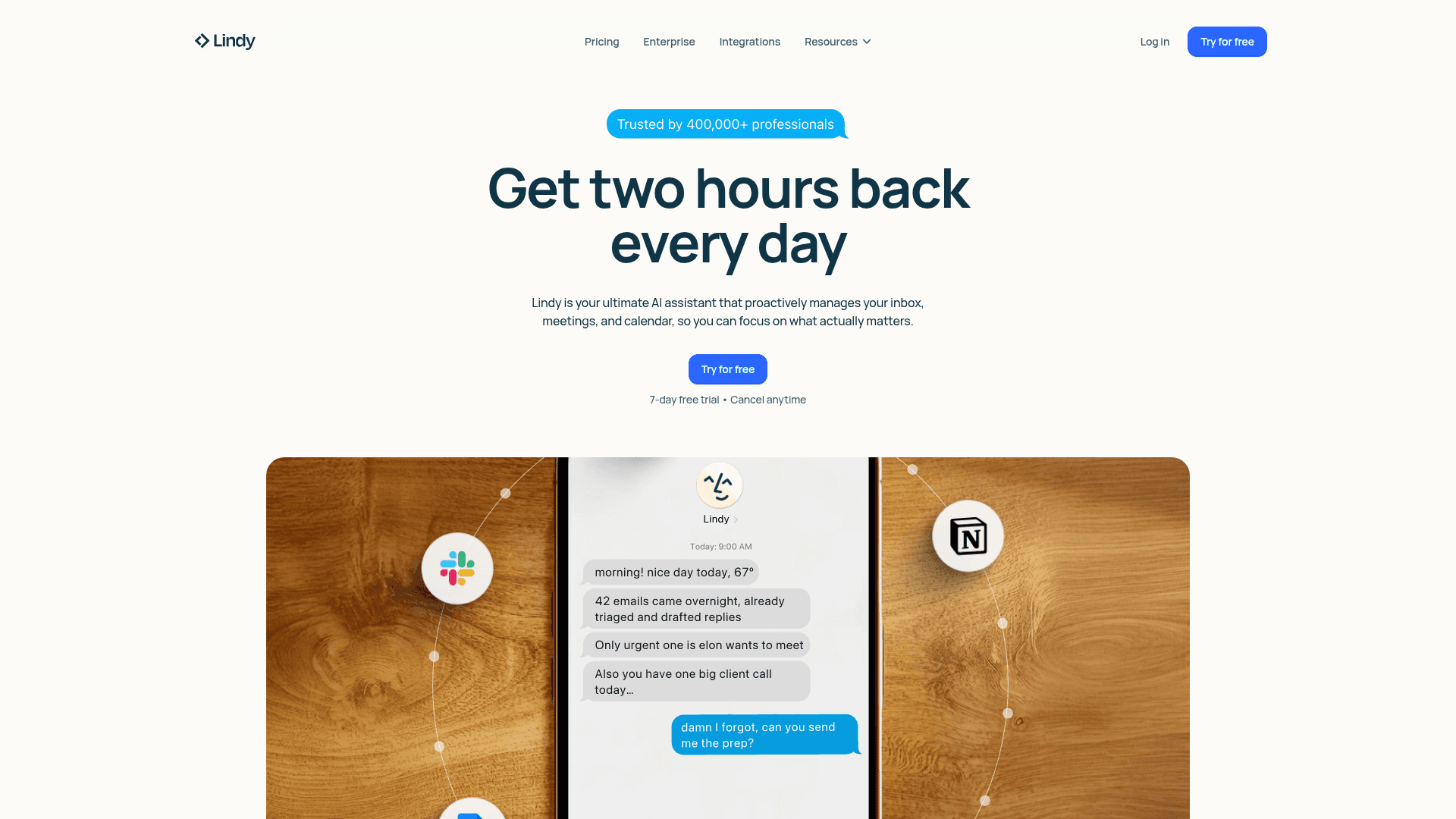
Lindy sits at the far end of this list's spectrum: not an if-this-then-that pipe, but "AI employees" — agents you create from a plain-language prompt that manage inboxes, take phone calls, run meetings, and browse the web with their own cloud computers (Autopilot, shipped with Lindy 3.0 in August 2025). Agent Swarms let one agent clone itself across hundreds of parallel tasks. It claims 6,000+ integrations, and its G2 rating (4.9/5 across 170 reviews) is the highest-volume top score in this roundup. Pricing moved upmarket in 2026: Plus at $49.99/mo, Pro at $99.99, Max at $199.99 — sold as usage multiples with credit allowances no longer published.
For judgment work — reading context, drafting replies, qualifying leads by phone — Lindy does things no deterministic tool on this list can, and for inbox/meeting/call-heavy founders it can genuinely replace hours of admin. But go in with eyes open, because the pricing model is the least founder-legible here: there's no free plan (7-day trial only), credit allowances are unpublished, credits don't roll over, agents pause when they run out, and overages reportedly bill at double the standard rate. User reviews describe "credit anxiety" — burning a month's allowance in two weeks, a single voice call draining ~265 credits, and agents wasting paid credits on failed attempts. The G2-vs-Trustpilot gap (4.9 vs. a reported ~2.4) tells the story: delighted power users, angry billing-surprise victims. Use Lindy for high-value judgment tasks; never for high-volume simple automation.
Key Features
- Agents from a prompt: inbox management, meeting handling, phone calls, SMS/iMessage
- Autopilot computer use — agents click and type in any web app, no API needed
- Agent Swarms: one agent self-clones to run hundreds of parallel tasks
- Claimed 6,000+ integrations plus model selection on Pro and above
- Team accounts with shared agents and central governance
Pricing
No free plan (7-day trial). Plus $49.99/mo (standard usage, 2 inboxes). Pro $99.99/mo (3x usage, computer use, model selection). Max $199.99/mo (7x usage, all-day delegation). Enterprise custom (HIPAA, SSO). Credit allowances unpublished; credits don't roll over; agents pause at zero.
Rating
4.9/5 — G2 (170+ reviews)
Best For
Founders drowning in judgment work — email triage, call handling, meeting follow...
Pros
- Genuine AI-judgment capability — inbox, voice, and browser autonomy nothing else here matches
- Highest-volume top rating on this list (4.9/5, 170 G2 reviews)
- Fast, ambitious shipping cadence: Lindy 3.0, Autopilot, and Swarms all landed within a year
Cons
- The least transparent pricing here: unpublished credit allowances, no free plan, reported 2x overage billing
- "Credit anxiety" is the documented complaint pattern — costs are unpredictable and failed AI attempts still burn credits
Integrately
Best for 1-Click Setup — 20M+ Ready Automations and Live-Chat Hand-Holding
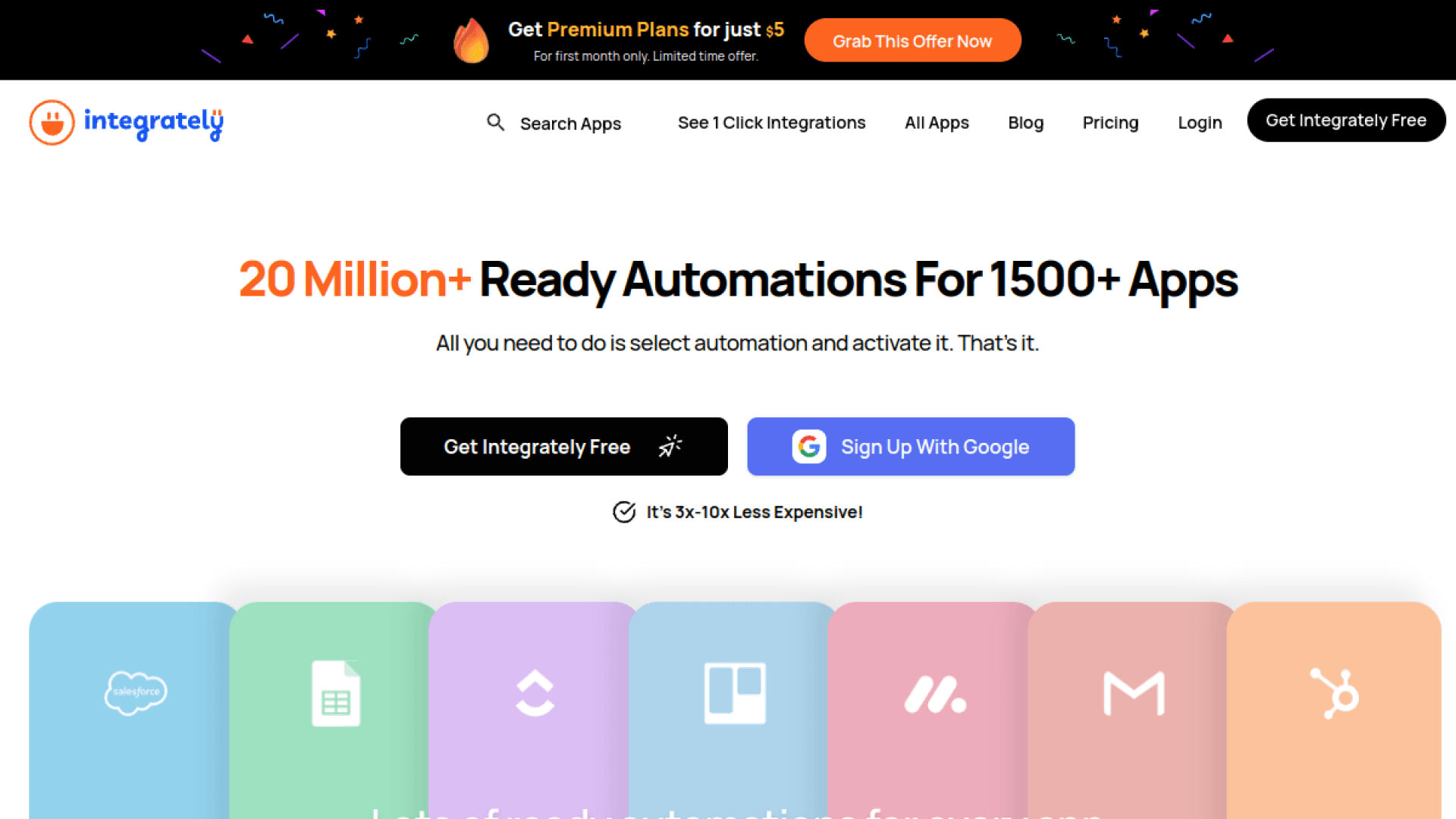
Integrately (from CompanyHub) attacks Zapier from the convenience angle: over 20 million pre-built automations across 1,200+ apps, so instead of building a workflow you search for one and switch it on. Its second differentiator is support — 24/7 live chat on every plan including free, in a category where most rivals bury you in docs. Pricing undercuts Zapier at every tier (the pricing page runs side-by-side comparisons), with 10,000 tasks a month at $39 on the Professional plan. Its 4.7/5 G2 rating across ~705 reviews is one of the strongest verified track records among the challengers.
For a non-technical founder who wants "when Stripe payment succeeds, add row to Sheets and Slack me" working in four minutes, Integrately's template library plus live chat is the shortest path on this list — a human will literally set up your automation with you. The ceiling is what you pay for that convenience: reviewers describe the builder as hard to use once you leave templates ("almost impossible... unless you are a programmer" per one TrustRadius review), conditions and data operations consume tasks (unlike Pabbly), complex branching is weak, and users report outgrowing it around 20-30 active automations. Start here for speed; expect to graduate to Make or n8n if your workflows grow brains.
Key Features
- 20M+ pre-built 1-click automations — search, connect accounts, activate
- 24/7 live chat support on all plans, including free — rare in this category
- Cheaper than Zapier at every tier, with explicit side-by-side pricing
- Webhooks and multi-step flows from the $19.99 Starter plan up
- 2-minute polling on Professional and above
Pricing
Free: 100 tasks/mo, 5 single-step automations. Starter $19.99/mo annual (2,000 tasks). Professional $39/mo (10,000 tasks, unlimited premium apps, branching). Growth $99/mo (30,000 tasks, unlimited users). Business $239/mo (150,000 tasks). Conditions and data operations count as tasks.
Rating
4.7/5 — G2 (705+ reviews)
Best For
Non-technical founders who want pre-made automations switched on in minutes with...
Pros
- Fastest time-to-first-automation on this list thanks to the template library
- Live-chat support on every plan is genuinely unusual and genuinely useful
- Strong verified track record: 4.7/5 across ~705 G2 reviews
Cons
- The builder frustrates users beyond templates — troubleshooting multi-step flows is the top complaint
- Conditions/data steps consume tasks, and power users report a complexity ceiling around 20-30 automations
Microsoft Power Automate
Best If You Live in Microsoft 365 — $15/User Premium, a Licensing Maze Otherwise
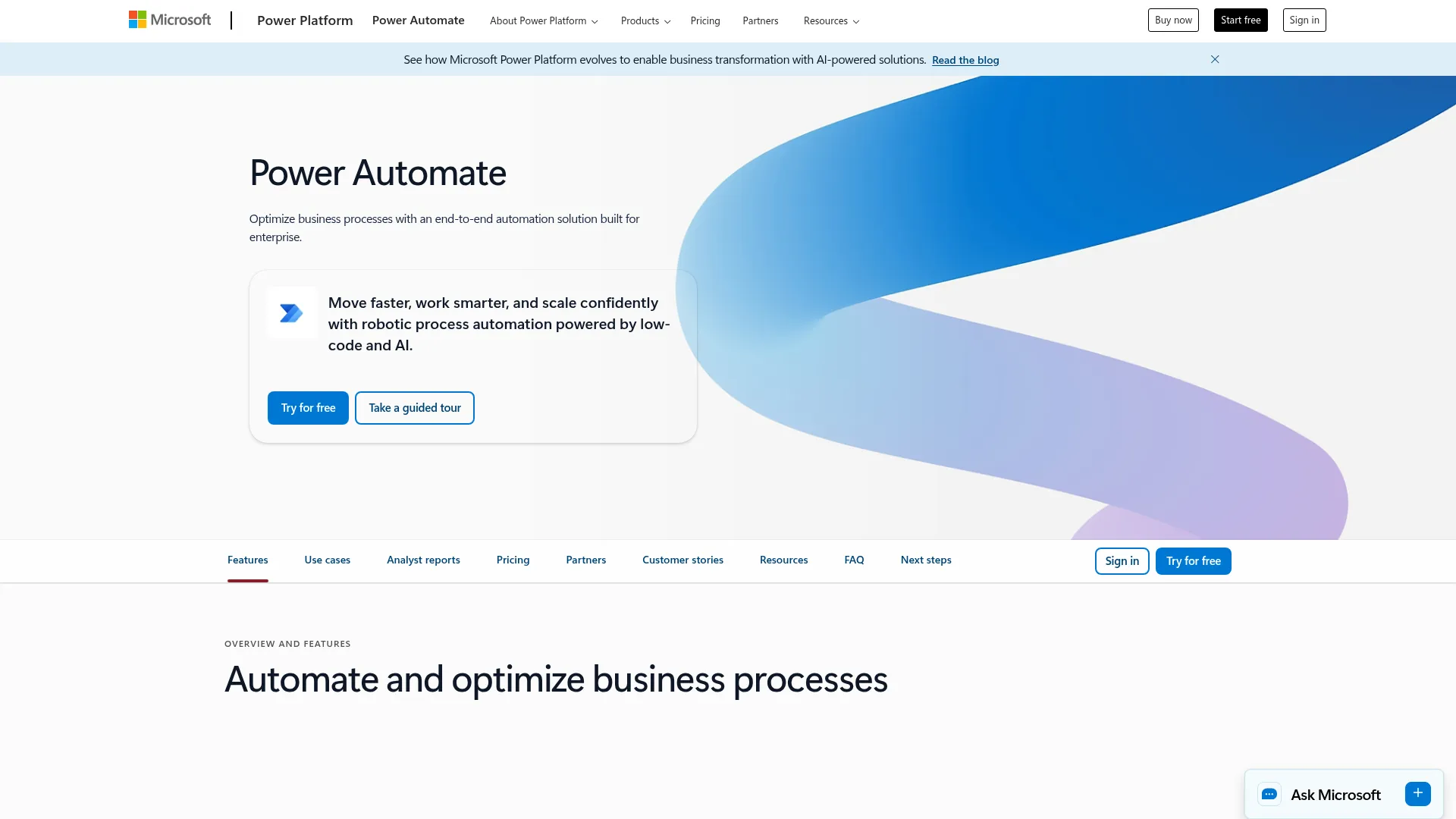
Power Automate is Microsoft's automation platform spanning cloud flows (Zapier-style API automation), desktop RPA bots, and process mining, wired deeply into Microsoft 365, Dataverse, and Copilot Studio. If your company already pays for M365, basic flows with standard connectors are effectively included, and the $15/user/mo Premium plan adds unlimited cloud flows, attended RPA, and 5,000 AI Builder credits. Copilot integration means flows can be described in natural language and agents built in Copilot Studio ($200 per 25,000 credits).
The reason Power Automate makes this list at all: for the millions of teams already inside Microsoft 365, it's the zero-additional-vendor answer, and $15/user for unlimited cloud flows is objectively cheap. The reason it's ranked last: everything else about it is built for IT departments, not founders. Licensing is a genuine maze (standard vs. premium connectors, per-user vs. per-bot, tenant-shared AI credits), the connector ecosystem for modern indie stacks — Stripe, Supabase, the long tail of SaaS — is far weaker than Zapier's or Make's, costs escalate sharply once RPA bots ($150-$215/bot/mo) or process mining ($5,000/tenant/mo) enter, and debugging is enterprise-grade clunky. In M365? Use what you're paying for. Not in M365? Nothing here is for you.
Key Features
- Included with many Microsoft 365 licenses for standard-connector cloud flows
- Premium $15/user/mo: unlimited cloud flows, attended desktop RPA, 5,000 AI Builder credits
- Copilot: build flows from natural-language descriptions; agents via Copilot Studio
- Desktop RPA (attended/unattended) and process mining for legacy-app automation
- Deep Dataverse/Teams/SharePoint/Dynamics integration nothing third-party matches
Pricing
Included flows with many M365 licenses (standard connectors). Premium $15/user/mo annual. Process $150/bot/mo (unattended RPA). Hosted Process $215/bot/mo. Copilot Studio $200 per 25,000 credits/mo. Process Mining add-on $5,000/tenant/mo.
Rating
4.4/5 — G2 (1,049+ reviews)
Best For
Teams already paying for Microsoft 365 who want automation without adding a vend...
Pros
- Effectively free-to-cheap for existing M365 organizations
- The only tool here with real desktop RPA for legacy Windows apps
- Massive validated review base (1,000+ G2 reviews) and Microsoft-grade platform stability
Cons
- Licensing complexity is the #1 user complaint — knowing what you'll pay requires a spreadsheet
- Weak connector coverage for modern indie/SaaS stacks; UI and debugging feel enterprise-clunky
What We Cut — And Why
Six credible platforms didn't make the ten, and the reasons are themselves useful buying signals:
- Pipedream — excellent developer-first tech (code-level steps, instant webhooks, a huge hosted MCP catalog), but Workday signed a definitive agreement to acquire it in November 2025 to power enterprise AI-agent integrations. Roadmap risk for the self-serve product is real; see the FAQ before building on it fresh.
- Workato — a genuinely great enterprise iPaaS (4.7/5, ~750+ G2 reviews), but pricing is quote-only with reported average contracts around $110K/year for SMBs. It's what your acquirer uses, not what you need.
- Tray.ai — powerful for complex enterprise integration, but no self-serve signup, reported entry pricing from ~$595/mo, and a ~20% staff cut in 2024 during its AI repositioning. Wrong list for founders.
- Bardeen — pivoted in May 2025 from general browser automation to a GTM/sales scraping platform. Still useful for LinkedIn prospecting, but no longer a general Zapier alternative, and users report credits burning fast with selector-based automations breaking when sites update.
- Zoho Flow — honest value at $24/org/mo for 10,000 tasks with per-organization (not per-user) pricing, and the automatic pick if you already live in Zoho One. Cut because its verified review base is thin (~20 G2 reviews) and its catalog outside the Zoho universe lags every ranked tool.
- Albato — a Make-style builder with an active AppSumo lifetime deal, but AppSumo buyers report trigger polling eating monthly quotas and shallow integrations (missing triggers, webhook limitations). If the LTD tempts you, read the recent AppSumo reviews first.
How We Chose These Tools
We evaluated 16 automation platforms in July 2026 against five founder-specific criteria. Most competing listicles are written by the vendors themselves; we weighted what the vendors don't publish.
- Billing-unit economics — what 10,000 monthly runs actually cost on each platform's unit (task, credit, execution, flow, CPU-second, step), including AI-step surcharges
- Overage mechanics — what happens at the cap: pause, hard stop, or surcharge (Make +25%, Lindy reportedly 2x, Latenode user-set spending caps)
- Verified user sentiment — G2 ratings and review counts cross-checked against community complaint themes; tiny samples flagged, not hidden
- Platform risk — funding, acquisitions (Pipedream → Workday), pivots (Bardeen), licensing changes, and lock-in escape hatches like self-hosting
- Honest AI positioning — whether AI features solve workflows or inflate the bill; agent platforms judged as a separate category with separate economics
How to Choose by Workflow Shape
Pick by the shape of your automation, not the brand. The same 10,000 monthly runs can cost $0 or $300 depending on how a platform counts them.
Few workflows, huge volume...
Activepieces (unlimited runs, free ≤10 flows) or Latenode (CPU-second billing, 10k free seconds). Volume never raises the bill.
Long, multi-step AI workflows...
n8n — per-execution billing means 20 steps cost the same as 2. Self-host when volume makes the math obvious.
Non-technical, want it working today...
Integrately (1-click templates + live chat) or Make ($12/mo, best visual builder) for anything the templates don't cover.
Consequential steps need a human...
Relay.app — approval checkpoints before the send/refund/CRM write. AI drafts, you approve, then it executes.
The work needs judgment, not pipes...
Lindy (inbox, voice, computer use) or Gumloop (scraping + enrichment + agents). Budget for credits, and measure burn in week one.
Kill the subscription entirely...
Pabbly Connect lifetime deal for linear volume work, or self-hosted n8n/Activepieces on a $5-10 VPS if you can run Docker.
Stay Ahead of the Tool Curve
We research dozens of tools so you don't have to. Get our top picks and insider insights delivered weekly.
Frequently Asked Questions
What is the best Zapier alternative in 2026?
For most technical founders: n8n — per-execution billing with unlimited steps means complex and AI-heavy workflows cost a fraction of Zapier's per-task math, and the self-hosted Community Edition removes volume pricing entirely. For non-technical founders, Make's visual builder at $12/mo for 10,000 credits is the best mainstream value, and Integrately's 20M pre-built automations are the fastest path to a working workflow. If your real problem is AI judgment work rather than pipes, look at Lindy or Gumloop instead — different category, different (higher) price.
What is the cheapest Zapier alternative that actually works?
Depends on your volume shape. For a handful of high-volume workflows: Activepieces cloud is free for up to 10 active flows with unlimited runs. For high-volume, compute-light workloads: Latenode's free 10,000 CPU seconds covers roughly 10,000 simple runs a month, then pay-as-you-go from $0.00012/CPU-second. For per-task pricing: Pabbly Connect at ~$16/mo for a five-figure task allowance — with triggers, filters, and routers not counting — is the lowest sticker in mainstream automation, and its lifetime deals remove the subscription entirely. Self-hosting n8n on a $5-10 VPS is the power-user answer: unlimited everything, your ops burden.
Why is Zapier so expensive at scale?
Because of the billing unit. Zapier charges per task, and every successfully executed action step counts — so a 5-step workflow running 150 times consumes 750 tasks, an entire Professional-plan base allowance. Independent pricing analyses (like eesel's worked table) put 10,000 tasks a month at roughly $300; the same volume runs ~$12 on Make, ~€20 on n8n cloud, and ~$16 on Pabbly Connect. Zapier has also folded AI steps, code, and MCP calls (2 tasks each) into the same task pool, so AI-heavy workflows compound the effect. Zapier's strengths — the 8,000-app catalog, reliability, team features — are real; you're paying for them by the step.
Is self-hosting n8n really free?
The software is — the Community Edition has no execution limits and runs fine in Docker on a $5-10/mo VPS. The honest total cost is the ops burden: you own updates, backups, credential security, and uptime. If a failed workflow at 3am costs you money, budget either monitoring time or n8n's cloud plans (from €20/mo), which exist precisely to sell that peace of mind. A common founder path: prototype on n8n cloud, move to self-hosted once volume makes the math obvious, keep the cloud plan if revenue depends on the workflows. Note n8n's license is "fair-code" (source-available), not OSI open source — for a pure MIT license, Activepieces is the alternative.
What counts as a "task" — and why does it matter so much?
Every platform defines its unit differently, and the definition is most of your bill. Zapier: every executed action step (triggers and filters free). Pabbly: actions only — filters, routers, and formatters are free on paid plans. Integrately: actions plus conditions and data operations. Make: 1 credit per standard module run, more for code and AI. n8n: one execution per workflow run, unlimited steps inside. Activepieces: no volume unit at all — you pay per active flow. Latenode: CPU seconds of actual runtime. Relay.app: steps, with triggers and transforms free. Before comparing prices, sketch your three biggest workflows and count what each platform would actually bill for them — rankings flip depending on workflow shape.
Should I use an AI agent platform like Lindy or a workflow tool like n8n or Make?
Ask whether the work needs judgment or just needs doing. Deterministic pipes — "when form submitted, create invoice, notify Slack" — belong on workflow tools where runs cost fractions of a cent. Judgment work — triaging an inbox, qualifying a lead on a phone call, researching a prospect and drafting a personalized email — is where agent platforms like Lindy (or Gumloop's agents) earn their premium pricing. The costly mistake is running high-volume deterministic work through an agent platform's credit meter, or expecting a $12 workflow tool to exercise judgment. Many founders end up with both: n8n or Make as the backbone, one agent product for the judgment layer. And per Gartner, over 40% of agentic AI projects will be canceled by 2027 — start with one high-value agent use case, not an agent-everything migration.
What happened to Pipedream? Should I still build on it?
Workday signed a definitive agreement to acquire Pipedream in November 2025, explicitly to power AI-agent integrations across Workday's enterprise suite. The technology is excellent — code-level workflows, instant webhooks, and one of the largest hosted MCP catalogs — which is why developers loved it. But for an indie hacker choosing a platform in 2026, an enterprise acquisition is a real roadmap risk for the self-serve product: pricing, free tiers, and priorities tend to shift toward the acquirer's customers. If you're already on it, there's no fire to put out today. If you're choosing fresh, n8n (self-hostable) or Latenode (similar compute-based pricing) give you comparable developer ergonomics without the uncertainty.
The Bottom Line
Automation pricing in 2026 is a billing-unit decision wearing a feature comparison as a disguise. Per-task tools tax every step, per-credit tools tax AI, per-seat enterprise tools tax your headcount — and the challengers win by changing the unit: per-execution (n8n), per-flow (Activepieces), per-CPU-second (Latenode).
For most technical founders the path is: prototype on Make or n8n cloud, move the volume workloads to self-hosted n8n or Activepieces when the meter starts mattering, and add one judgment-layer tool — Relay.app if you want approvals, Gumloop or Lindy if you want agents — for the work that needs a brain. Non-technical founders: start at Integrately or Make, and keep Pabbly's lifetime deal in your back pocket for volume work.
Whatever you pick: sketch your three biggest workflows, count what the platform would actually bill for them, set spending alerts on day one, and re-read the overage policy before turning on any AI step. The vendors aren't hiding the gotchas — they're just not putting them on the pricing page.
Related Reading
- n8n vs Make vs Zapier: Which Automation Platform Wins in 2026? — The head-to-head deep dive on this list's top contenders
- Best Workflow Automation Tools for Non-Technical Teams — If nobody on the team writes code, start here instead
- A Founder's Guide to Agent Loops — What AI agents actually do before you pay for one
- Best AI Tools for Internal Workflow Management — The ops layer your automations plug into
Sources
- Zapier — Official Pricing
- n8n — Official Pricing
- Make — Official Pricing
- Activepieces — Official Pricing
- Pabbly Connect — Official Pricing
- Relay.app — Official Pricing
- Gumloop — Official Pricing
- Latenode — Official Pricing
- Lindy — Official Pricing
- Integrately — Official Pricing
- Microsoft Power Automate — Official Pricing
- eesel — Zapier Subscription & Pricing Analysis (June 2026)
- Make — Credits as the New Billing Unit (official help center)
- n8n — Announcing Our $180M Series C (Accel, $2.5B valuation)
- TechCrunch — Gumloop Lands $50M Series B from Benchmark (March 2026)
- Workday — Definitive Agreement to Acquire Pipedream (Nov 2025)
- Gartner — 40% of Enterprise Apps Will Feature Task-Specific AI Agents by End of 2026
- Gartner — Over 40% of Agentic AI Projects Will Be Canceled by End of 2027
- Mordor Intelligence — Workflow Automation Market ($26B in 2026)
Stay Ahead of the Tool Curve
We research dozens of tools so you don't have to. Get our top picks and insider insights delivered weekly.
Trusted by indie hackers and startup founders
Keep Reading
10 Best AI Tools for Internal Workflow Management in 2026
Compare the 10 best AI tools for internal workflow management in 2026. Self-hostable automation, AI agents for approvals, knowledge Q&A, and team coordination — with real pricing, trade-offs, and the right pick for your stack.
Best OpenClaw Alternatives in 2026: Safer Options That Still Deliver
OpenClaw has 9 CVEs, 1,184 malicious skills on ClawHub, and 135,000 instances exposed to the internet. Here are the best alternatives and wrappers that give you agent power without the danger.
7 Best AI Search Visibility Tools for Agencies in 2026
Seven AI search visibility tools ranked for agencies by client workspaces, reporting, prompt economics, and the real cost of managing multiple brands.