
Stripe Paid $7B for OpenRouter. It Didn’t Buy the Router — It Bought the Meter.
Stripe bought OpenRouter for $7B+ — about 50x revenue, three months after a $1.3B round. Why it is not a routing bet, and the one-afternoon fix that keeps you portable.
Seven billion dollars. For an API proxy.
Engineers on Hacker News spent the day insisting they could rebuild OpenRouter in three months for under $10 million. They're probably right.
So work backwards. If the code is cheap, what cost $7 billion?
Key Takeaways
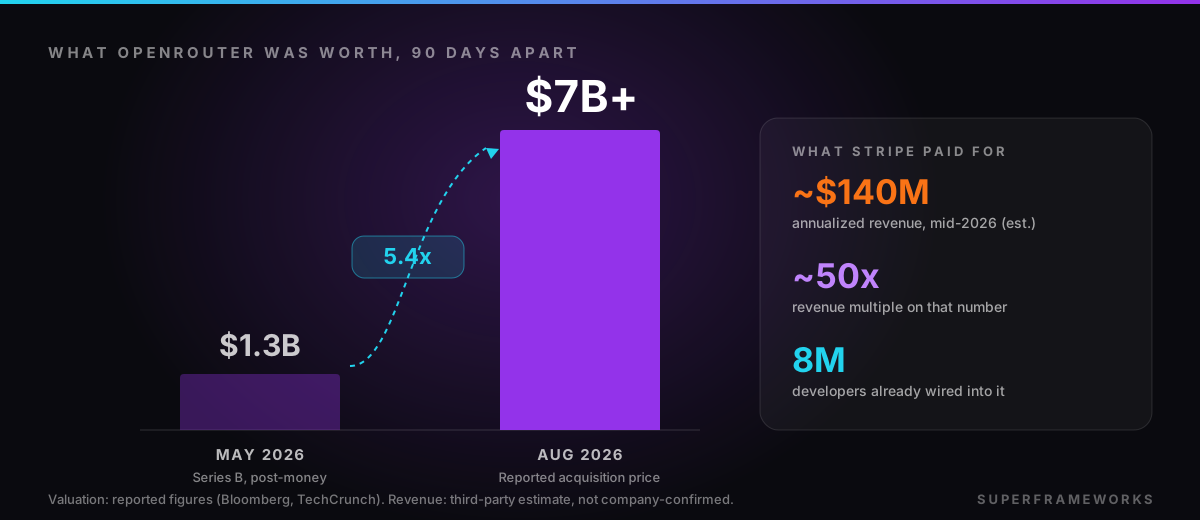
- Bloomberg reported on August 16, 2026 that Stripe finalized a deal for OpenRouter at more than $7B — about 5.4x the $1.3B valuation it raised at in May, and roughly 50x estimated revenue
- The software is not the asset. Stripe bought the only layer that counts tokens per customer in real time — the meter it was missing between Bridge, Privy, Tempo and its billing stack
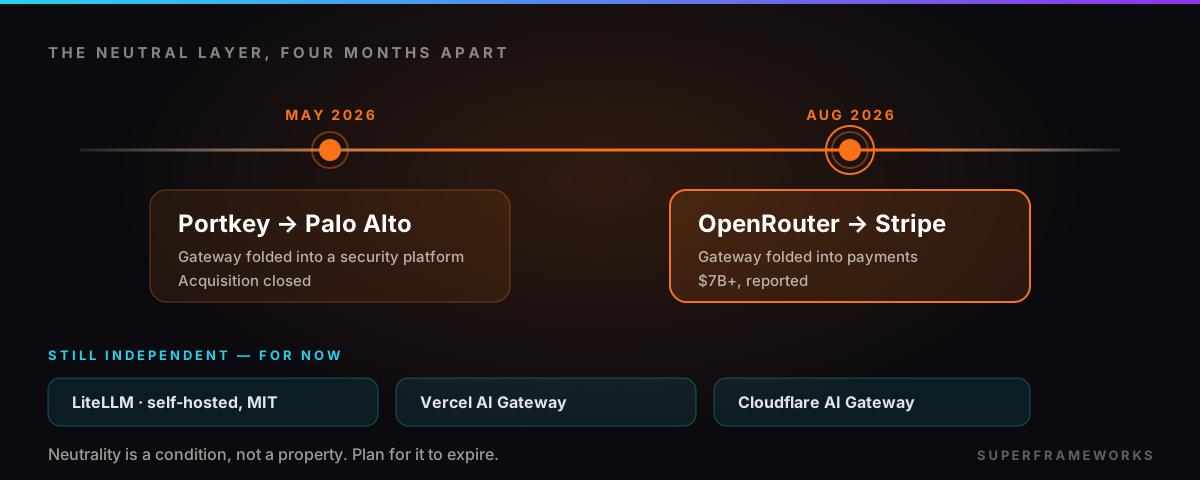
- You adopted a gateway to stay model-neutral. That layer now has an owner — and Portkey went to Palo Alto Networks the same way in May
- Do not migrate. Get portable: one interface in front of the gateway, your own usage logs, and a known switching cost. That is an afternoon of work
The news, in 20 seconds
- MAYOpenRouter raises a $113M Series B (Sequoia, a16z, Menlo, CapitalG) at a reported $1.3B.
- JULThe WSJ reports Stripe is in talks. Figures around $10B circulate.
- AUG 16Bloomberg reports the deal is done at $7B+. Stripe declines to comment on “rumors or speculation.”
What OpenRouter does, in one line: one API endpoint and one invoice for 400+ models across OpenAI, Anthropic, Google, DeepSeek and dozens of others. Roughly 8 million developers use it. It doesn't mark up tokens — it takes 5.5% when you buy credits, and 5% on bring-your-own-key requests past the first million a month.
Its CEO, Alex Atallah, has called it “the equivalent of Stripe for AI.” Stripe agreed hard enough to write a cheque instead of a competitor.
What Stripe actually bought
Not the routing. The metering.
OpenRouter sits at the one point in the stack where someone counts tokens as they're consumed — per customer, per model, in real time. Stripe has spent two years buying everything on both sides of that count: Bridge for stablecoin rails, Privy for wallets, Tempo for sub-cent settlement, usage-event billing for consumption pricing.
It was missing the count.
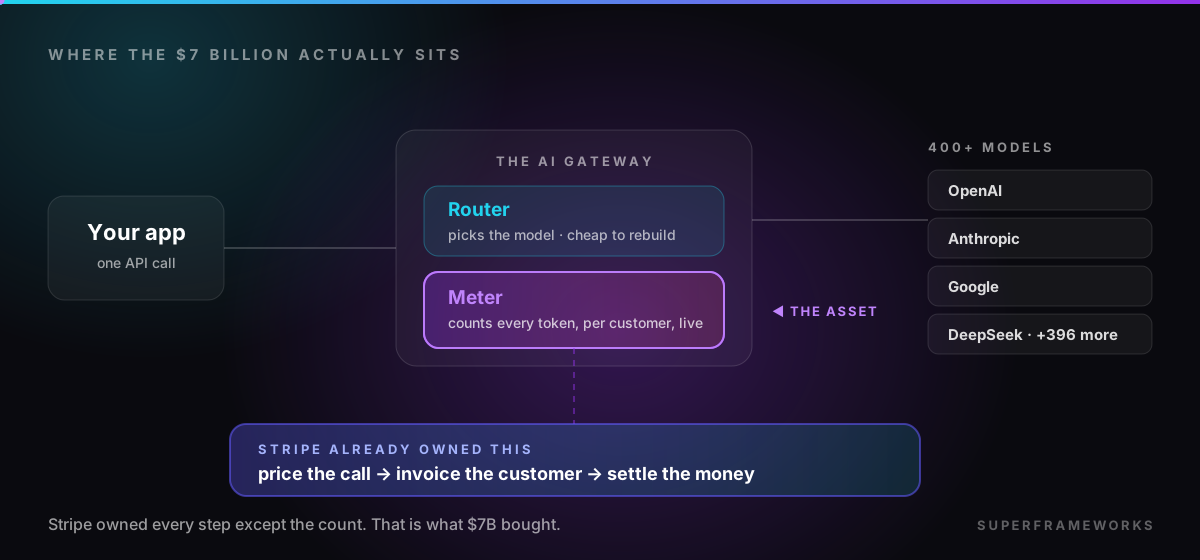
Here's why that's good news for you. Metered pricing is the hardest unsolved problem in shipping an AI product: your costs are per-token and variable, your pricing is per-seat and fixed, and the gap between them is your margin. If Stripe ships token-level metering and billing as a primitive, that gap becomes something you configure instead of something you build. (The trap itself is worth a read: the pricing decision you make before you know what it costs to run.)
And the part nobody in the business press mentioned: whoever holds the meter holds the data. Which models get used, for what, at what price, across 8 million developers. OpenRouter's public rankings already showed US-origin models falling from roughly 70% to 30% of token volume in a year, while Anthropic takes about 46% of dollar revenue on roughly 12% of traffic.
Stripe now owns the private version of that chart.
Stay Ahead of the Trends
Get insights like this before they're everywhere. Weekly, no fluff.
Your hedge has an owner now
Nobody adopted OpenRouter because they loved OpenRouter. You adopted it because you didn't want to marry a model. It was the hedge — the piece of your stack whose whole job was making the other pieces replaceable.
A hedge owned by a strategic acquirer is a different instrument. Stripe isn't a neutral party in AI billing; it's the largest interested party there is. Nothing has changed for developers yet, and there's no evidence anything will soon. But the reason you picked that layer — nobody upstream cares which model you choose — is no longer structurally true.
This isn't a one-off, either.
The 50x math
The bull case for you
Token metering and usage billing become a Stripe primitive. Charging for AI usage stops being a custom build. Multi-model fallback gets enterprise reliability behind it.
The bear case for you
Your model layer and your payment layer become one vendor. Fees get bundled and repriced. Roadmap follows enterprise agentic-commerce deals, not the builder spending $40 a month.
One more objection worth carrying over from Hacker News, where it drew 328 upvotes and zero business-press coverage: the gateway sees your prompts. That was already true. It's worth re-checking under new ownership if you handle anything regulated.
What to do this week
Don't rip anything out. Panic-migrating off a working gateway because of a headline is how you burn a week to land somewhere worse. Do this instead — it's an afternoon, and it's worth doing no matter who owns what.
1. Put your own interface in front of the gateway
One module — llm.complete() — that every feature calls, with the provider behind it. If your gateway's SDK is imported in 40 files, you don't have a hedge. You have a dependency wearing a hedge's clothes.
2. Keep your own usage log
Model, tokens in, tokens out, latency, cost — to your own database, on every call. The gateway's dashboard is the only real switching cost most people have. Thirty days of your own data makes you portable.
3. Price the switch before you need it
Thirty minutes. Self-hosted LiteLLM keeps data on your infrastructure and starts beating a managed gateway somewhere north of ~$4K–9K a month in model spend. Vercel AI Gateway charges no percentage credit fee. Under a few hundred a month, staying put is correct — but know that, don't assume it.
4. Re-read your data path if you touch regulated data
Your prompts pass through the gateway. Selling into healthcare, legal or finance? Your buyer's security review will ask about the ownership change before you do. Check retention, the subprocessor list after close, and whether BYOK or a self-hosted proxy gets you a cleaner answer.
Where this goes next
Expect the near term to be quiet and reassuring: OpenRouter keeps its brand, pricing holds, a blog post promises independence. Standard playbook, usually honest for about 18 months.
The tell to watch isn't a price rise. It's bundling. The moment routing gets discounted for Stripe billing customers, the layer has stopped being neutral in practice — whatever the announcement said.
The bigger consequence is competitive. Adyen, Cloudflare, Vercel and every cloud with a Bedrock-shaped product now has to answer this. Most likely response: gateways get cheap fast, possibly free, subsidised by whatever the vendor actually sells. Good for your COGS, and it makes that 5.5% credit fee harder to defend by the month. Watch for a free-tier war by year end.
The pattern generalises past this deal. The convenience layers you adopt to stay independent are exactly the ones that get bought — being between everyone is the whole point.
Own the abstraction. Rent the vendor.
The Bottom Line
- $7B for a proxy isn't a routing bet: Stripe bought the meter, and it already owned the rails on either side of it
- Gateway neutrality is a condition, not a property: OpenRouter to Stripe, Portkey to Palo Alto — plan for it to expire
- There is real upside: token metering as a Stripe primitive would fix the hardest part of pricing an AI product
- Don't migrate — get portable: one interface, your own logs, a known switching cost
Related Reading
- Stripe Just Shipped the Full Agentic Commerce OS — The indie hacker playbook for selling to AI agents
- The AI Model Pricing War Is Here — And your margins depend on picking the right side
- The Pricing Decision You Make Before You Know What It Costs to Run — Why per-seat pricing breaks on per-token costs
- We Tested 5 AI Models on Real Founder Work — What actually changes when you swap the model behind your product
- Anthropic Pulled Fable 5 and Mythos 5 Overnight — Why cloud AI is a platform risk and local models are the hedge
Sources
- TechCrunch: Stripe will reportedly acquire AI gateway startup OpenRouter for $7B+
- Bloomberg: Stripe finalizes deal to acquire OpenRouter for over $7 billion
- Fortune: Stripe clinches over $7 billion deal to buy AI firm OpenRouter
- Hacker News: Stripe clinches over $7B deal to buy AI firm OpenRouter (discussion)
- OpenRouter docs: FAQ and pricing (credit fees and BYOK)
- Forrester: Stripe Sessions 2026 — rearchitecting payments for an agentic AI economy
- Vercel: Best OpenRouter alternatives for production AI (2026)
Don't Miss the Next Big Shift
Every week, we break down the trends that matter for indie hackers and SaaS founders. Stay informed, stay ahead.
Join 3,000+ founders who stay ahead of the curve
Keep Reading
10 Best Apple HomeView App Ideas to Build for Apple’s New Smart Display
Apple just launched HomeView, its first smart display. These 10 app ideas use its shared screen, face recognition, Siri AI, and home hub to build what a phone cannot.
Google’s “Poisoned” Search Results: Can Founders Trust Rank Trackers?
Google poisoned search results are showing up in rank trackers, Nozzle reports. Learn what the data proves and how to check a sudden SEO drop before you act.
Deno Joins Cloudflare: A Migration Plan for Founders
Deno joins Cloudflare, with Deno Deploy set to close in six months. See what changes for the runtime and JSR, plus a practical migration plan for founders.