$25M Revenue in 2025 — From a Flat $100K Year to #1 on the Inc. 5000
What Akool Does
Akool is an AI video studio. You type or upload, and it makes the video.
- Swaps: face, head, hair, motion or a whole character in a video
- Avatars: talking avatars, live ones that chat back, or a copy of you
- Translation: your video, in another language, in your voice
- Agentic Canvas: AI agents that build long videos from a text prompt
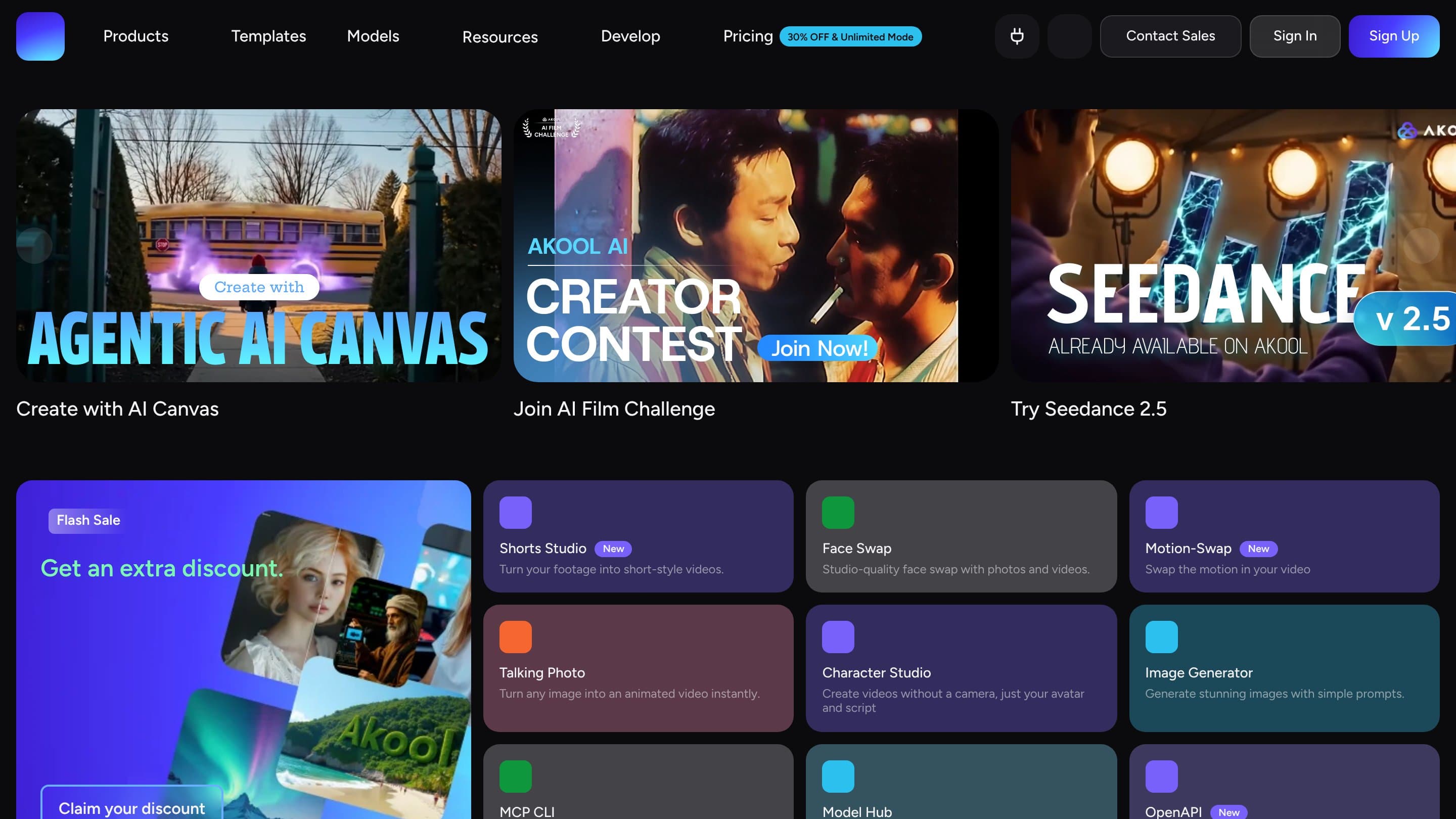
Prosumers pay by the month. Big companies pay by usage, often through the API. Avatars are the top seller with businesses.
The Problem They Solve
Video is the hardest content to make. You need cameras, actors, editors and time.
Jeff Lu had spent 10+ years on that problem:
- Microsoft
- Apple, working on Face ID
- Google Cloud, working on video
By 2022 he could see AI video was getting good. Google wasn't ready to ship it. AI video can't be 100% controlled, and Google wanted full control. So Jeff quit and went all in on his side project.
The scoreboard in July 2026:
- ~$25M recognized revenue in 2025
- $3M+ in June 2026 alone
- ~$60M expected for 2026
- ~500,000 images and videos made per day
- #1 on the 2025 Inc. 5000 (37,364% growth, 2021–2024)
And Jeff counts it the strict way. Asked if $60M was ARR:
“Revenue, not ARR.”
Watch: How Akool Grew from $100K to $25M Revenue (Nathan Latka interviews Jeff Lu)
The Growth Story
2021–2022: two flat years
Jeff wrote the first code around 2020–2021, part-time, during COVID.
- 2021: about $100K in revenue
- 2022: he quits Google. Still about $100K.
Why flat? The team spent most of its time chasing big B2B contracts. Those deals took forever to close.
2023: add a checkout
Meanwhile, people kept finding the tool and using it on their own.
So they put a payment page on it. People started paying online, with no sales call. That year Akool did $2–3M.
The early users came from places where people already make videos:
- Demo posts in Reddit communities, Facebook groups and Discord
- 1:1 calls with video creators to hear what they needed
- Freelancers on Fiverr selling video work, who could do it faster with Akool
Then a giant brand showed up. Latka's notes say it was Coca-Cola, running a 6-month campaign that swapped millions of faces. Jeff didn't name them. He said:
- They came to Akool. There was no sales team to find them.
- They hid who they were at first.
- They spent about 3 months testing tools before picking Akool.
Akool's own site has a Coca-Cola case study: a browser game where players swap their face onto a game character.
2024: the first salesperson
Akool hired its first account executive in 2024. Revenue that year: $12–13M.
Today there are 4–5 reps. Each carries a $1M quota.
2025–2026: enterprise takes over
- 2025: ~$25M recognized revenue
- 20,000–30,000 paying customers, mostly prosumers
- Several hundred business accounts — where most new growth comes from
- Biggest contract: about $4M a year, usage-based, through the API
All of this on about $10M raised in 4+ years. The last priced round was around a $100M valuation in 2024. Jeff thinks a new round could land near half a billion.
Would he sell to Google for $500M cash?
“Likely I will.”
What's next: the 1-hour movie
Short clips are mostly solved. Long videos are not.
- Making long videos that still look real is hard
- Sticking to the prompt for the whole video is hard
- Making it easy enough for anyone is the last gap
That's the bet behind Agentic Canvas. Jeff thinks people will soon make movie-quality videos by themselves.

Key Growth Tactics
Lots of tools can do a face swap. Here's what Akool did differently.
- Small models, one job each. For swaps, Akool designs and trains its own models from scratch. Each model does one task, like making a human in a video. So it's much smaller than a do-everything model, and cheaper to run.
- Rent the GPUs. No server room. Akool trains on rented cloud servers and uses Lambda a lot.
- Let people pay without talking to you. The checkout did more in one year than two years of chasing contracts.
- Win the benchmark. Big brands test for months. The best results close the deal.
- Price on usage. When a customer wires Akool into its own software, API calls grow with them. That's how one account reached ~$4M a year.
- Count revenue the strict way. Jeff reports money actually earned over 12 months, not last month times 12. Latka called it the fastest way to spot a technical founder.
What didn't work:
- Chasing big contracts first — two years stuck near $100K
- A pricing page with “so many sliders” that even Latka got lost — Akool just added a Starter plan

Key Takeaways for Builders
- ✓You don’t need a giant model to win. Akool trains small video models for one job each. Better results on that job, and a cost it can control.
- ✓If users keep showing up, let them pay. Big contracts stalled for a year. A simple checkout took Akool from ~$100K to $2–3M.
- ✓Go where people already do the work. Akool posted demos in Reddit, Facebook and Discord groups, and talked 1:1 with video freelancers on Fiverr.
- ✓Self-serve can feed enterprise. The first big deal was inbound. Akool hired its first sales rep only in 2024, at $12–13M in revenue.
- ✓Usage-based pricing lets big accounts grow on their own. The largest customer plugs in through the API and pays about $4M a year.
Sources & Further Reading
- 🎤Top Founders with Nathan Latka — interview with Akool founder and CEO Jeff Lu (YouTube, July 2026)
- 🎤GetLatka — How Akool Grew from $100K to $25M Revenue Selling AI Video Tools (interview notes, July 14, 2026)
- 📰Founderpath — How Akool Grew to $25M in 2025 Selling AI Video Avatars and Face Swaps
- 📰Akool blog — We’re #1 on the Inc. 5000 List
- 📰Banking Dive (Inc. press release) — Inc. reveals the 2025 Inc. 5000 list; Akool tops it with 37,364% growth
- 📰Benzinga — Coca-Cola, Amazon, Google and Nvidia have used this startup’s AI avatars (Aug 2025)
- 🔗Akool — Coca-Cola “Ultimate You” case study
- 🌐Akool — official website
More Case Studies
Didomi
$40–60M ARR From Cookie Banners — Grow Efficiently, Then Buy the Cross-Sell
Read the case study$30M ARRFathom
$30M ARR on $30M Raised — How Fathom Out-Grew Its VC-Backed Rivals by Giving the Product Away
Read the case study$10-25M ARRTeamSupport
$15M+ ARR — How a PE-Backed Support Tool Wins With Community, Not Ad Spend
Read the case study