$69K MRR in 2 Months — Built on 2,000 Customer Calls
What Fastlane Does
Fastlane makes short videos that market your product. You just pick the ones you like.
- Enter your website
- It finds what's trending in your niche
- It remixes those formats for your product: slideshows, hook + demo clips, AI UGC
- You swipe right on the good ones, like Tinder
- It writes the caption and posts to TikTok, Instagram and YouTube
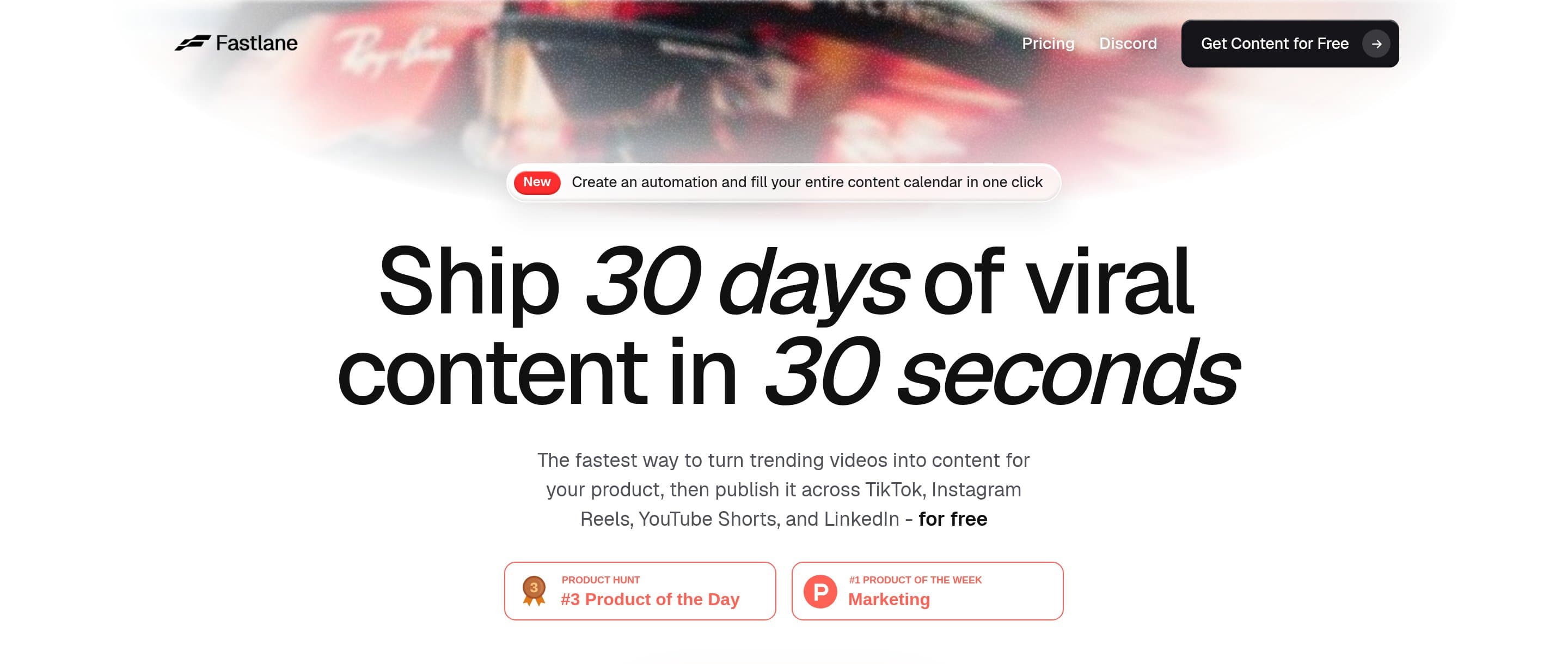
The buyers are solo builders with a mobile app or SaaS. Plans start at $29 a month, with $49 and $149 tiers above that.
The stack is simple: Convex, Vercel, Railway, Clerk, OpenAI and Claude models, fal.ai for images and video — and Claude Code on the 20x Max plan to ship fast.
The Problem They Solve
AI made building easy. Getting anyone to see what you built is still hard.
Gaurav Thapa learned that the hard way.
- He dropped out of law school at 21, in Sydney
- A Starter Story video got him building apps
- The apps got built. Nobody saw them.
- He didn't want to spend a big budget on ads
Then he met Jock Ferguson, who was stuck with his own SaaS for the same reason. Anish Sharma joined as the third co-founder.
The scoreboard two months after launch:
- $69K MRR from the software alone
- 1,000+ paid users
- $1M+ ARR across the whole business
- 60% week-on-week growth for 12 weeks straight
Pat Walls asked Gaurav for the secret. The answer made people roll their eyes:
“Biggest driver of how we ended up building Fastlane was literally just talking to as many customers as we possibly could.”
Watch: Gaurav on the “insanely obvious” secret behind Fastlane (Starter Story)
The Growth Story
July 2025: too broad
The first product was called Cast AI. It tried to do all of marketing:
- SEO and AI-search SEO
- Replying to people on Reddit
- Short-form video
They shipped versions in August and September. Then they started talking to users — and never stopped.
August 2025: ~20 calls a week
Gaurav and Jock ran about 20 customer calls a week, every week. Gaurav puts the total at about 2,000 since discovery began.
The calls kept pointing at the same thing: video was what people valued.
October 2025: all in on video
They dropped the rest and built only for short-form video.
- December: beta goes out to a ~2,000-person waitlist
- Beta revenue: about $16K ARR from paying beta users
- Early 2026: a seed round (amount not shared)
The UI that came from watching
Early testers got lost in the product. So the team rebuilt the main screen around one move:
- Left: a trending post from your niche (the demo one had nearly 3M views)
- Middle: Fastlane's version, made for your product
- Swipe left to skip. Swipe right to schedule.
- The post is live on TikTok in about 5 minutes
Pat Walls asked the right question: would they have dared ship a Tinder-style UI without all those calls?
March 23, 2026: launch day
The public launch went big:
- #3 Product of the Day on Product Hunt, 432 upvotes
- 250K+ views on X
- 3,000+ businesses signed up
- Over AUD $120K ARR by the end of launch week
The next two months: Sydney to San Francisco
The three founders flew to SF with, in Gaurav's words, “practically no plan.” They joined the Founders, Inc. Canopy program there.
About two months after launch they crossed $1M ARR across the business, with 20,000+ businesses on the platform.
Back home, an accelerator interviewer had once scoffed at them for wanting their own office.

From the Founders
Key Growth Tactics
“Talk to customers” is vague. Here is what they actually did.
- The rainbow button. A button in the app said: book a call with the team, get 7 days of extra access. It linked to Calendly. Users booked themselves.
- Discovery calls, Mom Test style. Never “would you use this?” Instead: how do you solve this now? What did it cost you last time?
- Silent usability tests. Every waitlist signup got an invite. They shared their screen and used the product while the team kept quiet. That is where the friction showed up — and where the swipe UI came from.
“The key here is to speak as little as possible.”
- Power-user calls. After launch they tracked usage, found the heaviest users and asked what was working. Views, signups and app installs. So they doubled down on short-form.
- A searchable customer brain. An AI note-taker sat in every call. Notes went into Notion, then into Claude. Jock, the non-technical co-founder, built a dashboard with Claude Code in plain English.
That dashboard changed what they built:
- It ranks every customer with a “customer love score”
- The roadmap follows what the highest scorers ask for
- It showed signups who were “just curious” stuck around less than ones who said “I need marketing now”
What didn't work:
- A do-everything marketing tool
- Stepping in to help during usability tests — it hides the real problem

Key Takeaways for Builders
- ✓Make booking a call a one-click trade. A rainbow button offered 7 extra days free for a call. Users booked themselves, week after week.
- ✓Ask about the past, not your idea. "Walk me through the last time you solved this" gets the truth. "Would you use this?" gets politeness.
- ✓Watch users in silence. Every time you jump in to help, you hide the friction you need to fix. Silent sessions led to Fastlane’s swipe UI.
- ✓Go narrow, then go deep. Cast AI tried to do all of marketing. Calls showed short-form video was the part people valued, so they cut the rest.
- ✓Put your calls somewhere you can search them. Notes went into Notion, then into a Claude-built dashboard. Roadmap calls follow who loves the product most.
Sources & Further Reading
- 🎤Starter Story — The Insanely Obvious Secret Behind This $69K/Month SaaS (YouTube interview)
- 📰Starter Story — The Insanely Obvious Secret Behind This $69K/Month SaaS (write-up)
- 🔗Starter Story — Fastlane revenue (launch week: over AUD $120K ARR)
- 🌐Fastlane — official website (features and pricing, Sept 2026)
- 🔗Product Hunt — Fastlane (#3 Product of the Day, 432 upvotes, March 23, 2026)
- 📰Gaurav Thapa on LinkedIn — "We went from $0 to $1m ARR in two months"
- 📰Gaurav Thapa on LinkedIn — launch-day post ("the Tinder for Marketing")
- 🔗Founders, Inc. Almanac — Fastlane (founders, Canopy Spring 2026, seed round)
- 📰Stork.AI — Fastlane’s Rainbow Button: the SaaS growth hack for user feedback
- 📰Stork.AI — This Tinder UI makes $70K/month
- 𝕏Gaurav (@gauravsbuilding) on X — launch post
- 𝕏Jock Ferguson (@jock_ferguson) on X
More Case Studies
Visualizee
$100/mo for 2 Years → ~$10K/mo After One Pivot
Read the case study$10M ARRChatbase
Bootstrapped to $10M ARR — $1M in 117 Days From a Tweet to 16 Followers
Read the case study$30M ARRFathom
$30M ARR on $30M Raised — How Fathom Out-Grew Its VC-Backed Rivals by Giving the Product Away
Read the case study