
Anthropic’s IPO Filing Reveals a 20× Agent Spend Gap. What Should SaaS Founders Do With It?
Anthropic’s S-1 reports 900% net revenue retention and a 20× spend gap among its heaviest Claude Code users. Here is what the numbers mean for SaaS founders—and what they do not prove.
The story in 30 seconds
The fact
Anthropic filed its public S-1 on October 26. Its IPO price and share count remain unset.
The caveat
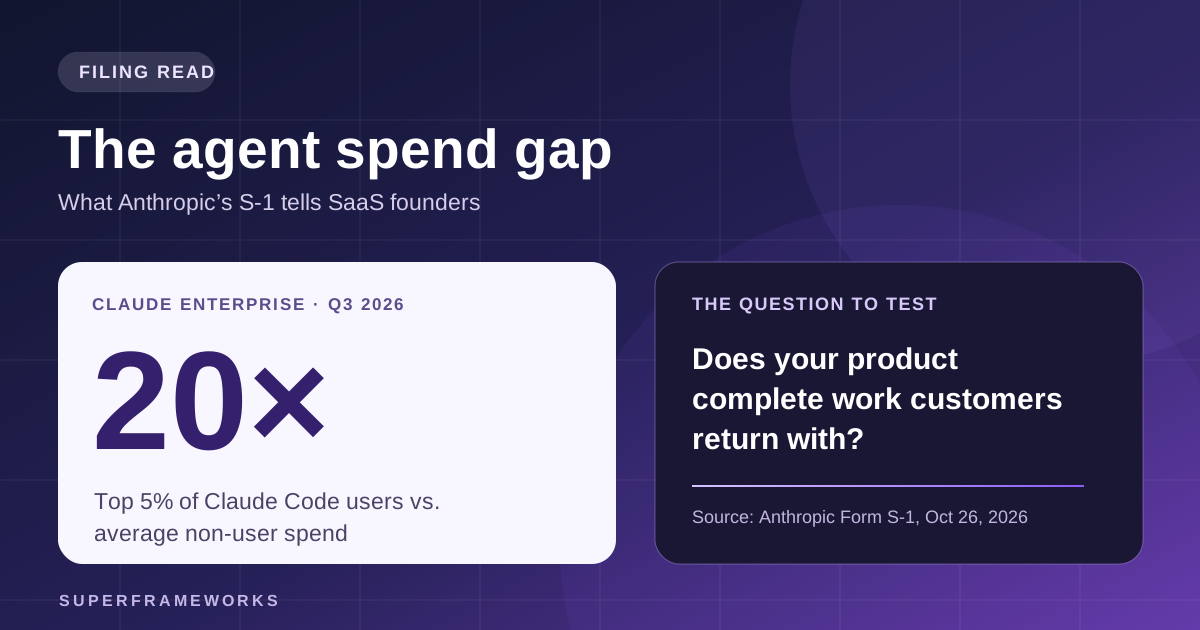
The 20× figure compares non-users with the top 5% of Claude Code users. It does not measure average uplift.
The move
Test one repeatable customer job. Measure completed work and margin before changing pricing.
The most useful part of Anthropic's IPO filing for a SaaS founder is a customer behavior clue.
On October 26, Anthropic announced its public S-1 filing for a proposed Nasdaq listing under ANT. Its IPO price and share count remain unset. The prospectus shows how Anthropic describes the shift from occasional chat to software that performs work.
The 20× figure needs its denominator
In the three months ended September 30, 2026, Claude Enterprise users who did not use Claude Code spent less than $75 per month on average. Anthropic says the top 5% of Enterprise users who did use Claude Code spent approximately 20 times that amount.
Who is being compared?
Claude Enterprise · Q3 2026Users without Claude Code
Average monthly spend
Claude Code power users
Top 5% by monthly spend
The comparison does not isolate the value of Claude Code from customer size, task volume, or maturity. Treat it as a clue about where usage concentrates, not a forecast for your own product.
The 900% retention number is a different lens
Anthropic also reports approximately 900% net revenue retention as of September 30, 2026. This measures revenue expansion in the same qualifying customer cohort over one year.
How Anthropic defines the cohort
Base period
Three months a year earlier
A customer qualifies with at least $1 of revenue.
Current period
The latest three months
Revenue from that same customer group is compared with the base.
A tiny starting spend can make expansion look enormous as customers adopt a new product. Anthropic's consumption-based mix also differs from a mature vertical SaaS business with annual contracts. Use your own cohort, not 900%, as the planning benchmark.
The founder signal: build for recurring work
Anthropic says customers often start with one use case, then expand across teams and workflows. Claude Code is one example of software moving from answering a question to carrying out a job.
A workflow that can expand
A narrow product could own one valuable job end to end: gathering evidence for a disputed charge or drafting a support resolution for approval. The work must be reliable enough that the customer sends the next task.
That is an inference from Anthropic's disclosure, not a promise of similar economics. Budgets, error tolerance, and implementation costs vary by market.
Run a four-week founder experiment
Use a real recurring job. The goal is evidence of completed work and repeat demand, not a dramatic retention headline.
- Week 1
Choose one recurring job
Pick a job customers already do weekly. Define what “done” means before adding an agent.
- Week 2
Instrument the full task
Track completions, corrections, elapsed time, and model and tool costs—not just tokens.
- Week 3
Watch expansion in a cohort
Compare the same customers over time. Look for repeat use, more jobs adopted, and healthy margin.
- Week 4
Price after the pattern appears
Test an allowance or fee per verified outcome. Keep a base plan, clear usage, and a cap.
At the end, ask three questions: Did customers send the next task? Did human repair fall? Did revenue exceed the full cost of the workflow? Then decide whether to expand the product or adjust pricing.
For a broader pricing discussion, see our guide to SaaS outcome pricing.
Sources
Keep Reading
The Indie Hacker App Cloning Loop: MailCheap, DataFast, and the Race to $0
Marc Lou built a beehiiv alternative. Then founders launched DataFast alternatives. What this week’s cloning loop says about software prices, trust, and distribution.
10 Best Apple HomeView App Ideas to Build for Apple’s New Smart Display
Apple just launched HomeView, its first smart display. These 10 app ideas use its shared screen, face recognition, Siri AI, and home hub to build what a phone cannot.
Google’s “Poisoned” Search Results: Can Founders Trust Rank Trackers?
Google poisoned search results are showing up in rank trackers, Nozzle reports. Learn what the data proves and how to check a sudden SEO drop before you act.