
The Indie Hacker App Cloning Loop: MailCheap, DataFast, and the Race to $0
Marc Lou built a beehiiv alternative. Then founders launched DataFast alternatives. What this week’s cloning loop says about software prices, trust, and distribution.
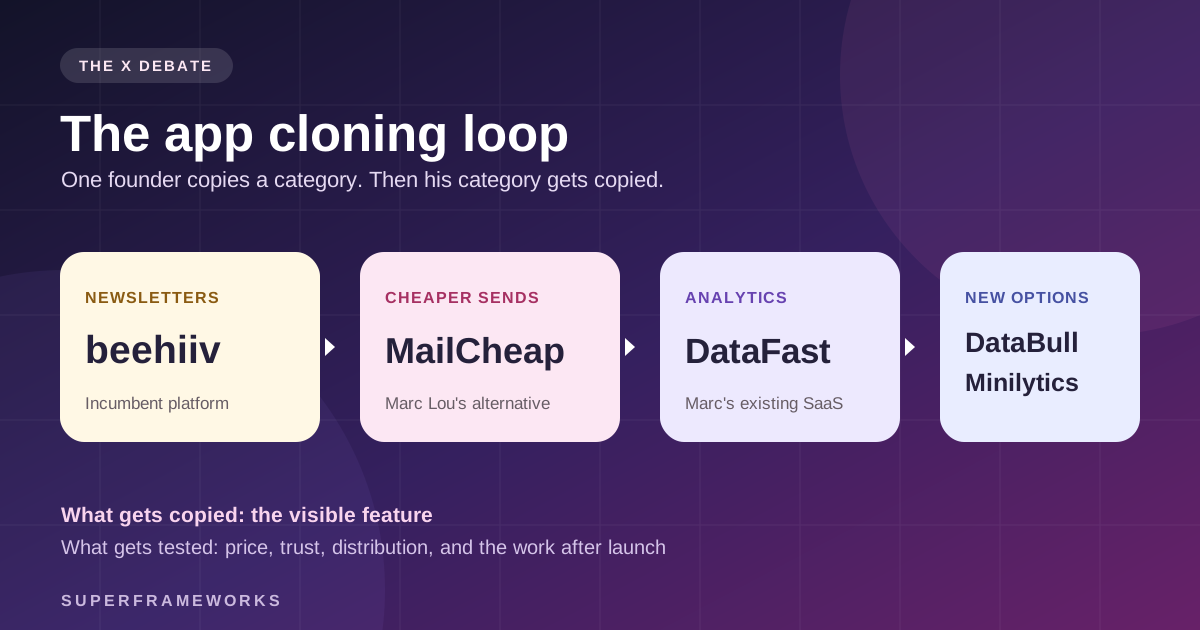
This month's indie hacker app cloning story has a neat symmetry: a founder built a cheaper version of the tool he used. Days later, other builders did the same to him.
Marc Lou launched MailCheap after objecting to beehiiv's pricing. Then DataBull and Minilytics appeared as alternatives to his analytics product, DataFast. The X debate quickly became a referendum on whether AI has made software businesses defenseless. The products tell a more useful story: the visible feature is getting cheaper to reproduce, while the cost of running it and earning customers' trust remains real.
How the cloning loop unfolded
- October 11
beehiiv reprices
New plans take effect for new customers; existing customers move at renewal on or after November 1.
See source - October 10–152
MailCheap arrives
Marc Lou publishes a self-hosted newsletter tool, then offers a hosted version from $19 per month.
See source - October 203
beehiiv responds
CEO Tyler Denk argues that deliverability and ongoing operations are part of the product.
See source - October 24–254
DataFast gets alternatives
DataBull pitches one-time-payment revenue analytics; Minilytics publishes an open source version.
See source
MailCheap began with a pricing complaint
beehiiv announced new plans on October 1. New customers moved immediately; existing customers face the new price at their first renewal on or after November 1. Lou said his annual bill would climb from about $1,000 to $4,000. Those are his account-specific figures, not beehiiv's universal price change.
Lou's answer was a self-hosted MailCheap repository, followed by a hosted service that starts at $19 a month and charges by emails sent instead of list size. The site advertises savings of up to 83% against beehiiv. That is a scenario, not a blanket discount: a publisher with a large list and few sends has different economics from one emailing daily.
It also matters which MailCheap someone is comparing. The repository lets a technically capable publisher operate a sender on their own infrastructure. The hosted service sells the convenience of having someone else run it. Treating the infrastructure cost of the first as the subscription price of the second makes the discount look larger than the choice a typical publisher faces.
beehiiv CEO Tyler Denk's response made the operational argument: authentication, spam prevention, deliverability, support, and new features all sit behind the send button. His essay also took personal shots at Lou and his customers. The insults made the exchange travel; the operational questions are what a publisher should actually evaluate.
Disclosure: Superframeworks uses beehiiv for newsletter signups. That makes price and portability practical questions for us too.
Then DataFast got its own alternatives
DataFast sells a simple promise: connect traffic sources to revenue so a founder can see which marketing brings paying customers. On October 24, Ahmed Gagan introduced DataBull with the same central job and a one-time, self-hosted offer. His launch post, mirrored from X, advertised $29 for life; the product page displayed $49 once on October 27. A one-time license also means the buyer runs it in their own Cloudflare account.
Surendra Pandar's Minilytics is open source and calls itself “inspired by DataFast.” Its README describes revenue attribution on Cloudflare's free tier. Free source code does not remove setup, hosting limits, maintenance, or the work of checking whether attribution matches your payments.
These are competing implementations of a product idea. Public evidence here does not establish that anyone copied DataFast's code. That distinction matters: “clone” is X shorthand for a similar product, but it is a serious accusation if used to suggest code theft.
The timing makes for a sharp story, but a launch is a weak test of replacement quality. Revenue attribution can fail silently: a visit is recorded, a payment is recorded, and the wrong source gets the credit. A useful comparison would connect the same site and payment flow to both tools, then check matched transactions and missed events over several weeks. Neither a landing page nor a viral post settles that.
What an indie founder can learn from this
The tempting reaction is to race the new entrant to the lowest price. That can work when your costs are genuinely lower, but “cheaper” needs a complete bill. For MailCheap, count send volume and the features a publisher actually uses. For self-hosted analytics, count Cloudflare usage, payment integrations, debugging, and your own time.
For the incumbent, the better defense is proof of outcomes. Publish deliverability measured over meaningful volume, migration success, attribution accuracy, support response, and retention. Lou's reach helped MailCheap become visible, but his own DataFast episode shows why distribution does not make a feature exclusive. Existing customers stay when the service keeps working and the switching cost is worth paying.
For a new entrant, copying a familiar category can be a valid way to find an underserved segment. Pick the segment precisely: a low-frequency newsletter, a founder who wants to own analytics data, or a team that needs expert support. Then show the tradeoff in plain language. The claim “same product for less” will age badly if the customer discovers the missing work after migrating.
We have written about the broader vibe coding market shift and newsletter platforms for indie hackers. This week adds a live test: customers can now build or buy a credible narrower version of a popular tool, and that option will keep pricing pressure on everyone.
What to watch next
Launch prices and screenshots are the opening chapter. The useful measures arrive later: do MailCheap publishers keep sending reliably, do DataBull and Minilytics users trust their revenue numbers, and do any of these customers still use the products after the X thread fades? Those results will tell us more about the economics of indie hacker app cloning than a viral discount percentage.
Sources
Keep Reading
Anthropic’s IPO Filing Reveals a 20× Agent Spend Gap. What Should SaaS Founders Do With It?
Anthropic’s S-1 reports 900% net revenue retention and a 20× spend gap among its heaviest Claude Code users. Here is what the numbers mean for SaaS founders—and what they do not prove.
10 Best Apple HomeView App Ideas to Build for Apple’s New Smart Display
Apple just launched HomeView, its first smart display. These 10 app ideas use its shared screen, face recognition, Siri AI, and home hub to build what a phone cannot.
Google’s “Poisoned” Search Results: Can Founders Trust Rank Trackers?
Google poisoned search results are showing up in rank trackers, Nozzle reports. Learn what the data proves and how to check a sudden SEO drop before you act.