
1 Million Agent Skills in Seven Months: Where Solo Founders Can Still Win
Vercel’s skills.sh report shows a million listings, concentrated installs, and surprising demand for business workflows. Here is how founders can test a real opportunity.
Key takeaways
- Vercel says skills.sh reached one million unique listings and nearly 280 million recorded installs in seven months. Installs are registry events, not unique users or revenue.
- In Vercel’s classified sample, business operations and writing drew more installs per listing than the registry average. Software engineering drew fewer.
- Popularity is concentrated: the top 1.2% of listings accounted for 94% of installs. Publishing another generic skill is a difficult distribution strategy.
- The founder opportunity is to encode a specific, costly workflow and prove that an agent performs it better with the skill than without it.
A million skills sounds like a gold rush. The more useful question for a founder is what those installs reveal about jobs people still struggle to get done.
On September 25, Vercel published its State of agent skills report. Its skills.sh registry had passed one million unique listings in seven months and recorded nearly 280 million installs. Skills are small packages of instructions and resources that tell an agent how to perform a particular job. Anthropic introduced the format last year; the open specification centers on a SKILL.md file.
The headline is supply. The interesting part is the gap between what gets published and what gets installed. That gap can guide a founder’s next customer interview, but it cannot by itself prove willingness to pay.
What the registry data actually says
Vercel classified the registry’s most-installed skills by function. That sample covers more than four-fifths of installs, but it is not the full catalog. In it, software engineering is the largest category by installs at 18%; agent workflows follow at about 15%, while business operations and writing each take nearly 11%.
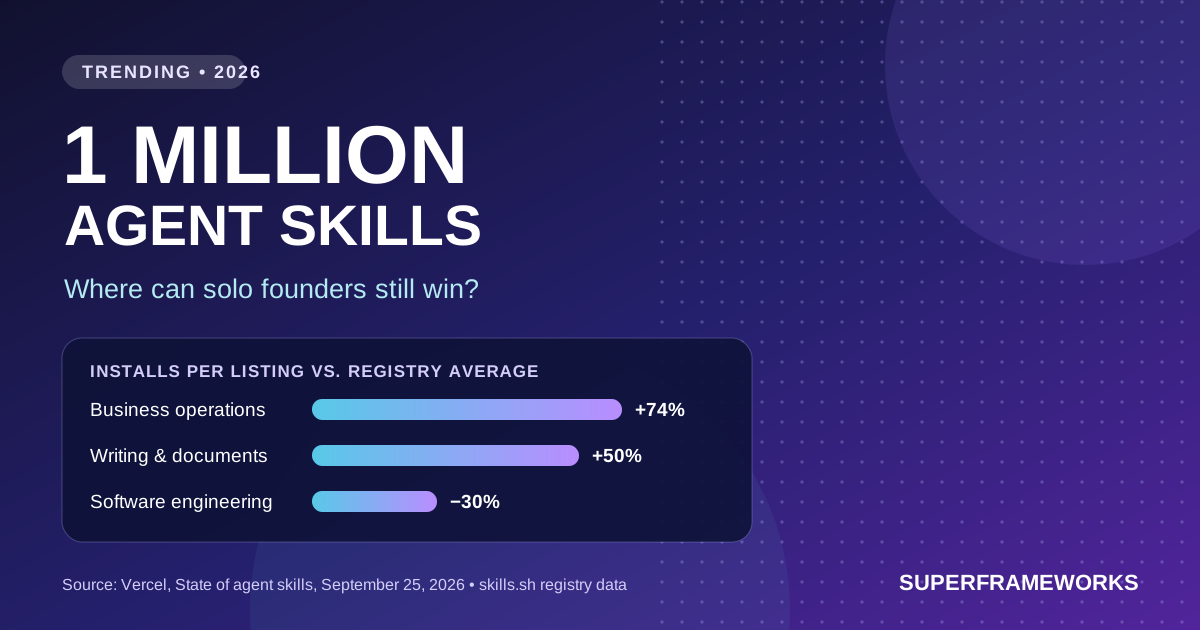
Vercel also divided each category’s share of installs by its share of listings. By that measure, business operations drew 74% more installs per listing than the average, writing and documents drew 50% more, and software engineering drew about 30% fewer. Those figures describe relative registry activity. They do not mean that any individual operations skill will outperform a coding skill.
Distribution is the other half of the story. Nearly half of listings were installed exactly once. Just 375 skills captured 62% of installs, and the top 1.2% captured 94%. A directory listing alone is unlikely to find customers for a new founder. The numbers favor starting with a known user and a job they already need done.
One more limit matters: Vercel says its install counters do not represent unique people or necessarily independent decisions. Reinstalls, automated workflows, and existing distribution can affect them. Treat the report as a map of where to investigate, not a revenue forecast.
Three workflows I would test
These are product hypotheses, not niches validated by Vercel’s report. Each uses a category with visible activity, then narrows it to a decision that can be checked against real examples.
Invoice exception triage
The job: Compare invoices, payment records, and a company’s approval rules; flag mismatches with evidence and the next owner.
First test: Give the skill 20 past cases with known outcomes. Count correctly flagged exceptions and false alarms.
What makes it useful: A general prompt cannot know a company’s approval thresholds or accounting rules. Those rules are the useful part.
Claim and source review
The job: Check a draft against approved product claims, source material, and house style; return a short edit list with citations.
First test: Run the same drafts with and without the skill. Ask an editor to score missed claims, invented facts, and review time.
What makes it useful: A generic “write better” skill competes with the base model. A maintained source of truth gives this workflow a reason to exist.
Support handoff router
The job: Read a ticket, gather the relevant policy and account context, and decide whether to draft a reply or escalate.
First test: Compare its decisions with a support lead’s decisions on historical tickets, especially edge cases.
What makes it useful: Start with read-only access and human approval. A wrong refund or account action has a real cost.
The product may be the workflow around the skill
A SKILL.md file is easy to copy. A working system also needs current rules, access to the right data, an approval step, and a way to detect bad outputs. That suggests two possible businesses: a service that installs and maintains private skills for teams, or a product that connects a skill to one repeatable workflow and measures the result. Both require customer discovery. The report offers no evidence that skill downloads alone convert to paid accounts.
Vercel found that 87.5% of installs in its classified sample went to skills used across industries. That supports testing a workflow shared by many teams, such as invoice review, while tailoring each deployment to a customer’s rules. It does not rule out a valuable industry-specific product with fewer installs and a higher price.
A seven-day test before you build a business
- 1
Pick one repeated decision
Find a task someone already performs every week. Collect the instructions, examples, and exceptions they actually use.
- 2
Write the smallest useful skill
Use the open SKILL.md format: clear trigger, inputs, steps, output, and stop conditions. Keep customer-specific rules in a separate file.
- 3
Run a baseline test
Give an agent the same 20 representative tasks with and without the skill. Measure correct outcomes, review time, and mistakes.
- 4
Find a buyer before a catalog listing
Show the results to five people who own the workflow. Ask whether they would pay for setup, maintenance, or a connected product.
The decision at the end is simple. If the skill does not improve the work, revise or drop it. If it does, find out whether someone will pay to keep it accurate as rules and tools change. That maintenance is where a founder may create lasting value.
Review any third-party skill before you install it, especially if it contains scripts or requests access to company systems. Our earlier agent-skill supply-chain analysis shows why provenance and limited permissions matter. For the broader mechanics, see our guide to agent loops.
The founder takeaway
One million listings make the easy-to-publish part obvious. Vercel’s data points toward a harder task: find a business decision that happens repeatedly, encode the judgment behind it, and show that the result gets better. Start with the customer and the test cases. Publish the skill when it has earned its place in the workflow.
Sources
Build from evidence
Get research and practical experiments for founders building small, durable software businesses.
Related reading
What a poisoned agent skill taught us about trustKeep Reading
10 Best Apple HomeView App Ideas to Build for Apple’s New Smart Display
Apple just launched HomeView, its first smart display. These 10 app ideas use its shared screen, face recognition, Siri AI, and home hub to build what a phone cannot.
Google’s “Poisoned” Search Results: Can Founders Trust Rank Trackers?
Google poisoned search results are showing up in rank trackers, Nozzle reports. Learn what the data proves and how to check a sudden SEO drop before you act.
Deno Joins Cloudflare: A Migration Plan for Founders
Deno joins Cloudflare, with Deno Deploy set to close in six months. See what changes for the runtime and JSR, plus a practical migration plan for founders.